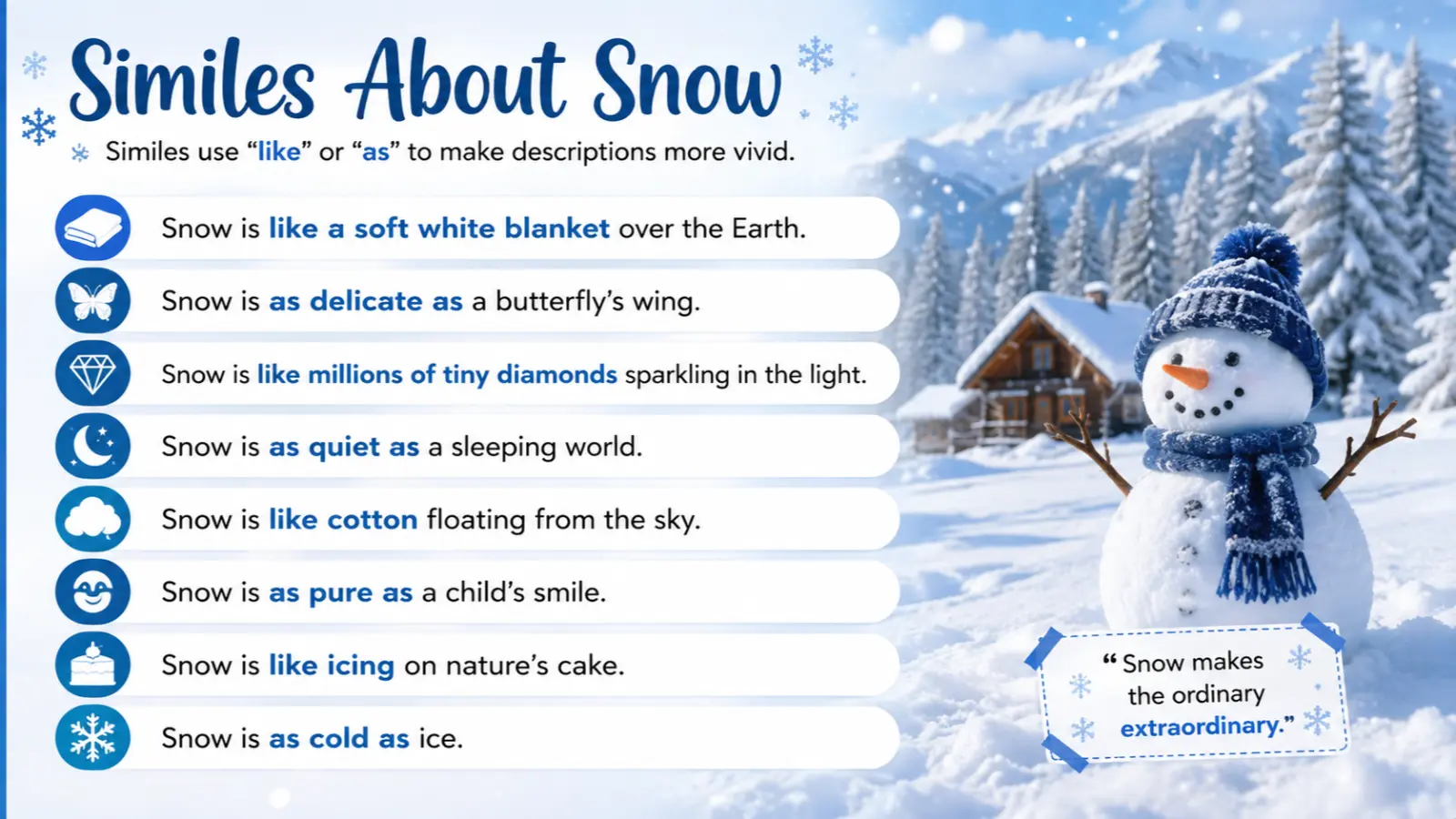
Similes About Snow can transform an ordinary scene into something quiet, mysterious, playful, or breathtaking. A writer can simply say that snow is white, but a well-chosen comparison can help readers see, hear, and feel the winter scene.
A simile compares two different things using words such as “like” or “as.” For example, “The snow fell like tiny feathers” compares falling snow with feathers to emphasize its softness and gentle movement.
These similes about snow can help with poems, creative writing, school assignments, stories, captions, descriptions, and everyday conversation. The key is not simply to find a comparison that sounds beautiful. A strong simile should add a specific image, mood, or feeling.
What Is a Simile About Snow?
A simile about snow is a comparison that describes snow by connecting it to another familiar object, experience, sound, texture, color, or feeling.
For example:
The fresh snow was as soft as a pillow.
The comparison helps the reader imagine the softness of untouched snow.
Another example:
Snowflakes drifted through the air like tiny pieces of lace.
Here, the comparison focuses on the delicate appearance and movement of snowflakes.
Snow similes can describe many different qualities, including:
- Color
- Texture
- Temperature
- Movement
- Sound
- Brightness
- Stillness
- Freshness
- Beauty
- Winter atmosphere
30 Creative Similes About Snow
The best snow comparisons do more than tell readers that winter is beautiful. They give the reader something specific to picture.
1. Snow Was Like a Blanket Over the Town
Meaning: The snow covered streets, rooftops, and yards almost completely.
Example:
The first snowfall was like a blanket over the town, hiding the muddy roads beneath a clean white layer.
Writing purpose: This comparison works especially well when you want to emphasize coverage, warmth, or quietness.
2. Snowflakes Fell Like Feathers From the Sky
Meaning: The snowflakes appeared light, delicate, and gentle as they descended.
Example:
Snowflakes fell like feathers from the sky as Mia watched from the window.
Best context: Use this in children’s stories, peaceful winter scenes, and descriptive writing.
Writing tip: Comparisons involving feathers are most effective when the snow is falling slowly rather than blowing violently.
3. The Snow Sparkled Like Crushed Glass
Meaning: Sunlight or moonlight made the snow glitter with tiny points of brightness.
Example:
Under the morning sun, the snow sparkled like crushed glass across the hillside.
Emotional effect: This creates a bright, magical, almost dazzling image.
4. The Snow Was as White as Fresh Paper
Meaning: The snow looked exceptionally clean and untouched.
Example:
The backyard was as white as fresh paper before the children stepped outside.
Writing purpose: This is useful when describing the beginning of a snowfall or a landscape without footprints.
Adaptation: You can replace “fresh paper” with another object associated with cleanliness or blankness.
5. Snow Covered the Roofs Like Icing on a Cake
Meaning: A layer of snow rested on rooftops in a way that resembled cake frosting.
Example:
Snow covered every roof like icing on a giant winter cake.
Best context: This playful comparison works especially well in children’s writing and lighthearted descriptions.
6. The Snow Drifted Like White Confetti
Meaning: Snowflakes moved through the air in scattered, celebratory-looking patterns.
Example:
White snow drifted like confetti around the players on the field.
Emotional effect: This creates an energetic and cheerful winter mood.
7. The Snow Felt Like Powdered Silk
Meaning: Very fine, fresh snow had an exceptionally soft texture.
Example:
The new snow felt like powdered silk beneath her gloves.
Writing tip: This comparison emphasizes texture rather than color, making it more useful in sensory writing.
8. The Snow-Covered Trees Looked Like Frozen Sculptures
Meaning: Heavy snow made the trees appear carefully shaped and almost artificial.
Example:
The snow-covered trees stood along the road like frozen sculptures.
Best context: Landscape descriptions, photography captions, poetry, and fiction.
9. Snowflakes Twirled Like Tiny Dancers
Meaning: The flakes moved in graceful, swirling patterns.
Example:
Snowflakes twirled like tiny dancers beneath the streetlights.
Emotional effect: This gives falling snow a graceful and lively quality.
10. The Snow Was as Quiet as a Sleeping Room
Meaning: The snowfall created a peaceful atmosphere with very little noise.
Example:
After the storm, the neighborhood was as quiet as a sleeping room.
Writing purpose: This is useful when you want to describe the silence that often accompanies a snowy landscape.
11. The Snowy Road Shone Like a Silver Ribbon
Meaning: A snow-covered road appeared long, bright, and reflective.
Example:
The snowy road shone like a silver ribbon beneath the moon.
Best context: Nighttime winter scenes and poetic descriptions.
12. Snow Fell Like Lace From the Clouds
Meaning: The snowflakes appeared delicate, patterned, and beautiful.
Example:
Snow fell like lace from the clouds, covering the garden one branch at a time.
Emotional effect: This creates an elegant and delicate image.
13. The Snowdrifts Rose Like Soft Waves
Meaning: Wind-created piles of snow formed curved shapes similar to waves.
Example:
The snowdrifts rose like soft waves along the empty road.
Writing purpose: This comparison helps readers visualize the shape of accumulated snow.
14. The Frozen Lake Was Like a Giant Mirror
Meaning: The ice reflected the surrounding sky, trees, or light.
Example:
The frozen lake was like a giant mirror beneath the pale winter sky.
Best context: Nature writing and landscape descriptions.
Writing tip: This is particularly effective when the ice is smooth and reflective.
15. The Snow Crunched Like Tiny Crackling Leaves
Meaning: Walking through the snow produced a crisp, repeated sound.
Example:
The snow crunched like tiny crackling leaves beneath our boots.
Writing purpose: Sound-based similes can make a scene feel more immediate because they engage the reader’s sense of hearing.
16. The Snowbank Was as High as a Wall
Meaning: A pile of accumulated snow had become unusually tall.
Example:
The snowbank beside the driveway was as high as a wall.
Best context: Practical descriptions, stories, and exaggerated winter scenes.
17. Snow Covered the Field Like a Blank Canvas
Meaning: The untouched snow created an empty surface ready for footprints, tracks, or new activity.
Example:
The field stretched before us like a blank canvas waiting for the first footprints.
Emotional effect: This suggests possibility and new beginnings.
18. The Snowflakes Glittered Like Tiny Stars
Meaning: Individual flakes caught light and appeared bright or sparkling.
Example:
The snowflakes glittered like tiny stars beneath the porch light.
Best context: Magical, romantic, or poetic winter scenes.
Writing tip: Avoid using a familiar comparison simply because it sounds pretty. Make sure the surrounding scene supports the image.
19. The Snow Was as Smooth as Frosted Glass
Meaning: A fresh, undisturbed surface looked smooth and even.
Example:
The frozen pond was as smooth as frosted glass after the overnight snowfall.
Writing purpose: This comparison combines visual appearance with the feeling of a cold, polished surface.
20. Snow Covered the Branches Like White Coral
Meaning: Snow formed unusual shapes along tree branches.
Example:
Snow covered the bare branches like white coral against the gray sky.
Emotional effect: This creates a more unusual and artistic winter image.
21. The Snowstorm Roared Like a Distant Train
Meaning: Strong wind during a snowstorm produced a deep, powerful sound.
Example:
Outside the cabin, the snowstorm roared like a distant train.
Best context: Dramatic fiction and intense weather scenes.
Writing tip: Match the strength of the comparison to the weather. A powerful simile can make a mild snowfall seem unrealistically violent.
22. The Snowflakes Floated Like Tiny Boats
Meaning: Snowflakes moved gently through the air as if floating across invisible water.
Example:
The flakes floated like tiny boats through the still winter air.
Writing purpose: This gives falling snow a slow, peaceful rhythm.
23. The Hill Was White Like a Giant Piece of Chalk
Meaning: The snow-covered hill appeared completely white.
Example:
From the village, the hill looked white like a giant piece of chalk.
Best context: Simple descriptive writing, children’s stories, and classroom exercises.
24. Snow Wrapped the Forest Like a Winter Cloak
Meaning: Snow seemed to surround and cover the entire forest.
Example:
Snow wrapped the forest like a winter cloak, muting every path beneath it.
Emotional effect: This creates a mysterious, enclosed atmosphere.
25. The Snow Shimmered Like Pearl Dust
Meaning: The surface had a soft, delicate shine.
Example:
At sunrise, the snow shimmered like pearl dust across the meadow.
Writing purpose: This works well when you want a refined or elegant image rather than a simple description of whiteness.
26. The Snow Fell as Gently as Whispered Words
Meaning: The snowfall was quiet, delicate, and almost imperceptible.
Example:
Snow fell as gently as whispered words outside the bedroom window.
Best context: Quiet scenes, reflective writing, and poetry.
Emotional effect: The comparison gives the snowfall an intimate and peaceful quality.
27. The Snowy Mountains Looked Like Sleeping Giants
Meaning: Large mountains covered in snow appeared massive, still, and imposing.
Example:
The snowy mountains stood like sleeping giants beyond the village.
Writing purpose: This comparison emphasizes scale and stillness.
28. The Snow on the Fence Looked Like White Feathers
Meaning: Thin layers of snow resting on the fence appeared soft and featherlike.
Example:
Snow rested along the wooden fence like white feathers.
Best context: Close-up descriptions where small details matter.
29. The Winter Morning Was as Pale as Watered Milk
Meaning: The morning light had a soft, muted, almost colorless appearance.
Example:
The winter morning was as pale as watered milk, with clouds hiding the sun.
Writing purpose: This focuses on atmosphere rather than snow itself.
30. The Fresh Snow Was Like a New Page
Meaning: Untouched snow suggested a beginning, possibility, or opportunity.
Example:
The fresh snow was like a new page, waiting for the first footprints.
Emotional effect: This can symbolize a new beginning after a difficult period.
Best context: Personal essays, reflective writing, stories, and poetry.
How to Make Snow Similes More Vivid
A strong simile usually begins with a specific quality. Instead of asking, “What is snow like?” ask a narrower question:
- What does the snow look like?
- How does it move?
- What does it sound like?
- How does it feel?
- What mood does it create?
- What does the snow remind the character of?
- What does the snowfall mean in this particular scene?
For example, “The snow was like cotton” focuses on softness. But if your scene is about silence, a comparison such as “The neighborhood became as quiet as an empty theater” may communicate the atmosphere more effectively.
The lesson: Choose the comparison based on the job you want it to perform.
Snow Similes for Different Writing Situations
For Stories
Story writers can use snow similes to establish setting quickly.
The road disappeared beneath the snow like a forgotten path beneath a white curtain.
This does more than describe the snow. It suggests that the road is becoming difficult to recognize.
For Poetry
Poetry allows more unusual associations.
Snowflakes drifted like thoughts that had forgotten where they were going.
This comparison gives falling snow a reflective, almost dreamlike quality.
For School Writing
Simple, precise comparisons are often strongest.
The snow was as white as a blank sheet of paper.
The image is easy to understand while still making the description more visual.
For Conversation
Natural comparisons should sound easy to say.
That snow is coming down like tiny pieces of paper.
Conversation usually benefits from simple language rather than elaborate imagery.
For Captions
Short comparisons can create a quick visual impression.
Snowflakes shining like little stars.
A caption does not need a complicated literary explanation to create an image.
How to Avoid Cliché Snow Similes
Some comparisons become less powerful when readers encounter them too often. Familiar images such as stars, diamonds, clouds, and blankets can still work, but the surrounding details should make them feel specific.
Compare these:
Basic:
The snow was like diamonds.
More specific:
Morning light caught the uneven snow, making each icy ridge flash for a second before the clouds returned.
The second version does not depend entirely on a familiar comparison. It gives the reader an action to visualize.
When you use a common comparison, add a fresh detail around it.
Instead of:
The snow was like a blanket.
Try:
Snow covered the sleeping garden like a quilt stitched from moonlight.
The added detail gives the image its own identity.
The Difference Between a Snow Simile and a Snow Metaphor
A simile usually uses like or as to make a comparison.
Simile:
The snow looked like powdered sugar.
A metaphor makes the comparison more directly.
Metaphor:
The snow was powdered sugar across the rooftops.
Both devices create imagery, but they create it in slightly different ways.
When you want the comparison to feel explicit, a simile is often the clearest choice.
Use the Five Senses to Improve Snow Descriptions
Snow is especially useful for sensory writing because it can be described through several senses.
Sight
Think about:
- Brightness
- Shadows
- Footprints
- Shapes
- Reflections
- Changing colors
Example:
The snow glowed like pale silver beneath the streetlights.
Sound
Think about:
- Crunching footsteps
- Wind
- Falling branches
- Silence after a storm
Example:
Boots crossed the frozen path with a sound like dry twigs snapping.
Touch
Think about:
- Coldness
- Wetness
- Powdery texture
- Hard ice
- Soft flakes
Example:
The snow felt like cold flour between his gloves.
Movement
Think about:
- Drifting
- Swirling
- Blowing
- Melting
- Sliding
- Falling
Example:
Snowflakes spun like tiny dancers in the wind.
Using different senses prevents every winter description from becoming another statement about whiteness.
How Professional Writers Build Better Comparisons
One useful technique is to separate the subject from the quality.
Suppose your subject is snow.
Ask what quality you want to emphasize:
Softness:
The snow felt like velvet dust.
Brightness:
The snow flashed like scattered bits of silver.
Silence:
The street became as quiet as a closed library.
Movement:
Snowflakes spun like paper caught in a slow breeze.
Weight:
Snow pressed against the branches like a heavy quilt.
The same subject can produce very different imagery because the writer changes the quality being highlighted.
This is one of the easiest ways to make your writing more precise.
Common Mistakes When Writing Snow Similes
1. Using a Comparison That Does Not Add Anything
A simile should make the description clearer, stronger, or more memorable.
Weak:
The snow was white like something white.
The comparison adds nothing.
Better:
The untouched snow was white like a fresh sheet of paper.
2. Mixing Unrelated Images
Avoid forcing several unrelated comparisons into one sentence.
For example, describing snow as “a blanket, a mirror, a stormy ocean, and a flock of birds” at the same time can make the scene confusing.
Choose the image that best fits the moment.
3. Choosing Beauty Over Accuracy
A beautiful comparison can still be wrong for the scene.
A gentle comparison such as “snowflakes floated like feathers” may not fit a blizzard.
For heavy snowfall, a stronger comparison might be:
Snow drove across the windows like handfuls of sand thrown by the wind.
The imagery changes because the weather changes.
4. Overusing Similes
Not every sentence needs a comparison.
Too many similes can make prose feel crowded. Give your strongest image enough space to matter.
5. Confusing Similes With Metaphors
Remember:
Simile: The snow was like a blanket.
Metaphor: The snow was a blanket.
Both compare, but the grammatical structure is different.
How to Create Your Own Similes About Snow
You do not need to memorize dozens of comparisons. You can create your own whenever you write.
Step 1: Identify the Snow’s Quality
Choose one:
soft, bright, cold, silent, heavy, delicate, wild, smooth, sparkling, drifting
Step 2: Brainstorm Five Related Objects
For “soft,” you might think of:
- Feathers
- Velvet
- Flour
- Cotton
- Powder
For “bright,” you might think of:
- Silver
- Glass
- Paper
- Frosted light
- Pearls
Step 3: Choose the Most Specific Image
Do not automatically choose the prettiest object. Choose the one that creates the clearest mental picture.
Step 4: Add a Verb
Instead of only saying:
Snow was like feathers.
Try:
Snowflakes drifted like feathers across the dark sky.
The verb gives the image movement.
Step 5: Check the Mood
Ask whether the simile matches the scene.
A cheerful snow-day story may need playful comparisons. A lonely winter scene may need quieter, colder imagery.
A Quick Exercise for Better Winter Writing
Take this plain sentence:
Snow covered the street.
Now rewrite it five ways.
Focus on color:
Snow covered the street like a sheet of fresh paper.
on silence:
Snow covered the street as quietly as dust settling in an empty room.
Focus on movement:
Snow swept across the street like pale smoke.
Focus on possibility:
Snow covered the street like a blank page waiting for footprints.
on danger:
Snow covered the street like a curtain hiding the road beneath it.
The subject stays the same, but the mood changes because the comparison changes.
That is the real power of a simile: it controls what the reader notices.
Related Literary Devices for Winter Writing
Metaphor
A metaphor makes a direct comparison without “like” or “as.”
The snowy field was a blank canvas.
Personification
Personification gives human qualities to something nonhuman.
The snow whispered against the window.
Hyperbole
Hyperbole deliberately exaggerates something.
Snow covered the entire world.
Imagery
Imagery uses descriptive language to create sensory experiences.
Cold flakes tapped against the glass while silver light spread across the snow.
Alliteration
Alliteration repeats beginning consonant sounds.
Soft snow silently settled across the sidewalk.
These devices can work together. A paragraph might contain imagery, a simile, and personification without becoming confusing—as long as each device serves the scene.
Frequently Asked Questions About Similes About Snow
What is a good simile for snow?
A good snow simile depends on the quality you want to describe. For example, “The snow fell like feathers” emphasizes softness and gentle movement, while “The snowy field looked like a blank canvas” suggests freshness and possibility.
What is a simile for snow falling?
You could write, “Snowflakes fell like tiny pieces of lace.” This emphasizes the delicate appearance of falling snow.
What is a simile for fresh snow?
A useful example is, “The fresh snow was like a new page.” It suggests that the surface is clean, untouched, and ready for something new.
What is a simile for snow’s color?
“The snow was as white as fresh paper” is a simple comparison that emphasizes its clean, bright appearance.
What is a simile for a snowstorm?
For an intense storm, you could write, “The snowstorm roared like a distant train.” This focuses on the powerful sound and movement of the weather.
What are some snow similes for poetry?
Poetry allows more imaginative comparisons, such as “Snowflakes drifted like thoughts across a sleeping sky” or “The snowy mountains stood like sleeping giants.”
How can I make a snow simile more original?
Start with a specific quality instead of searching for a generic comparison. Think about sound, texture, movement, light, temperature, or emotion. Then connect that quality to an unexpected but believable image.
Conclusion
The strongest similes about snow do not simply make winter descriptions prettier. They help readers experience the scene. A comparison can turn falling snow into feathers, an untouched field into a blank page, a snowy mountain into a sleeping giant, or a silent neighborhood into a world temporarily removed from ordinary life. When writing your own similes, begin with what you want the reader to notice. Then choose an image that makes that quality clearer. Keep the comparison natural, avoid unnecessary clichés, and remember that one precise simile can be more powerful than several forced ones. Snow gives writers endless material: its silence, movement, brightness, texture, coldness, and changing shapes. Use those details as starting points, experiment with unexpected comparisons, and let your own winter imagery develop from there.

I am Helena Frost, a writer captivated by the beauty of language and the art of comparison. Through my words, I explore the world by turning ordinary moments into vivid similes and reflections. I enjoy crafting phrases that spark imagination, evoke emotion, and linger in the mind. My writing celebrates the subtle connections between people, nature, and the stories we live. For me, every sentence is an opportunity to reveal the extraordinary in the everyday.











1 thought on “Similes About Snow: Beautiful, Creative & Easy Examples”