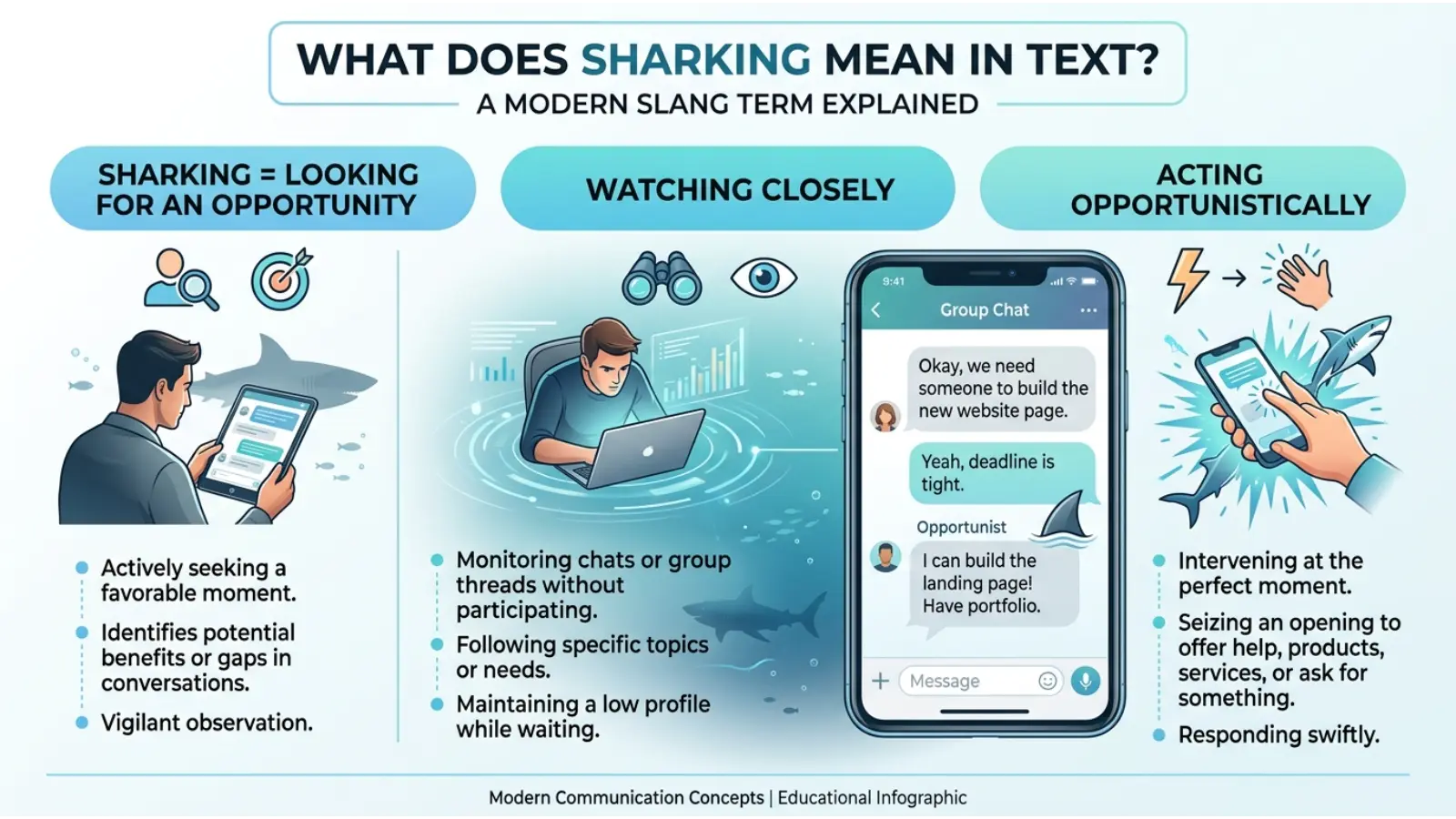
Sharking meaning slang can be confusing because the word “sharking” has more than one informal meaning.
If you have seen someone use it in a text, comment, gaming chat, or social media post, you may wonder whether they are talking about actual sharks or using the word as slang.
The meaning usually depends on the situation, the people involved, and the tone of the conversation.
Unlike many internet abbreviations, sharking does not have one universal “full form.” It is a slang word formed from shark, and different communities may use it in different ways.
In some contexts, it can describe aggressively or opportunistically taking advantage of someone. In other contexts, it may refer to watching, circling, looking for an opportunity, or behaving like a shark.
Quick Answer
Sharking is informal slang whose meaning depends heavily on context. It can describe someone who is aggressively looking for an opportunity, taking advantage of others, or behaving in a predatory or opportunistic way.
What Does Sharking Mean in Text?
When someone uses sharking in a text message, they are generally using “shark” as a metaphor.
A shark is often associated with being:
- Aggressive
- Alert
- Competitive
- Opportunistic
- Persistent
- Ready to take advantage of a situation
Therefore, sharking can describe the act of moving around or watching for an opportunity.
For example:
“He’s been sharking around the new players.”
This could mean that he is watching the new players and looking for a chance to benefit from their inexperience.
However, the exact interpretation can change between communities. Always consider the surrounding conversation before deciding what someone means.
Sharking Meaning Slang in Different Contexts
The word can have different shades of meaning depending on where it appears.
1. Taking Advantage of Someone
One common figurative use describes someone looking for an easy opportunity to benefit from another person.
Example:
“He was sharking for a chance to make money from the situation.”
Here, “sharking” suggests actively looking for an opportunity.
2. Watching for an Opportunity
It can also mean carefully watching what is happening and waiting for the right moment.
Example:
“She was sharking around the table waiting for someone to leave.”
The speaker is comparing the person’s behavior to a shark circling its target.
3. Being Aggressively Competitive
In competitive environments, sharking may describe someone who is constantly looking for an advantage.
Example:
“He’s sharking everyone in the tournament.”
The meaning could be that the person is aggressively competing or searching for weaknesses.
4. Acting Predatory
In some situations, “sharking” can have a more negative meaning. It may suggest behavior that feels predatory, manipulative, or exploitative.
Because of this meaning, be careful when describing a person as “sharking.”
Is Sharking Rude, Offensive, or Neutral?
Sharking is generally informal rather than automatically offensive. However, it can sound negative depending on how it is used.
For example:
- Neutral: “He’s sharking for good deals at the market.”
- Negative: “He’s sharking vulnerable customers.”
- Playful: “I’m sharking for the last slice of pizza.”
The word becomes more serious when it suggests that someone is exploiting another person.
Tone Matters
If you are unsure how the listener will interpret it, choose a clearer word such as:
- Looking
- Searching
- Watching
- Hunting for opportunities
- Taking advantage
- Competing aggressively
Where Is “Sharking” Commonly Used?
You may encounter this slang in several informal environments:
- Text messages
- Social media
- Online forums
- Gaming communities
- Competitive environments
- Casual conversations
- Memes and jokes
- Business or negotiation discussions
Its meaning is not always standardized across these communities.
This is why searching for sharking meaning slang without looking at the original sentence may not give you the complete answer.
Real-Life Conversation Examples
Friendly Example
Alex: “Are you sharking for another slice?”
Sam: “Maybe! It looks too good to leave.”
Here, the word is playful and means looking for an opportunity to get something.
Casual Example
Mia: “Why is Jake walking around the room?”
Leo: “He’s sharking for a free seat.”
The speaker is joking about Jake searching for an available seat.
Argumentative Example
Person 1: “You were sharking for a chance to embarrass me.”
Person 2: “That’s not what I was doing.”
Here, “sharking” has a negative emotional meaning. The first person believes the other was deliberately waiting for an opportunity to attack or embarrass them.
Emotional and Psychological Meaning of Sharking
Because “sharking” comes from the image of a shark constantly moving and looking for opportunities, it can suggest certain personality traits or emotional states.
Depending on context, it may imply:
- Alertness
- Ambition
- Suspicion
- Aggression
- Opportunism
- Competition
- Impatience
For example, someone might say:
“He’s always sharking for the next opportunity.”
This could describe an ambitious person who constantly searches for ways to succeed.
But if the situation involves vulnerable people, the same word can imply manipulation or exploitation.
Origin and Background of the Slang
The slang use of sharking comes from the figurative use of the noun shark.
The word “shark” has long been used metaphorically to describe a person who is aggressive, highly skilled, or willing to take advantage of others.
For example, English has expressions such as:
- Loan shark
- Card shark
- Pool shark
These expressions helped develop the broader idea of a “shark” as someone who operates aggressively or skillfully in a particular environment.
“Sharking” is therefore a verb-like informal formation meaning to behave like a shark or act in an opportunistic way.
Sharking Full Form: Is It an Acronym?
There is no standard sharking full form.
Unlike slang abbreviations such as “LOL” or “BRB,” sharking is a regular English-derived word used informally.
So, if someone asks:
“What does sharking stand for?”
The best answer is that it doesn’t officially stand for a phrase. Its meaning comes from the metaphorical use of “shark.”
Sharking vs. Similar Slang Terms
Several words can overlap with the meaning of sharking, but they are not exact synonyms.
| Term | General Meaning | Tone |
|---|---|---|
| Sharking | Looking aggressively or opportunistically for an advantage | Informal |
| Hustling | Working hard or trying to make money; sometimes manipulating | Casual |
| Scouting | Looking around for information or opportunities | Usually neutral |
| Hunting | Searching strongly for something | Neutral/informal |
| Preying | Taking advantage of someone vulnerable | Strongly negative |
| Fishing | Trying to get information, attention, or a response | Informal |
The closest meaning depends on the sentence.
When to Use Sharking and When to Avoid It
You can use sharking in relaxed conversations when everyone understands informal slang.
Good situations
- Casual texting
- Jokes with friends
- Informal social media posts
- Gaming conversations
- Humorous descriptions
Avoid it when:
- Writing a formal email
- Speaking in a professional meeting
- Writing an academic paper
- Talking about sensitive situations
- Describing someone’s potentially harmful behavior
If you need to communicate clearly, use a more precise word.
Polite Alternatives to Sharking
If sharking sounds too aggressive, consider these alternatives:
- Looking for an opportunity
- Searching
- Watching
- Keeping an eye out
- Exploring options
- Trying to find an advantage
- Looking for a good deal
For example:
Slang:
“He’s sharking for a deal.”
Polite alternative:
“He’s looking for a good deal.”
The second version is clearer and less judgmental.
Why Do People Use Sharking Slang?
People often use metaphorical slang because it makes communication more vivid.
Instead of saying:
“He’s constantly looking for opportunities.”
Someone might jokingly say:
“He’s always sharking.”
The shorter expression can make a conversation sound:
- More casual
- More humorous
- More expressive
- More dramatic
- More conversational
Internet communities especially enjoy turning ordinary words into playful expressions.
Impact of Using Sharking in Communication
The word can create a strong image in the listener’s mind.
Calling someone a “shark” may make them sound confident and competitive. But it can also make them sound aggressive or manipulative.
Therefore, context and tone are extremely important.
If you say it jokingly to a friend, it may be harmless.
If you say it about a coworker, customer, or vulnerable person, it could sound insulting.
Is Sharking Safe for Social Media?
Generally, sharking is not inherently inappropriate for social media. It is an informal expression rather than a universally offensive term.
However, social media removes much of the context available in face-to-face conversations.
A sarcastic comment such as:
“He’s sharking again 😂”
might be understood as a joke by your friends but interpreted negatively by someone else.
Use surrounding words, emojis, or a clearer explanation when the meaning could be misunderstood.
Common Misunderstandings About Sharking
“Does sharking always mean attacking someone?”
No. It can simply describe searching, watching, or looking for an opportunity.
“Is sharking an abbreviation?”
No. There is no standard acronym expansion or sharking full form.
“Does sharking always have a negative meaning?”
No. It can be playful or neutral, although it can carry a negative meaning in certain contexts.
“Does sharking mean swimming with sharks?”
Not necessarily. In literal contexts, it could relate to sharks, but slang usage is usually metaphorical.
Variations and Types of Sharking
You may see the word used in several informal patterns.
“Sharking around”
Usually suggests moving around while watching or looking for an opportunity.
“Sharking for something”
Suggests actively searching for something.
Example:
“I’m sharking for a bargain.”
“He’s sharking”
This can be a shortened way of saying someone is actively looking for an opportunity.
The meaning still depends on the conversation.
How to Respond When Someone Uses “Sharking”
If you understand the context, respond naturally.
Playful response:
“Haha, you caught me sharking!”
Clarifying response:
“What do you mean by sharking?”
Neutral response:
“Are you looking for an opportunity?”
Asking for clarification is perfectly reasonable because slang can vary between communities.
Regional and Cultural Usage
The metaphorical use of shark is widespread in English, but the exact meaning of sharking can vary among communities.
Online gaming groups, social media users, sports communities, and casual speakers may give the word slightly different meanings.
That is why there is no single definition that works for every conversation.
If you encounter the term in another country or online community, look at the surrounding sentence and the speaker’s tone before interpreting it.
FAQs About Sharking Meaning Slang
What does sharking mean in text?
In text, sharking usually means actively watching, searching, or looking for an opportunity, often with an aggressive or opportunistic sense.
What does sharking stand for?
Sharking does not stand for a specific phrase. It is an informal word derived from “shark.”
Is sharking a bad word?
Not necessarily. It is informal, but it can sound negative when used to describe someone who takes advantage of others.
Is sharking slang or a real word?
“Sharking” can function as a regular word formation from “shark,” while its figurative uses are often informal or slang-like.
Can I use sharking on social media?
Yes, especially in casual posts or conversations. Just remember that its meaning may not be obvious to everyone.
What is another word for sharking?
Depending on the context, alternatives include searching, scouting, watching, hunting for opportunities, hustling, or looking for an advantage.
Conclusion
Understanding sharking meaning slang requires looking at the context. The term generally describes someone who is actively looking, watching, or searching for an opportunity, often with the aggressive or opportunistic qualities associated with a shark.
It does not have a standard full form, and it does not always have a negative meaning. Among friends, it can be playful, while in a serious conversation it may suggest that someone is exploiting or targeting others.
If you are using the word yourself, pay attention to your audience and tone. When clarity matters, expressions such as “looking for an opportunity,” “searching,” or “watching for a chance” are safer and easier to understand.





1 thought on “Sharking Meaning Slang What Does Sharking Mean in Text”