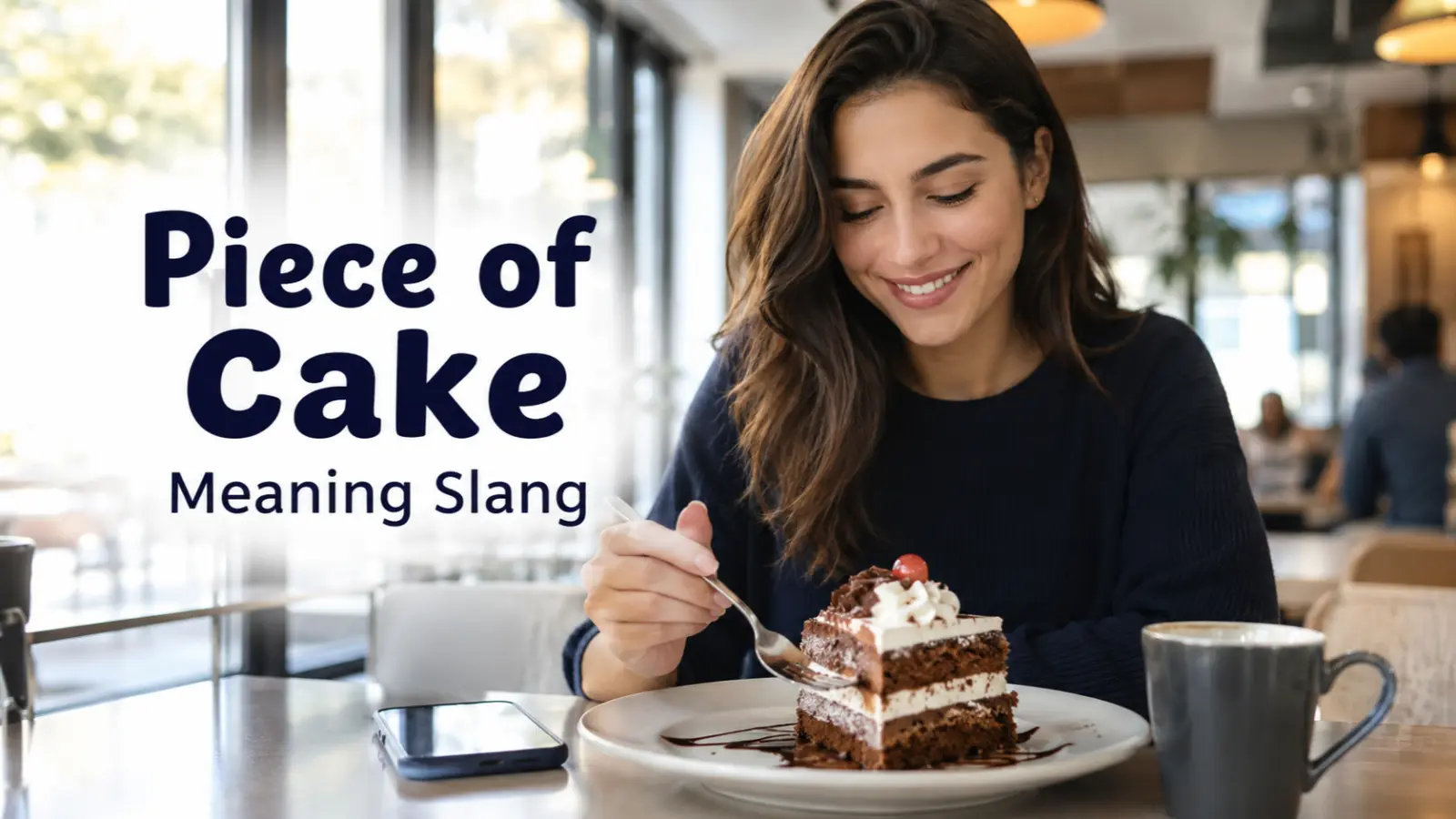
Piece of cake meaning slang is something people often search for when they see this phrase in a text, conversation, movie, or social media post.
At first, it may sound like someone is talking about an actual slice of cake. However, in everyday English, “piece of cake” is an informal idiom that usually means something is very easy to do.
You might hear someone say, “That test was a piece of cake!” after finishing an easy exam. A friend might also tell you, “Don’t worry, fixing it will be a piece of cake.”
Understanding this phrase is useful because its meaning depends on context. It is friendly, casual, and generally not offensive.
Quick Answer
“Piece of cake” means something is very easy, simple, or effortless to do. It is an informal expression, not usually literal slang.
What Does “Piece of Cake” Mean in Text?
When someone writes “piece of cake” in a text, they usually mean “that was easy” or “this will be easy.”
For example:
“How was your driving test?”
“A piece of cake!”
Here, the person is saying the driving test was easy.
The phrase can describe:
- An easy task
- A simple problem
- Something that requires little effort
- An activity someone feels confident about
- An unexpectedly easy experience
“Piece of Cake” Full Form
“Piece of cake” does not have a full form like an acronym such as LOL or BTW. It is an idiomatic expression.
So, if you are searching for the piece of cake full form, the simple answer is that there is no acronym-style full form.
“Piece of Cake” Meaning Slang in Different Contexts
The meaning is usually similar across contexts, but the tone can change.
In Text Messages
In texting, “piece of cake” means:
“Easy!”
Example:
“Can you help me set up this app?”
“Sure. Piece of cake.”
In School
A student might say:
“The math homework was a piece of cake.”
This means the homework was very easy.
At Work
A colleague could say:
“Don’t worry about the presentation. It’ll be a piece of cake.”
They mean the presentation should be easy to complete.
In Sports
An athlete might say:
“That opponent was a piece of cake.”
Here, the speaker means the opponent was easy to defeat.
However, this version can sound boastful depending on the situation.
Is “Piece of Cake” Rude or Offensive?
Generally, no. “Piece of cake” is a neutral and friendly informal expression.
It is not normally considered vulgar, insulting, or offensive.
However, context matters.
For example:
“That assignment was a piece of cake.”
This is harmless.
But:
“Your job is a piece of cake.”
could sound dismissive if someone has been working hard. The speaker may unintentionally make the other person’s work sound easier than it really is.
So, the phrase itself is not rude, but tone and situation can affect how it is received.
Where Is “Piece of Cake” Commonly Used?
The expression is common in everyday English, especially in informal conversations.
You may see it in:
- Text messages
- Social media posts
- Movies and TV shows
- Conversations with friends
- Workplace conversations
- School discussions
- Online chats
- Sports conversations
It is especially common in casual American English, but English speakers in many other regions understand it as well.
Real-Life Conversation Examples
Friendly Example
A: “Can you help me carry these boxes?”
B: “Of course. Piece of cake!”
The speaker is confidently saying the task will be easy.
Casual Example
A: “Did you finish the assignment?”
B: “Yep. It was a piece of cake.”
Argumentative Example
A: “You don’t understand how difficult this project is.”
B: “Come on. It’s a piece of cake.”
Here, the phrase may sound dismissive because the speakers disagree about how difficult the task is.
Work Example
Manager: “Can you prepare this report by Friday?”
Employee: “Sure, it should be a piece of cake.”
Social Media Example
“Passed my driving test today! It was a piece of cake! 🎉”
The phrase expresses confidence and relief.
Emotional and Psychological Meaning
“Piece of cake” can communicate more than just difficulty.
Depending on the speaker, it may show:
- Confidence: “I know I can do this.”
- Relief: “That wasn’t as difficult as I expected.”
- Excitement: “That was surprisingly easy!”
- Reassurance: “Don’t worry; you can handle it.”
- Pride: “I completed the task without much trouble.”
Sometimes people use the phrase to encourage someone who feels nervous.
“Your interview will be a piece of cake. Just relax.”
In this situation, it works as reassurance rather than simply describing difficulty.
Origin and Background of “Piece of Cake”
“Piece of cake” is an old English idiom rather than modern internet slang.
The phrase became popular in the 20th century, particularly in American English. It is often associated with the idea that eating a piece of cake is enjoyable and requires very little effort.
The exact historical origin is not completely certain, but by the mid-20th century, “piece of cake” was widely used to describe something easy.
Today, it remains a common informal expression.
Similar Slang and Expressions
Several English expressions have a meaning close to “piece of cake.”
| Expression | Meaning | Tone |
|---|---|---|
| Piece of cake | Very easy | Casual |
| Easy peasy | Very easy | Playful |
| A breeze | Easy to do | Casual |
| No sweat | No difficulty or problem | Informal |
| Walk in the park | Very easy | Casual |
| Child’s play | Extremely easy | Informal |
| Simple as ABC | Very simple | Casual |
Piece of Cake vs. Easy Peasy
“Piece of cake” sounds natural in many everyday situations.
“The exam was a piece of cake.”
“Easy peasy” sounds more playful:
“Don’t worry. It’s easy peasy!”
Piece of Cake vs. No Sweat
“No sweat” often means that something is not a problem.
“Can you help me tomorrow?”
“No sweat.”
“Piece of cake” focuses more directly on how easy the task is.
When Should You Use “Piece of Cake”?
Use it when you are speaking or writing casually and want to say something is easy.
It works well with:
- Friends
- Family
- Classmates
- Informal online conversations
- Casual workplace conversations
Examples:
“The quiz was a piece of cake.”
“Don’t worry about the setup. It’s a piece of cake.”
“Cooking this recipe is a piece of cake.”
When Should You Avoid “Piece of Cake”?
Although it is not offensive, it may not fit every situation.
Avoid it in highly formal writing, such as:
- Academic research
- Legal documents
- Formal business reports
- Official applications
- Professional instructions
Instead of:
“The process is a piece of cake.”
you could write:
“The process is relatively simple.”
This sounds more professional.
Also be careful when describing someone else’s difficult work. Saying their task is a “piece of cake” could make them feel that their effort is being ignored.
Polite Alternatives to “Piece of Cake”
If you want a more professional or neutral expression, try:
- “It should be fairly straightforward.”
- “It should be relatively easy.”
- “The process is quite simple.”
- “This shouldn’t be too difficult.”
- “It should be manageable.”
- “This can be completed without much difficulty.”
These alternatives are useful in formal communication.
Why Do People Use “Piece of Cake”?
People use this expression because it is short, memorable, and expressive.
Instead of saying:
“I believe this task will require very little effort.”
someone can simply say:
“It’s a piece of cake.”
The idiom makes everyday communication sound more natural and conversational.
It can also make reassurance sound warmer:
“Don’t stress about the interview. You’ll do great. It’ll be a piece of cake.”
Impact of Using “Piece of Cake” in Communication
The phrase can make communication feel:
- Friendly
- Relaxed
- Confident
- Conversational
- Encouraging
But it can have a negative effect if used at the wrong time.
For example, telling someone:
“Your job is a piece of cake.”
when they are exhausted may sound like you are minimizing their effort.
Context, relationship, and tone matter.
Is “Piece of Cake” Safe for Social Media?
Yes. “Piece of cake” is generally safe for social media.
It does not contain profanity or offensive language. You can commonly use it in captions, comments, posts, and messages.
For example:
“Finished my first 5K! Piece of cake! 🏃”
or:
“This recipe was a piece of cake to make! 🍰”
The second example can be especially fun because it uses the phrase while discussing actual cake.
Common Misunderstandings
Does “Piece of Cake” Mean Actual Cake?
Not always.
If someone says:
“The exam was a piece of cake.”
they are not talking about food. They mean the exam was easy.
However:
“I ate a piece of cake.”
is literal and means an actual portion of cake.
Is It Really Slang?
“Piece of cake” is often searched as slang, but technically it is better described as an idiom or informal expression.
Does It Mean “Free”?
No. It means easy, not necessarily free.
“The task was a piece of cake.”
means it was easy to complete.
Variations and Types
You may see slightly different forms of the expression:
- A piece of cake
- It was a piece of cake
- That’s a piece of cake
- It’s a piece of cake
- Piece of cake!
The meaning remains essentially the same.
The shortened form “Piece of cake!” is especially common in casual speech.
How to Respond When Someone Says “Piece of Cake”
Your response depends on the conversation.
If someone says:
“Don’t worry. It’s a piece of cake.”
you could respond:
- “I hope so!”
- “Great, thanks!”
- “Good to know.”
- “That makes me feel better.”
- “Let’s get started!”
If someone says:
“The exam was a piece of cake.”
you might say:
- “Lucky you!”
- “Really? I found it difficult.”
- “Glad it went well!”
- “I hope mine is easy too!”
Regional and Cultural Usage
“Piece of cake” is widely understood across English-speaking cultures. It is particularly familiar in American and British English.
The expression does not usually carry a hidden offensive meaning based on region or culture. Still, informal expressions can vary between communities, so the speaker’s tone and local language habits can influence how natural it sounds.
For international English learners, “piece of cake” is a useful everyday idiom to recognize and understand.
Frequently Asked Questions
What does “piece of cake” mean in slang?
It means something is very easy or requires little effort. It is more accurately called an informal idiom.
What does “piece of cake” stand for?
It does not stand for anything because it is not an acronym. It is an idiomatic phrase meaning “very easy.”
Is “piece of cake” positive?
Usually, yes. It can express confidence, relief, or encouragement. However, it can sound dismissive if you use it to describe something another person finds difficult.
Can I use “piece of cake” in texting?
Yes. It is very common in casual texting and online conversations.
Is “piece of cake” rude?
No, it is generally neutral and friendly. The tone and context determine whether it could sound dismissive.
What is another word for “piece of cake”?
Common alternatives include easy, simple, effortless, a breeze, no sweat, easy peasy, and a walk in the park.
Conclusion
Understanding piece of cake meaning slang is simple: the phrase means something is very easy to do. It is an informal English idiom that appears frequently in conversations, text messages, social media, movies, and everyday speech.
For example, saying “That test was a piece of cake” means the test was easy. The expression is generally friendly and safe to use, although it may sound dismissive if you minimize someone else’s hard work.
Remember that “piece of cake” does not have a full form and does not usually refer to actual food when used as an idiom. When the situation is formal, phrases such as “relatively easy” or “straightforward” are better choices.
In short, when someone says “It’s a piece of cake,” they are simply telling you: “Don’t worry—it’s easy.”










1 thought on “Piece of Cake Meaning Slang What Does It Mean”