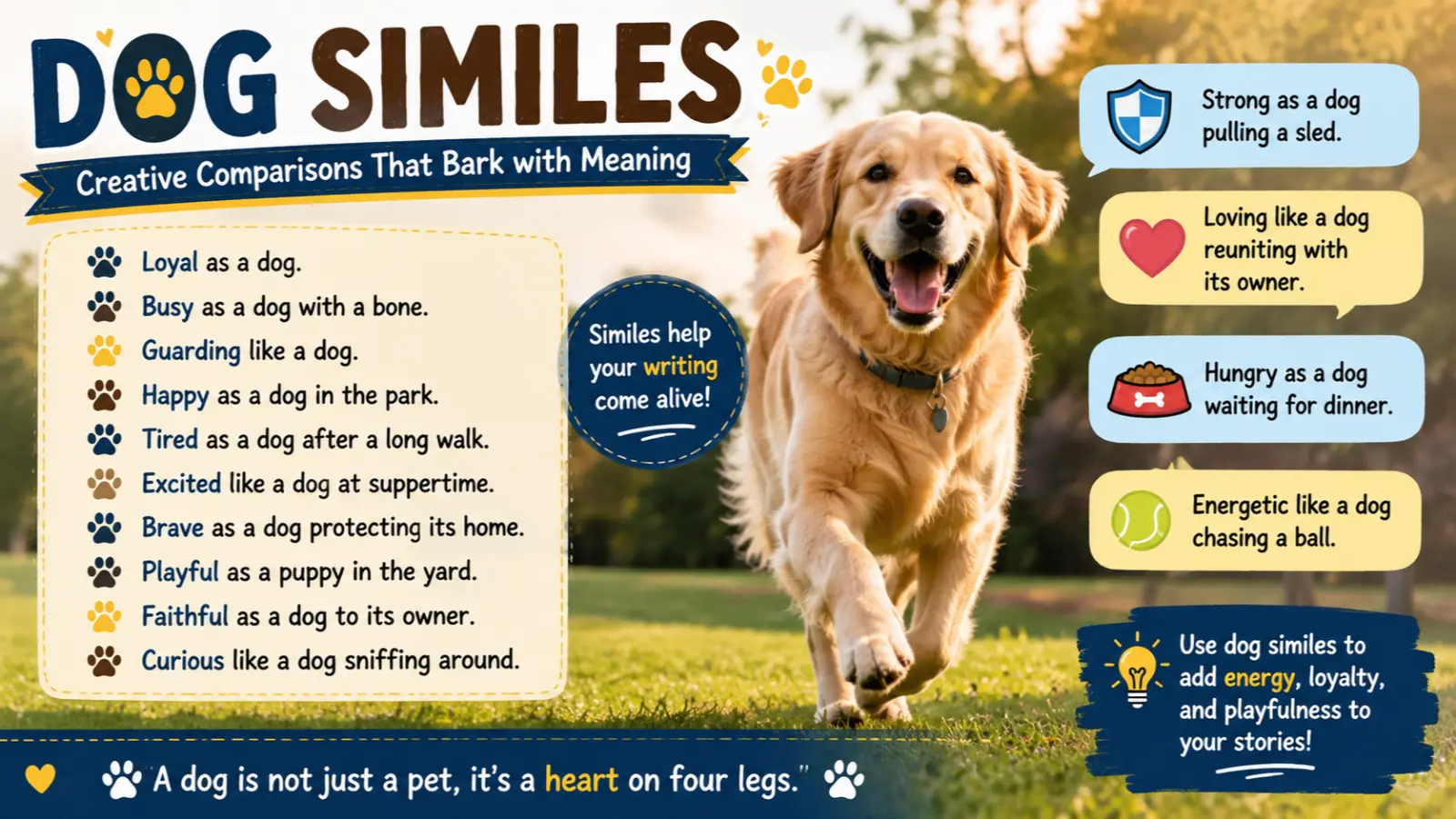
Dog Similes can be playful, loyal, nervous, energetic, stubborn, gentle, or wonderfully unpredictable. That makes them excellent subjects for creative comparisons. A well-chosen dog simile can turn a simple sentence into a picture readers can almost see.
A simile compares two different things using words such as like or as. For example, instead of saying, “The puppy was excited,” a writer might say, “The puppy bounced like a spring released from a box.”
This guide explores dog similes for different moods, actions, appearances, and personalities. You will find original examples, explanations, sentence ideas, and practical techniques for creating your own comparisons.
What Is a Dog Simile?
A dog simile is a comparison that describes a dog, its behavior, appearance, movement, or personality by comparing it with something else.
For example:
“The puppy raced across the yard like a tiny rocket.”
The dog is not literally a rocket. The comparison emphasizes its speed and energy.
Dog similes can be useful in:
- Creative writing
- Short stories
- Poems
- Children’s writing
- School assignments
- Character descriptions
- Dialogue
- Funny captions
- Fiction and storytelling
The strongest similes do more than decorate a sentence. They help readers understand how something feels, looks, sounds, or moves.
Quick Answer: What Are Some Good Dog Similes?
Here are a few original dog similes:
- The puppy was like a bouncing rubber ball.
- The old dog moved as slowly as a drifting cloud.
- Her ears stood up like two curious flags.
- The terrier darted around the garden like a spark skipping across dry grass.
- His tail wagged like a little windshield wiper.
- The sleepy dog curled up like a comma at the end of a sentence.
- The puppy followed me like a small shadow with paws.
Each comparison focuses on a recognizable quality such as energy, movement, shape, loyalty, or sleepiness.
30 Creative Dog Similes for Writers
1. The Puppy Bounced Like a Rubber Ball
Meaning: The puppy was extremely energetic and kept jumping around.
Example sentences:
- The puppy bounced like a rubber ball whenever someone entered the room.
- After hearing the food bag open, he bounced like a rubber ball across the kitchen.
Emotional effect: Playful, cheerful, energetic.
Writing purpose: This works well when introducing an excited puppy.
Writing tip: Choose a comparison that behaves like the thing you are describing. A rubber ball naturally suggests repeated bouncing.
2. His Tail Wagged Like a Windshield Wiper
Meaning: The dog’s tail moved rapidly from side to side.
Example sentences:
- His tail wagged like a windshield wiper when he saw his owner.
- The little dog greeted every visitor with a tail that moved like a windshield wiper.
Best context: Everyday storytelling and humorous descriptions.
This comparison is especially effective because the reader immediately understands the movement.
3. She Followed Me Like a Little Shadow
Meaning: The dog stayed very close to the person.
Example sentences:
- My dog followed me like a little shadow throughout the house.
- Wherever I went, she followed like a little shadow with four paws.
Emotional effect: Affectionate and loyal.
Writing tip: For emotional scenes, simple comparisons can sometimes work better than elaborate ones.
4. The Dog Slept Like a Folded Blanket
Meaning: The dog was curled up peacefully and comfortably.
Example sentences:
- After the long walk, the dog slept like a folded blanket beside the fireplace.
- He curled into the corner and slept like a folded blanket.
Best context: Cozy scenes and gentle storytelling.
The comparison focuses on shape and stillness rather than simply saying the dog was tired.
5. The Terrier Darted Like a Spark
Meaning: The dog moved extremely quickly and unpredictably.
Example sentences:
- The terrier darted like a spark between the garden chairs.
- She darted like a spark whenever someone tossed the ball.
Emotional effect: Energetic and exciting.
Writing purpose: Useful for action scenes.
6. His Ears Stood Up Like Curious Flags
Meaning: The dog’s ears were raised as if it were alert and interested.
Example sentences:
- His ears stood up like curious flags when he heard a strange sound.
- The puppy’s ears rose like curious flags at the sound of footsteps.
Writing tip: This comparison combines appearance with personality, making the description more vivid.
7. The Old Dog Walked Like a Slow Clock
Meaning: The dog moved slowly and steadily.
Example sentences:
- The old dog walked like a slow clock around the yard.
- He walked like a slow clock, taking his time with every step.
Emotional effect: Calm, reflective, slightly nostalgic.
Best context: Descriptions of older dogs or peaceful scenes.
8. The Puppy Barked Like a Tiny Alarm
Meaning: The puppy’s bark was sharp, persistent, or attention-grabbing.
Example sentences:
- The puppy barked like a tiny alarm whenever the doorbell rang.
- From the backyard came a bark like a tiny alarm.
Writing purpose: Good for humorous or lively scenes.
9. Her Fur Shimmered Like Freshly Brushed Velvet
Meaning: The dog’s coat looked smooth, soft, and attractive.
Example sentences:
- Her dark fur shimmered like freshly brushed velvet in the sunlight.
- The dog’s coat looked like freshly brushed velvet beneath the morning light.
Best context: Appearance-focused descriptions.
Notice how the comparison appeals to touch and sight at the same time.
10. He Sat Like a Patient Little Statue
Meaning: The dog remained very still while waiting.
Example sentences:
- He sat like a patient little statue beside the door.
- During the training exercise, the dog sat like a patient little statue.
Emotional effect: Calm, disciplined, slightly humorous.
11. The Dog Ran Like a Kite Caught by the Wind
Meaning: The dog ran quickly and freely with lively movement.
Example sentences:
- The dog ran like a kite caught by the wind across the open field.
- She ran like a kite caught by the wind when the gate opened.
Writing tip: Comparisons become stronger when the image captures not only speed but also how the movement feels.
12. His Nose Worked Like a Detective’s Magnifying Glass
Meaning: The dog seemed extremely focused on finding a scent.
Example sentences:
- His nose worked like a detective’s magnifying glass as he searched the garden.
- The tracking dog moved carefully, using his nose like a detective’s magnifying glass.
Best context: Tracking scenes, adventures, and humorous stories.
13. The Puppy Trembled Like a Leaf in a Breeze
Meaning: The puppy was nervous or frightened.
Example sentences:
- The puppy trembled like a leaf in a breeze during the thunderstorm.
- She trembled like a leaf in a breeze when she heard the unfamiliar noise.
Emotional effect: Vulnerable and sympathetic.
14. His Bark Was Like a Drumbeat at the Door
Meaning: The dog’s repeated barking was loud and rhythmic.
Example sentences:
- His bark was like a drumbeat at the door.
- Every knock produced another bark, like a drumbeat echoing through the hallway.
Writing purpose: Useful when describing sound.
15. The Dog Curled Up Like a Question Mark
Meaning: The dog’s body formed a curved shape while resting.
Example sentences:
- The small dog curled up like a question mark on the rug.
- By midnight, she was curled like a question mark beneath the table.
Emotional effect: Cozy and visually distinctive.
Writing tip: Shape-based similes are excellent for animal descriptions because they let readers visualize posture.
16. His Paws Moved Like Tiny Drums
Meaning: The dog’s feet moved quickly or tapped repeatedly.
Example sentences:
- His paws moved like tiny drums as he waited for dinner.
- The excited puppy’s feet tapped like tiny drums against the floor.
Best context: Funny and energetic scenes.
17. The Dog’s Eyes Sparkled Like Morning Dew
Meaning: The dog’s eyes appeared bright, fresh, or lively.
Example sentences:
- The puppy’s eyes sparkled like morning dew in the sunlight.
- Her eyes were bright like morning dew after she spotted the children.
Writing tip: Use visual comparisons when you want readers to pause and notice an animal’s expression.
18. The Puppy Chased the Ball Like a Meteor Chasing the Sky
Meaning: The puppy pursued the ball with intense excitement and speed.
Example sentences:
- The puppy chased the ball like a meteor chasing the sky.
- He raced after the tennis ball like a meteor streaking through open space.
Emotional effect: Exciting and exaggerated.
Best context: Playful storytelling.
19. The Dog Was as Gentle as a Feather Falling
Meaning: The dog behaved softly and carefully.
Example sentences:
- Despite his size, the dog was as gentle as a feather falling.
- He approached the child as gently as a feather falling through still air.
Writing purpose: This is useful when contrasting a large dog’s appearance with a gentle personality.
20. Her Excitement Spread Like a Ripple in a Pond
Meaning: The dog’s excitement seemed to affect everyone around her.
Example sentences:
- Her excitement spread like a ripple in a pond when the family returned home.
- The puppy’s joy spread like a ripple in a pond through the room.
Writing tip: Not every simile has to describe physical movement. Comparisons can also describe emotional influence.
21. The Dog Stretched Like a Long Ribbon
Meaning: The dog extended its body fully while stretching.
Example sentences:
- After waking, the dog stretched like a long ribbon across the rug.
- She stretched like a ribbon before standing up.
Best context: Morning scenes and relaxed descriptions.
22. He Guarded the Door Like a Tiny Captain
Meaning: The dog appeared serious and responsible while watching the entrance.
Example sentences:
- The little dog guarded the door like a tiny captain.
- He stood proudly beside the entrance like a tiny captain protecting his ship.
Emotional effect: Humorous and affectionate.
23. The Puppy Slid Across the Floor Like a Sled
Meaning: The puppy moved smoothly or lost traction while racing across a smooth surface.
Example sentences:
- The puppy slid across the kitchen floor like a sled.
- He chased the toy and slid like a sled when he tried to stop.
Best context: Comedy and playful action.
24. His Loyalty Was Like a Lamp That Never Went Out
Meaning: The dog remained dependable and devoted.
Example sentences:
- His loyalty was like a lamp that never went out.
- Through every difficult day, the dog’s loyalty remained like a steady lamp.
Writing purpose: Emotional storytelling.
This works because the lamp suggests something dependable and continuously present.
25. The Dog Moved Through the Snow Like a Brush Across a Blank Canvas
Meaning: The dog’s movement created a visible trail through fresh snow.
Example sentences:
- The dog moved through the snow like a brush across a blank canvas.
- His paws crossed the field like a brush leaving marks on a white canvas.
Best context: Descriptive nature writing and winter stories.
26. Her Whiskers Quivered Like Grass in a Gentle Breeze
Meaning: The dog’s whiskers moved slightly and delicately.
Example sentences:
- Her whiskers quivered like grass in a gentle breeze.
- The dog’s whiskers moved like blades of grass whenever she sniffed the air.
Writing tip: Small physical details can make animal descriptions feel more observant.
27. The Dog’s Happiness Was Like Sunshine Through an Open Window
Meaning: The dog’s cheerful presence created a warm atmosphere.
Example sentences:
- The dog’s happiness was like sunshine through an open window.
- Her cheerful greeting felt like sunshine through an open window.
Emotional effect: Warm, comforting, optimistic.
28. The Puppy Was as Curious as a Question With No Answer
Meaning: The puppy constantly explored and wanted to understand everything.
Example sentences:
- The puppy was as curious as a question with no answer.
- He inspected every box because he was as curious as a question with no answer.
Best context: Children’s stories and playful descriptions.
29. His Howl Rose Like a Lonely Train in the Distance
Meaning: The howl sounded distant, sustained, and slightly mournful.
Example sentences:
- His howl rose like a lonely train in the distance.
- At night, the dog’s howl sounded like a distant train moving through the darkness.
Emotional effect: Lonely, mysterious, reflective.
Writing tip: Sound-based similes can establish atmosphere without directly naming the emotion.
30. The Sleeping Puppy Was Like a Warm Footnote to the Day
Meaning: The puppy’s peaceful presence made the end of the day feel comforting.
Example sentences:
- The sleeping puppy was like a warm footnote to the day.
- After the house became quiet, the puppy seemed like a warm footnote to everything that had happened.
Best context: Reflective storytelling and literary writing.
This is an example of a more unusual simile. It works because a footnote is something quiet and secondary, while the warmth adds emotional meaning.
How to Make Dog Similes More Vivid
A weak simile often compares something with an object that has no strong connection to the quality being described.
For example:
The dog was like a chair.
The reader may wonder: In what way?
A stronger comparison gives the reader a specific quality:
The dog sat like a patient little statue.
Now the reader understands that the dog is still and waiting.
When creating a dog simile, ask yourself:
- What exactly am I describing?
- What quality stands out most?
- What object or experience shares that quality?
- Can the reader picture the comparison immediately?
- Does the comparison add something to the sentence?
The goal is not to make every sentence poetic. The goal is to make the right sentence more memorable.
Dog Similes for Different Moods
A dog’s behavior changes the kind of comparison you need.
Happy Dog Similes
For happiness, choose images associated with movement, light, warmth, or celebration.
- The puppy bounced like a rubber ball.
- Her tail moved like a windshield wiper.
- His eyes sparkled like morning dew.
- Her happiness was like sunshine through an open window.
Sad or Lonely Dog Similes
For quieter emotions, use slower movement and distant sounds.
- The dog sat like a forgotten statue.
- His howl rose like a lonely train in the distance.
- She watched the empty doorway like a traveler waiting for a familiar face.
Energetic Dog Similes
Fast-moving comparisons create excitement.
- The puppy darted like a spark.
- He raced like a kite caught by the wind.
- Her paws moved like tiny drums.
- The puppy chased the ball like a streak of summer lightning.
Calm Dog Similes
Use soft, steady imagery.
- The dog rested like a folded blanket.
- He sat like a patient little statue.
- She slept like a warm stone beside the fire.
- The old dog moved like a slow clock.
How Writers Can Avoid Cliché Dog Similes
Some comparisons are so common that they may no longer surprise readers.
That does not make them grammatically wrong. It simply means they may have less creative impact.
Instead of automatically writing:
The dog was as loyal as a dog.
Look for a fresh image:
His loyalty was like a lamp that never went out.
Instead of:
The puppy was fast as lightning.
Try identifying how the puppy moves:
The puppy darted like a spark skipping across the garden.
The second version gives readers a more specific visual experience.
A Simple Formula for Original Similes
Try this pattern:
Subject + action or quality + like/as + unexpected but believable comparison.
For example:
The puppy + bounced + like + a rubber ball.
Then make the comparison more specific:
The puppy bounced like a rubber ball whenever the front door opened.
The extra context makes the image feel connected to the story rather than inserted simply to sound creative.
Simile vs. Metaphor in Dog Writing
A simile makes a comparison using like or as.
The puppy ran like a rocket.
A metaphor makes a direct comparison.
The puppy was a rocket.
Both can create strong imagery, but they have different effects.
A simile usually signals the comparison clearly. A metaphor can make the comparison feel more direct and dramatic.
When writing a dog description, choose the form that matches your style and purpose.
Other Literary Devices That Work With Dog Similes
Imagery
Imagery uses descriptive language to create sensory experiences.
The wet dog shook beside the doorway, scattering cold drops across the floor.
The reader can imagine the scene more clearly because the description appeals to sight and touch.
Personification
Personification gives human qualities to nonhuman things.
The old dog seemed to listen to every secret the house had kept.
This can make an animal character feel more emotionally important.
Hyperbole
Hyperbole deliberately exaggerates something.
The puppy had enough energy to run around the planet twice.
The statement is not meant literally. It emphasizes extraordinary energy.
Alliteration
Alliteration repeats beginning sounds.
The playful puppy pounced past the porch.
The repeated p sound adds rhythm and energy.
How to Create Your Own Dog Similes
You do not need to memorize dozens of comparisons. Learning how to build your own is more valuable.
Step 1: Observe the Dog
Look at one specific behavior.
Is the dog:
- Running?
- Sleeping?
- Barking?
- Waiting?
- Sniffing?
- Playing?
- Trembling?
- Watching?
- Stretching?
Step 2: Identify the Strongest Quality
Maybe the dog is moving quickly.
Or perhaps it is:
- Gentle
- Curious
- Noisy
- Nervous
- Loyal
- Sleepy
- Playful
- Alert
Step 3: Brainstorm Related Images
For speed, think about:
- Sparks
- Arrows
- Kites
- Racing objects
- Wind
- Flowing water
For stillness, consider:
- Statues
- Stones
- Paintings
- Shadows
- Sleeping objects
Step 4: Connect the Two
Now build the comparison.
The puppy ran like a spark.
Step 5: Add Context
Make it part of a real sentence.
The puppy ran like a spark from the porch to the garden gate.
Step 6: Remove Anything Unnecessary
A good simile should strengthen the sentence. If the comparison distracts from the meaning, replace it.
Creative Exercises for Dog Similes
Exercise 1: Five Moods
Write one simile for a dog that is:
- Happy
- Nervous
- Sleepy
- Curious
- Excited
Try not to use the same comparison twice.
Exercise 2: One Dog, Three Actions
Choose one imaginary dog and describe it:
- Running
- Eating
- Sleeping
Use a different sensory image for each action.
Exercise 3: Upgrade a Basic Sentence
Start with:
The dog ran quickly.
Now create three versions:
The dog ran like ______.
Then choose the most vivid comparison and explain why it works.
Exercise 4: Avoid the Obvious
Write a simile for a barking dog without using:
- Alarm
- Drum
- Thunder
- Lightning
This forces you to search for less predictable imagery.
Common Mistakes When Writing Dog Similes
Using Overused Comparisons
A familiar comparison may be appropriate in simple writing, but creative writing often benefits from a more specific image.
Instead of reaching automatically for “fast as lightning,” think about the dog’s actual movement.
Mixing Images
Avoid combining unrelated comparisons in one sentence.
For example, a sentence that compares a dog’s movement to a rocket, a blanket, and a river at the same time becomes confusing.
Choose one clear image.
Forcing a Simile
Not every sentence needs one.
Compare:
The dog entered the room.
with:
The dog entered the room like a mysterious comet wearing muddy paws.
The second sentence may be creative, but it could feel unnecessary if the scene does not call for dramatic imagery.
Confusing Similes and Metaphors
Remember:
Simile: The dog moved like a shadow.
Metaphor: The dog was a shadow.
The distinction is small but important.
Making the Comparison Too Vague
A comparison should give the reader something concrete.
Instead of:
The dog was like something nice.
Try:
The dog rested like a warm blanket beside the chair.
The second sentence gives the reader an actual image.
Frequently Asked Questions About Dog Similes
What is a simple dog simile?
A simple dog simile compares a dog with something else using like or as. For example, “The puppy bounced like a rubber ball.”
What are some good similes for a happy dog?
You can describe a happy dog as “bouncing like a rubber ball,” with a tail “wagging like a windshield wiper,” or with eyes that “sparkle like morning dew.”
What is a simile for a fast dog?
A fast dog can be described as darting “like a spark” or running “like a kite caught by the wind.” The best comparison depends on the type of movement you want readers to imagine.
What is a simile for a loyal dog?
You might compare a dog’s loyalty to “a lamp that never went out.” The image suggests reliability and constant presence.
What is a simile for a sleepy dog?
A sleepy dog might curl up “like a folded blanket” or “like a question mark” on a rug.
How do I make a dog simile more creative?
Start with a specific behavior rather than simply trying to sound poetic. Identify the dog’s most noticeable quality, then find an unusual but believable image that shares that quality.
Are dog similes useful in children’s writing?
Yes. Clear, playful comparisons can help children visualize characters and practice descriptive writing. Simple images are usually easier for younger readers to understand.
Conclusion
The best dog similes do not simply tell readers that a dog is fast, happy, sleepy, or curious. They give those qualities a shape, sound, movement, or feeling that readers can picture. A puppy can bounce like a rubber ball. An alert dog can raise its ears like curious flags. An older dog can move like a slow clock. A loyal companion can feel like a lamp that never goes out. When you write your own similes, start with observation. Notice one small detail, identify the quality behind it, and search for a comparison that feels natural rather than predictable. The more you experiment, the easier it becomes to create descriptions that sound like your own voice.

I am Helena Frost, a writer captivated by the beauty of language and the art of comparison. Through my words, I explore the world by turning ordinary moments into vivid similes and reflections. I enjoy crafting phrases that spark imagination, evoke emotion, and linger in the mind. My writing celebrates the subtle connections between people, nature, and the stories we live. For me, every sentence is an opportunity to reveal the extraordinary in the everyday.