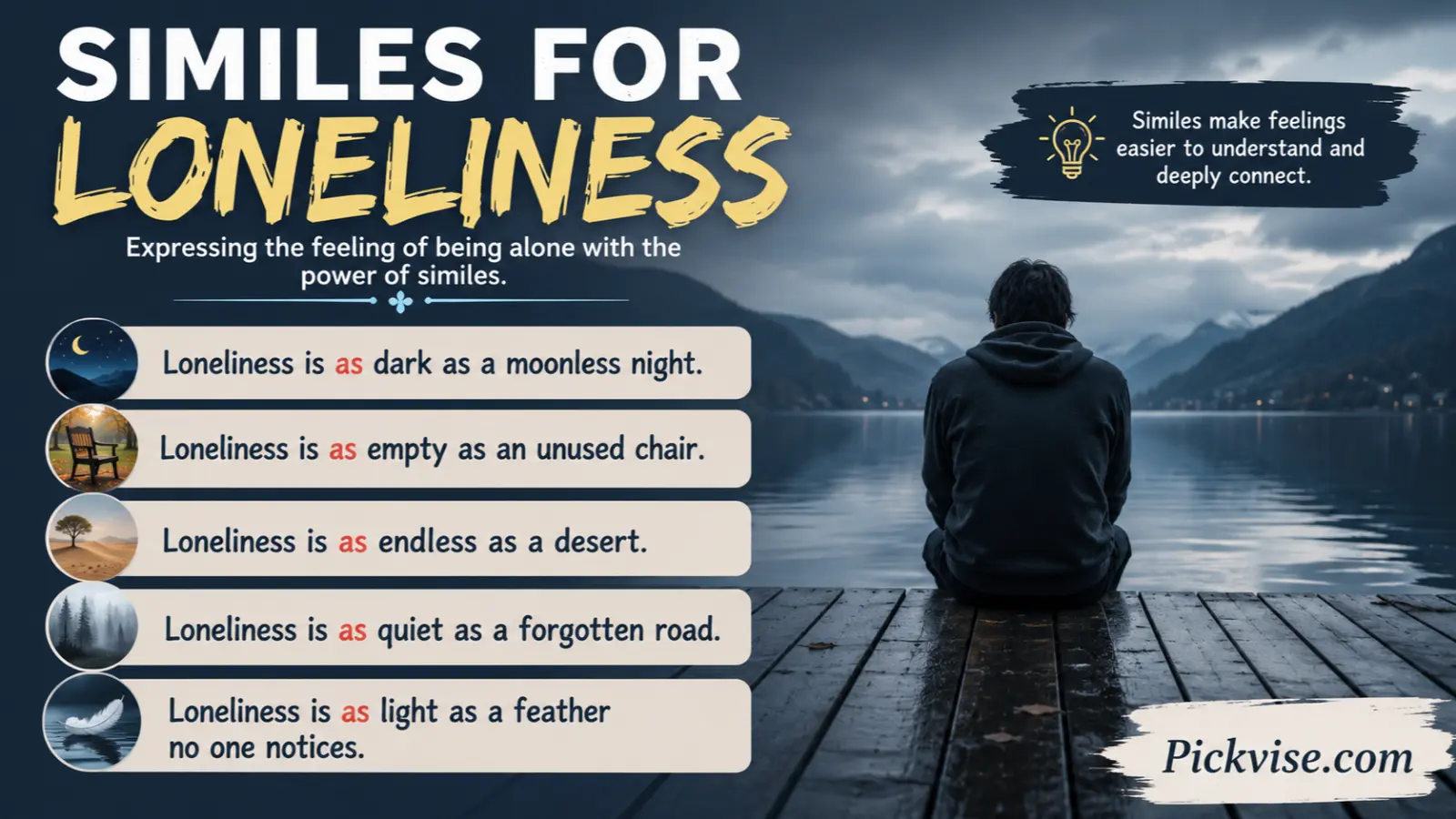
Similes for Loneliness can be difficult to describe because it is an invisible feeling. A writer cannot simply point to loneliness the way they can point to a storm, a broken window, or a crowded street. That is why a well-chosen simile can make the emotion easier for readers to see and feel.
A simile compares two different things using words such as like or as. For example, saying, “Her loneliness spread like frost across a window” turns an abstract emotion into a concrete image.
Writers use similes in poetry, novels, songs, personal essays, dialogue, storytelling, and everyday conversation. When the comparison is fresh and precise, it can give a familiar emotion a completely new shape.
This collection of similes for loneliness focuses on original comparisons that writers can adapt for poems, stories, emotional descriptions, and creative exercises.
What Are Similes for Loneliness?
Similes for loneliness compare the feeling of being alone, disconnected, forgotten, or emotionally distant to something readers can imagine.
For example:
Loneliness felt like an empty chair waiting at a table set for two.
The comparison works because an empty chair is visible, while loneliness is not. The physical image gives the emotion a place in the reader’s imagination.
Quick Answer: What Is a Good Simile for Loneliness?
A strong simile for loneliness connects the emotion to a vivid image of emptiness, distance, silence, isolation, or longing. For example, “His loneliness was like a lighthouse with no ships on the horizon.” The image suggests someone who remains present while desperately waiting for connection.
30 Creative Similes for Loneliness
1. Loneliness was like an empty chair at a crowded table.
Meaning: The person is surrounded by others but still feels excluded.
Example:
“Even with everyone laughing around him, loneliness was like an empty chair at a crowded table.”
This comparison is especially useful for writing about emotional isolation, rather than simply being physically alone.
Writing purpose: Use it when a character feels disconnected in a social setting.
2. Her loneliness spread like frost across a window.
Meaning: The feeling gradually covered her ability to connect with the world.
The image of frost suggests something that develops quietly and makes the outside world harder to see.
Example:
“After months without hearing from her friends, her loneliness spread like frost across a window.”
Best context: Reflective prose and poetry.
3. He carried loneliness like a coat that never came off.
Meaning: Loneliness had become a constant part of his life.
This works because a coat is something a person carries and wears throughout the day. The comparison makes loneliness feel persistent without describing it directly.
Writing tip: Comparisons involving clothing work well when you want an emotion to feel like something a character carries with them.
4. The quiet around her was like snow covering every footprint.
Meaning: Silence seemed to erase traces of human connection.
The snow image creates both beauty and isolation. It suggests that evidence of companionship is gradually disappearing.
Poetry example:
“The quiet was like snow / covering every footprint home.”
The image works particularly well in poems about separation.
5. His loneliness hung over him like a cloud that had forgotten how to move.
Meaning: The feeling seemed permanent instead of temporary.
The unusual detail—a cloud that had forgotten how to move—makes the comparison more original than simply saying loneliness was “like a dark cloud.”
Writing purpose: Useful for portraying prolonged sadness or isolation.
6. She felt alone like a single star beyond the reach of the constellation.
Meaning: She felt separate even though other people existed around her.
A constellation normally suggests connection between stars, so placing one star outside it creates a strong contrast.
Best context: Literary fiction, poetry, and reflective writing.
7. Loneliness settled over the room like dust on an unopened book.
Meaning: The room feels neglected, still, and untouched.
The unopened book also carries a subtle suggestion of an untold story.
Example:
“After he left, loneliness settled over the room like dust on an unopened book.”
Writing tip: Choose objects that already carry emotional associations. A neglected book can suggest silence, forgotten memories, or words left unsaid.
8. Her heart felt like a house with every light switched off.
Meaning: She felt emotionally empty and disconnected.
The house provides a familiar physical image for an internal emotional state.
Example:
“Without her family nearby, her heart felt like a house with every light switched off.”
Best context: Emotional fiction and personal essays.
9. He wandered through the evening like a traveler without a map.
Meaning: He felt directionless and disconnected from where he belonged.
Unlike comparisons based entirely on emptiness, this simile emphasizes uncertainty and lack of belonging.
Writing purpose: Good for characters who are searching for connection or purpose.
10. The silence between them was like a locked door.
Meaning: Something prevented communication or emotional closeness.
This comparison is especially effective because a locked door implies that connection may exist on the other side but cannot currently be reached.
Example:
“The silence between them was like a locked door neither wanted to open.”
Best context: Dialogue scenes and relationship conflicts.
11. Loneliness followed him like a second shadow.
Meaning: He could not easily escape the feeling.
A shadow normally follows a person, making this a natural way to suggest a persistent emotional burden.
Writing tip: Avoid adding too many explanations after a strong image. Let the comparison do some of the emotional work.
12. She felt like a message sent to a number that no longer existed.
Meaning: She wanted connection but felt as though nobody could receive what she had to give.
This modern comparison can work particularly well in contemporary fiction.
Example:
“Her attempts to reconnect felt like messages sent to a number that no longer existed.”
Best context: Modern stories, essays, and digital-age poetry.
13. His loneliness was like an island appearing after the tide went out.
Meaning: Separation became visible when circumstances changed.
The island image creates a sense of distance without making loneliness sound completely hopeless.
Writing purpose: Useful when loneliness develops after friends or family leave.
14. The room felt like a theater after the final audience had gone home.
Meaning: A place that was once full of energy now feels strangely empty.
This simile is particularly strong for describing a home after someone important has left.
Example:
“After the celebration ended, the house felt like a theater after the final audience had gone home.”
15. She held her memories like photographs from a place she could never visit again.
Meaning: Memories provide comfort but also emphasize separation from the past.
This comparison combines nostalgia with loneliness.
Best context: Memoir-style writing, historical fiction, and poetry.
16. His loneliness grew like vines over an abandoned gate.
Meaning: Isolation gradually became stronger and harder to overcome.
The vines suggest time, neglect, and something slowly becoming difficult to remove.
Writing purpose: Use this when you want loneliness to feel like something that develops over time.
17. The morning arrived like a visitor who did not know her name.
Meaning: Even a new day feels unfamiliar and emotionally distant.
This is useful when loneliness affects how a character experiences ordinary moments.
Example:
“Morning arrived like a visitor who did not know her name.”
The comparison makes the day itself seem disconnected from the character.
18. He sat among strangers like a book written in a language no one understood.
Meaning: He feels unable to communicate or be understood.
The book comparison focuses on communication, making it different from similes based only on physical isolation.
Best context: Stories about moving to a new place, social anxiety, cultural differences, or feeling misunderstood.
19. Her loneliness was like an unanswered question hanging in the air.
Meaning: She feels uncertain about why she is disconnected or whether anyone will respond.
Example:
“Her loneliness remained like an unanswered question hanging in the air.”
Writing tip: Comparisons involving questions work well when the character is searching for an explanation.
20. The empty hallway stretched before him like a road with no footsteps.
Meaning: The setting reinforces the character’s isolation.
Instead of simply saying the hallway was empty, the comparison gives it a sense of emotional significance.
Best context: Fictional scenes and atmospheric descriptions.
21. He felt like the last window glowing in a sleeping neighborhood.
Meaning: He is awake, aware, and alone while everyone else seems distant.
This simile can suggest loneliness without making the character completely disconnected from the world.
Writing purpose: Strong for nighttime scenes.
22. Her loneliness was like a song playing in a room where nobody could hear it.
Meaning: She has emotions or thoughts that remain unnoticed.
This comparison is especially useful for poetry and music-related writing because it connects loneliness with expression.
Example:
“She kept smiling, but inside she felt like a song playing in a room where nobody could hear it.”
23. He moved through the crowd like a boat separated from its harbor.
Meaning: He is physically surrounded by people but emotionally disconnected.
The harbor suggests safety and belonging, while the boat represents someone searching for that connection.
Best context: Crowded-city scenes and stories about homesickness.
24. The house became like a clock that had stopped at the moment she left.
Meaning: Life seems frozen after someone’s departure.
The clock introduces the idea that emotional loneliness can change a person’s sense of time.
Writing purpose: Use this when exploring grief, separation, or major life changes without relying on direct emotional statements.
25. His words fell like leaves into an empty street.
Meaning: He speaks, but nobody seems to respond.
The falling leaves suggest movement that ends in silence.
Example:
“His jokes fell like leaves into an empty street.”
This can work particularly well when describing failed attempts at conversation.
26. She felt like a bridge connecting two places where no one wanted to stay.
Meaning: She is caught between people or groups without truly belonging to either.
This simile expresses a more complicated kind of loneliness: being useful to others while feeling personally disconnected.
Best context: Character-driven fiction and reflective essays.
27. Loneliness curled around him like smoke in a closed room.
Meaning: The feeling surrounds him and becomes difficult to escape.
The smoke creates a sense of heaviness and limited space.
Writing tip: Environmental images can make emotions feel physical without explicitly describing them as physical objects.
28. Her unanswered calls felt like paper boats drifting away from shore.
Meaning: Her attempts to reach someone seem increasingly distant and ineffective.
The paper boat creates a fragile image rather than a dramatic one.
Best context: Contemporary poetry, personal writing, and emotional fiction.
29. He remembered friendship like a warm room seen through winter glass.
Meaning: Friendship feels comforting but distant from his current experience.
This comparison contains emotional contrast: warmth exists, but the character cannot reach it.
Writing purpose: Contrast is one of the easiest ways to make an emotional simile more powerful.
30. The night wrapped around her like a blanket with no warmth.
Meaning: Although the night surrounds her, it provides no comfort.
The contradiction between a blanket and its lack of warmth creates emotional tension.
Best context: Poetry and introspective storytelling.
How to Make a Simile About Loneliness More Powerful
A good loneliness simile does more than attach like or as to an adjective. It should reveal something about the character’s experience.
Compare these two sentences:
“He was lonely like an empty room.”
The idea is understandable, but it is predictable.
Now consider:
“He felt like a room prepared for guests who never arrived.”
The second version introduces expectation, disappointment, and time. The reader learns more about the character’s loneliness.
Start With the Type of Loneliness
Not every lonely character feels the same way.
Ask what kind of loneliness you are describing:
- Social loneliness: being surrounded by people but feeling excluded.
- Emotional loneliness: having nobody who understands your inner thoughts.
- Situational loneliness: being alone because of distance or circumstances.
- Nostalgic loneliness: missing people or places from the past.
- Existential loneliness: feeling disconnected from the world itself.
Once you identify the emotion, choose an image that matches it.
Use Specific Objects Instead of Abstract Words
Instead of writing:
“She felt extremely lonely.”
Try asking:
What would this loneliness look like if it were an object, place, sound, or landscape?
It might resemble:
- an unused train seat,
- a porch light waiting for someone,
- an unopened letter,
- a silent playground,
- a path without footprints,
- a window facing an empty street.
Specific images give readers something they can visualize.
Let the Comparison Reveal Character
A writer can use different similes for different characters experiencing the same emotion.
A musician might experience loneliness like a song nobody hears.
A traveler might experience it like a road without signs.
A child might experience it like a playground after everyone has gone home.
A person missing family might experience it like a familiar photograph kept in a distant room.
The best comparison often comes from the character’s own world.
How to Avoid Cliché Loneliness Similes
Some comparisons are so familiar that readers barely notice them. Examples include phrases built around “a dark cloud,” “an empty shell,” or “a lonely island.”
These aren’t automatically wrong, but they usually need a fresh angle.
Instead of:
“Loneliness was like a dark cloud.”
Try:
“Loneliness was like a cloud that followed only one person through the sunlight.”
The second version adds a specific situation and creates contrast.
A Simple Revision Test
After writing a simile, ask:
- Have readers encountered this comparison many times?
- Does the image fit the character?
- Can the reader visualize it immediately?
- Does it add an emotion beyond the word lonely?
- Could one specific detail make it more memorable?
If the answer to the last question is yes, revise it.
Similes for Loneliness in Poetry
Poetry gives similes room to become more compressed and suggestive.
For example:
“I was a window
facing a house
with every light asleep.”
The comparison does not need to explain loneliness directly. The images create the emotional atmosphere.
When writing poetry, avoid explaining an image immediately after using it. If the comparison is clear enough, let the reader interpret it.
A Useful Poetry Exercise
Choose one lonely object—a chair, window, road, lamp, or photograph.
Then complete three lines:
Loneliness is like ______.
It waits ______.
Nobody ______.
Do not try to make the lines perfect on the first attempt. Generate several images and keep the one that feels least predictable.
Similes for Loneliness in Stories
In fiction, similes can deepen a scene without stopping the story for an explanation.
Weak:
“Marcus was lonely. He felt sad because nobody was around.”
More vivid:
“Marcus ate beneath the kitchen light, listening to the refrigerator hum like it was the only person willing to keep him company.”
The second version gives the reader a setting, sound, character action, and emotional comparison at once.
A strong narrative simile should usually belong naturally to the scene.
Related Literary Devices That Can Strengthen Emotional Writing
Metaphor
A metaphor makes a direct comparison without using like or as.
Simile:
“Loneliness was like a locked room.”
Metaphor:
“Loneliness was a locked room.”
The metaphor is more direct, while the simile gives the writer slightly more distance from the comparison.
Imagery
Imagery uses sensory details to help readers experience a scene.
For loneliness, consider sound, temperature, light, texture, and distance rather than relying only on visual images.
A silent phone, cold coffee, a humming refrigerator, or an untouched second plate can create emotional imagery.
Personification
Personification gives human qualities to nonhuman things.
For example:
“The empty hallway seemed to wait for footsteps that never came.”
The hallway does not literally wait, but the personification gives the setting emotional presence.
Hyperbole
Hyperbole intentionally exaggerates something for effect.
For example:
“The silence seemed wide enough to swallow an entire city.”
Use exaggeration carefully. If every sentence is dramatic, individual images lose their impact.
Symbolism
An object can represent a larger idea.
A locked door might symbolize emotional separation. A distant light might symbolize hope or connection.
The strongest symbolism usually develops naturally from the story rather than being explained directly.
How to Create Your Own Similes for Loneliness
You do not need to memorize hundreds of comparisons. Learning how to build your own is more valuable.
Step 1: Name the Exact Emotion
Instead of starting with “loneliness,” choose a more precise feeling:
forgotten, disconnected, homesick, misunderstood, excluded, abandoned, restless, invisible, or isolated.
Step 2: Choose a Sensory World
Pick one category:
- Nature
- Rooms
- Travel
- Music
- Weather
- Technology
- Objects
- Animals
- Food
- Light and darkness
Step 3: Find an Image With Similar Behavior
Suppose your emotion is feeling forgotten.
Think of something that is also forgotten:
- an unopened letter,
- an old photograph,
- a key left in a drawer,
- a book gathering dust.
Now create a comparison:
“He felt like an old photograph left inside a drawer.”
Step 4: Add One Unexpected Detail
Instead of stopping there, make the image more specific:
“He felt like an old photograph left inside a drawer nobody opened anymore.”
That small detail creates a stronger emotional story.
Step 5: Test the Simile in Context
A comparison that sounds beautiful by itself may not fit the scene.
Read it inside the paragraph or poem. If it interrupts the character’s voice, simplify it.
Creative Exercises for Writers
The Five-Object Challenge
Choose five objects near you. For each one, write a loneliness comparison.
For example:
- a cup
- a window
- a backpack
- a lamp
- a notebook
Do not judge the first ideas. Your goal is to discover an unusual connection.
Change the Point of View
Write one simile from the perspective of:
- A lonely child
- A traveler in a new city
- Someone missing an old friend
- A person sitting in a crowded room
- A character waiting for a reply
The same emotion will produce different imagery when the character changes.
Turn a Weak Simile Into a Strong One
Start with:
“She was lonely like an empty room.”
Now add a detail:
“She was lonely like an empty room after the furniture had been carried away.”
Then make it specific to the character:
“After her sister moved away, she felt like the bedroom after every familiar photograph had been taken down.”
The goal is not simply to make the sentence longer. The goal is to make the image more meaningful.
Common Mistakes When Writing Similes About Loneliness
Using the Same Familiar Images
If every lonely character becomes an island, empty room, or dark cloud, your writing may feel predictable.
Use familiar images only when they genuinely fit. Otherwise, search for an image connected to the character.
Mixing Images
Avoid combining unrelated comparisons:
“Her loneliness was like a locked ocean, a shadowy door, and a broken road.”
The reader has too many images to process.
Choose one strong comparison and develop it.
Making the Simile Too Complicated
A simile should clarify or intensify an idea, not make the reader solve a puzzle.
If the comparison requires several sentences of explanation, it may need simplifying.
Explaining What the Image Already Shows
If you write:
“He felt like a single light in a dark street, which meant he was lonely and isolated from everyone.”
The explanation weakens the image.
Trust the reader when the comparison communicates the emotion clearly.
Confusing Similes With Metaphors
A simile normally uses a comparison word such as like or as.
Simile: “Her loneliness was like an unopened letter.”
Metaphor: “Her loneliness was an unopened letter.”
Both can be effective. They simply create different effects.
Choosing an Image That Does Not Fit the Emotion
A beautiful image is not automatically a useful image.
If the scene is about social exclusion, an image of a deserted desert might be less precise than an image of someone sitting at a crowded table.
Specificity beats decoration.
Frequently Asked Questions
What is a good simile for loneliness?
A strong example is: “Loneliness was like an empty chair at a crowded table.” It captures the difference between being physically surrounded by people and feeling emotionally excluded.
How do you describe loneliness in a creative way?
Use a concrete image connected to isolation, distance, silence, waiting, or disconnection. Instead of simply saying someone is lonely, show what that loneliness resembles.
What are some poetic similes for loneliness?
Poetic comparisons can include images such as a song nobody hears, a distant window light, an unopened letter, or a path without footprints. The strongest choice depends on the poem’s mood and speaker.
How can I make a loneliness simile less cliché?
Start with the character rather than the emotion. Think about what the character knows, uses, sees, or misses, and compare loneliness to something from that world.
Can similes for loneliness be happy or hopeful?
Yes. Loneliness does not always need dark imagery. A lonely character might compare their feeling to a single lantern still burning at dawn, creating a mixture of isolation and hope.
What is the difference between a simile and a metaphor?
A simile makes an explicit comparison, usually with like or as. A metaphor states the comparison directly. For example, “Loneliness is like a locked door” is a simile, while “Loneliness is a locked door” is a metaphor.
Are similes useful in everyday writing?
Yes. Similes can make personal essays, speeches, stories, poems, dialogue, and even casual descriptions more vivid. The key is to use them when they add meaning rather than simply decoration.
Conclusion
The most effective similes for loneliness do not merely replace the word lonely. They show what that loneliness feels like. An empty chair can suggest exclusion. A forgotten photograph can suggest memory. A silent song can suggest the desire to be heard. A locked door can suggest emotional distance. When creating your own comparisons, begin with the character, identify the exact kind of loneliness, and then search for an image that behaves in a similar way. Choose specific details, avoid predictable comparisons, and give readers enough space to interpret the image for themselves.A memorable simile is often a small sentence that opens a much larger emotional world. Experiment with different images, revise the predictable ones, and let your comparisons become part of your own writing voice.

I am Helena Frost, a writer captivated by the beauty of language and the art of comparison. Through my words, I explore the world by turning ordinary moments into vivid similes and reflections. I enjoy crafting phrases that spark imagination, evoke emotion, and linger in the mind. My writing celebrates the subtle connections between people, nature, and the stories we live. For me, every sentence is an opportunity to reveal the extraordinary in the everyday.