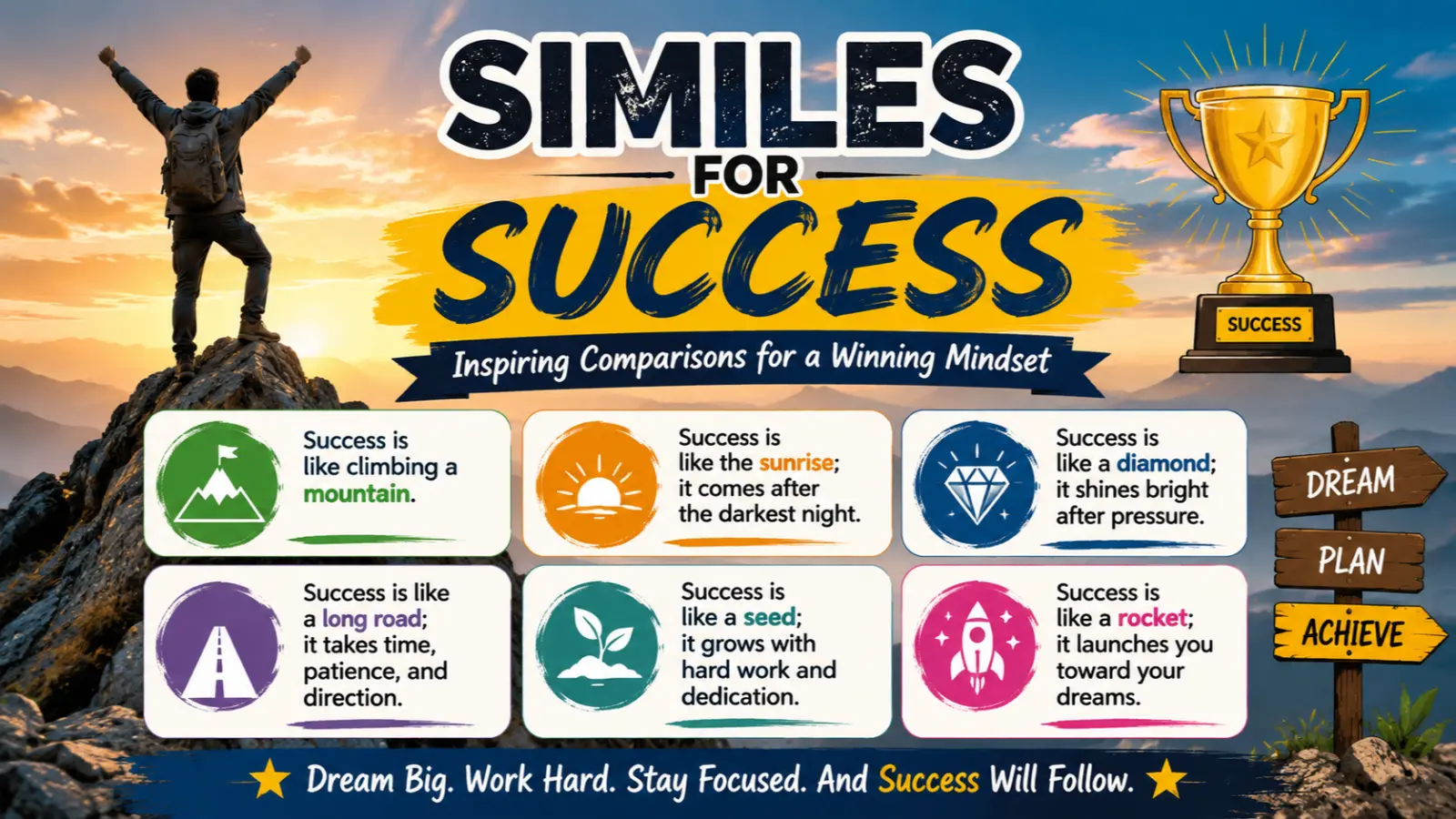
Similes for Success can be difficult to describe because it means something different to everyone. For one person, it is reaching a long-term goal. For another, it is finally overcoming fear, finishing a difficult project, or watching years of effort begin to pay off.
A good simile can make that feeling easier to see. By comparing success to something familiar, writers can turn an abstract idea into a vivid image. Similes for success can make essays more memorable, speeches more inspiring, stories more emotional, and everyday conversations more expressive.
A simile usually compares two different things using words such as like or as. Instead of simply saying, “She was successful,” you might write, “Her success unfolded like a locked door finally opening.”
The comparison gives the reader something concrete to imagine.
Below, you will find original examples, explanations of why they work, suggestions for different kinds of writing, and practical ways to create your own.
What Is a Simile for Success?
A simile for success compares achievement, progress, ambition, confidence, or victory to another image using like or as.
For example:
His success grew like a garden he had patiently watered every morning.
The garden represents gradual growth, while the watering represents consistent effort. The comparison suggests that success did not happen instantly; it developed through patience and care.
Similes about success can be useful in:
- Creative writing
- Essays
- Speeches
- Motivational writing
- Poems
- Personal narratives
- School assignments
- Social media captions
- Stories about achievement
- Conversations about goals
30 Original Similes for Success
1. Success rose like a sunrise after a long night
Meaning: Achievement finally appeared after a difficult period.
Why it works: A sunrise naturally suggests hope, renewal, and a new beginning.
Example:
After years of setbacks, her success rose like a sunrise after a long night.
Best context: Inspirational writing, personal stories, and speeches.
2. His success grew like a tree rooted in patient effort
Meaning: His achievements developed gradually from consistent work.
Why it works: Trees take time to grow, making the image useful for describing long-term achievement.
Example:
His career grew like a tree rooted in patient effort.
Writing tip: Use growth imagery when you want to emphasize the process rather than the final result.
3. Her confidence shone like a window catching the morning sun
Meaning: Success made her confidence visible and bright.
Example:
After completing the competition, her confidence shone like a window catching the morning sun.
Emotional effect: Warm, optimistic, and uplifting.
4. Their victory landed like the final piece of a puzzle
Meaning: The achievement completed something that had been carefully built over time.
Why it works: A puzzle suggests planning, patience, and many small efforts coming together.
Best context: Team achievements, projects, and stories.
5. His progress moved like a river carving patiently through stone
Meaning: His improvement was steady and powerful despite resistance.
Example:
His progress moved like a river carving patiently through stone.
Writing purpose: This is especially useful when describing someone who succeeds despite obstacles.
6. Success felt like finding a door in a wall you thought was solid
Meaning: Achievement created an unexpected opportunity.
Emotional effect: Surprise and relief.
Best context: Personal narratives and stories involving breakthroughs.
7. Her achievement sparkled like frost beneath the first morning light
Meaning: Her accomplishment felt beautiful, fresh, and rewarding.
Why it works: The image creates a quiet sense of beauty instead of using a predictable victory comparison.
8. His ambition burned like a lantern that refused to go dark
Meaning: He continued pursuing his goals despite difficulties.
Example:
Even after three failed attempts, his ambition burned like a lantern that refused to go dark.
Best context: Character descriptions and motivational writing.
9. Their success spread like ripples from a single stone
Meaning: One achievement created several additional benefits.
Example:
The team’s first successful project spread like ripples from a single stone, opening new opportunities for everyone.
Writing tip: This comparison works well when one success leads to another.
10. Her hard work stacked up like bricks in a bridge
Meaning: Every small effort contributed to a larger achievement.
Why it works: Bricks are ordinary individually but powerful when assembled together.
Best context: Essays about discipline, education, careers, and personal development.
11. His breakthrough arrived like fresh air through an open window
Meaning: Success brought relief after a difficult period.
Emotional effect: Freedom, relief, and renewal.
12. She climbed toward success like a hiker following a trail through fog
Meaning: She continued forward even without knowing exactly what would happen.
Why it works: The fog represents uncertainty, while the trail represents continued direction.
Best context: Stories about ambition and uncertain futures.
13. Their confidence stood like a lighthouse above rough water
Meaning: Their confidence remained strong during difficult circumstances.
Example:
During the crisis, her confidence stood like a lighthouse above rough water.
Writing purpose: Excellent for leadership and resilience.
14. His achievement felt like a key turning in a stubborn lock
Meaning: A difficult goal was finally unlocked.
Why it works: The reader can almost feel the resistance before the breakthrough.
Best context: Academic achievements, career milestones, and personal victories.
15. Her success unfolded like a map revealing roads she had never seen
Meaning: Achievement opened new possibilities.
Example:
Winning the scholarship unfolded like a map revealing roads she had never seen.
Emotional effect: Wonder and possibility.
16. Their teamwork fit together like gears in a well-built machine
Meaning: Each person contributed effectively to a shared goal.
Best context: Business writing, sports, school projects, and team stories.
Writing tip: Use mechanical imagery when you want to emphasize coordination and precision.
17. His determination was as steady as a clock that never stopped ticking
Meaning: He remained consistent and persistent.
Why it works: The clock represents regular, uninterrupted movement.
Best context: Character descriptions and motivational essays.
18. Success arrived like a quiet train after hours on an empty platform
Meaning: Achievement finally came after a long period of waiting.
Emotional effect: Patience, anticipation, and relief.
Best context: Reflective writing and personal stories.
19. Her ideas opened like flowers after a season of rain
Meaning: Creativity and confidence developed after a difficult period.
Example:
Once she stopped fearing mistakes, her ideas opened like flowers after a season of rain.
Writing purpose: Great for describing creative or academic growth.
20. His reputation grew like a path worn into the ground by many travelers
Meaning: His reputation developed through repeated actions over time.
Why it works: It suggests that credibility is earned rather than instantly created.
Best context: Professional writing and character development.
21. Their achievement rang like a bell across a silent valley
Meaning: Their success attracted attention and felt significant.
Emotional effect: Celebration and importance.
Best context: Speeches, stories, and dramatic moments.
22. Her persistence was like a small flame surviving a cold wind
Meaning: She kept going despite discouragement.
Example:
Her persistence was like a small flame surviving a cold wind.
Writing tip: Small images can communicate strength more effectively than exaggerated comparisons.
23. His success became like a bridge between who he was and who he wanted to become
Meaning: Achievement represented personal transformation.
Best context: Personal essays, biographies, and reflective writing.
24. The team’s confidence gathered like clouds before a summer storm
Meaning: Their confidence gradually became stronger and more powerful.
Emotional effect: Anticipation and energy.
Best context: Sports stories and competitive scenes.
25. Her first accomplishment was like a match lighting a row of candles
Meaning: One achievement inspired many more.
Example:
Passing the exam was like a match lighting a row of candles; suddenly, she believed other goals were possible too.
Writing purpose: Useful for describing momentum.
26. His career accelerated like a bicycle finally reaching a downhill road
Meaning: Progress became faster after overcoming resistance.
Why it works: The image gives the reader a physical sense of increasing momentum.
Best context: Career stories and business writing.
27. Their success felt as satisfying as hearing the final note of a song played perfectly
Meaning: The achievement provided a feeling of completion.
Emotional effect: Satisfaction, peace, and fulfillment.
Best context: Artistic writing and reflective essays.
28. Her goals stood before her like mountains waiting to be climbed
Meaning: Her ambitions were challenging but achievable through effort.
Writing tip: This is useful when emphasizing challenge rather than immediate success.
29. His small improvements collected like coins in a jar
Meaning: Many small gains eventually became something valuable.
Why it works: The comparison encourages readers to recognize the importance of incremental progress.
Best context: Educational writing, self-improvement, and motivational content.
30. Success settled over the room like sunlight after a storm
Meaning: Achievement brought warmth and relief after difficulty.
Example:
When the final results were announced, success settled over the room like sunlight after a storm.
Best context: Stories, speeches, and emotional endings.
How to Choose the Right Simile for Success
Not every comparison communicates the same kind of success. The strongest simile depends on what you want the reader to feel.
If success came after hard work, use an image involving growth, construction, climbing, or endurance.
If success brought relief, consider images involving sunlight, fresh air, open doors, or the end of a difficult journey.
A success created new opportunities, maps, roads, bridges, and windows can work well.
If success involved teamwork, gears, musical notes, or connected structures can communicate cooperation.
If success was unexpected, an opening door, a sudden sunrise, or an unexpected path may create the right feeling.
The key is to match the comparison to the story behind the achievement.
Why Similes Make Success More Vivid
“Success” is an abstract idea. Readers cannot physically touch success or watch it grow.
A simile gives that abstract idea a physical shape.
Compare:
She finally succeeded.
with:
Her success rose like a sunrise after a long night.
The first sentence gives information. The second creates an image and an emotional atmosphere.
That difference matters in creative writing. Strong description does not simply tell readers what happened; it gives them a way to experience the moment.
How to Avoid Cliché Success Similes
Some comparisons are so common that they can lose their impact. Expressions involving mountains, stars, rockets, or shining lights can work, but they may feel predictable if used without a fresh detail.
Instead of writing:
His success was like reaching the top of a mountain.
Try making the image more specific:
His success felt like reaching a ridge just as the fog finally began to lift.
The second version gives the reader more information. There is a mountain-like challenge, but there is also uncertainty, timing, and relief.
A simple rule
Do not only ask, “What is success like?” Ask, “What kind of success is this?”
Was it:
- Slow?
- Unexpected?
- Hard-earned?
- Quiet?
- Public?
- Emotional?
- Collaborative?
- Life-changing?
Your answer will lead you toward a more original comparison.
Simile vs. Metaphor for Success
A simile makes a comparison using words such as like or as.
Her success grew like a tree.
A metaphor makes the comparison directly.
Her success was a tree with deep roots.
Both can create strong imagery, but they produce slightly different effects.
Similes often make comparisons easier to recognize because the connection is stated openly. Metaphors can feel more direct and symbolic.
For writers, the choice depends on the tone and rhythm of the passage.
How to Create Your Own Similes for Success
Creating an original simile becomes easier when you stop searching for a synonym for “success” and instead think about its experience.
Step 1: Identify the kind of success
Ask yourself what happened.
Did someone win, improve, graduate, recover from failure, earn recognition, or reach a personal goal?
Step 2: Identify the emotion
Was the moment:
- Joyful?
- Peaceful?
- Surprising?
- Powerful?
- Relieving?
- Humbling?
- Exciting?
Step 3: Choose a concrete image
Look for something readers can see, hear, touch, or experience.
Consider:
- A garden
- A bridge
- A lighthouse
- A window
- A trail
- A river
- A clock
- A key
- A song
- A road
Step 4: Find the shared quality
Your two subjects need something meaningful in common.
For example:
Success + river
Both can involve steady movement and overcoming resistance.
That can produce:
His progress moved like a river carving patiently through stone.
Step 5: Add a specific detail
Specificity makes a familiar comparison feel more personal.
Instead of:
Her success was like sunlight.
Try:
Her success settled over the room like sunlight after a storm.
The added context gives the image a reason to exist.
A Quick Exercise for Writers
Choose one of these situations:
A student passes an important exam.
Start with:
Her success was like…
Now choose three different images:
- A key
- A sunrise
- A bridge
You might create:
Her success was like a key turning in a stubborn lock.
Her success was like sunrise entering a room that had been dark for months.
Her success was like a bridge carrying her from uncertainty toward possibility.
Notice how each version changes the emotional meaning.
The first emphasizes breakthrough.
The second emphasizes hope.
The third emphasizes transition.
That is the real power of similes: one event can be described from several emotional angles.
Common Mistakes When Writing Success Similes
Using an image that has nothing to do with the meaning
A comparison should clarify the idea, not confuse the reader.
Mixing unrelated images
Avoid jumping from a river to a machine to a garden in the same sentence unless there is a clear reason.
Consistent imagery creates stronger prose.
Making every success sound enormous
Not every achievement needs to be described as explosive, gigantic, or world-changing. Quiet success can be more emotionally powerful.
Explaining the simile too much
Once the comparison is clear, trust the reader.
For example:
Her success rose like a sunrise after a long night, meaning that she finally succeeded after experiencing difficulties and therefore felt hopeful.
The explanation weakens the image. A cleaner version is:
After years of setbacks, her success rose like a sunrise after a long night.
Using a simile simply because you can
A sentence does not automatically improve because it contains figurative language.
If “He succeeded after years of practice” is stronger and clearer than a forced comparison, keep the straightforward sentence.
Using Success Similes in Different Types of Writing
In Essays
Use similes selectively to make abstract arguments easier to understand.
Building confidence is like strengthening a muscle: repeated effort gradually makes it easier to use.
In Stories
Use comparisons to reveal a character’s emotional state.
The certificate in her hands felt like a key to a room she had spent years trying to enter.
In Poetry
Similes can create compressed emotional images.
Hope returned
like sunlight
through a cracked curtain.
In Speeches
Choose clear, memorable comparisons.
Every small effort is like another brick in the road toward your goal.
In Conversation
Keep the comparison natural and easy to understand.
Getting that promotion felt like finally seeing the payoff from all those late nights.
Other Literary Devices That Work With Similes
Similes become even more effective when writers understand related devices.
Imagery creates sensory details that help readers picture an idea.
Metaphor compares two things directly without using like or as.
Personification gives human qualities to nonhuman things.
Hyperbole uses deliberate exaggeration for emphasis.
Symbolism allows an object, action, or image to represent a larger idea.
For example, a bridge can function as both imagery and symbolism. In a success story, it might represent the transition from one stage of life to another.
FAQ About Similes for Success
What is a good simile for success?
A strong simile for success connects achievement with a concrete image. For example, “Her success rose like a sunrise after a long night” suggests hope and achievement after hardship.
What is a simile for achieving a goal?
You could write, “Reaching his goal felt like turning a key in a stubborn lock.” This emphasizes persistence followed by a breakthrough.
What are some positive similes for success?
Positive comparisons can use images such as sunrise, open windows, growing trees, bridges, paths, candles, and flowing rivers. Choose the image according to the emotion you want to create.
How do you describe success creatively?
Focus on what the success felt like rather than simply calling it “great.” Think about whether it brought relief, confidence, freedom, pride, surprise, or new opportunities, then compare that feeling with a concrete image.
Can similes be used in motivational writing?
Yes. Similes can make motivational ideas easier to remember by turning abstract concepts such as persistence, ambition, and progress into vivid images.
What is the difference between a success simile and a success metaphor?
A simile explicitly compares two things using like or as. A metaphor makes the comparison directly. “Success grew like a tree” is a simile, while “Success was a tree” is a metaphor.
How can I make a success simile more original?
Start with the specific experience instead of a generic idea of success. Consider what the person overcame, what changed afterward, and what emotion dominated the moment.
Should every sentence contain a simile?
No. Too many comparisons can make writing feel crowded or artificial. Use similes where they add clarity, emotion, rhythm, or a memorable image.
Conclusion
The best similes for success do more than decorate a sentence. They help readers understand what achievement actually feels like. Success can be a sunrise after hardship, a key finally turning, a bridge toward a new life, or a small flame that survives discouragement. The right image depends on the story you are telling. When creating your own similes, begin with the emotion and experience behind the achievement. Then find a concrete image that shares that quality. Make the comparison specific, natural, and useful. Most importantly, do not be afraid of quiet comparisons. A small, precise image can stay with a reader much longer than a dramatic but familiar phrase. The next time you write about achievement, pause before saying someone was simply “successful.” Ask yourself what that success looked, sounded, or felt like—and let the answer become your simile.

I am Helena Frost, a writer captivated by the beauty of language and the art of comparison. Through my words, I explore the world by turning ordinary moments into vivid similes and reflections. I enjoy crafting phrases that spark imagination, evoke emotion, and linger in the mind. My writing celebrates the subtle connections between people, nature, and the stories we live. For me, every sentence is an opportunity to reveal the extraordinary in the everyday.