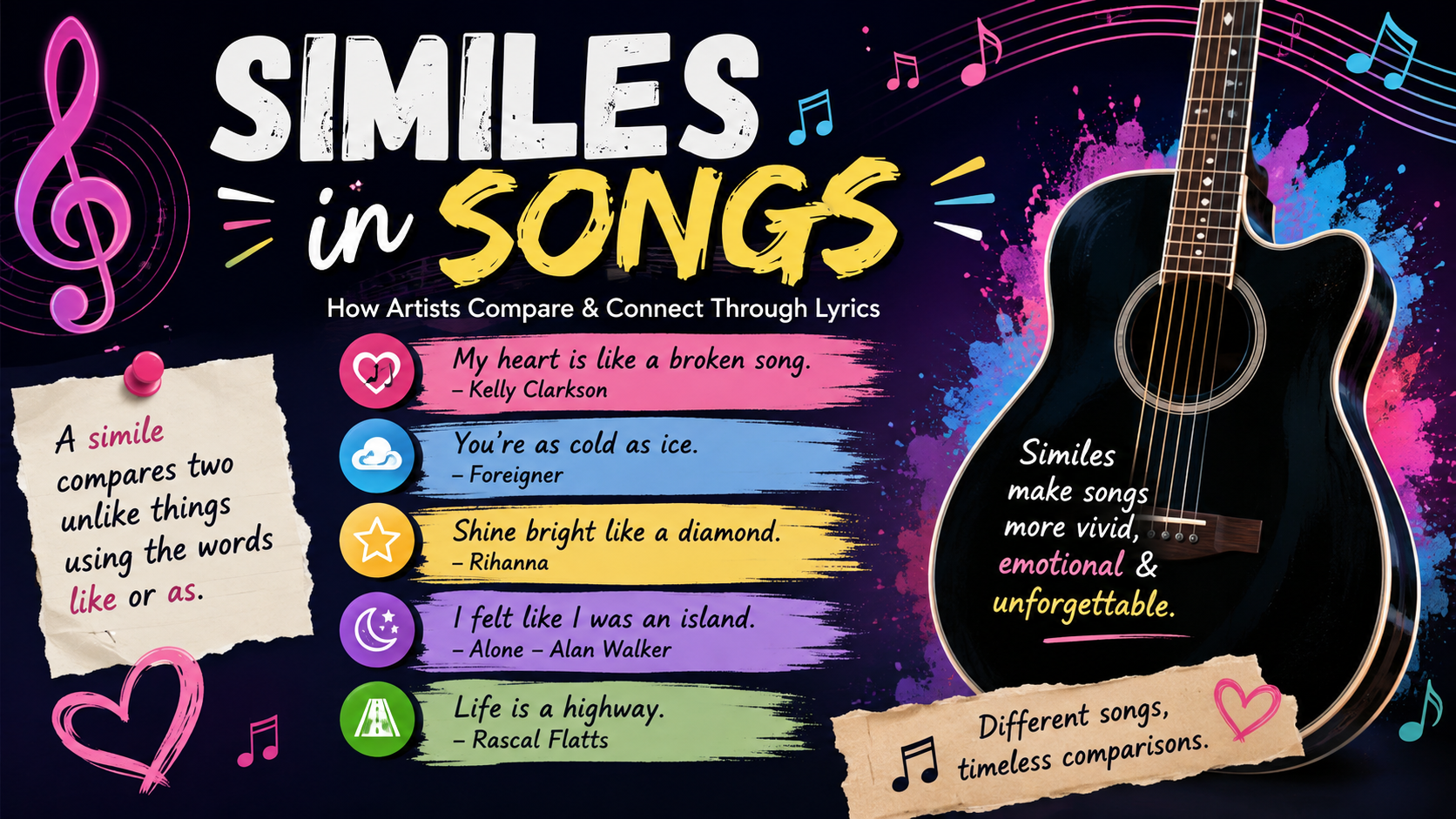
Similes Song have a special way of turning ordinary feelings into images we can see, hear, and remember. A songwriter may describe love, heartbreak, freedom, fear, or happiness through a simple comparison that suddenly makes the emotion feel real.
That is where similes in songs become powerful. A Similes Song compares two different things using words such as “like” or “as.” Instead of simply saying, “I miss you,” a songwriter might compare missing someone to an empty room, a fading photograph, or a song that keeps playing after everyone has left.
Similes Song are common in songwriting because lyrics need to communicate a lot in very few words. A Similes Song strong comparison can create an image, establish a mood, reveal personality, and make a line easier to remember.
This guide explains how song similes work and provides original examples you can adapt for lyrics, poems, stories, captions, or creative writing.
What Is a Simile in a Song?
A Similes Song is a comparison between two unlike things, usually using like or as, to make an emotion, person, object, or experience more vivid.
For example:
“Your voice was like rain on a room full of dust.”
The voice is not literally rain. The Similes Song comparison suggests that hearing the voice brought relief, freshness, or renewal.
A song simile can describe almost anything:
- Love
- Heartbreak
- Happiness
- Anger
- Friendship
- Loneliness
- Music
- Nature
- Memories
- Time
- Dreams
- Relationships
The Similes Song best comparisons do more than sound poetic. They give the listener something concrete to imagine.
Why Do Songwriters Use Similes?
Lyrics often have limited space. A songwriter cannot explain every emotion in a paragraph, so imagery does some of the work.
Compare these two lines:
Plain:
“I felt nervous when you walked toward me.”
With a simile:
“My heartbeat shook like loose coins in a jar.”
The second version gives the listener a physical image. We can almost hear the coins rattling.
A good song simile can:
- Make abstract emotions easier to understand
- Create memorable images
- Add emotional intensity
- Establish atmosphere
- Help listeners connect personal experiences with the lyrics
- Give a song its own visual identity
30 Original Similes for Songs
The following examples are original comparisons designed to inspire songwriting. They are not quotations from existing songs.
1. “Your smile was like sunrise through a dusty window.”
Meaning: The person’s smile brings warmth and hope after a difficult period.
Example:
“Your smile was like sunrise through a dusty window,
slowly teaching my dark room how to glow.”
Emotional effect: Warm, hopeful, intimate.
Best context: Love songs, healing songs, romantic poetry.
Writing tip: Notice how “dusty window” adds history. The comparison suggests the speaker has been in darkness for a while.
2. “My heart beat like a drum with nowhere to march.”
This simile describes excitement mixed with uncertainty.
Example:
“My heart beat like a drum with nowhere to march
when you called my name across the crowded park.”
It works especially well for nervous romance because the drum suggests energy while “nowhere to march” introduces confusion.
3. “Your goodbye fell like snow on warm pavement.”
Here, goodbye is compared with snow that disappears quickly.
Meaning: The farewell feels beautiful but temporary.
Example:
“Your goodbye fell like snow on warm pavement,
beautiful for a moment, then gone.”
Best context: Breakup songs and reflective lyrics.
The contrast between cold snow and warm pavement creates emotional tension.
4. “Our memories flickered like lights on an empty stage.”
This comparison makes memories feel fragile and distant.
It could fit a song about looking back on a relationship that has ended.
Writing lesson: An empty stage gives the listener a visual setting rather than simply saying “I remember the past.”
5. “Your laughter was like silver bells in summer.”
This creates a bright, cheerful image.
Best context: Romantic or nostalgic songs.
The comparison works because both laughter and bells can feel light, clear, and musical.
6. “Loneliness sat beside me like an old coat.”
This simile personifies loneliness through something familiar.
It suggests loneliness is uncomfortable but also strangely familiar.
Example:
“Loneliness sat beside me like an old coat,
worn at the edges but still keeping me close.”
7. “Her words were as sharp as winter glass.”
The comparison suggests speech that hurts.
Best context: Arguments, betrayal, or emotional songs.
Instead of simply calling someone’s words “hurtful,” the image gives the listener a physical sensation.
8. “The city moved like a river of headlights.”
This works beautifully for urban songs.
The moving headlights become a flowing river, giving the scene motion and scale.
Example:
“Midnight found us walking downtown
while the city moved like a river of headlights.”
9. “My dreams rose like birds from a broken cage.”
This simile represents freedom after hardship.
Emotional effect: Hopeful and triumphant.
Best context: Inspirational songs, personal-growth lyrics, and songs about overcoming obstacles.
10. “Your silence was like an unplugged radio.”
This comparison suggests the speaker expects communication but receives nothing.
It can work especially well in relationship songs because a radio normally carries voices and music.
11. “Hope burned like a candle under the door.”
The image suggests that hope is small but still visible.
Best context: Songs about difficult times, recovery, or persistence.
A useful songwriting principle appears here: small images can carry large emotions.
12. “We danced like sparks around a campfire.”
This creates movement, warmth, and excitement.
It fits an energetic romantic song or a memory of carefree youth.
13. “His anger rose like thunder behind the hills.”
The comparison gives anger a sense of approaching danger.
Rather than saying someone became angry, the lyric makes the emotion feel like weather moving closer.
14. “Time slipped like sand through open fingers.”
This familiar type of comparison communicates how quickly time can disappear.
To make a familiar idea fresher, add a specific situation:
“Our summer slipped like sand through open fingers.”
The added detail gives the image a particular emotional setting.
15. “Your name stayed like ink beneath my skin.”
This suggests a memory that remains difficult to erase.
Best context: Deep love, heartbreak, memory, or regret.
The image also works because ink has a strong connection with permanence.
16. “The moon hung like a question above us.”
This turns a familiar object into an emotional symbol.
The moon becomes associated with uncertainty rather than simply beauty.
Example:
“The moon hung like a question above us
while neither of us knew what came next.”
17. “Her kindness spread like warmth through cold hands.”
This comparison focuses on the physical sensation of warmth.
It is useful when writing about friendship, compassion, or emotional support.
18. “My thoughts raced like trains after midnight.”
The image suggests restless, continuous thinking.
Best context: Anxiety, insomnia, uncertainty, or late-night reflection.
The specific setting makes the comparison more memorable than simply saying, “I couldn’t stop thinking.”
19. “Our friendship grew like vines around an old wall.”
This suggests a relationship that becomes stronger over time.
It can work particularly well in songs about childhood friendship or lifelong connection.
20. “Your absence echoed like footsteps in an empty hall.”
This simile makes absence feel audible.
That is an important songwriting technique: give an invisible emotion a physical or sensory form.
21. “The crowd roared like waves against the shore.”
This is useful for concert, sports, celebration, and victory songs.
The comparison communicates both volume and repeated movement.
22. “My courage was as small as a match in the rain.”
This creates a vulnerable image.
The speaker has courage, but it is fragile and threatened by circumstances.
23. “We were like two songs playing in different rooms.”
This comparison suggests emotional connection mixed with separation.
It could describe two people who care about each other but cannot seem to meet at the same emotional moment.
24. “Her tears fell like beads from a broken necklace.”
The comparison creates a delicate but sorrowful visual.
It can fit a quiet heartbreak song better than an aggressive breakup lyric.
25. “The morning arrived like a letter I was afraid to open.”
This gives the new day an emotional purpose.
Instead of automatically treating morning as hopeful, the comparison allows uncertainty and fear.
That makes the lyric more complex.
26. “His voice was like gravel beneath velvet.”
This is an unusual sensory contrast.
The gravel suggests roughness while velvet suggests softness.
Best context: Character-driven lyrics where you want to describe a distinctive voice.
27. “Our secrets curled like smoke beneath the ceiling.”
This simile suggests secrets that remain present even when nobody talks about them.
It creates a mysterious atmosphere.
28. “Happiness arrived like a stray dog choosing my doorstep.”
This unexpected comparison makes happiness feel accidental and surprising.
It can suit a playful or unconventional song.
29. “The old photograph faded like a memory in sunlight.”
The comparison connects a physical object with emotional loss.
It is especially useful for nostalgic lyrics.
30. “Freedom felt like running barefoot after years indoors.”
This gives freedom a physical sensation.
The reader can imagine movement, space, vulnerability, and relief all at once.
Best context: Songs about change, independence, recovery, or new beginnings.
How to Make Similes in Songs More Vivid
A weak simile usually chooses the first comparison that comes to mind.
A stronger songwriter asks:
What does this emotion actually feel, sound, look, or move like?
Suppose you want to write about sadness.
A basic line might be:
“I was as sad as a rainy day.”
It communicates the emotion, but the image is familiar.
Try moving closer to the character:
“Sadness followed me like wet shoes across a clean floor.”
Now the feeling has behavior. It follows the speaker and creates an uncomfortable trail.
Use Specific Details
Specific nouns often make comparisons stronger.
Instead of:
“Her voice was like music.”
Try:
“Her voice was like a vinyl record humming in the next room.”
The second version creates a particular atmosphere.
Give the Comparison a Reason
Ask what the two things actually share.
A good comparison might connect through:
- Sound
- Movement
- Shape
- Color
- Texture
- Temperature
- Behavior
- Emotional association
The comparison becomes stronger when the connection is clear.
How to Avoid Cliché Similes in Lyrics
Some comparisons are so familiar that they no longer create a strong image.
Examples include:
- Busy as a bee
- Cold as ice
- Strong as an ox
- Brave as a lion
- Sweet as honey
These are not grammatically wrong. They are simply predictable.
If the familiar comparison fits your character or song, you can still use it. But when you want a lyric to feel distinctive, look for an image from the song’s specific world.
For example, instead of:
“My love is as strong as a mountain.”
Try connecting strength to something personal:
“My love stood like the porch light through three winters.”
Now the comparison carries a story.
Simile vs. Metaphor in Song Lyrics
Both similes and metaphors create comparisons, but they do it differently.
A simile usually uses “like” or “as”:
“Your voice is like rain.”
A metaphor makes a direct comparison:
“Your voice is rain.”
The simile creates a little distance between the two ideas. The metaphor merges them.
Songwriters can use both devices in the same piece.
For example:
“Your silence was a locked door,
and my questions rattled like keys.”
The metaphor establishes the central image, while the simile expands it.
Simile and Imagery: Why the Combination Works
A simile becomes much stronger when it activates the senses.
Consider:
“The room was quiet like a library.”
This gives us a general idea.
Now consider:
“The room was quiet like a library after midnight,
with only the old clock clearing its throat.”
The scene has sound, time, and atmosphere.
When writing lyrics, don’t only ask, “What can I compare this to?”
Ask:
“What would my listener see if this line became a movie?”
That question can lead to much stronger imagery.
How to Create Your Own Song Similes
You do not need to wait for inspiration. Try this five-step process.
1. Choose the emotion
Start with one emotional target:
love → loneliness → excitement → regret → freedom
2. Make a sensory list
For loneliness, you might write:
- Empty chair
- Cold coffee
- Unanswered phone
- Hallway
- Rain on glass
- Unmade bed
3. Choose an unexpected object
Pick something that shares an emotional quality with the feeling.
For example:
Loneliness + unanswered phone
4. Connect them with “like” or “as”
“Loneliness waited like a phone that never rang.”
5. Test the line aloud
Song lyrics are meant to be heard.
Say the comparison out loud. If it feels awkward, too long, or difficult to sing, simplify it.
A Quick Exercise for Songwriters
Choose one emotion and create three comparisons.
For example, choose hope.
Nature:
“Hope rose like sunlight through storm clouds.”
Object:
“Hope was like a match I kept dry in my pocket.”
Sound:
“Hope sounded like one clear note after the noise.”
Now choose your favorite and build two more lines around it.
This exercise teaches an important songwriting skill: one emotion can produce many different images.
Common Mistakes When Using Similes in Songs
Using a comparison just because it contains “like”
Not every comparison improves a lyric.
Before keeping a simile, ask:
Does this make the emotion clearer or more memorable?
If the answer is no, remove it.
Mixing unrelated images
Avoid jumping from one image system to another without purpose.
For example:
“My heart was a ship, burning like a telephone, flying through the desert.”
The reader has too many competing pictures.
Choose one dominant image and develop it.
Explaining the simile too much
If the image is strong, let it breathe.
Instead of:
“Your absence was like an empty chair, which means I felt lonely because you weren’t there.”
The explanation destroys the lyric’s subtlety.
Trust the image.
Making every line poetic
Songs also need plain language.
A powerful lyric may move between simple statements and vivid imagery:
“I waited by the door.
Your silence fell like snow.”
The ordinary first sentence makes the image in the second line stand out.
Choosing rhyme over meaning
A rhyme should support the image, not force it.
If you have to distort a comparison simply to make it rhyme, rewrite the line.
How Professional Songwriters Can Strengthen a Simile
A useful revision technique is to remove the first comparison you write.
Write the obvious version first. Then ask:
What would be more specific to this character?
For example:
“Her love was like sunshine.”
Ask what kind of sunshine.
Maybe it is:
- Winter sunshine
- Morning sunshine
- Light through blinds
- Sunlight on a dashboard
- The last light before evening
Now the line can become:
“Her love was like winter sunlight on the kitchen floor.”
That feels more personal because the image contains a place and season.
Similes for Different Types of Songs
Romantic Songs
Use comparisons involving warmth, distance, touch, memory, light, and movement.
“Your hand found mine like a compass finding north.”
Breakup Songs
Images of fading, empty spaces, unfinished objects, and silence can work well.
“Your goodbye lingered like perfume in a room I couldn’t leave.”
Happy Songs
Try energetic images involving movement, color, sound, and light.
“We laughed like fireworks had filled the afternoon.”
Sad Songs
Quiet objects can be more effective than dramatic ones.
“Your photograph waited like an unopened letter.”
Inspirational Songs
Use images involving movement, growth, weather, doors, roads, or light.
“Courage grew like grass through the cracks in the pavement.”
Frequently Asked Questions
What is a simile in a song?
A simile in a song is a comparison between two different things, usually using “like” or “as.” Songwriters use similes to make emotions, people, places, and experiences easier to visualize.
Why are similes useful in songwriting?
Similes make lyrics more vivid and memorable. They can turn an abstract feeling such as love, loneliness, or fear into a concrete image listeners can picture.
What is an example of a simile in a song?
An original example is: “Your voice was like rain on a room full of dust.” The comparison suggests that the person’s voice brings relief, freshness, or emotional renewal.
Are similes and metaphors the same?
No. Both are forms of comparison, but a simile generally uses words such as “like” or “as,” while a metaphor makes a direct comparison.
How can I write better similes for lyrics?
Start with the emotion you want to communicate, list sensory details associated with it, choose a specific object or experience, and create a comparison based on a genuine connection between the two.
Should song similes rhyme?
No. A simile does not need to rhyme. In songwriting, natural wording and emotional meaning should usually come before forced rhyme.
Can I use similes in poetry as well as songs?
Absolutely. Similes work in poetry, fiction, speeches, creative nonfiction, captions, and everyday conversation. The main difference is how the comparison supports the purpose and rhythm of the writing.
Conclusion
The best similes in songs do not exist simply to make lyrics sound poetic. They help listeners experience an emotion through an image. When you write a simile, move beyond the easiest comparison. Look for something specific: an object from the character’s room, a sound from the street, a memory from childhood, a change in weather, or a tiny physical detail that carries emotional weight. A strong comparison can make a listener pause because the feeling suddenly becomes visible. So start with one emotion, find an unexpected image, connect the two honestly, and read the line aloud. Your next memorable lyric may begin with nothing more complicated than the word “like.”

I am Helena Frost, a writer captivated by the beauty of language and the art of comparison. Through my words, I explore the world by turning ordinary moments into vivid similes and reflections. I enjoy crafting phrases that spark imagination, evoke emotion, and linger in the mind. My writing celebrates the subtle connections between people, nature, and the stories we live. For me, every sentence is an opportunity to reveal the extraordinary in the everyday.