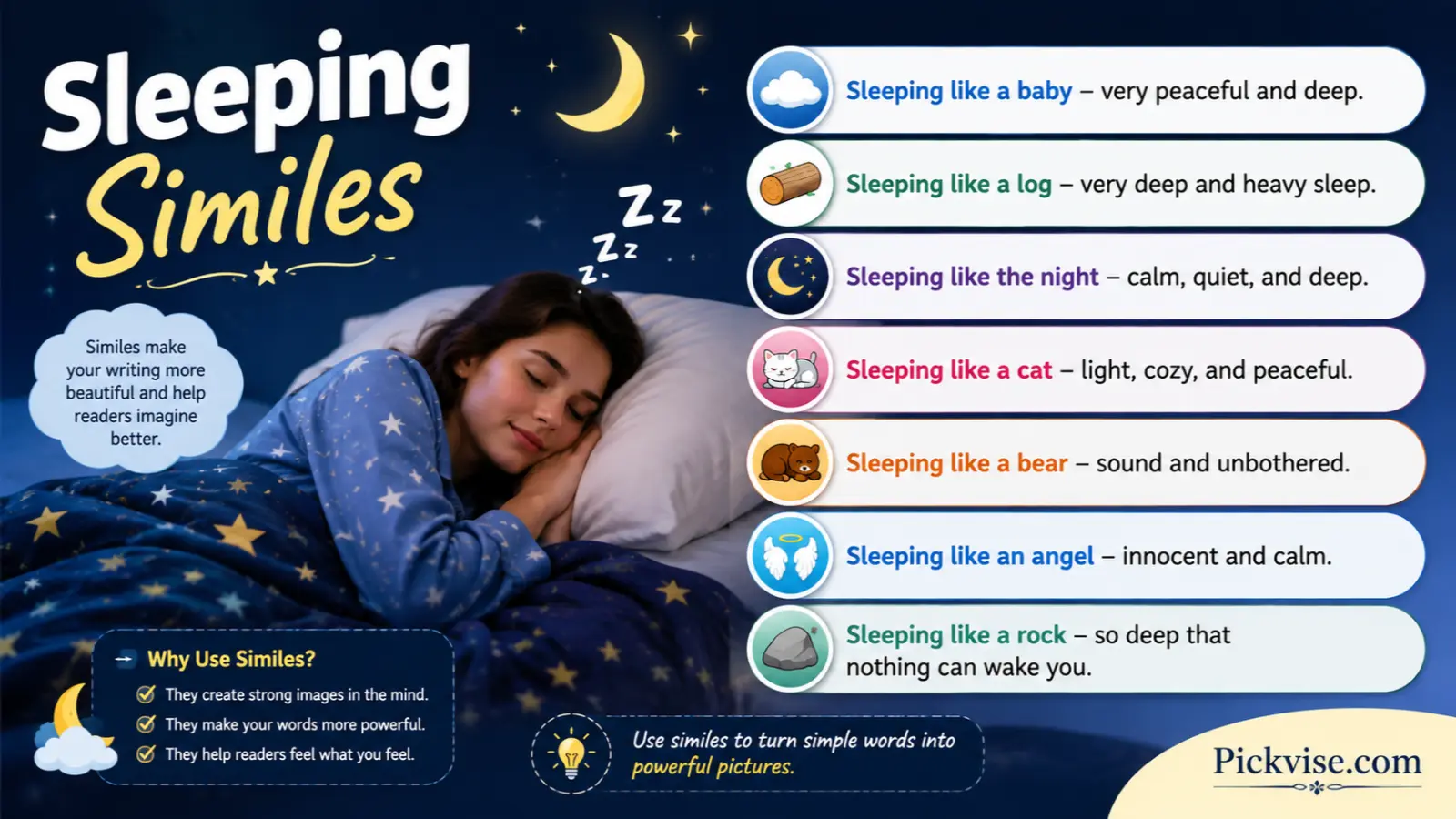
A Sleeping Similes compares two different things using words such as “like” or “as.” Sleeping similes use these comparisons to describe rest, drowsiness, dreams, nighttime stillness, or the feeling of slowly drifting away.
Instead of simply writing, “She was asleep,” a writer can create a stronger image: “She slept like a lantern whose flame had finally gone quiet.”
That comparison gives the reader something to picture.
You can use sleeping similes in short stories, novels, poems, school assignments, captions, bedtime writing, and creative descriptions. The best ones do more than say someone is asleep—they suggest how the sleep feels.
This collection of sleeping similes gives you original ideas while showing how to adapt comparisons to different moods, from peaceful rest to restless nights.
Quick Answer: What Are Some Good Sleeping Similes?
Some original sleeping similes include:
- He slept like a boat floating on a moonlit lake.
- She rested as quietly as snow settling on a windowsill.
- The baby slept like a tiny bird tucked beneath a warm wing.
- His breathing was as steady as a clock in an empty room.
- I drifted into sleep like a leaf carried gently downstream.
- She was as still as a painting after midnight.
- The child slept like a candle protected from the wind.
- He sank into sleep as softly as dusk settles over a field.
These comparisons work because they connect sleep with familiar images of stillness, warmth, softness, darkness, or peaceful movement.
30 Original Sleeping Similes for Creative Writing
1. He slept like a boat floating on a moonlit lake.
Meaning: He was completely relaxed and undisturbed.
Example sentences:
- After the long journey, he slept like a boat floating on a moonlit lake.
- The cabin was silent while he rested like a boat drifting across calm water.
Writing purpose: This is useful when you want peaceful sleep to feel spacious and serene.
Writing tip: Water imagery works especially well for calm scenes because it naturally suggests gentle movement.
2. She rested as quietly as snow settling on a windowsill.
This simile creates a delicate, almost weightless image. It fits peaceful nighttime scenes, winter stories, and reflective poetry.
Example:
“She rested as quietly as snow settling on a windowsill.”
The comparison emphasizes silence rather than simply saying that she was asleep.
3. The baby slept like a tiny bird beneath a warm wing.
The image suggests safety, comfort, and protection.
Best context: Use it in family scenes, children’s stories, or warm emotional passages.
Writing tip: When writing about sleep, choose a comparison that reveals the character’s emotional environment, not just their physical condition.
4. His breathing was as steady as a clock in an empty room.
This simile focuses on rhythm.
The quiet ticking of a clock gives the reader a sense of regular breathing and deep rest. It can also create a slightly mysterious atmosphere in a nighttime scene.
5. I drifted into sleep like a leaf carried gently downstream.
Here, sleep becomes a journey rather than a state.
Emotional effect: Relaxed and dreamy.
Best context: First-person storytelling, reflective writing, and poetry.
The verb “drifted” strengthens the comparison because both a sleeping person and a leaf can move without deliberate effort.
6. She was as still as a painting after midnight.
This comparison emphasizes complete stillness.
It can work especially well when a room is dark and quiet.
Example:
“She was as still as a painting after midnight, her breathing barely disturbing the silence.”
7. The child slept like a candle protected from the wind.
The candle suggests warmth and vulnerability, while protection suggests security.
Best context: Stories involving a parent, guardian, or safe home.
This is a good example of a simile that communicates more than one idea at once.
8. He sank into sleep as softly as dusk settles over a field.
This comparison makes falling asleep feel gradual.
Writing purpose: Use it when you want to describe the transition between wakefulness and sleep rather than deep sleep itself.
9. Her dreams moved like clouds across a summer sky.
This simile focuses on dreams rather than the sleeping body.
The comparison suggests that dreams are constantly changing, appearing and disappearing without warning.
10. He slept as peacefully as a garden before sunrise.
A garden before sunrise can feel quiet, cool, and untouched.
Best context: Peaceful descriptions and nature-inspired poetry.
11. The exhausted traveler slept like a stone beneath a quiet tree.
This comparison suggests deep, heavy sleep after physical exhaustion.
Example:
“After walking all day, the traveler slept like a stone beneath a quiet tree.”
Use it when the character has reached a point of complete physical tiredness.
12. Her eyelids grew as heavy as curtains at the end of a long show.
This is useful for describing sleepiness before sleep.
It does not describe someone already sleeping; instead, it captures the moment when the body begins giving in to fatigue.
13. He nodded off like a train disappearing into a distant tunnel.
This gives falling asleep a sense of gradual disappearance.
Best context: Creative prose where you want an unusual comparison rather than a traditional sleep image.
14. The room was as quiet as a library beneath the stars.
This simile describes the environment surrounding sleep.
Sometimes the strongest sleeping description focuses on the room instead of the sleeper.
15. She curled up like a kitten beside the warm blanket.
The comparison creates an image of comfort and smallness.
Best context: Cozy fiction, children’s writing, and informal descriptions.
16. His thoughts scattered like birds before he finally slept.
This simile is especially useful for describing someone struggling to fall asleep.
The birds represent thoughts that refuse to stay still.
Writing insight: A good simile can show an invisible experience. Thoughts cannot literally be seen, but the comparison gives them movement.
17. Sleep covered him like a soft evening fog.
This makes sleep seem gradual and enveloping.
It works well when a character slowly loses awareness of the world around them.
18. She slept as deeply as roots buried beneath winter soil.
This comparison suggests deep, hidden, undisturbed sleep.
Best context: Literary prose, winter scenes, and reflective writing.
19. His dreams flashed like lanterns along a dark road.
Unlike peaceful dream imagery, this simile gives dreams movement and brightness.
Use it when dreams are vivid, fragmented, or constantly changing.
20. The old house slept like a giant resting beneath the moon.
Here, the house is being compared to a sleeping creature.
This combines simile with personification and can make a setting feel alive.
Example:
“At midnight, the old house slept like a giant resting beneath the moon.”
21. She fell asleep as easily as a feather lands on water.
The comparison suggests effortless, gentle movement.
Best context: Peaceful bedtime scenes.
22. He was as still as a closed book on a midnight desk.
This simile combines silence, stillness, and nighttime imagery.
It can be particularly effective in descriptions of study rooms, libraries, or quiet homes.
23. The baby breathed like a tiny bellows working beneath a blanket.
This gives the reader a physical sense of rhythmic breathing.
Because the image is mechanical rather than sentimental, it can add personality to a child’s scene.
24. She drifted through dreams like a traveler crossing an unknown country.
This makes dreaming feel adventurous and mysterious.
Best context: Fantasy, imaginative fiction, and poetry.
25. His tired mind folded like a letter finally placed inside an envelope.
This unusual comparison describes the mind gradually shutting away the day’s thoughts.
It is useful when writing about mental exhaustion rather than physical sleep alone.
26. They slept like two travelers resting beside a quiet road.
This creates a feeling of temporary peace after a long journey.
Best context: Adventure stories, travel writing, and narrative scenes.
27. The night wrapped around her like a dark velvet curtain.
This focuses on the atmosphere surrounding sleep.
The velvet image adds softness while the curtain suggests the world becoming hidden.
28. His breathing rose and fell like waves on a distant shore.
The rhythmic movement of waves makes this a natural comparison for steady breathing.
Writing tip: Comparisons based on rhythm are especially effective when describing breathing, footsteps, rain, or repeated sounds.
29. She slept like a secret kept safely inside the night.
This is more poetic than literal.
It suggests quietness, privacy, and mystery.
Best context: Poetry, reflective prose, and atmospheric storytelling.
30. Sleep arrived as gently as morning light through thin curtains.
This simile describes sleep as something that arrives gradually rather than suddenly.
It is especially useful for peaceful endings to scenes.
How to Make Sleeping Similes More Vivid
A weak simile often uses a comparison simply because it sounds pretty. A stronger simile has a specific job.
Compare:
“He slept like a baby.”
with:
“He slept like a boat floating beyond the reach of the tide.”
The second comparison gives the reader a particular quality: distance, calmness, and freedom from disturbance.
When creating your own sleeping similes, ask what you actually want the reader to feel.
Do you want the sleep to seem:
- Peaceful?
- Deep?
- Restless?
- Safe?
- Lonely?
- Dreamy?
- Mysterious?
- Exhausted?
- Vulnerable?
Once you know the emotion, choose an image that naturally carries that feeling.
Sleeping Similes for Different Moods
Peaceful Sleep
For peaceful scenes, use images associated with stillness and gentle movement.
- “She slept like a boat in sheltered water.”
- “He rested as quietly as moonlight on an empty road.”
- “Sleep settled over him like a soft blanket of mist.”
Deep Sleep
Deep sleep benefits from heavier or more rooted imagery.
- “He slept like roots beneath the earth.”
- “She was as still as a stone beneath deep water.”
- “Sleep held him like a quiet cave holds darkness.”
Restless Sleep
Restless sleep needs movement, interruption, or unstable imagery.
- “His dreams jumped like sparks from a dying fire.”
- “She tossed like a small boat caught between restless waves.”
- “His thoughts raced like footsteps in an empty hallway.”
Dreamy Sleep
For dreams, choose images that feel fluid or surreal.
- “Her dreams floated like paper lanterns across a dark sky.”
- “He wandered through sleep like a traveler without a map.”
- “The night opened around her like a door into another world.”
Why These Similes Work
The strongest comparisons share a meaningful quality with the subject.
A sleeping person and a calm lake are not physically alike. But both can suggest stillness.
A dream and a cloud are not the same thing. Yet both can suggest movement, change, and uncertainty.
That shared quality is the heart of a good simile.
A useful formula is:
Subject + like/as + image + shared quality
For example:
Sleep + like + falling snow + quietness
This gives you a simple way to invent original comparisons instead of memorizing lists.
How to Create Your Own Sleeping Similes
1. Identify the exact state
Don’t stop at “sleep.”
Ask whether the character is:
- Falling asleep
- Already deeply asleep
- Half-awake
- Dreaming
- Having a nightmare
- Resting after exhaustion
- Sleeping peacefully
- Sleeping restlessly
Each state needs a different image.
2. Choose a sensory image
Think about things you can see, hear, touch, or imagine clearly.
Try:
- Snow
- Water
- Curtains
- Clouds
- Leaves
- Candles
- Birds
- Empty roads
- Gardens
- Moonlight
- Books
- Fog
3. Find the shared quality
Ask: What does my subject have in common with this image?
For example:
Sleep + snow
Possible shared qualities:
- Quiet
- Soft
- Gradual
- Covering
- Peaceful
Now you can build several different similes from one idea.
4. Add a specific detail
Instead of:
“He slept like water.”
Try:
“He slept like a boat floating on water after the wind had disappeared.”
The added detail gives the image direction and mood.
5. Read it aloud
A simile may look good on a page but sound awkward when spoken.
Read your sentence aloud. If the comparison interrupts the natural rhythm, simplify it.
Common Mistakes When Writing Sleeping Similes
Relying on clichés
Some comparisons are so familiar that they no longer create a strong image.
For example, “slept like a baby” is understandable, but it may not tell the reader much about the specific scene.
Try replacing familiar comparisons with an image connected to your setting.
Forcing an unrelated image
A comparison should have a clear connection.
If your character is sleeping peacefully, comparing them to something chaotic may confuse the reader unless the contrast is intentional.
Mixing images
Avoid starting with one image and suddenly switching to another.
For example, a sentence that compares sleep to water and then describes it using fire imagery can become difficult to visualize.
Choose one central picture and develop it.
Making every simile dramatic
Not every sentence needs poetic language.
Sometimes a simple sentence is stronger:
“After the hike, Maya slept like a stone.”
Save more elaborate comparisons for moments where imagery adds something meaningful.
Confusing similes with metaphors
A simile normally makes the comparison explicit:
“He slept like a stone.”
A metaphor makes the comparison directly:
“Sleep was a stone resting on him.”
Both can be effective, but they create different effects.
Simile vs. Metaphor in Sleep Writing
A simile says one thing is like another:
“Her dreams moved like clouds.”
A metaphor states the comparison more directly:
“Her dreams were clouds drifting through darkness.”
Similes are often easier to understand because the comparison is clearly signaled. Metaphors can feel more immediate and bold.
Writers can use both techniques in the same piece, depending on the desired style.
Other Literary Devices That Work With Sleeping Similes
Imagery
Imagery gives readers sensory details.
“His breathing moved like waves against a distant shore.”
The comparison creates both visual and auditory imagery.
Personification
Personification gives human qualities to nonhuman things.
“The old house slept like a tired giant.”
The house cannot literally sleep, but the description makes the setting feel alive.
Hyperbole
Hyperbole deliberately exaggerates.
“He was so tired he could have slept through a thunderstorm.”
This is not a literal claim; it emphasizes extreme tiredness.
Symbolism
Sleep can symbolize peace, escape, vulnerability, renewal, or the passage of time.
A simile can reinforce that symbolic meaning.
A Simple Exercise for Creating Better Similes
Choose one sentence:
“The character fell asleep.”
Now rewrite it three ways.
Peaceful:
“The character fell asleep like a leaf settling onto still water.”
Exhausted:
“The character fell asleep like a traveler dropping a heavy pack at the end of a road.”
Dreamy:
“The character fell asleep like a door slowly opening into a world of clouds.”
The subject stays the same, but the emotional effect changes.
That is one of the most useful things about similes: the comparison controls the mood.
Frequently Asked Questions About Sleeping Similes
What is a good simile for sleeping?
A good sleeping simile connects sleep with an image that communicates a specific quality. For example, “He slept like a boat floating on a moonlit lake” suggests calm, peaceful rest.
What is a simile for falling asleep?
You can write, “She fell asleep as softly as dusk settles over a field.” This focuses on the gradual transition from being awake to sleeping.
What is a simile for deep sleep?
A comparison such as “He slept as deeply as roots buried beneath winter soil” can suggest heavy, undisturbed sleep.
What is a simile for dreams?
For dreams, try a comparison involving movement or change, such as “Her dreams moved like clouds across a summer sky.”
What is a simile for being tired?
You might write, “His eyelids were as heavy as curtains at the end of a long show.” This emphasizes the physical feeling of tiredness.
How do I make a sleeping simile more creative?
Start with the emotion you want to communicate, then choose an unusual but believable image that shares that quality. Specific details usually make the comparison stronger.
Can sleeping similes be used in poems?
Yes. Sleeping similes work particularly well in poetry because they can create mood, rhythm, sensory imagery, and emotional depth with very few words.
What is the difference between a sleeping simile and a sleeping metaphor?
A sleeping simile uses an explicit comparison such as “sleeping like a leaf,” while a metaphor makes the comparison directly, such as “sleep was a leaf settling over him.”
Conclusion
Sleeping similes can turn an ordinary description of rest into something readers can picture and feel. The key is not to make every comparison elaborate. Instead, choose an image that reveals something specific about the character, setting, or mood. A peaceful sleeper might become a boat on still water. A restless mind might become a flock of startled birds. A dream might become a cloud, a road, or a distant lantern. The best comparison is the one that tells the reader something they could not get from the plain sentence alone. So when your next story, poem, or creative paragraph needs a description of sleep, look beyond the obvious. Notice the quiet things around you, find a shared quality, and turn that observation into your own original simile.
I am Helena Frost, a writer captivated by the beauty of language and the art of comparison. Through my words, I explore the world by turning ordinary moments into vivid similes and reflections. I enjoy crafting phrases that spark imagination, evoke emotion, and linger in the mind. My writing celebrates the subtle connections between people, nature, and the stories we live. For me, every sentence is an opportunity to reveal the extraordinary in the everyday.