Why Use Similes are one of the simplest ways to make writing more vivid. By comparing one thing to another using words such as like or as, a writer can turn an ordinary description into an image readers can see, feel, or remember.
Instead of saying someone is very happy, you might describe their smile as bright as a window catching morning sunlight. The second version gives the reader something concrete to imagine.
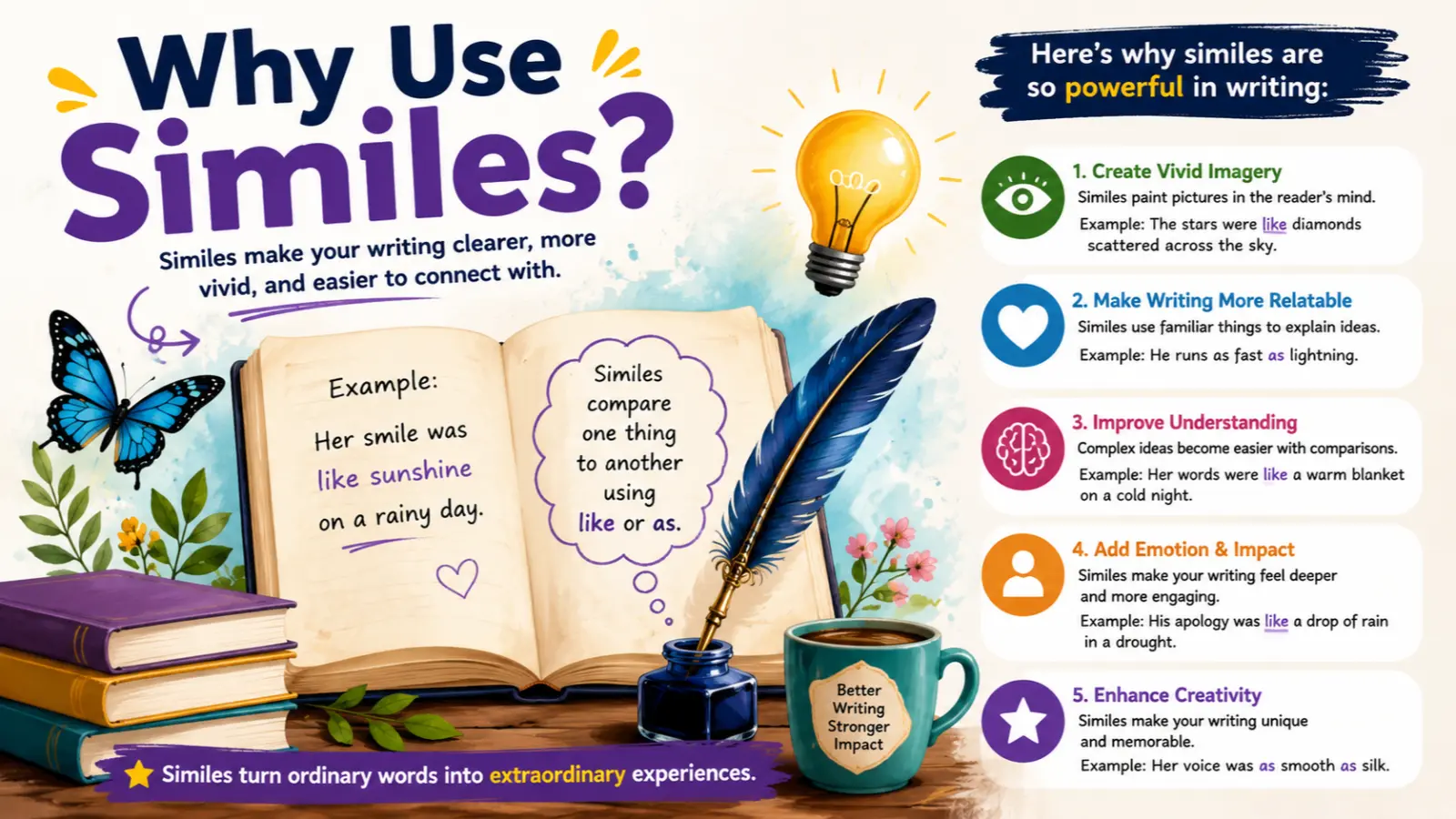
So, why use similes? Writers use them to clarify ideas, create imagery, express emotion, add personality, and make descriptions more memorable. You can find similes in poetry, fiction, speeches, conversations, advertising, songs, and everyday language.
This guide explains how similes work, when they are most effective, and how you can create stronger comparisons of your own.
Why Do Writers Use Similes?
A good simile does more than decorate a sentence. It gives an unfamiliar or abstract idea a familiar shape.
For example:
Her happiness spread through the room like sunlight through an open window.
The reader does not simply learn that she is happy. The comparison suggests warmth, movement, brightness, and a positive effect on other people.
Writers commonly use similes to:
- Make descriptions easier to visualize
- Explain unfamiliar ideas
- Communicate emotions
- Establish mood
- Add rhythm and personality
- Make characters more memorable
- Strengthen poetry and storytelling
- Make ordinary observations more interesting
The key is purpose. A comparison should help the reader experience something, not merely make a sentence longer.
How a Simile Works
A simile normally connects two different things through like or as.
Basic structure:
Subject + verb + like + comparison
Example:
The old house stood like a forgotten ship on the hill.
Another common structure uses as:
Her voice was as soft as falling snow.
The two things being compared should have a meaningful connection. A strong simile makes the reader think, Yes, I can see why those things belong together.
25 Original Similes That Show Why Comparisons Matter
1. Her happiness moved through the room like sunlight finding cracks in a curtain.
Meaning: Her happiness gradually affected everyone around her.
This comparison works because sunlight naturally suggests warmth, brightness, and positive energy.
Best context: Character descriptions, stories, reflective writing, and poetry.
2. His laughter bounced around the kitchen like marbles on a wooden floor.
This creates an energetic, playful sound. It is especially useful when you want readers to hear a scene rather than simply understand it.
His laughter bounced around the kitchen like marbles on a wooden floor.
The comparison also gives the laughter a sense of movement.
3. Their friendship was like a well-worn trail through a familiar forest.
The trail suggests trust, history, and familiarity. It implies that the friends have traveled through many experiences together.
Writing tip: Nature comparisons work particularly well when describing relationships because natural objects can represent growth, endurance, and change.
4. The rain tapped against the roof like impatient fingers on a closed door.
This simile turns rainfall into an action readers can almost hear.
It creates a slightly restless mood, making it useful in mystery, suspense, or dramatic storytelling.
5. Her kindness was like a small lamp left on for someone coming home late.
The image suggests quiet care rather than dramatic generosity.
This is a useful lesson in writing: small comparisons can create large emotional effects when the image is specific.
6. His anger rose like steam trapped beneath a metal lid.
Instead of simply telling readers that someone became angry, the comparison suggests pressure building toward a release.
By the time the meeting ended, his anger had risen like steam trapped beneath a metal lid.
This works especially well for controlled or developing anger.
7. The melody floated through the theater like a ribbon carried by warm air.
Similes are particularly useful in writing about music because sound cannot literally be seen.
The comparison gives an invisible melody a visual quality.
8. Her apology landed between them like a letter dropped into an empty mailbox.
This creates a sense of uncertainty and emotional distance. The apology has been offered, but its response is unknown.
Best context: Fiction, emotional essays, and poetry.
9. The city woke like a giant machine slowly remembering its purpose.
This comparison gives a busy city a sense of life and movement.
It can work well in travel writing or stories that begin at dawn.
10. The child’s excitement fizzed like soda just opened from the bottle.
The comparison communicates energy, movement, and anticipation.
It is especially effective for younger characters because the image feels familiar and playful.
11. Her words were as sharp as freshly broken glass.
This creates a strong impression of painful speech.
Use comparisons like this carefully. A vivid image should match the emotional intensity of the scene.
12. The classroom became quiet like a theater moments before the curtain rose.
This comparison creates anticipation rather than simple silence.
The reader senses that something important is about to happen.
13. Their secret sat between them like a locked box neither wanted to open.
The locked box represents something hidden and emotionally difficult.
This is an example of a simile that also creates symbolic meaning.
14. The snow covered the neighborhood like a clean sheet pulled across a messy bed.
The image emphasizes how completely the snow changes the appearance of the surroundings.
It can work especially well in descriptive prose because it contrasts disorder with temporary neatness.
15. His confidence cracked like thin ice beneath a careless step.
This shows how quickly confidence can disappear.
The comparison is effective because thin ice suggests something that appears stable but is actually fragile.
16. Her memories returned like birds landing briefly on a telephone wire.
This creates a softer, more reflective feeling.
Unlike a comparison involving something heavy or violent, the birds suggest memories that appear, pause, and disappear.
17. The old photograph felt like a doorway into a house that no longer existed.
This comparison connects an object with memory and loss.
It is useful when writing about family history, nostalgia, or change.
18. His ideas scattered like papers caught in a sudden wind.
The simile communicates confusion and lack of control.
It can describe thoughts, plans, conversations, or even a chaotic scene.
19. The puppy followed her like a tiny shadow with four paws.
This creates a warm, humorous image without simply saying the puppy followed her everywhere.
It is a good example of how similes can add personality to ordinary moments.
20. The sunset burned across the horizon like paint spilled across a dark canvas.
The comparison makes the colors feel expansive and dramatic.
It is especially appropriate for poetry and visual description.
21. Their conversation moved like a slow game of chess.
This suggests careful thinking, pauses, strategy, and hidden intentions.
A comparison does not always need to describe appearance. It can describe how an interaction behaves.
22. The news hit him like cold water after a comfortable dream.
This emphasizes a sudden change from comfort to shock.
The contrast between the pleasant dream and cold water makes the emotional shift clearer.
23. Her voice trembled like a leaf caught in a narrow stream.
The comparison communicates vulnerability without directly explaining every emotion.
It can be useful when writing scenes involving nervousness, fear, or uncertainty.
24. The empty playground looked like a stage after the audience had gone home.
This creates loneliness through contrast. A playground is normally associated with movement and noise, but the empty setting feels unusually still.
That contrast is what gives the simile its emotional power.
25. Hope returned like a distant song becoming clearer with every step.
This comparison presents hope as something gradual rather than instant.
It can work well in reflective writing, stories about recovery from difficult situations, and inspirational poetry.
Similes for Happiness: How to Show Joy Instead of Naming It
Writers often rely on words such as happy, excited, or joyful. Those words are useful, but a simile can make the emotion more tangible.
Compare:
She was very happy.
with:
Her excitement spread through the room like sunlight across a dark floor.
The second sentence gives happiness a physical presence.
When creating a happiness simile, think about things associated with light, movement, warmth, music, color, celebration, or growth.
For example:
His grin opened across his face like sunrise over a quiet field.
The goal is not to find the fanciest comparison. It is to find an image that matches the character’s particular kind of happiness.
Similes for Friendship That Feel Personal
Friendship can be difficult to describe because it is an abstract relationship. A concrete comparison can give it emotional shape.
Consider:
Their friendship was like a favorite jacket—soft with years of use and always there when needed.
The comparison suggests comfort, familiarity, and reliability.
For friendship writing, consider comparisons involving:
- Roads traveled together
- Familiar places
- Bridges
- Shared routines
- Reliable objects
- Growing plants
- Music played together
- Shelters during difficult weather
Avoid making every friendship comparison about being “unbreakable.” Real friendships can change, become distant, or survive disagreements. A more specific image often feels more truthful.
Similes for Rain That Create Atmosphere
Rain is an excellent subject for similes because it can produce completely different moods.
A gentle rain might be:
Rain whispered against the windows like someone telling a secret.
A storm could be:
The rain hammered the roof like a drummer refusing to stop.
The first creates intimacy. The second creates intensity.
Before writing a rain simile, decide what the rain means in your scene. Is it peaceful, gloomy, romantic, frightening, refreshing, or annoying?
The emotional purpose should guide the comparison.
Similes for Love Without Falling Into Clichés
Love has inspired countless comparisons, which means it is easy to reach for familiar phrases.
Instead of automatically comparing love to roses, stars, or fire, consider what the relationship actually feels like.
For example:
Loving her felt like finding a familiar song in a crowded room.
This suggests recognition and comfort.
Another possibility:
His love was like a porch light left on through every storm.
This emphasizes reliability and welcome.
The strongest romantic similes usually reveal something specific about the relationship rather than making a generic statement about love.
Similes for Anger That Show Different Kinds of Rage
Anger can be quiet, explosive, controlled, bitter, or temporary. Your comparison should reflect the type.
For restrained anger:
Her anger sat beneath her words like a stone beneath shallow water.
A rapidly growing anger:
His temper climbed like a spark racing along a trail of dry leaves.
For exhausted anger:
Her anger faded like thunder moving beyond the hills.
Notice that each comparison communicates a different emotional state. This is one reason similes are useful for characterization.
Similes in Music: Making Sound Visible
Songwriters and poets often need to describe something that cannot literally be touched or seen: sound.
A simile can translate music into another sensory experience.
The guitar melody curled through the room like smoke from a distant fire.
Or:
The singer’s voice rose like a kite catching a sudden wind.
These comparisons allow readers to imagine qualities such as movement, softness, speed, height, warmth, or tension.
When writing about music, ask:
What does the sound feel like?
Then choose a comparison from another sense.
You can compare music to:
- Water
- Wind
- Light
- Movement
- Texture
- Weather
- Objects
- Places
- Physical sensations
This technique is especially powerful in poetry and creative reviews.
Common Similes: Why Familiar Comparisons Still Work
Some similes become common because they communicate an idea quickly.
Examples include comparisons involving:
- Being busy as a bee
- Being quiet as a mouse
- Being strong as an ox
- Being light as a feather
These expressions are easy to understand because readers already know the association.
The problem is not that common similes are automatically bad. The problem comes when a familiar comparison adds nothing new.
If a character is described as “busy as a bee,” the reader receives a basic idea. If you write:
She moved through the bakery like a hummingbird visiting every flower before sunrise.
the image becomes more specific.
Use a common simile when speed and familiarity are useful. Create a fresh one when you want personality or surprise.
Funny Similes: How Humor Changes the Comparison
Humorous similes often work because they create an unexpected connection.
For example:
He walked into the interview as nervous as a cat accidentally locked inside a bathtub showroom.
The comparison is funny because the situation is strange and specific.
Another:
My alarm clock sounded like a tiny emergency broadcast designed specifically to ruin my dreams.
Funny similes work best when the comparison exaggerates a recognizable experience without becoming confusing.
Try combining an ordinary situation with an unusual image.
How to Make a Simile More Vivid
A weak simile often uses a broad comparison:
The room was like a mess.
A stronger version identifies something concrete:
The room looked like a suitcase had exploded five minutes before guests arrived.
The second sentence gives the reader an actual scene.
When revising a simile, ask:
- Can the reader picture the comparison?
- Does the comparison match the emotion?
- Is the image specific?
- Does it reveal something about the character or setting?
- Would removing the simile make the sentence weaker?
If the answer to the last question is no, the simile may not be doing enough work.
How Professional Writers Avoid Cliché Similes
A cliché is a comparison that has become so familiar that readers barely notice it.
Common comparisons can sometimes be useful, especially in dialogue, but creative writing benefits from fresh observation.
Instead of asking:
What is this thing usually compared to?
ask:
What does this thing remind this character of?
That small change can produce more original writing.
A chef might compare rain to ingredients hitting a hot pan. A musician might compare it to percussion. A child might compare it to marbles racing down glass.
Original similes often come from the character’s experience.
Simile vs. Metaphor: What’s the Difference?
A simile makes a direct comparison using words such as like or as.
The moon looked like a silver coin.
A metaphor makes the comparison directly:
The moon was a silver coin above the rooftops.
Both devices create imagery, but they produce slightly different effects.
A simile signals the comparison clearly. A metaphor can make the comparison feel more immediate or absolute.
Neither is automatically better. Choose the form that best fits your sentence and voice.
Simile, Imagery, and Personification
Similes often work together with other literary devices.
Imagery creates sensory detail:
The rain smelled fresh against the warm pavement.
Personification gives human qualities to nonhuman things:
The rain whispered against the window.
Simile compares two things:
The rain fell like silver threads.
A single passage can combine all three:
The rain whispered against the window, falling like silver threads beneath the streetlight.
Each device contributes something different.
How to Create Your Own Similes
Creating original similes becomes easier when you stop searching for “beautiful words” and start observing ordinary things.
Step 1: Identify what you want to describe
Choose an emotion, person, sound, place, movement, or object.
Example:
Loneliness
Step 2: Decide what the feeling actually does
Does loneliness feel heavy? Empty? Quiet? Restless? Cold? Repetitive?
Suppose you decide it feels quiet and distant.
Step 3: Brainstorm unrelated images
Think about:
- An empty station
- A distant lighthouse
- A single chair
- A closed store
- A radio losing its signal
Step 4: Find the strongest connection
You might write:
Loneliness followed him like a radio signal fading between stations.
Now the comparison communicates distance and uncertainty.
Step 5: Test the simile
Ask whether the comparison adds something the original sentence did not.
If it does, keep it.
If it merely sounds decorative, revise it.
A Simple Exercise for Better Similes
Take one ordinary sentence:
The girl was nervous.
Now create three different comparisons.
Gentle nervousness:
She was nervous like a bird testing a new branch.
Strong nervousness:
Her thoughts raced like shoes pounding down an empty hallway.
Hidden nervousness:
Her smile stayed in place like a picture pinned over a crack.
The exercise teaches an important principle: the best simile depends on the exact emotion you want readers to experience.
Common Mistakes Writers Make With Similes
Using too many similes
If every sentence contains a comparison, the imagery loses its impact.
Let some sentences remain simple.
Choosing a comparison that does not fit
A peaceful scene usually needs different imagery from an intense action scene. Match the simile to the mood.
Mixing images
Avoid creating confusing combinations:
His anger was like a volcano sailing through a storm of broken clocks.
Several unrelated images compete for attention.
Choose one central image and develop it clearly.
Explaining the simile too much
If the image already communicates the meaning, trust the reader.
Weak:
Her smile was like sunshine, meaning she was happy and made everyone feel positive.
Often, the comparison itself is enough.
Confusing a simile with an ordinary description
A sentence does not become a simile simply because it is descriptive. There must be a clear comparison between two different things.
Choosing a clever image over a useful one
A strange comparison may attract attention but still fail to communicate.
Clarity comes first. Creativity should support meaning.
When Should You Use a Simile?
Use a simile when a comparison can make an idea clearer, more emotional, or more memorable.
They are especially useful when:
- Describing characters
- Establishing atmosphere
- Expressing difficult emotions
- Writing poetry
- Creating fictional settings
- Describing music or sound
- Making dialogue more distinctive
- Explaining abstract ideas
- Adding humor
- Creating memorable openings or endings
You do not need a simile in every paragraph. Sometimes the most powerful sentence is simply direct.
Frequently Asked Questions
Why are similes important in writing?
Similes make abstract or ordinary ideas easier to imagine by connecting them with familiar images. They can also create emotion, atmosphere, humor, and stronger characterization.
What is the main purpose of a simile?
The main purpose is to create a meaningful comparison that helps readers understand or experience something more vividly.
Why do writers use similes instead of simple descriptions?
A simple description tells readers what something is like. A strong simile can show them what it feels, sounds, looks, or behaves like, making the writing more memorable.
What makes a simile effective?
An effective simile is clear, relevant, specific, and appropriate to the mood. It should add meaning rather than simply decorate a sentence.
Are common similes bad?
No. Common similes can be useful when you want familiar, immediate meaning. However, original comparisons are usually more memorable in creative writing.
Can similes be used in songs?
Yes. Similes are common in songwriting because they can communicate emotions and sensory experiences in compact, memorable language.
What is the difference between a simile and a metaphor?
A simile makes a comparison explicitly, usually with like or as. A metaphor makes the comparison directly without using those comparison words.
How can I make my similes more original?
Base comparisons on specific observations, character experiences, sensory details, and unexpected but believable connections. Avoid automatically choosing the first familiar comparison that comes to mind.
Conclusion
The real value of a simile is not the word like or as. It is the connection created in the reader’s mind. A strong comparison can make happiness feel warm, anger feel pressurized, friendship feel dependable, rain feel musical, and love feel personal. It can turn sound into an image and an ordinary moment into something worth remembering. When you write your next description, pause before reaching for a familiar comparison. Look closely at the thing you are describing. Ask what it reminds you of, how it moves, what it sounds like, and what emotion it creates. Then make the comparison specific enough that the reader does not just understand your sentence—they can see it, hear it, and feel it.

I am Helena Frost, a writer captivated by the beauty of language and the art of comparison. Through my words, I explore the world by turning ordinary moments into vivid similes and reflections. I enjoy crafting phrases that spark imagination, evoke emotion, and linger in the mind. My writing celebrates the subtle connections between people, nature, and the stories we live. For me, every sentence is an opportunity to reveal the extraordinary in the everyday.