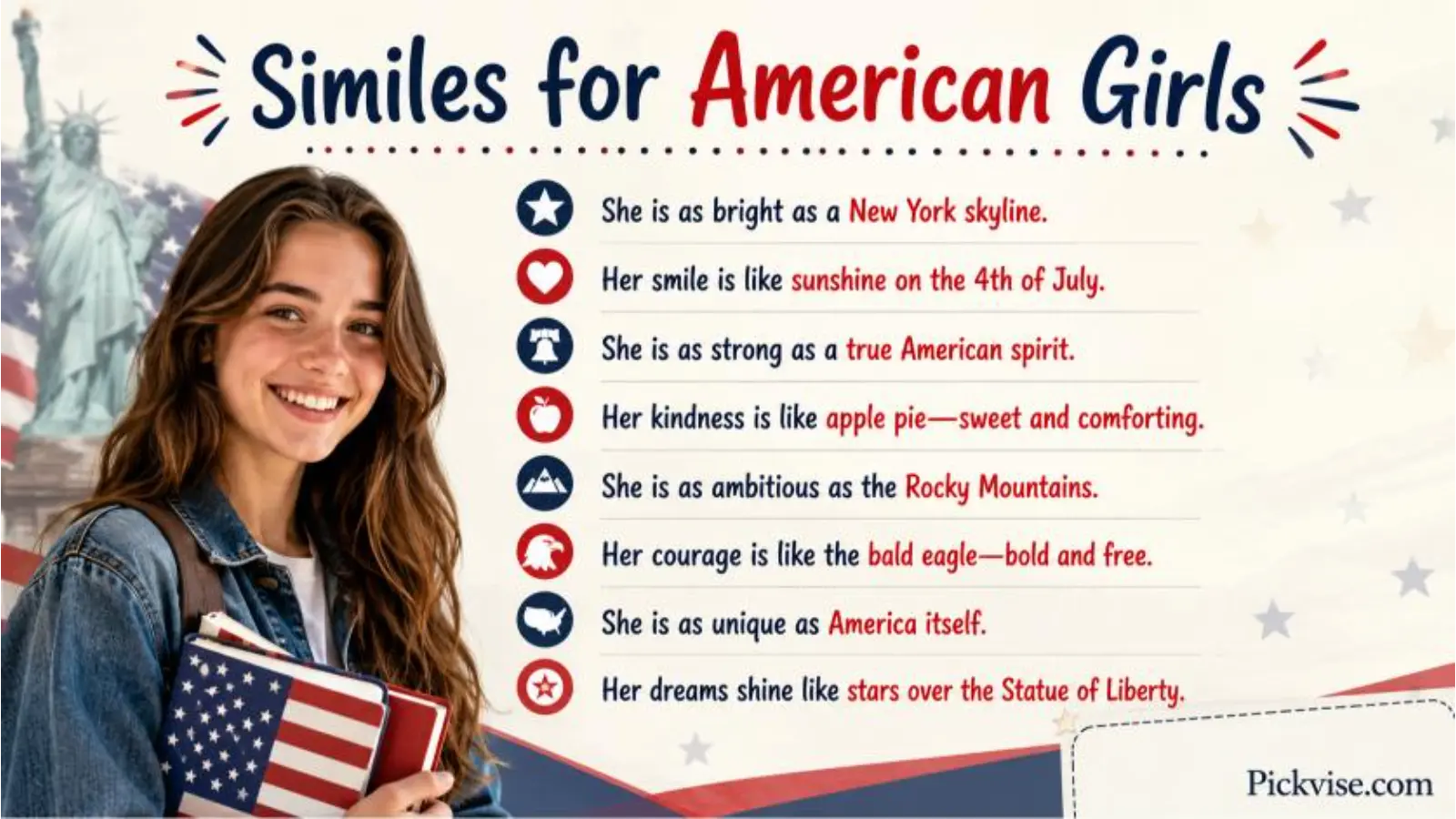
A good Similes for American Girls can turn an ordinary description into an image readers can actually see. Instead of simply saying that a Similes for American Girls is confident, funny, kind, nervous, or energetic, a writer can compare her quality to something familiar and vivid.
A Similes for American Girls is a comparison between two different things using words such as like or as. For example, Her confidence stood like a lighthouse in a storm compares confidence with a lighthouse to suggest strength and direction.
This collection of similes for American girls focuses on personality, emotions, friendships, everyday experiences, school, creativity, confidence, and storytelling. The comparisons are written to be flexible rather than tied to one narrow personality or appearance.
You can use them in creative writing, poems, school assignments, character descriptions, social captions, dialogue, or simply as inspiration for creating your own.
Quick Answer: What Are Some Good Similes for American Girls?
Some original examples include:
- Her confidence was like a bright porch light, welcoming everyone around her.
- She laughed like a room suddenly filling with sunshine.
- Her curiosity was as restless as a kite searching for higher wind.
- She moved through the school hallway like a song everyone seemed to know.
- Her friendship was like a well-worn path that always led home.
- Her determination burned like a small campfire that refused to go out.
- Her ideas scattered like colorful notes across a musician’s desk.
- Her kindness was as gentle as rain tapping against a bedroom window.
The strongest simile depends on the quality you want the reader to notice.
How to Choose the Right Simile for a Girl Character
BeforeS imiles for American Girls choosing a comparison, decide what you want the reader to feel.
A cheerful character might need a bright, energetic image. A thoughtful character may work better with something quiet and reflective. A determined character can be compared with something persistent rather than simply something powerful.
For example:
She was strong like a mountain.
This communicates strength, but it is broad and familiar.
A Similes for American Girls more specific version might be:
Her determination was like a trail marker in thick fog—it kept pointing her forward.
The Similes for American Girls second comparison gives the reader an image and a sense of action.
30 Original Similes for American Girls
1. Her Confidence Was Like a Porch Light
Simile: Her confidence was like a porch light, bright enough to make everyone feel welcome.
Meaning: She has a self-assured personality that also makes other people comfortable.
Example:
When Maya entered the classroom, her confidence was like a porch light, bright enough to make everyone feel welcome.
Writing purpose: This works especially well when you want to describe confidence without making the character seem arrogant.
Best context: Character introductions, school stories, biographies, and inspirational writing.
2. She Laughed Like a Room Filling With Sunshine
Simile: She Similes for American Girls laughed like a room filling with sunshine.
Meaning: Her laughter makes the atmosphere happier.
Example:
She laughed like a room filling with sunshine, and even the quietest students began to smile.
This is useful when laughter changes the mood of a scene. Notice that the comparison does more than describe a sound—it shows its effect on other people.
3. Her Curiosity Was as Restless as a Kite
Simile: Her curiosity was as restless as a kite searching for higher wind.
Meaning: She Similes for American Girls constantly wants to discover, question, and explore.
Example:
Her curiosity was as restless as a kite searching for higher wind, always pulling her toward another question.
Writing tip: Comparisons involving movement are particularly useful for describing curious characters because curiosity itself is difficult to see.
4. She Moved Like a Song Everyone Knew
Simile: She moved through the hallway like a song everyone knew but nobody could stop humming.
Meaning: Her presence feels energetic, familiar, and memorable.
Best context: Teen characters, school stories, coming-of-age fiction, and creative descriptions.
The comparison works because a song can create an emotional atmosphere without needing a physical description of the person.
5. Her Friendship Was Like a Well-Worn Path
Simile: Her friendship was like a well-worn path that always led home.
Meaning: The friendship feels familiar, dependable, and comforting.
Example:
Even after months apart, their friendship was like a well-worn path that always led home.
This is a useful simile for friendship because the path represents a connection that remains easy to return to.
6. Her Kindness Was as Gentle as Rain on a Window
Simile: Her kindness was as gentle as rain tapping against a bedroom window.
Meaning: Her kindness feels quiet and comforting rather than dramatic.
Writing purpose: Use this when describing someone who helps others without seeking attention.
7. Her Determination Burned Like a Campfire
Simile: Her determination burned like a small campfire that refused to go out.
Meaning: She keeps working toward her goal even when progress is slow.
Example:
Every failed attempt only made her try again; her determination burned like a small campfire that refused to go out.
The smallness of the campfire matters. It suggests that determination does not have to be loud to be powerful.
8. Her Ideas Were Like Colorful Notes
Simile: Her ideas were like colorful notes scattered across a musician’s desk.
Meaning: She has many creative thoughts that may seem disconnected at first but can eventually form something meaningful.
Best context: Artists, students, musicians, writers, designers, and imaginative characters.
9. Her Happiness Sparked Like String Lights
Simile: Her happiness sparked like string lights coming on at dusk.
Meaning: Her happiness gradually brightens the surrounding atmosphere.
Example:
When she heard the good news, her happiness sparked like string lights coming on at dusk.
This is a useful simile for happiness because it shows happiness as something that spreads visually.
10. Her Excitement Was Like a Backpack Full of Fireflies
Simile: Her excitement was like carrying a backpack full of fireflies.
Meaning: She has so much energetic anticipation that it feels impossible to contain.
Writing tip: Unexpected comparisons often make similes more memorable. Fireflies give the abstract emotion of excitement a playful visual quality.
11. Her Anger Rose Like a Storm Behind the Hills
Simile: Her anger rose like a storm gathering behind distant hills.
Meaning: Her anger is becoming stronger, but it has not fully erupted.
Best context: Fiction, dialogue scenes, dramatic storytelling.
This is a useful simile for anger because the storm suggests both intensity and approaching conflict without directly telling the reader how angry the character is.
12. Her Patience Was Like a Clock That Never Rushed
Simile: Her patience was like a clock that never rushed the next minute.
Meaning: She is calm and willing to wait.
Example:
While everyone else complained, her patience was like a clock that never rushed the next minute.
13. Her Voice Was Like a Bell Across a Busy Playground
Simile: Her voice carried like a bell across a busy playground.
Meaning: Her voice is easy to hear even when there is a lot of activity around her.
Writing purpose: This is more useful than simply saying she had a loud voice because it gives the reader a sound and setting.
14. Her Dreams Were Like Windows With No Curtains
Simile: Her dreams were like windows with no curtains, open to possibilities she had never imagined.
Meaning: She is open-minded and hopeful about her future.
Best context: Inspirational stories, coming-of-age writing, and reflective essays.
15. Her Courage Was Like a Match in the Wind
Simile: Her courage was like a match in the wind—small, unsteady, but still burning.
Meaning: Courage does not mean feeling fearless. It can mean continuing despite uncertainty.
This comparison adds emotional complexity because the flame is vulnerable while still showing strength.
16. Her Smile Was Like the First Page of a New Book
Simile: Her smile was like the first page of a new book, full of possibilities.
Meaning: Her smile creates a feeling of curiosity, optimism, or a fresh beginning.
Best context: Character introductions and gentle descriptive writing.
17. Her Creativity Ran Like Paint From an Open Jar
Simile: Her creativity ran like paint from an open jar, finding color in places nobody else noticed.
Meaning: Her imagination is abundant and appears in unexpected places.
Writing tip: When creating a simile, choose an image that can perform an action. Active comparisons often feel more alive than static ones.
18. Her Focus Was Like a Camera Finding One Face in a Crowd
Simile: Her focus was like a camera finding one face in a crowded room.
Meaning: She can concentrate on one goal despite distractions.
Best context: Students, athletes, artists, performers, and ambitious characters.
19. Her Friendship Felt Like an Old Hoodie
Simile: Their friendship felt like an old hoodie—comfortable, familiar, and easy to return to.
Meaning: The friendship provides emotional comfort.
This is an example of a casual, contemporary comparison that can fit conversational storytelling.
20. Her Hope Was Like a Window Left Open
Simile: Her hope was like a window left open after a long winter.
Meaning: She remains receptive to better possibilities after a difficult period.
Writing purpose: This works well in reflective or emotional scenes because the window can symbolize change without explicitly explaining the symbolism.
21. Her Energy Was Like a City Before Sunrise
Simile: Her energy was like a city before sunrise, already humming before everyone else had awakened.
Meaning: She is energetic and active before others are ready.
Best context: Morning routines, school scenes, sports, and lively character descriptions.
22. Her Humor Was Like a Paper Airplane
Simile: Her humor was like a paper airplane, simple at first but capable of crossing the whole room.
Meaning: Her jokes may seem small but can quickly spread through a group.
Example:
One comment from her was like a paper airplane; within seconds, everyone nearby was laughing.
23. Her Memories Were Like Polaroids in a Shoebox
Simile: Her memories were like Polaroids in a shoebox, each one carrying a different kind of warmth.
Meaning: Her memories are separate moments that preserve emotional experiences.
Best context: Nostalgic stories, essays, memoir-style writing, and poetry.
24. Her Determination Was Like a Trail Through Snow
Simile: Her determination was like a trail through fresh snow, appearing one step at a time.
Meaning: Progress is created through continued effort.
This comparison teaches an important writing principle: you can use an image to explain an idea rather than simply naming the idea.
25. Her Love for Her Friends Was Like a Blanket Around a Campfire
Simile: Her love for her friends was like a blanket around a campfire, making difficult nights easier to endure.
Meaning: Her friendship provides warmth, protection, and emotional support.
This can work particularly well in stories where characters face challenges together.
26. Her Nervousness Fluttered Like Curtains in an Open Window
Simile: Her nervousness fluttered like curtains in an open window.
Meaning: She feels unsettled and unable to stay completely calm.
Writing tip: Notice that the sentence does not say she was very nervous. The physical movement of the curtains lets the reader infer the emotion.
27. Her Ambition Was Like a Map Covered in Handwritten Routes
Simile: Her ambition was like a map covered in handwritten routes, each one leading toward another possibility.
Meaning: She has many goals and is actively figuring out how to reach them.
Best context: School essays, career stories, and ambitious fictional characters.
28. Her Calmness Was Like a Lake Before Dawn
Simile: Her calmness was like a lake before dawn, quiet without feeling empty.
Meaning: She has a peaceful presence that still feels alive.
This is especially useful when you want to distinguish calmness from sadness.
29. Her Words Were Like Seeds in Dry Soil
Simile: Her words were like seeds in dry soil, taking time before anyone noticed what they could become.
Meaning: Her ideas may not have an immediate effect, but they can influence people later.
Best context: Teachers, leaders, writers, mentors, and thoughtful characters.
30. Her Personality Was Like a Playlist With Unexpected Turns
Simile: Her personality was like a playlist with unexpected turns—quiet one moment, hilarious the next, and never boring.
Meaning: She has a varied and unpredictable personality.
Best context: Character descriptions, informal writing, social captions, and humorous storytelling.
How to Make Similes More Vivid
The secret to a strong simile is not choosing the fanciest object. It is choosing an image that reveals something important.
Compare:
She was happy like the sun.
with:
Her happiness sparked like string lights coming on at dusk.
The second version gives the reader a particular moment. It has movement, atmosphere, and a visual quality.
When creating your own simile, ask:
- What quality am I describing?
- What physical thing behaves in a similar way?
- What specific action connects them?
- What emotion should the comparison create?
- Would this image feel natural in the scene?
That process turns a basic comparison into purposeful imagery.
Similes for Happiness, Friendship, Love, Rain, and Anger
Certain emotions appear repeatedly in creative writing because they are difficult to describe directly.
Similes for Happiness
Instead of writing:
She was extremely happy.
Try an image that shows the change happiness creates:
Her happiness spread like string lights across a dark backyard.
The comparison works because the lights transform the environment.
Other original possibilities include:
- Her happiness bounced like a rubber ball across the room.
- Her joy opened like a window after a stuffy afternoon.
- Her excitement glittered like confetti caught in sunlight.
Similes for Friendship
Friendship often works well with images of connection, shelter, journeys, or familiarity.
Examples:
- Their friendship was like two paths meeting beneath the same tree.
- Their friendship held together like stitching on a favorite jacket.
- Her best friend was like a familiar song on a difficult day.
The strongest friendship similes usually communicate how the relationship feels, not merely that the friends are close.
Similes for Rain
Rain can represent comfort, sadness, renewal, suspense, or loneliness depending on the context.
Try:
- Rain tapped the roof like impatient fingers.
- The rain fell like silver threads across the street.
- The afternoon rain sounded like a quiet conversation against the windows.
The same natural phenomenon can produce completely different emotional effects.
Similes for Love
Love can be gentle, exciting, protective, complicated, or enduring.
Examples:
- Their affection grew like ivy finding a wall to climb.
- Her love was like a steady lamp beside a late-night desk.
- Their connection was as familiar as a road traveled many times.
A useful writing principle here is to avoid automatically making love sound enormous or dramatic. Quiet comparisons can sometimes feel more believable.
Similes for Anger
Anger becomes more interesting when you show its stages.
Examples:
- His anger simmered like water just below a boil.
- Her frustration cracked like ice under a heavy step.
- His temper gathered like thunder beyond the horizon.
These comparisons allow readers to sense whether anger is beginning, growing, or reaching a breaking point.
Why Some Similes Feel Clichéd
A cliché is an expression or comparison that has been used so often that it may no longer create a fresh image.
For example, phrases involving someone being busy as a bee or cold as ice are immediately understandable, but they may not surprise the reader.
Clichés are not automatically wrong. They can be useful in ordinary conversation because everyone understands them quickly. But literary writing often benefits from a more specific image.
Instead of:
She was busy as a bee.
Try:
She moved between tasks like a conductor keeping five sections of an orchestra together.
The second comparison gives the reader a stronger sense of controlled activity.
Simile vs. Metaphor: What’s the Difference?
A simile makes a comparison using words such as like or as:
Her ideas were like sparks.
A metaphor makes the comparison directly:
Her ideas were sparks.
Both devices create imagery, but they produce slightly different effects.
Similes often make comparisons feel more exploratory because the writer openly tells the reader that one thing resembles another.
Metaphors can feel more direct and forceful.
Simile, Imagery, and Personification
Similes are closely connected to imagery, which uses descriptive language to help readers imagine an experience through the senses.
For example:
The rain sounded like tiny fingers drumming on the roof.
The simile creates auditory imagery.
A writer can also combine simile with personification, which gives human qualities to nonhuman things:
The wind teased the curtains like a mischievous child.
The wind is personified as mischievous, while the comparison is expressed through a simile.
These devices can work together as long as each one contributes something meaningful.
How to Create Your Own Similes
Creating original comparisons becomes easier when you stop searching for a perfect phrase and start observing the world.
Step 1: Name the quality
Choose one thing you want to describe:
confidence, nervousness, kindness, excitement, loneliness, determination, humor
Step 2: Find a physical image
Think about objects, places, weather, sounds, movement, food, technology, nature, or everyday experiences.
For determination, you might consider:
- a trail
- a candle
- a river
- a climbing rope
- a clock
Step 3: Find the shared behavior
Do not simply ask, “What looks similar?”
Ask:
What does this object do that resembles the emotion or quality?
A river keeps moving. A candle keeps burning. A trail appears through repeated footsteps.
Step 4: Add a specific detail
Instead of:
Her determination was like a candle.
Try:
Her determination was like a candle that kept burning beside an open window.
The detail introduces difficulty while preserving the central image.
Step 5: Test the sentence
Read it aloud.
If the comparison sounds forced, exaggerated, or unrelated to the character, replace it.
A strong simile should feel like it belongs naturally in the sentence.
Creative Exercises for Better Similes
Exercise 1: Emotion to Object
Choose an emotion and three ordinary objects.
For nervousness, you might choose:
- shoelaces
- curtains
- a bouncing basketball
Write three comparisons and decide which one creates the clearest image.
Exercise 2: Replace a Weak Description
Start with:
She was very confident.
Rewrite it three ways using different images.
For example, compare confidence with something that:
- gives light
- stands firmly
- guides other people
Exercise 3: Change the Mood
Take the same subject—rain—and create:
- a comforting simile
- a frightening simile
- a romantic simile
- a funny simile
- a lonely simile
This teaches an important lesson: the object does not determine the mood; the details surrounding it do.
Funny Similes for Casual Writing
Funny similes work best when the comparison is unexpected but understandable.
Try:
- She organized her desk like a squirrel preparing for a very serious winter.
- He stared at the homework like it had personally offended him.
- Her alarm clock was treated like an enemy negotiator.
- The backpack was as heavy as if it had been secretly collecting bricks.
- She searched for her phone like an archaeologist hunting for a lost civilization.
Humor often comes from exaggeration, surprise, and a mismatch between the seriousness of the situation and the comparison.
Common Mistakes Writers Make With Similes
Using Too Many Similes
A paragraph filled with comparisons can become exhausting. Give your strongest image room to work.
Mixing Images
Avoid creating a comparison that begins with one image and suddenly switches to another.
A sentence that combines oceans, airplanes, fire, and gardens can confuse the reader unless the mixed imagery is deliberate.
Choosing an Image That Does Not Fit
A comparison may sound clever but still be wrong for the character.
A quiet, serious scene probably does not need a wildly comic comparison unless the contrast is intentional.
Explaining the Simile Too Much
If the image already communicates the meaning, let the reader experience it.
Instead of:
Her smile was like sunrise, which means she was very happy and made everyone feel better.
Try:
Her smile was like sunrise after a long night.
The image can carry much of the emotional meaning by itself.
Confusing Similes and Metaphors
Remember:
Simile: Her confidence was like a lighthouse.
Metaphor: Her confidence was a lighthouse.
Neither is automatically better. Choose the form that gives your sentence the tone you want.
Frequently Asked Questions
What is a good simile for a girl?
A good simile depends on the personality or quality being described. For confidence, you might write, Her confidence was like a porch light, welcoming everyone around her. For creativity, Her ideas were like colorful notes scattered across a musician’s desk.
What are some cute similes for girls?
Gentle comparisons can describe personality without focusing on appearance. For example, Her laughter was like sunshine through a window or Her kindness was like rain tapping softly against glass.
What is a simile for a confident girl?
Try: Her confidence was like a lighthouse in a crowded harbor, steady enough to help others find their way.
What is a simile for a happy girl?
Try: Her happiness sparked like string lights coming on at dusk.
What are some similes for friendship?
Examples include Their friendship was like a well-worn path that always led home and Their friendship felt like an old hoodie—comfortable, familiar, and easy to return to.
How do you make a simile more creative?
Start with the quality you want to describe, find an unexpected but believable object that behaves similarly, and add one specific detail. Avoid choosing a comparison simply because it sounds fancy.
Are similes good for creative writing?
Yes. Similes can make abstract emotions, characters, settings, and actions easier for readers to visualize. They are especially useful when a direct description feels flat.
Conclusion
The best similes do more than decorate a sentence. They reveal character, establish mood, sharpen emotion, and give readers something memorable to picture. When writing similes for American girls, avoid assuming that every character should fit the same personality or style. A confident student, an imaginative artist, a funny friend, a quiet observer, and an ambitious athlete can all be described through completely different imagery. Start with one quality. Find an image that behaves in a similar way. Add a precise detail. Then read the sentence aloud and ask whether the comparison actually makes the character clearer. Once you begin looking at ordinary objects, weather, sounds, places, and everyday moments as sources of imagery, original similes become much easier to create—and your writing becomes more vivid at the same time.

I am Helena Frost, a writer captivated by the beauty of language and the art of comparison. Through my words, I explore the world by turning ordinary moments into vivid similes and reflections. I enjoy crafting phrases that spark imagination, evoke emotion, and linger in the mind. My writing celebrates the subtle connections between people, nature, and the stories we live. For me, every sentence is an opportunity to reveal the extraordinary in the everyday.