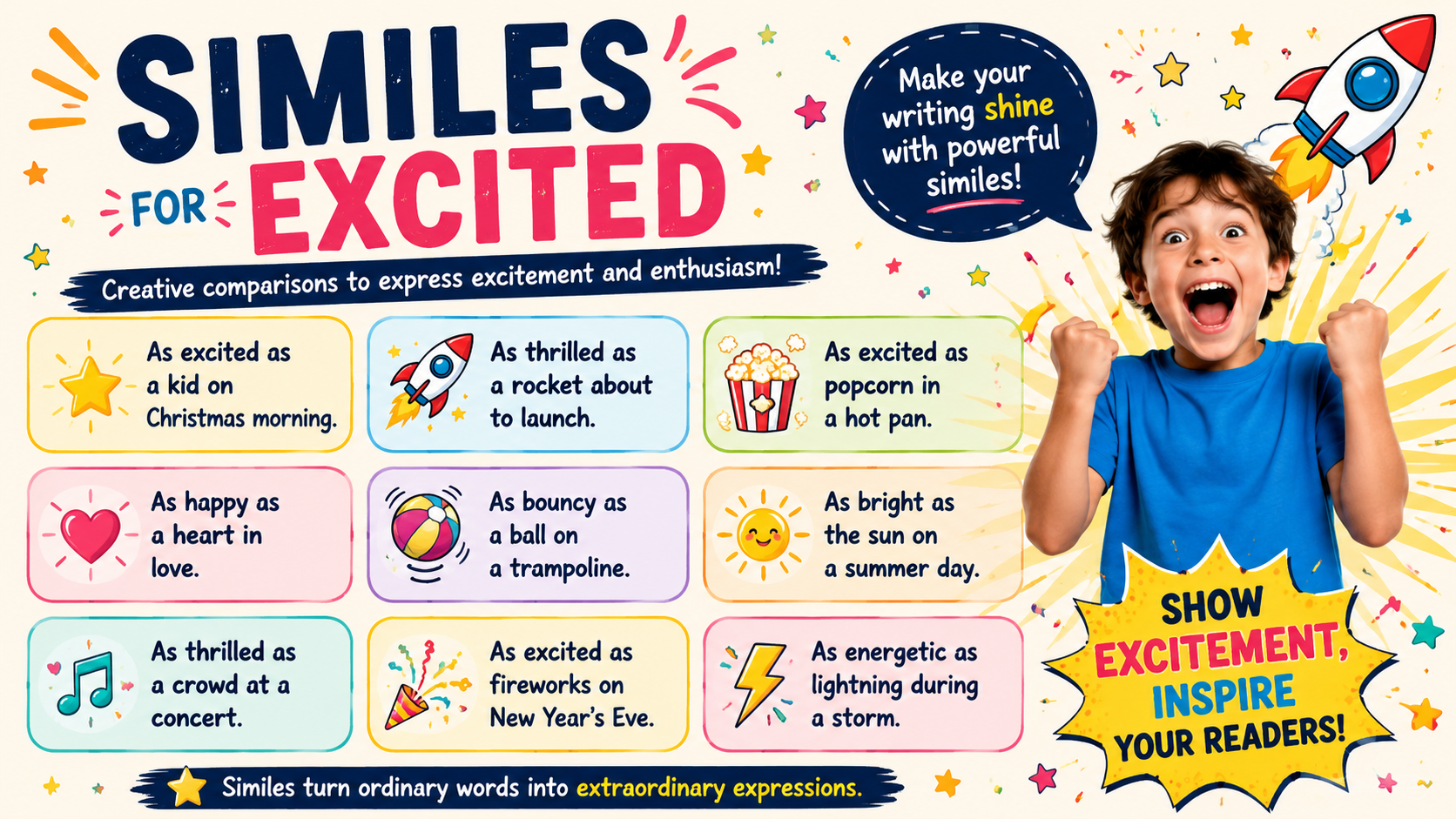
Excitement is one of the easiest emotions to feel but one of the hardest to describe well. Simply saying someone was “very excited” rarely captures the rush of anticipation, nervous energy, or overwhelming happiness.That’s where similes help. A simile compares one thing to another using like or as, helping readers picture emotions instead of simply reading about them.Whether you’re writing fiction, poetry, essays, speeches, or everyday conversations, these similes for excited will help your descriptions feel more vivid, memorable, and original.
Quick Answer
Similes for excited compare excitement to something energetic, joyful, fast-moving, or full of life using like or as. They make writing more expressive by helping readers imagine the emotion through familiar images.
Example:
- She was as excited as a child discovering a secret garden.
Why Excitement Is Fun to Describe
Excitement isn’t just happiness.
It often includes:
- Anticipation
- Curiosity
- Nervous energy
- Joy
- Surprise
- Hope
Because excitement combines several emotions at once, creative similes make it much easier for readers to experience the feeling instead of simply being told about it.
25 Original Similes for Excited
1. As excited as a kite catching its first strong breeze
Meaning: Filled with fresh energy and enthusiasm.
Formal Example:
She was as excited as a kite catching its first strong breeze before the competition.
Conversation:
“I’m as excited as a kite today!”
Writing Tip:
Works well for hopeful beginnings.
2. Like fireworks waiting for the night sky
Meaning: Barely able to contain excitement.
Story Example:
His thoughts were like fireworks waiting for the night sky.
Best Context:
Big announcements and celebrations.
3. As excited as sunlight breaking through morning clouds
Meaning: Bright, positive anticipation.
Poetry Example:
Her smile spread as excited as sunlight breaking through morning clouds.
4. Like a puppy hearing its owner’s footsteps
Meaning: Pure, joyful excitement.
Conversation:
The kids were like puppies hearing their parents arrive.
Writing Tip:
Perfect for warm, cheerful scenes.
5. As excited as a river racing toward the sea
Meaning: Full of unstoppable momentum.
Formal Example:
The team felt as excited as a river racing toward the sea.
6. Like stars waking across the evening sky
Meaning: Quiet but growing excitement.
Best Context:
Romantic or reflective writing.
7. As excited as fresh rain meeting thirsty fields
Meaning: Excitement mixed with relief.
Storytelling Example:
She greeted the good news as excited as fresh rain meeting thirsty fields.
8. Like a bird discovering an open sky
Meaning: Feeling free and eager.
Writing Tip:
Excellent for travel or adventure stories.
9. As excited as a musician hearing the first applause
Meaning: Reward after hard work.
Formal Example:
He stood as excited as a musician hearing the first applause.
10. Like a lighthouse spotting a returning ship
Meaning: Joyful anticipation.
Emotional Effect:
Creates warmth and hope.
11. As excited as spring opening its first flower
Meaning: Fresh beginnings.
Poetry Example:
Her heart bloomed as excited as spring opening its first flower.
12. Like waves rushing toward the shore
Meaning: Constant growing excitement.
Writing Tip:
Useful for building suspense.
13. As excited as a child opening an unknown gift
Meaning: Curious excitement without relying on common holiday imagery.
14. Like a spark finding dry wood
Meaning: Excitement spreading rapidly.
Storytelling Example:
The announcement spread through the room like a spark finding dry wood.
15. As excited as birds greeting the sunrise
Meaning: Cheerful, energetic happiness.
Best Context:
Morning scenes.
16. Like a compass finally finding north
Meaning: Excitement mixed with certainty.
Writing Purpose:
Great for achieving long-term goals.
17. As excited as autumn leaves dancing in the wind
Meaning: Lively movement and joyful energy.
18. Like a rocket waiting for countdown
Meaning: Ready to burst into action.
Conversation:
I’m like a rocket waiting for countdown!
19. As excited as a painter facing a blank canvas
Meaning: Inspired by endless possibilities.
Writing Tip:
Ideal for creative projects.
20. Like fresh bread filling a quiet kitchen with aroma
Meaning: Excitement spreading naturally.
Emotional Effect:
Creates comfort and warmth.
21. As excited as a traveler seeing a new skyline
Meaning: Wonder and anticipation.
22. Like butterflies discovering a blooming garden
Meaning: Gentle, beautiful excitement.
Best Context:
Romantic stories and nature writing.
23. As excited as a drummer hearing the opening beat
Meaning: Ready to begin something important.
24. Like the first snowflake touching warm hands
Meaning: Gentle excitement filled with wonder.
25. As excited as dawn greeting a sleeping world
Meaning: Hopeful excitement that signals something new.
Poetry Example:
Her dreams rose as excited as dawn greeting a sleeping world.
What Makes an Excitement Simile Feel Real?
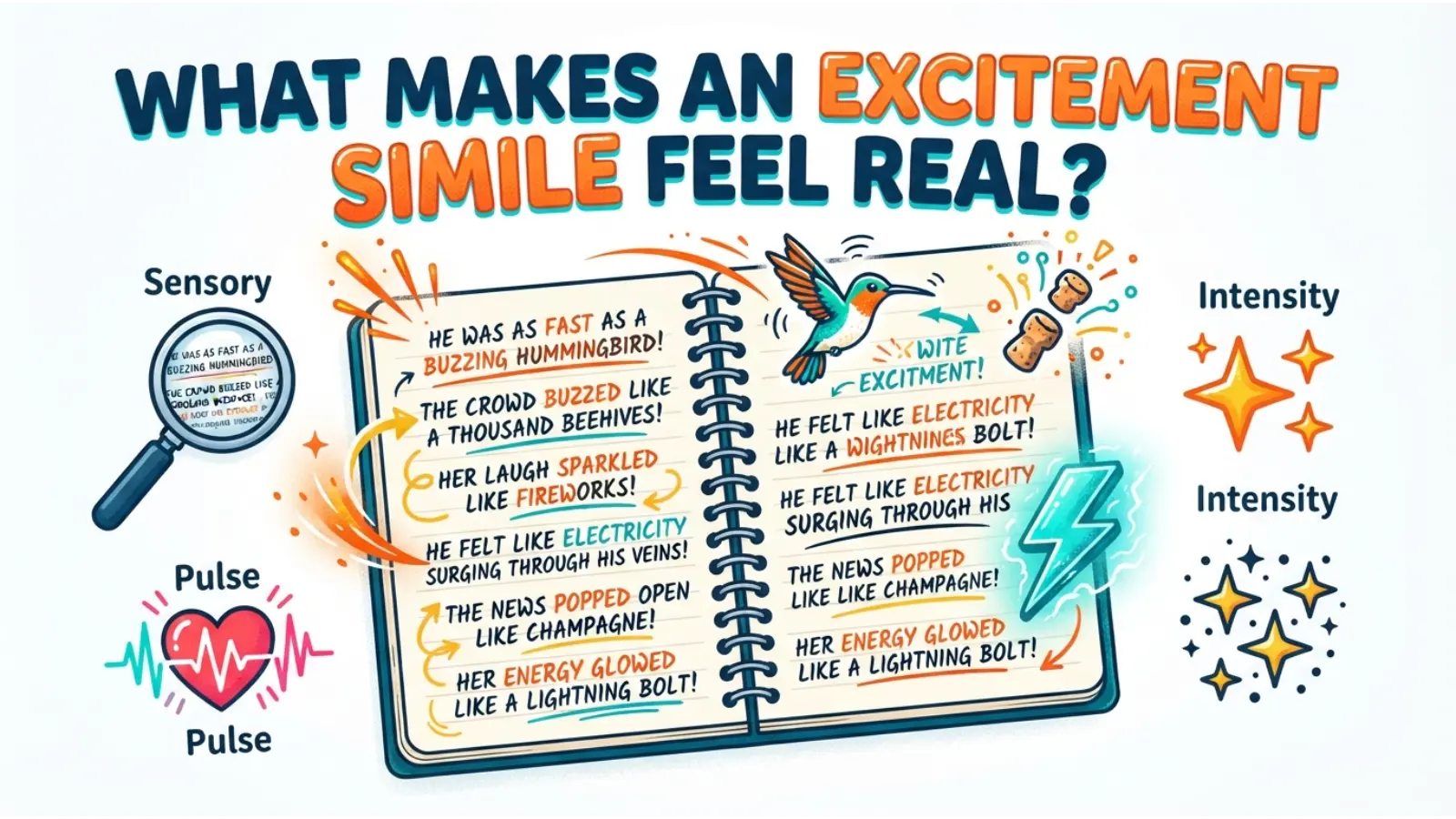
The strongest similes don’t simply compare excitement to something loud.
Instead, they connect the emotion to experiences readers recognize:
- Natural movement
- Brightness
- Discovery
- Celebration
- New beginnings
- Freedom
- Energy
The more specific the image, the more memorable the comparison becomes.
How Professional Writers Build Better Similes
Instead of choosing the first comparison that comes to mind, ask yourself:
- What kind of excitement is it?
- Is it quiet or explosive?
- Is the character nervous or confident?
- Is the excitement growing or immediate?
Matching the image to the exact emotion creates stronger writing.
For example:
Weak:
She was as excited as Christmas.
Stronger:
She was as excited as a traveler spotting the first glimpse of an unfamiliar city.
The second comparison paints a clearer picture and feels more original.
Create Your Own Similes for Excited
You can invent memorable similes by following a simple process.
Step 1: Identify the feeling
Is it:
- Joy
- Anticipation
- Nervous excitement
- Celebration
- Curiosity
Step 2: Think of something that behaves the same way
Examples:
- Rivers
- Birds
- Wind
- Fireworks
- Sunrise
- Music
- Ocean waves
Step 3: Connect them using like or as
Example:
She was as excited as a river finally reaching the sea.
Creative Exercise
Choose one event below and write three different similes for it:
- First day of school
- Winning a contest
- Meeting a favorite athlete
- Starting a new job
- Going on vacation
Try to use nature, music, weather, or movement instead of common comparisons.
Common Mistakes When Writing Excitement Similes
Using Overused Comparisons
Readers have seen familiar comparisons many times. Fresh images make your writing stand out.
Mixing Imagery
Avoid combining unrelated images in one sentence.
Poor:
He was like a rocket blooming into sunshine.
Choose one clear image instead.
Confusing Similes with Metaphors
A simile uses like or as.
Example:
She was as excited as a hummingbird before sunrise.
A metaphor removes those comparison words.
Example:
She was a hummingbird before sunrise.
Forcing the Comparison
Every simile should match the situation naturally. If the comparison distracts readers, simplify it.
Related Literary Devices
Metaphor
Metaphors make direct comparisons without using like or as. They often create a stronger, more dramatic effect.
Imagery
Imagery appeals to the senses. Pairing vivid imagery with similes helps readers see, hear, or feel excitement.
Hyperbole
Hyperbole exaggerates for emphasis. Used carefully alongside similes, it can make emotional moments feel larger than life.
Personification
Giving human qualities to nature or objects can strengthen emotional descriptions.
Example:
The morning welcomed her excitement with open arms.
Alliteration
Repeating beginning sounds can make emotional writing more rhythmic.
Example:
Bright, buzzing beginnings.
Frequently Asked Questions
What is a simile for excited?
A simile for excited compares excitement to another image using like or as, helping readers imagine the emotion more clearly.
Why should I use similes instead of simply saying “excited”?
Similes create vivid mental pictures, making emotions feel stronger and more memorable for readers.
Are similes useful in everyday conversations?
Yes. They make speech more expressive, engaging, and easier for listeners to picture.
Can I invent my own similes?
Absolutely. Original similes often make writing more creative and personal, as long as the comparison is clear and meaningful.
What makes a good excitement simile?
A good simile matches the exact feeling, uses a believable comparison, and creates a memorable image without sounding forced.
Should children learn similes?
Yes. Learning similes helps children expand their vocabulary, improve descriptive writing, and develop creative thinking.
What’s the difference between a simile and a metaphor?
A simile uses like or as, while a metaphor makes a direct comparison without those words.
Conclusion
Excitement comes in many forms—from quiet anticipation before a new adventure to the burst of joy that follows wonderful news. The best similes capture those subtle differences through fresh, meaningful comparisons rather than familiar clichés. As you practice writing, pay attention to the emotions behind each scene. Ask what the excitement feels like, then compare it to something readers can easily imagine. With time, you’ll create similes that don’t just describe excitement—they allow readers to experience it alongside your characters or ideas.
I am Helena Frost, a writer captivated by the beauty of language and the art of comparison. Through my words, I explore the world by turning ordinary moments into vivid similes and reflections. I enjoy crafting phrases that spark imagination, evoke emotion, and linger in the mind. My writing celebrates the subtle connections between people, nature, and the stories we live. For me, every sentence is an opportunity to reveal the extraordinary in the everyday.