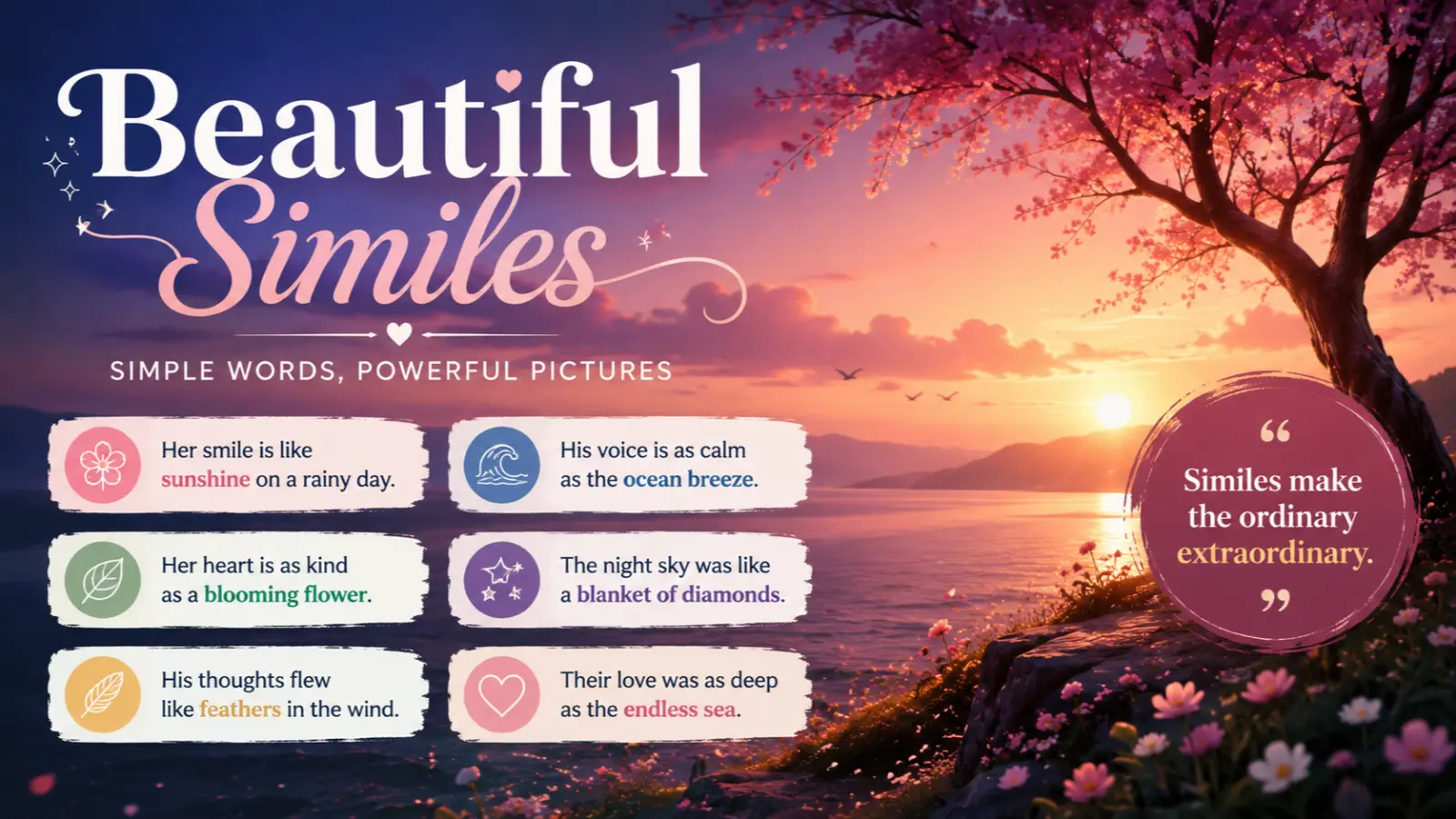
Beautiful similes help ordinary descriptions become memorable. A well-crafted simile paints a clear picture, adds emotion, and helps readers connect with your words. Whether you’re writing poetry, stories, essays, speeches, or everyday conversations, a fresh simile can make your language feel more alive A simile compares two different things using words such as like or as. Unlike plain descriptions, similes encourage readers to imagine, feel, and experience what you’re describing instead of simply reading about it This collection of beautiful similes goes beyond common comparisons. You’ll discover original examples, learn why they work, and gain practical techniques for creating your own.
What Is a Beautiful Simile?
A beautiful simile is a comparison that creates vivid imagery while feeling natural and meaningful. Instead of relying on overused phrases, it introduces readers to fresh connections that deepen emotion and spark imagination.
For example:
Her kindness spread like morning sunlight across a quiet valley.
This comparison doesn’t simply say someone is kind—it helps readers picture warmth, comfort, and hope.
Why Beautiful Similes Matter
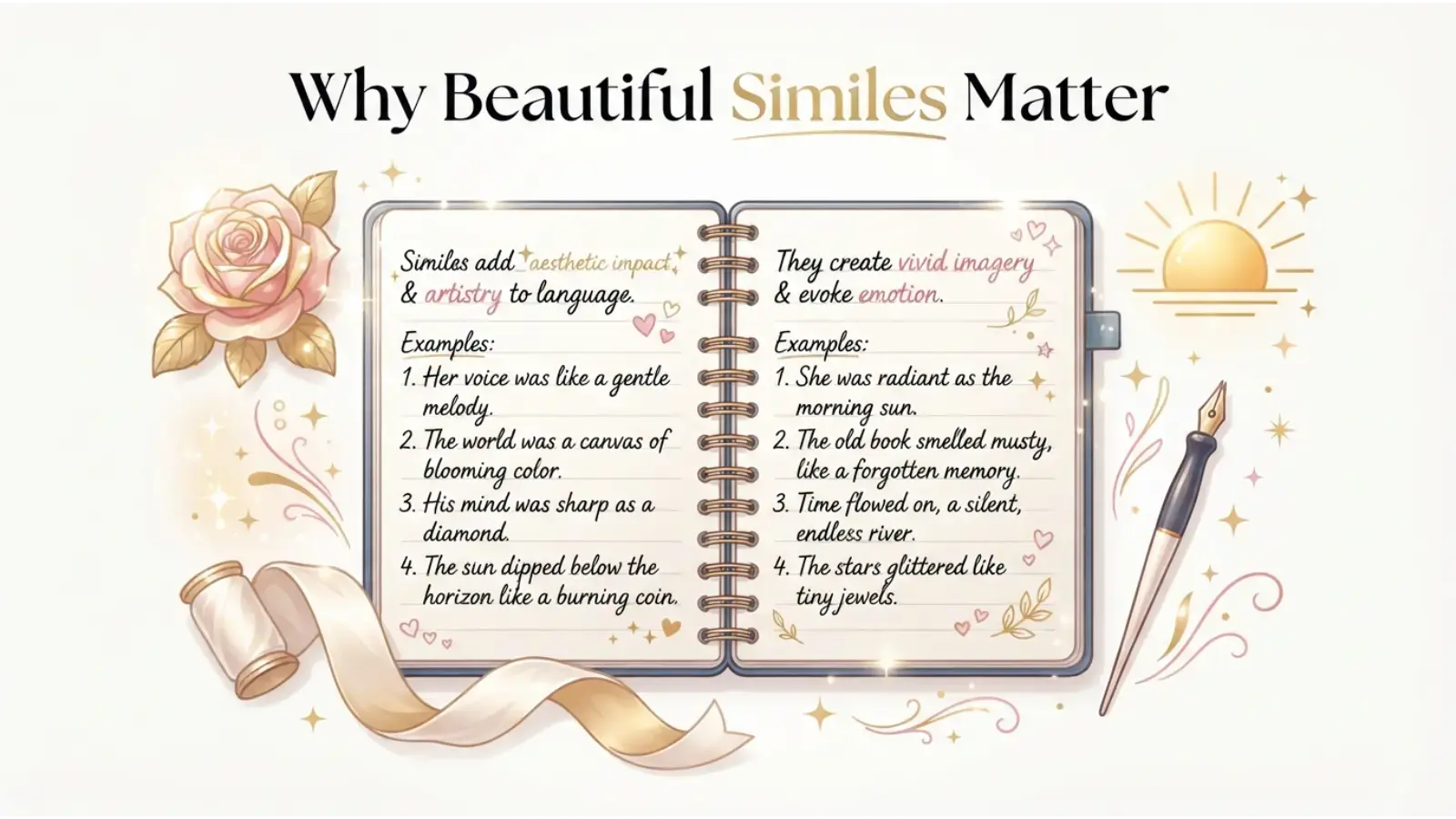
Beautiful similes make writing more engaging because they:
- Create memorable imagery.
- Strengthen emotional impact.
- Help readers visualize scenes.
- Make characters feel more realistic.
- Add rhythm to poetry and storytelling.
- Turn ordinary descriptions into expressive language.
Professional writers often choose comparisons that reveal something unexpected rather than repeating familiar expressions.
30 Original Beautiful Similes
1. As graceful as a feather drifting across still water
Meaning
Gentle and elegant movement.
Formal Example
The dancer moved as graceful as a feather drifting across still water.
Conversation Example
She walked into the room like a feather floating over a calm lake.
Storytelling Example
Every step carried the softness of a feather finding its resting place.
Writing Tip
Use when describing elegance without exaggeration.
2. Like moonlight resting on fresh snow
Meaning
Pure, peaceful beauty.
Poetry Example
Her smile lingered like moonlight resting on fresh snow.
Best Context
Romantic writing and nature descriptions.
3. As bright as wildflowers after spring rain
Meaning
Joyful and refreshing.
Conversation Example
His laughter was as bright as wildflowers after spring rain.
Why It Works
It combines color, growth, and renewal.
4. Like a lighthouse guiding quiet seas
Meaning
Reliable beauty and comfort.
Storytelling Example
Her advice stood like a lighthouse guiding quiet seas.
5. As peaceful as clouds resting above distant mountains
Meaning
Calm and reassuring.
Writing Tip
Excellent for reflective scenes.
6. Like a melody carried by the evening breeze
Meaning
Soft and unforgettable.
Poetry Example
Her voice floated like a melody carried by the evening breeze.
7. As gentle as sunrise touching sleepy hills
Meaning
Kindness and warmth.
Formal Example
His encouragement felt as gentle as sunrise touching sleepy hills.
8. Like crystal rain catching the first light
Meaning
Sparkling beauty.
Emotional Effect
Creates wonder and freshness.
9. As elegant as ivy climbing ancient stone
Meaning
Natural sophistication.
Best Context
Character descriptions.
10. Like stars blooming across velvet skies
Meaning
Magnificent nighttime beauty.
Storytelling Example
Hope appeared like stars blooming across velvet skies.
11. As refreshing as cool rain after a summer afternoon
Meaning
Relief and comfort.
Conversation Example
Talking with her felt as refreshing as cool rain after a hot day.
12. Like a pearl hidden beneath calm waves
Meaning
Quiet, understated beauty.
Writing Purpose
Perfect for describing humble people.
13. As warm as fresh bread from an old family kitchen
Meaning
Comfort and belonging.
14. Like golden leaves dancing with autumn wind
Meaning
Natural movement and color.
15. As calm as a sleeping forest before dawn
Meaning
Complete tranquility.
16. Like soft paint spreading across a sunrise sky
Meaning
Gradual beauty.
17. As timeless as mountains greeting every sunrise
Meaning
Lasting beauty.
18. Like fresh blossoms opening after gentle rain
Meaning
Growth and hope.
19. As clear as a mountain stream beneath blue skies
Meaning
Honesty and purity.
20. Like butterflies discovering a field of flowers
Meaning
Joyful excitement.
21. As delicate as frost decorating autumn leaves
Meaning
Fragile elegance.
22. Like sunlight weaving through forest branches
Meaning
Natural warmth.
23. As inviting as a glowing window on a winter evening
Meaning
Safety and welcome.
24. Like silver ripples across a quiet lake
Meaning
Peaceful movement.
25. As radiant as blossoms beneath the first spring sunrise
Meaning
Youthful beauty.
26. Like soft echoes filling an ancient cathedral
Meaning
Gentle, lasting emotion.
27. As hopeful as the first bird singing before dawn
Meaning
Optimism.
28. Like fresh dew sparkling on emerald grass
Meaning
Fresh beginnings.
29. As comforting as a favorite story remembered years later
Meaning
Emotional warmth.
30. Like a garden waking beneath the morning sun
Meaning
New life and happiness.
What Makes a Beautiful Simile Effective?
The strongest similes do more than compare two things. They create an emotional experience.
Good similes often:
- Appeal to the senses.
- Feel surprising without becoming confusing.
- Match the tone of the writing.
- Reveal something meaningful about the subject.
- Help readers picture a scene instantly.
Instead of comparing beauty to diamonds or roses every time, consider weather, seasons, music, architecture, or everyday experiences that carry emotional meaning.
How Professional Writers Create Fresh Similes
Experienced writers rarely choose the first comparison that comes to mind.
Instead they:
Observe Carefully
Notice small details in nature, cities, people, and everyday life.
Think About Emotion First
Ask yourself what feeling you want readers to experience before choosing the comparison.
Use Specific Images
Specific images create stronger mental pictures than general ones.
Instead of:
Beautiful like a flower.
Try:
Beautiful like lavender blooming after a quiet spring shower.
Create Your Own Beautiful Similes
Follow this simple process.
Step 1
Choose what you’re describing.
Example:
- Smile
- Sky
- Voice
- Friendship
Step 2
List emotions connected to it.
Examples:
- Peace
- Hope
- Joy
- Wonder
Step 3
Think of something in nature or daily life that creates the same feeling.
Step 4
Build the comparison using like or as.
Example:
Her smile spread like sunlight slipping through morning curtains.
Practice Exercise
Complete these original prompts.
- The sunset looked like __________.
- His courage was as __________.
- Her laughter danced like __________.
- The garden felt as __________.
- Hope arrived like __________.
Try writing three different answers for each. The more possibilities you explore, the more original your writing becomes.
Common Mistakes When Writing Beautiful Similes
Using Overused Comparisons
Readers have seen many classic similes countless times. Fresh comparisons leave a stronger impression.
Mixing Imagery
Avoid combining unrelated images.
Incorrect:
Her smile was like thunder blooming in the ocean.
The images compete instead of supporting each other.
Confusing Similes with Metaphors
Similes use like or as.
Metaphors make a direct comparison without those words.
Forcing Comparisons
Every simile should fit naturally within the sentence. If it distracts readers instead of helping them visualize, simplify it.
Adding Too Many Similes
A few carefully chosen comparisons are often more powerful than filling every paragraph with them.
Related Literary Devices
Metaphor
A metaphor directly states one thing is another, creating a stronger but less explicit comparison.
Imagery
Imagery uses sensory details to help readers see, hear, smell, taste, or feel a scene.
Personification
Personification gives human qualities to nonhuman things, making descriptions more expressive.
Hyperbole
Hyperbole uses intentional exaggeration for dramatic effect.
Symbolism
Symbols allow objects or actions to represent deeper meanings, adding layers to your writing.
Frequently Asked Questions
What is a beautiful simile?
A beautiful simile is a creative comparison using like or as that creates vivid imagery and emotional impact.
Why should I use beautiful similes?
They make writing more engaging, memorable, and descriptive while helping readers visualize your ideas.
Can beautiful similes be used in everyday conversation?
Yes. Natural similes can make conversations more expressive without sounding overly poetic.
How do I avoid cliché similes?
Look beyond common comparisons. Observe everyday life, nature, music, weather, and personal experiences for fresh inspiration.
Are similes better than metaphors?
Neither is better. Similes are often clearer, while metaphors can feel more powerful. The best choice depends on your purpose.
Can students use beautiful similes in school essays?
Absolutely. Original similes can improve descriptive writing, narratives, and creative assignments when used naturally.
How many similes should I include in one paragraph?
Use only as many as the writing needs. One strong simile is usually more effective than several weak ones.
Conclusion
Beautiful similes invite readers to see familiar things from a fresh perspective. The goal isn’t to create the most complicated comparison but the most meaningful one. Pay attention to the world around you, experiment with unexpected yet believable connections, and revise until each simile feels effortless.With practice, you’ll begin creating comparisons that sound natural, strengthen your storytelling, and leave lasting images in your readers’ minds. The best beautiful similes are the ones that reveal not only what something looks like, but also how it feels.
I am Helena Frost, a writer captivated by the beauty of language and the art of comparison. Through my words, I explore the world by turning ordinary moments into vivid similes and reflections. I enjoy crafting phrases that spark imagination, evoke emotion, and linger in the mind. My writing celebrates the subtle connections between people, nature, and the stories we live. For me, every sentence is an opportunity to reveal the extraordinary in the everyday.