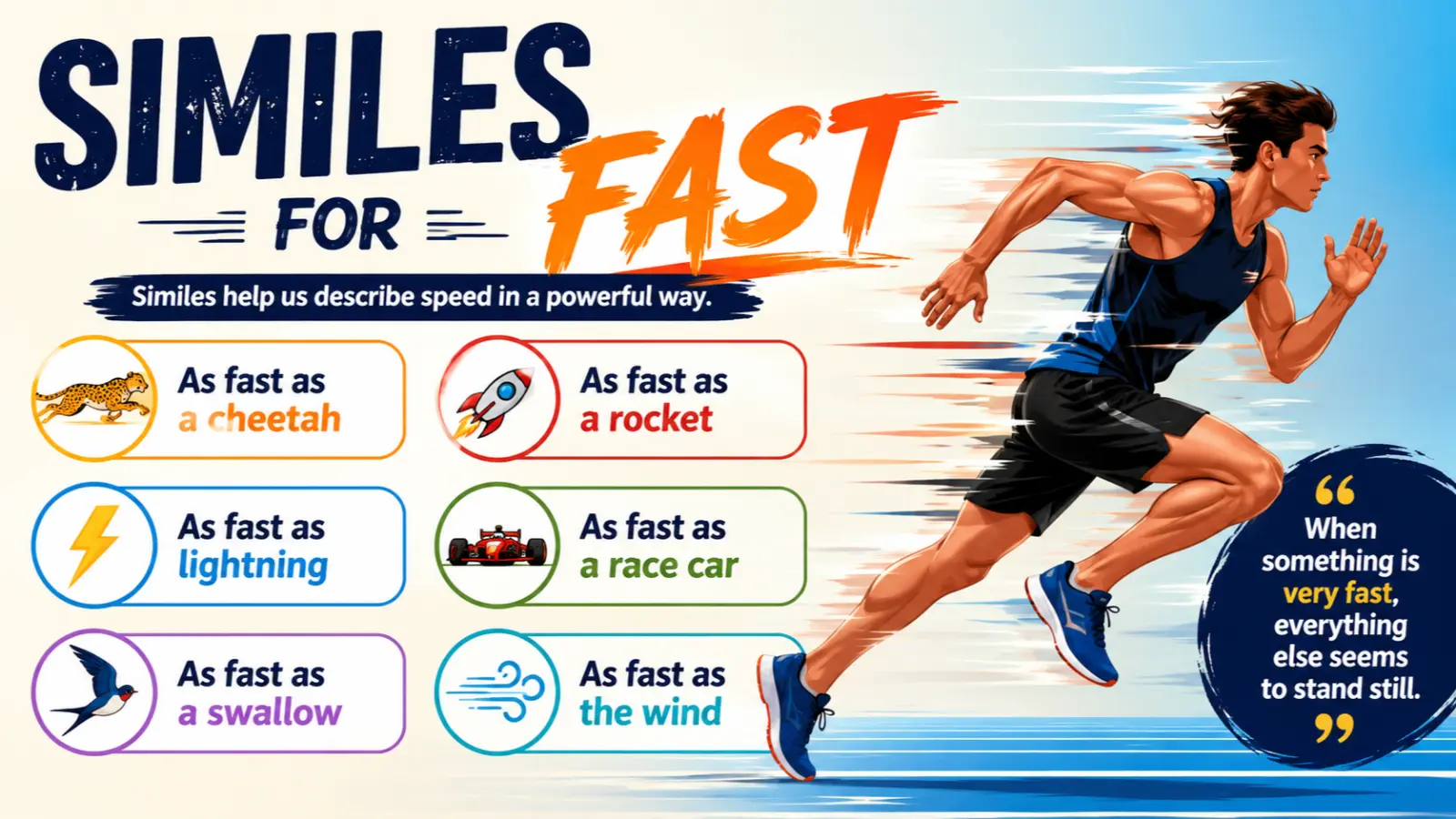
Speed is one of the easiest ideas to describe, but it can also become repetitive if every sentence relies on words like quick, rapid, or fast. That’s where similes become valuable. They compare one thing to another using like or as, helping readers instantly picture movement, energy, and urgency. Whether you’re writing a story, poem, school assignment, speech, or conversation, similes for fast can make your descriptions feel more alive. In this guide, you’ll discover original comparisons, learn why they work, and find practical ways to create your own memorable similes.
Quick Answer
Similes for fast compare speed to something familiar using like or as. For example, “as fast as a racing shadow” or “like rain chasing the wind.” Good similes help readers visualize motion while adding emotion and personality to your writing.
Why Speed Similes Make Writing Stronger
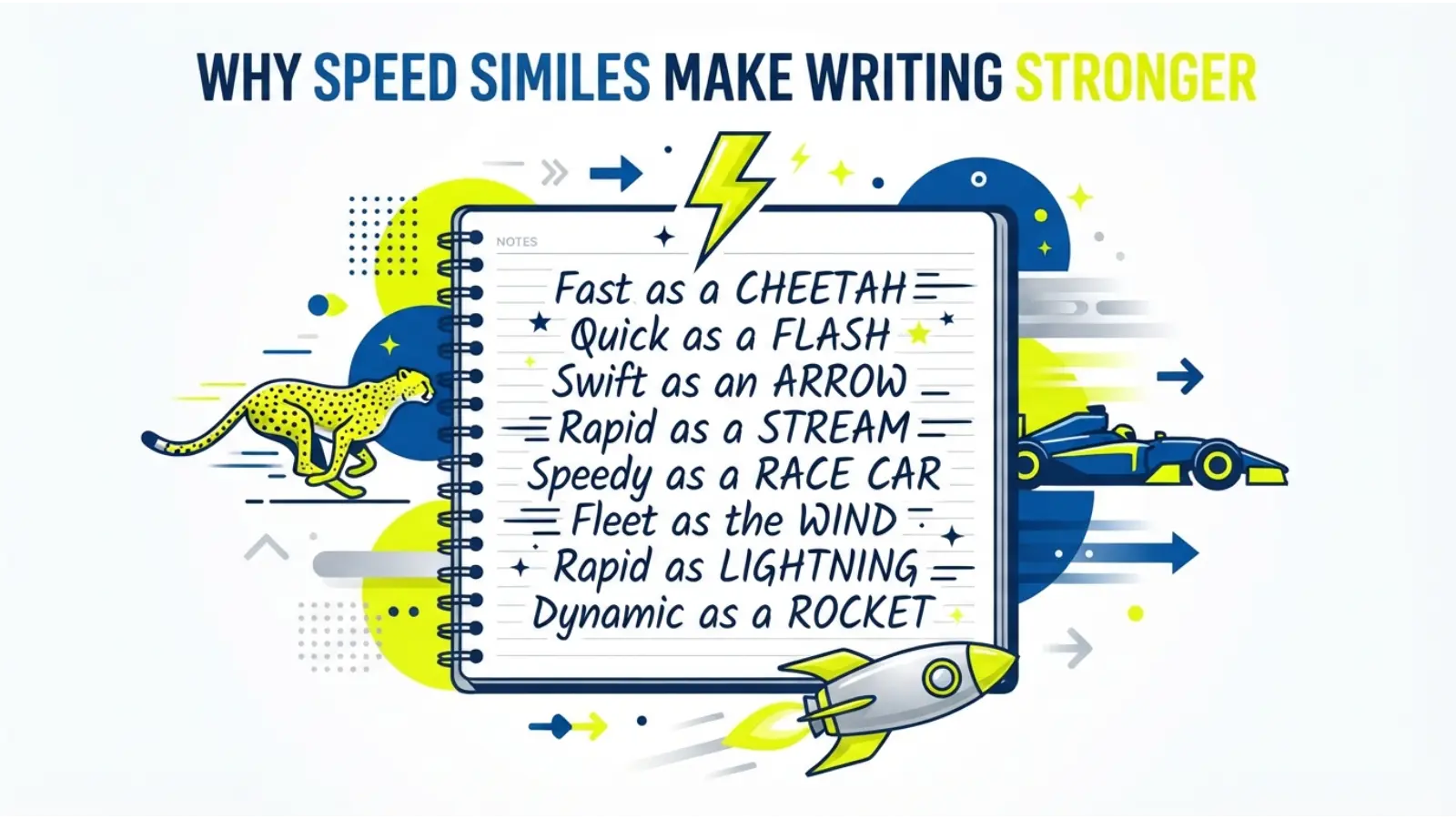
Fast movement creates excitement. It can build suspense, show determination, express panic, or highlight impressive skill.
Instead of writing:
The runner was fast.
You might write:
The runner flew across the track like a spark skipping over dry leaves.
The second sentence gives readers an image instead of simply telling them what happened.
Original Similes for Fast
As Fast as a Falling Star
Meaning: Extremely quick with a touch of beauty.
Formal Example:
The rescue team moved as fast as a falling star.
Storytelling Example:
She disappeared into the crowd as fast as a falling star across the night sky.
Best For: Adventure and fantasy writing.
Like Rain Chasing the Wind
This comparison suggests unstoppable movement.
Conversation Example:
He finished his chores like rain chasing the wind.
Writing Tip:
Use when speed feels effortless.
As Fast as a River After the Storm
This simile combines power with speed.
Poetry Example:
His thoughts rushed as fast as a river after the storm.
Like a Feather Caught in a Gust
Perfect for describing light, unpredictable movement.
As Fast as Morning Light Filling a Room
A softer comparison ideal for positive scenes.
Like a Pebble Skipping Across Water
Useful for describing quick repeated movements.
As Fast as a Fox Crossing an Open Field
Works well in nature-inspired writing.
Like Fire Racing Through Dry Grass
Creates urgency and intensity.
As Fast as Fresh Paint Dripping Down Glass
A creative comparison for smooth, continuous movement.
Like an Arrow Finding Its Target
Suggests both speed and precision.
As Fast as Waves Reaching the Shore
Excellent for natural descriptions.
Like Snow Sliding from a Rooftop
Ideal for sudden movement.
As Fast as Leaves Swept by Autumn Wind
Shows natural motion with elegance.
Like a Flash Across a Mirror
Useful for describing brief appearances.
As Fast as Water Escaping Open Hands
Highlights speed that cannot be stopped.
Like a Song Racing Through an Empty Hall
Adds rhythm and energy.
As Fast as a Shadow at Sunset
Works well for mystery stories.
Like Clouds Driven by Mountain Winds
Suggests constant movement.
As Fast as Sand Slipping Through Fingers
Perfect when time seems to disappear.
Like a Bird Diving Toward the Sea
Captures graceful speed.
As Fast as a Candle Flame Dancing in Wind
Shows quick, lively motion.
Like Moonlight Crossing Quiet Water
A gentle comparison for graceful movement.
As Fast as an Echo Returning
Useful when something happens almost instantly.
Like a Bee Returning to Its Hive
Great for describing purposeful speed.
As Fast as a Droplet Rolling Down a Window
A subtle image for smooth movement.
Like Smoke Rising Through Cool Air
Works well for upward movement.
As Fast as Spring Water Down a Hill
Natural and refreshing imagery.
Like Wind Weaving Through Tall Pines
Creates a vivid outdoor scene.
As Fast as a Shooting Spark
Ideal for action scenes.
Like Sunshine Breaking Through Clouds
Expresses sudden movement with optimism.
Choosing the Right Simile for Your Writing
Action Stories
Choose energetic comparisons that create urgency.
Examples include arrows, rivers, sparks, and fire.
Poetry
Focus on rhythm and emotion.
Nature-based comparisons often sound more musical.
Everyday Conversation
Simple similes are usually the most effective.
Example:
“She answered as fast as morning light.”
Children’s Writing
Use familiar images that are easy to imagine.
For example:
- Like a bunny hopping home
- As fast as rolling marbles
- Like popcorn popping
Why These Similes Work
Strong similes share three important qualities.
They Create a Picture
Readers immediately imagine the comparison.
They Match the Mood
A race and a peaceful sunrise create different emotional effects.
They Feel Natural
Good comparisons sound believable rather than forced.
How Professional Writers Create Fresh Similes
Experienced writers often begin with an emotion instead of an object.
Ask yourself:
- Is the movement smooth?
- Is it powerful?
- Is it surprising?
- Is it graceful?
- Is it chaotic?
Then find something in nature, everyday life, or human experience that behaves the same way.
This approach produces original imagery instead of repeating familiar comparisons.
Create Your Own Similes for Fast
Follow these simple steps.
Step 1
Think about the type of speed.
Is it gentle, explosive, graceful, or unstoppable?
Step 2
Look around for something with similar movement.
Water, wind, animals, light, music, or weather can all inspire comparisons.
Step 3
Compare them naturally.
Example:
The bicycle moved like sunlight spilling across the sidewalk.
Creative Exercise
Choose one object from each category.
- Animal
- Weather
- Water
- Light
- Music
Write one original simile for each. Compare its movement to speed in a unique way.
Related Literary Devices
Metaphor
A metaphor makes a direct comparison without using like or as.
Simile: She ran like the wind.
Metaphor: She was the wind.
Imagery
Imagery uses descriptive language to help readers experience a scene through their senses. Many effective similes strengthen imagery.
Hyperbole
Hyperbole exaggerates for emphasis.
Example:
“He finished before the clock could blink.”
Personification
Personification gives human actions to non-human things.
Example:
“The wind hurried through the valley.”
Alliteration
Pairing alliteration with similes creates memorable phrases.
Example:
“Swift as silent snow.”
Common Mistakes to Avoid
Using Overused Comparisons
Readers have seen the same comparisons countless times. Fresh imagery is usually more memorable.
Mixing Images
Avoid combining unrelated ideas.
Weak:
“Fast as lightning swimming through honey.”
Choose one clear image instead.
Forcing Comparisons
A simile should feel natural.
If readers have to stop and decode it, simplify it.
Confusing Similes with Metaphors
Remember:
- Similes use like or as.
- Metaphors do not.
Choosing the Wrong Mood
A playful comparison may weaken a serious scene.
Always match the simile to the emotion of your writing.
Frequently Asked Questions
What is a simile for fast?
A simile for fast compares speed to another object or action using like or as to create a vivid image.
What are good alternatives to “as fast as lightning”?
Try fresh comparisons such as as fast as a falling star, like rain chasing the wind, or as fast as morning light filling a room.
Are similes useful in school writing?
Yes. They improve descriptive writing, storytelling, essays, and creative assignments by making ideas easier to imagine.
Can I invent my own similes?
Absolutely. Original similes often make writing more memorable than familiar expressions.
Should every sentence contain a simile?
No. Similes are most effective when used selectively to highlight important moments.
What’s the difference between a simile and imagery?
A simile is one technique that creates imagery. Imagery includes all descriptive language that appeals to the senses.
Conclusion
Great writing doesn’t simply tell readers that something is fast—it helps them experience the movement. Original similes turn ordinary descriptions into memorable scenes by connecting speed with images people instantly recognize. Experiment with different comparisons, observe the world around you, and don’t be afraid to invent your own. The more you practice, the more naturally vivid your writing will become.
I am Helena Frost, a writer captivated by the beauty of language and the art of comparison. Through my words, I explore the world by turning ordinary moments into vivid similes and reflections. I enjoy crafting phrases that spark imagination, evoke emotion, and linger in the mind. My writing celebrates the subtle connections between people, nature, and the stories we live. For me, every sentence is an opportunity to reveal the extraordinary in the everyday.