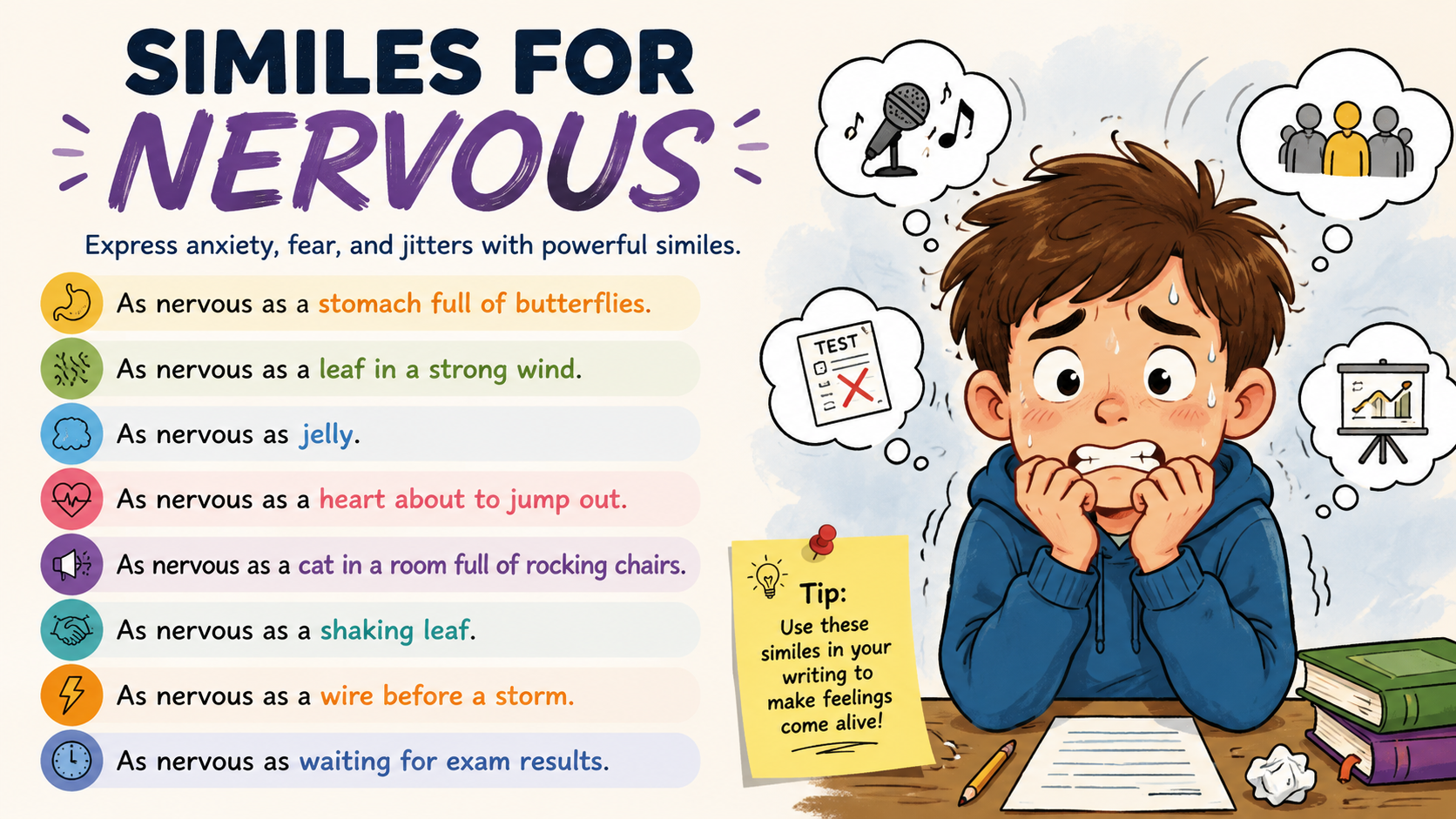
Feeling nervous is something everyone experiences, whether before an interview, a speech, an exam, or an important conversation. Writers often struggle to describe that emotion in a fresh, believable way. That’s where similes become useful. A simile compares one thing to another using “like” or “as.” It helps readers picture emotions instead of simply being told about them. Strong similes can make characters feel more real, poems more vivid, and everyday writing more memorable. In this guide, you’ll discover original similes for nervous feelings, learn why they work, see them used in different kinds of writing, and pick up practical techniques for creating your own.
Quick Answer
Similes for nervous compare the feeling of anxiety or anticipation to familiar experiences using like or as. For example, “She was as nervous as a candle flickering in the wind.” These comparisons help readers imagine emotional tension more clearly and add depth to stories, conversations, and creative writing.
Why Use Similes to Describe Nervousness?
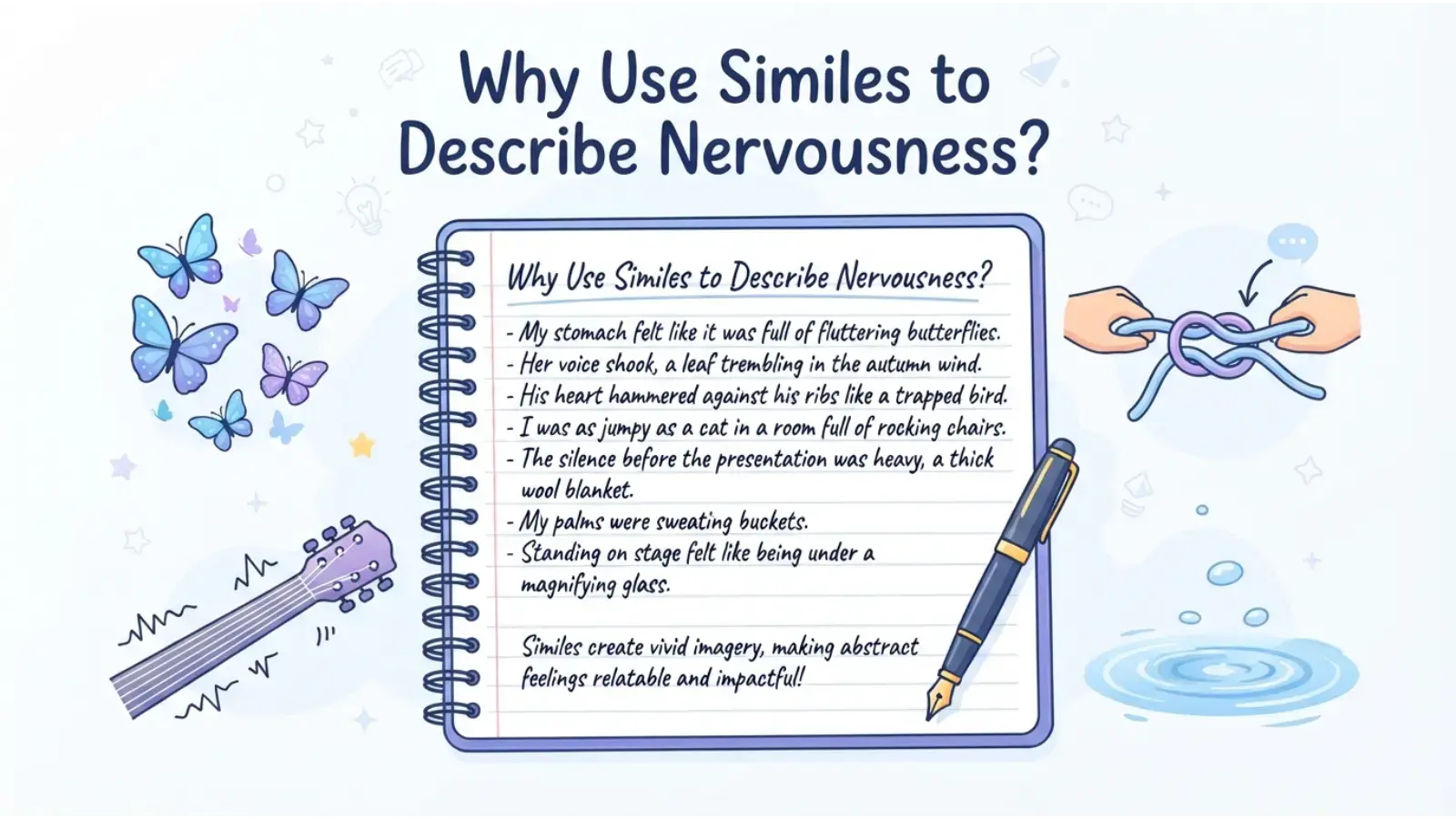
Nervousness isn’t always easy to explain directly. Saying someone was “very nervous” tells the reader little about how that emotion feels.
A well-crafted simile can reveal:
- Physical tension
- Emotional uncertainty
- Fear of the unknown
- Excitement mixed with anxiety
- Vulnerability before an important moment
Instead of describing the emotion, you allow readers to experience it.
Original Similes for Nervous Feelings
Like a Leaf Waiting for the First Strong Wind
Meaning: Expecting something unsettling to happen.
Formal Example: He stood outside the courtroom like a leaf waiting for the first strong wind.
Conversation: I felt like a leaf waiting for the first strong wind before the interview.
Writing Tip: Works well for suspenseful scenes.
As Nervous as a Candle Flickering in the Wind
Meaning: Emotionally fragile.
Story Example: She smiled politely, but inside she was as nervous as a candle flickering in the wind.
Like a Bird Hovering Above Unfamiliar Water
Meaning: Unsure whether it’s safe to move forward.
Poetry Example: My thoughts circled like a bird hovering above unfamiliar water.
As Nervous as Shoes at the Edge of a Cliff
Meaning: Feeling one step away from disaster.
Best used in dramatic storytelling.
Like Ice Beginning to Crack
Meaning: Holding together, but only just.
Conversation:
“I looked calm, but inside I felt like ice beginning to crack.”
As Nervous as a Letter Waiting to Be Opened
Meaning: Full of uncertainty about what comes next.
Perfect for emotional fiction.
Like a Rabbit Listening for Footsteps
Meaning: Extremely alert and cautious.
As Nervous as a Star Before Sunrise
Meaning: Afraid of disappearing or losing confidence.
Works beautifully in poetry.
Like a Balloon Floating Through Thorn Bushes
Meaning: Feeling exposed to danger.
As Nervous as Fresh Paint Before the Rain
Meaning: Worried everything might go wrong.
Like a Compass Spinning Without North
Meaning: Feeling confused and anxious.
As Nervous as a Snowflake Landing on Fire
Meaning: Feeling completely out of place.
Like a Piano Key Waiting for the First Note
Meaning: Anticipating an important moment.
As Nervous as Glass Crossing a Stone Road
Meaning: Feeling delicate under pressure.
Like a Sail Waiting for the Storm
Meaning: Expecting difficulty.
As Nervous as Ink Before the First Word
Meaning: Waiting for creativity or judgment.
Excellent for writers.
Like a Deer Hearing an Unexpected Sound
Meaning: Instantly alert.
As Nervous as a Bridge During Its First Crossing
Meaning: Facing an important test.
Like a Seed Beneath Frozen Soil
Meaning: Full of hidden anticipation.
As Nervous as Morning Fog Before the Sun
Meaning: Unsure how long uncertainty will last.
Like a Feather Balancing on a Fence
Meaning: Emotionally unsettled.
As Nervous as a Clock Before Midnight
Meaning: Waiting for a significant event.
Like a Wave Holding Its Breath
Meaning: Quiet anticipation.
As Nervous as a Firefly in Daylight
Meaning: Feeling exposed.
Like a Book Waiting for Its Ending
Meaning: Wondering what will happen next.
As Nervous as a Violin Before the Concert
Meaning: Preparing for an important performance.
Like Rain Gathering Behind Dark Clouds
Meaning: Anxiety slowly building.
As Nervous as an Empty Chair Before an Interview
Meaning: Waiting to be judged.
Like Sand Slipping Through Open Fingers
Meaning: Losing confidence.
As Nervous as a Door Before the Knock
Meaning: Expecting unexpected news.
What Makes These Similes Effective?
The strongest similes do more than compare objects.
They connect an emotional experience with something readers already understand. A flickering candle suggests uncertainty. Cracking ice suggests emotional pressure. A spinning compass reflects confusion.
When readers recognize both images, the comparison becomes memorable.
Writing Better Similes for Nervous Characters
Focus on One Emotion
Choose whether your character feels:
- Fear
- Excitement
- Anxiety
- Embarrassment
- Anticipation
Trying to express several emotions in one comparison often weakens the image.
Notice Physical Reactions
Nervousness often appears through:
- Shaking hands
- Dry mouth
- Racing heartbeat
- Restless movement
- Tight muscles
These details can inspire fresh comparisons.
Use Familiar Images in New Ways
Instead of comparing nervousness to obvious objects, think about ordinary things that behave in uncertain ways.
Examples include:
- A loose thread
- A paper boat
- A dim lantern
- A frozen stream
- A waiting train
Fresh images keep your writing original.
Related Literary Devices
Metaphor
A metaphor states that something is another thing instead of using “like” or “as.”
Simile: She was as nervous as a flickering candle.
Metaphor: She was a flickering candle in the storm.
Imagery
Imagery appeals to the senses. Strong similes often create vivid imagery by helping readers see, hear, or even feel a moment.
Hyperbole
Hyperbole intentionally exaggerates emotion.
Example:
“I was so nervous I thought my heartbeat could wake the neighborhood.”
Personification
Personification gives human qualities to non-human things.
Example:
“The hallway watched me with silent curiosity.”
Symbolism
Objects can symbolize emotional states. Storms, cracked glass, fading light, or tangled vines often symbolize uncertainty or anxiety.
Create Your Own Similes for Nervous Feelings
You don’t need to wait for inspiration.
Follow this simple process:
Step 1: Identify the Emotion
Ask yourself what kind of nervousness you’re describing.
Step 2: Observe the World
Think about everyday objects or natural events that behave similarly.
Step 3: Compare Carefully
Use like or as to connect the feeling with the image.
Step 4: Test the Comparison
Ask:
- Does it create a clear picture?
- Does it feel believable?
- Is it original?
- Does it fit the character?
Creative Exercise
Write five situations where someone feels nervous.
For each situation, avoid using common comparisons. Instead, describe the feeling using an object, place, weather condition, or animal you’ve personally observed.
Common Mistakes When Writing Similes
Relying on Overused Comparisons
Readers have seen familiar comparisons many times. Fresh imagery leaves a stronger impression.
Mixing Different Images
Avoid combining unrelated comparisons in one sentence.
Weak:
“He was like a bird swimming through lightning.”
The images compete instead of supporting each other.
Confusing Similes and Metaphors
Remember:
- Similes use like or as.
- Metaphors make a direct comparison.
Choosing Images That Don’t Match the Emotion
Make sure your comparison reflects nervousness rather than another feeling like happiness or anger.
Explaining Too Much
Once the simile creates a vivid picture, trust the reader. Extra explanation often reduces its impact.
Frequently Asked Questions
What is a good simile for nervous?
A strong example is “as nervous as a candle flickering in the wind,” because it suggests uncertainty and emotional vulnerability.
How do similes improve writing?
They create vivid mental images that help readers experience emotions instead of simply reading about them.
Can similes describe positive nervousness?
Yes. Nervous excitement before a performance, wedding, or celebration can also be expressed through thoughtful comparisons.
Are similes suitable for academic writing?
They are generally better suited to creative writing, speeches, and descriptive essays than formal academic papers.
What’s the difference between a simile and a metaphor?
A simile uses like or as, while a metaphor directly equates one thing with another.
How can I make my similes more original?
Observe everyday objects, nature, movement, and emotions. Build comparisons from real experiences instead of relying on familiar expressions.
Conclusion
The best similes for nervous feelings don’t simply decorate your writing—they help readers understand emotions through vivid, relatable images. Whether you’re writing fiction, poetry, personal essays, or dialogue, thoughtful comparisons can transform ordinary descriptions into memorable moments. Experiment with your own observations, pay attention to how emotions appear in everyday life, and don’t be afraid to create comparisons that feel fresh and authentic. The more you practice, the more naturally original similes will come to you.
I am Helena Frost, a writer captivated by the beauty of language and the art of comparison. Through my words, I explore the world by turning ordinary moments into vivid similes and reflections. I enjoy crafting phrases that spark imagination, evoke emotion, and linger in the mind. My writing celebrates the subtle connections between people, nature, and the stories we live. For me, every sentence is an opportunity to reveal the extraordinary in the everyday.