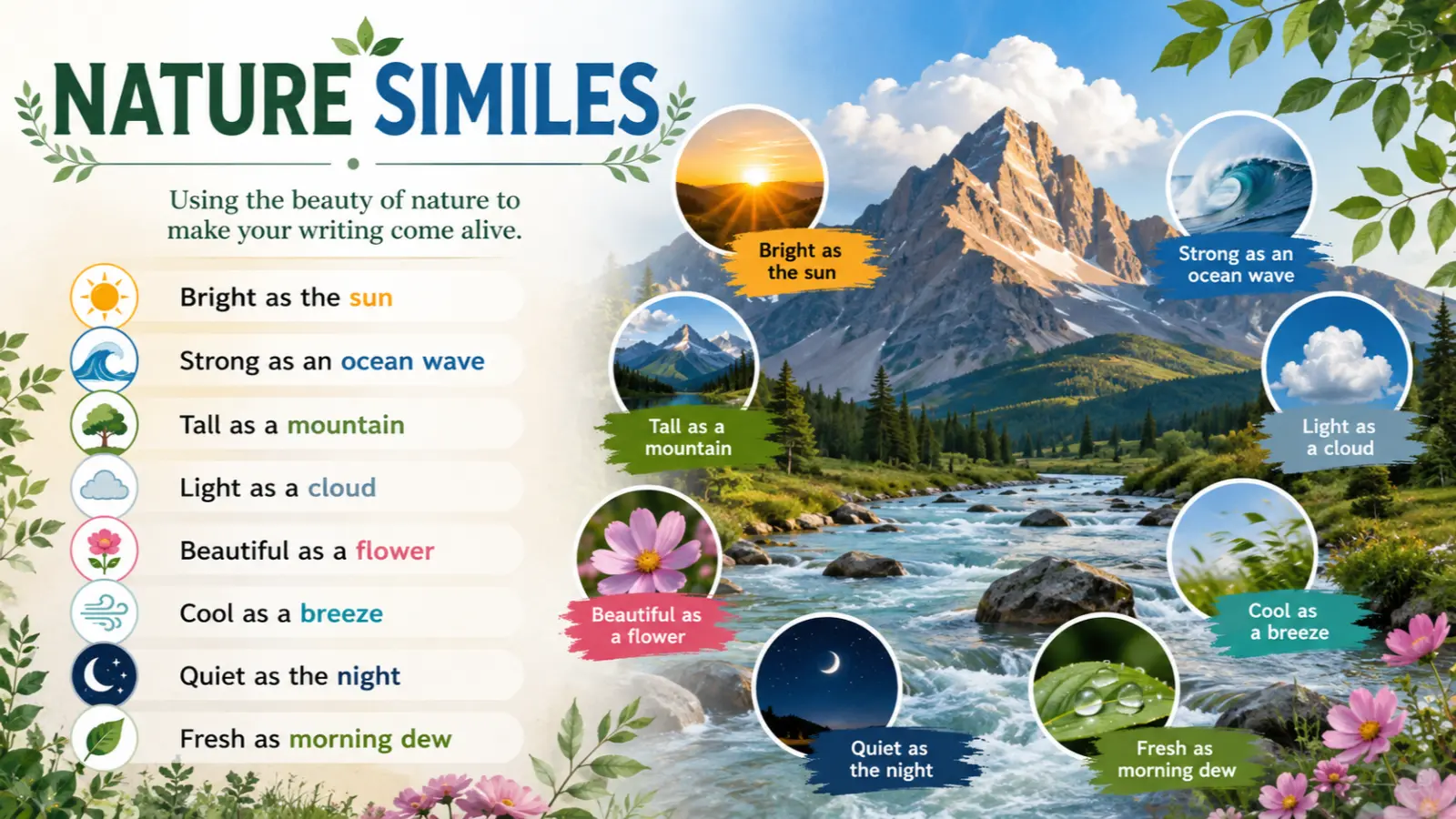
Nature has inspired writers for centuries because it offers endless colors, sounds, textures, and emotions. A quiet forest, a rushing river, or a glowing sunset can instantly paint a picture in a reader’s mind. When these natural images are used in similes, ordinary writing becomes memorable. A simile compares two different things using the words “like” or “as.” Instead of simply saying someone is calm, you might describe them as “as peaceful as a lake at dawn.” The comparison helps readers see and feel the emotion instead of just reading about it. Nature similes appear everywhere—from novels and poems to speeches, classrooms, and everyday conversations.
Quick Answer
Nature similes compare people, emotions, objects, or experiences with elements of nature using “like” or “as.” They create strong imagery by connecting ideas with familiar natural scenes such as forests, rivers, mountains, flowers, rain, or the sky. Well-crafted nature similes make writing more expressive, memorable, and emotionally engaging.
Why Nature Makes Powerful Similes
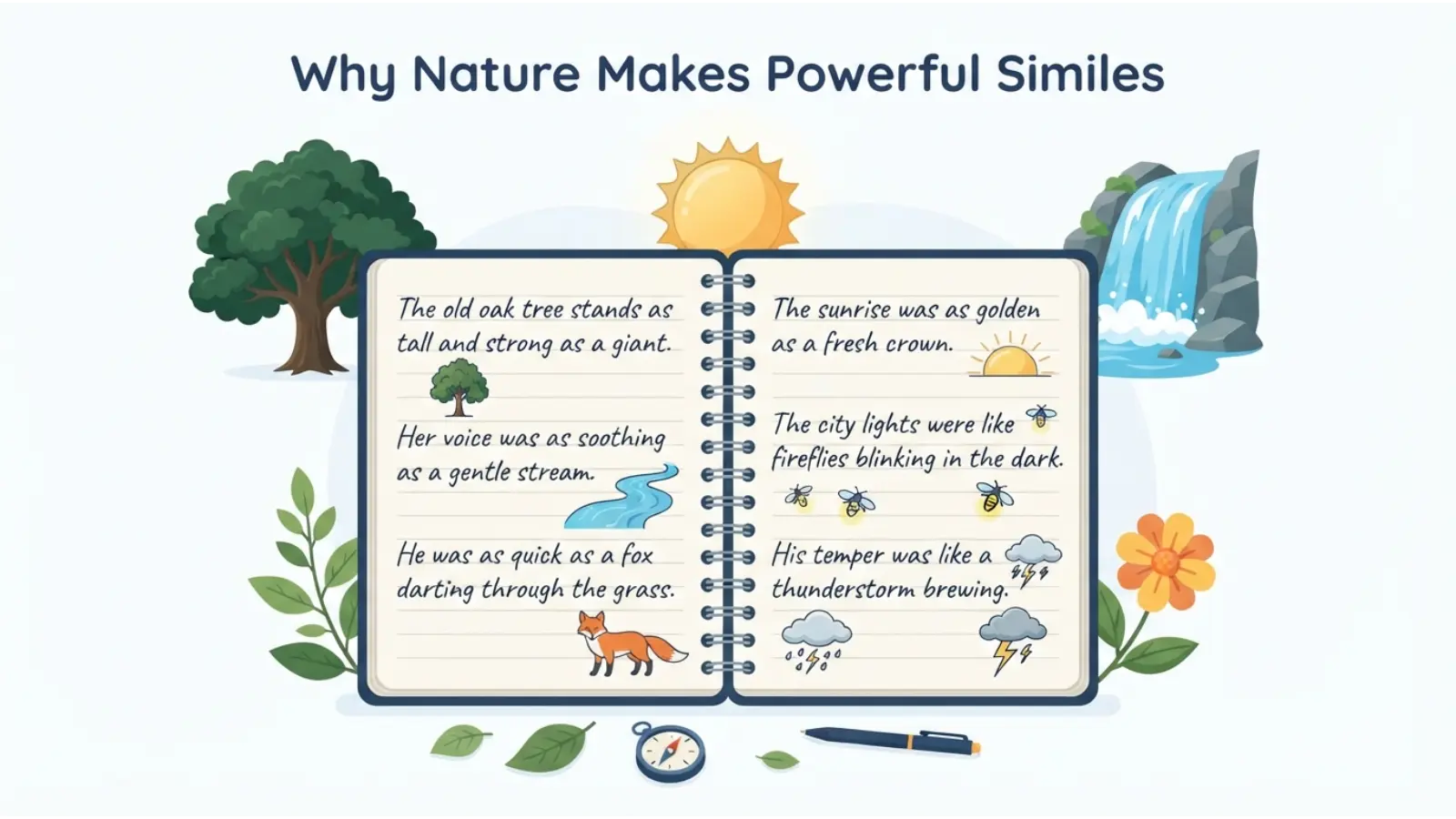
Nature constantly changes, making it one of the richest sources of comparison.
A gentle breeze can suggest comfort. A mountain can represent strength. Morning sunlight often symbolizes hope, while gathering clouds can hint at uncertainty.
Because readers already understand these natural images, they quickly connect with the feelings behind the comparison.
Good nature similes do more than decorate a sentence—they deepen its meaning.
Finding Fresh Inspiration in Nature
The strongest comparisons usually come from careful observation rather than familiar sayings.
Instead of reaching for overused expressions, notice small details:
- The shimmer of dew before sunrise
- The quiet movement of drifting clouds
- The steady rhythm of ocean waves
- The first flower after winter
- Leaves dancing in the wind
These observations lead to unique and believable similes.
Original Nature Similes with Meanings and Examples
1. As patient as a mountain waiting for spring
Meaning: Calm endurance over a long period.
Formal example:
The old gardener remained as patient as a mountain waiting for spring despite years of drought.
Storytelling:
She waited without complaint, as patient as a mountain waiting for spring, believing better days would come.
Writing Tip:
Use this simile when describing resilience instead of simple waiting.
2. Like sunlight slipping through pine trees
Meaning: Gentle hope arriving quietly.
Conversation:
Your advice felt like sunlight slipping through pine trees when I needed encouragement.
Poetry:
Her laughter arrived like sunlight slipping through pine trees, warming forgotten places.
3. As graceful as mist floating over a quiet lake
Meaning: Elegant and effortless movement.
Best Context: Dance, wildlife, peaceful scenes, or gentle personalities.
Story Example:
The ballerina moved as graceful as mist floating over a quiet lake.
4. Like a river finding its own path
Meaning: Following one’s purpose naturally.
Formal Example:
His career developed like a river finding its own path, shaped by experience rather than careful plans.
Writing Tip:
Excellent for personal growth stories.
5. As refreshing as rain after a long summer
Meaning: Bringing relief or comfort.
Conversation:
Seeing an old friend was as refreshing as rain after a long summer.
Emotional Effect: Creates feelings of renewal.
6. Like leaves dancing with the autumn wind
Meaning: Joyful movement filled with freedom.
Storytelling:
The children ran across the field like leaves dancing with the autumn wind.
7. As steady as the morning tide
Meaning: Dependable and reliable.
Formal Example:
Her support remained as steady as the morning tide through every challenge.
Best Context: Loyalty, leadership, friendship.
8. Like wildflowers brightening forgotten paths
Meaning: Bringing unexpected happiness.
Poetry:
Kind words bloomed like wildflowers brightening forgotten paths.
Writing Tip:
Perfect for hopeful or uplifting scenes.
9. As quiet as snow settling on pine branches
Meaning: Complete silence filled with peace.
Storytelling:
The village became as quiet as snow settling on pine branches before sunrise.
10. Like the first breeze after sunrise
Meaning: Gentle new beginnings.
Conversation:
Starting my new job felt like the first breeze after sunrise.
11. As bright as dew catching the morning light
Meaning: Full of freshness and optimism.
Formal Example:
Her ideas were as bright as dew catching the morning light.
Writing Purpose:
Ideal for describing creativity or youthful energy.
12. Like a waterfall singing through the valley
Meaning: Full of life and joyful energy.
Storytelling:
His laughter echoed like a waterfall singing through the valley.
Writing Insight: Why These Similes Feel Fresh
Notice that each comparison focuses on a specific moment in nature rather than a broad object.
Compare these two examples:
❌ As beautiful as a flower.
✅ As bright as dew catching the morning light.
The second example paints a clearer picture because it highlights a precise image instead of a general idea.
Professional writers often build similes from small observations. The more specific your comparison, the more memorable it becomes.
More Original Nature Similes
The best nature similes do more than compare two things—they create an experience. The following original examples explore different moods, emotions, and settings while showing how you can adapt each comparison in your own writing.
13. Like moonlight resting on still water
Meaning: Calm, gentle beauty that quietly captures attention.
Storytelling:
Her smile spread like moonlight resting on still water, peaceful and reassuring.
Best Context: Romance, reflective moments, quiet endings.
14. As fearless as an eagle riding a mountain wind
Meaning: Bold confidence in uncertain situations.
Formal Example:
The explorer remained as fearless as an eagle riding a mountain wind.
Writing Tip:
Works well for heroes, adventurers, and leaders.
15. Like moss softening an ancient stone
Meaning: Kindness gradually easing pain or hardship.
Conversation:
Her encouragement settled over my worries like moss softening an ancient stone.
16. As lively as a meadow after spring rain
Meaning: Filled with energy, color, and excitement.
Poetry:
The festival became as lively as a meadow after spring rain.
17. Like clouds opening for the morning sun
Meaning: Worry giving way to hope.
Story Example:
His doubts faded like clouds opening for the morning sun.
18. As rooted as an old oak beside the river
Meaning: Strong, dependable, and deeply connected.
Formal Example:
Their traditions remained as rooted as an old oak beside the river.
19. Like frost melting beneath gentle sunlight
Meaning: Anger or sadness slowly disappearing.
Conversation:
My frustration vanished like frost melting beneath gentle sunlight.
20. As clear as a forest stream after rainfall
Meaning: Easy to understand.
Formal Example:
Her explanation became as clear as a forest stream after rainfall.
21. Like stars appearing one by one
Meaning: Hope growing gradually.
Storytelling:
New ideas arrived like stars appearing one by one.
22. As gentle as petals carried by the breeze
Meaning: Soft, caring, and delicate.
Poetry:
His voice floated as gentle as petals carried by the breeze.
23. Like roots searching through rich soil
Meaning: Determined growth and quiet persistence.
Writing Purpose:
Ideal for personal development stories.
24. As colorful as autumn reflected in a quiet lake
Meaning: Rich, vibrant, and full of personality.
Storytelling:
The village market was as colorful as autumn reflected in a quiet lake.
25. Like the scent of pine after fresh rain
Meaning: Refreshing and comforting.
Conversation:
Coming home felt like the scent of pine after fresh rain.
26. As endless as the horizon over the sea
Meaning: Boundless possibilities or dreams.
Formal Example:
Her imagination seemed as endless as the horizon over the sea.
27. Like fireflies lighting a summer field
Meaning: Small moments creating unexpected joy.
Storytelling:
Their laughter sparkled like fireflies lighting a summer field.
28. As balanced as branches holding morning birds
Meaning: Peaceful stability.
Writing Tip:
Use when describing harmony rather than perfection.
29. Like waves polishing smooth stones
Meaning: Improvement through patience and time.
Formal Example:
Experience shaped his skills like waves polishing smooth stones.
30. As welcoming as the first bloom of spring
Meaning: Warm, inviting, and full of hope.
Conversation:
Their home felt as welcoming as the first bloom of spring.
How Professional Writers Build Strong Nature Similes
Great writers rarely choose the first comparison that comes to mind. Instead, they observe nature closely and ask questions such as:
- What color stands out?
- How does it move?
- What sound does it make?
- What emotion does it naturally suggest?
- What tiny detail would readers notice?
For example, instead of comparing someone to a flower, think about a flower opening at sunrise, bending in the wind, or blooming after rain. Specific details create stronger imagery.
How to Create Your Own Nature Similes
Creating original similes becomes easier when you follow a simple process.
Step 1: Choose an emotion or quality
Think about what you want to describe.
Examples:
- Courage
- Joy
- Loneliness
- Curiosity
- Strength
- Peace
Step 2: Find a matching scene in nature
Ask yourself:
- What natural image feels similar?
- Does it move slowly or quickly?
- Is it bright, quiet, powerful, or delicate?
For example:
Emotion: Hope
Nature: Sunrise after a storm
Step 3: Connect them using “like” or “as”
Example:
Hope spread through the village like sunrise washing away the last shadows of night.
Step 4: Make it more specific
Avoid:
As beautiful as nature.
Instead write:
As radiant as wildflowers glowing beneath the evening sun.
Specific details make your writing memorable.
Creative Writing Exercises
Exercise 1
Choose one season.
Write three similes inspired by:
- Weather
- Trees
- Animals
Exercise 2
Describe a character without mentioning emotions directly.
Instead, use only nature similes.
Exercise 3
Visit a park or simply look outside your window.
Write down five small natural details.
Turn each observation into an original simile.
For example:
Observation: Leaves spinning in the wind.
Simile:
Ideas scattered through her mind like leaves spinning in an autumn breeze.
Writing Insight: Fresh Beats Familiar
Readers remember unusual yet believable comparisons. Instead of relying on famous expressions, pay attention to the details around you. The sparkle of dew, the hush before snowfall, or the scent after rain can inspire similes that feel authentic and original.
Strong nature similes don’t try to impress with complexity—they succeed because they help readers see, hear, and feel exactly what the writer imagined.
Common Mistakes When Writing Nature Similes
Even experienced writers revise their similes. A comparison should clarify your idea, not distract from it. Here are some of the most common mistakes and how to avoid them.
Relying on Overused Comparisons
Some similes have been repeated so often that they no longer create a vivid image.
Less effective:
- As busy as a bee
- As light as a feather
- As fresh as a daisy
These expressions are familiar, but they rarely surprise readers.
Try this instead:
- As determined as a river carving through stone
- Like dew gathering on untouched grass
- As cheerful as wildflowers after spring rain
Fresh imagery helps your writing stand out.
Mixing Different Images
A simile should create one clear picture.
Confusing:
Her thoughts rolled like ocean waves while her roots reached into the sky.
The sentence blends unrelated images.
Better:
Her thoughts rolled like gentle ocean waves, steady and unhurried.
Keep each comparison focused on a single image.
Forcing a Comparison
A simile should feel natural.
Weak:
The notebook was like a volcano.
Unless the notebook actually suggests explosive ideas or emotions, the comparison feels random.
Better:
The notebook opened like a forest trail, revealing new discoveries with every page.
Confusing Similes with Metaphors
A simile uses like or as.
Her voice was like birdsong.
A metaphor makes a direct comparison.
Her voice was birdsong.
Both are valuable, but they work differently. Choose the one that best fits your style and purpose.
Using Too Many Similes
Adding a simile to every sentence can overwhelm readers.
Instead, place your strongest comparisons where they have the greatest impact—perhaps at the beginning of a scene, during an emotional moment, or in a memorable conclusion.
Quality always matters more than quantity.
Related Literary Devices
Nature similes often work alongside other literary techniques.
Metaphor
A metaphor compares two things directly without using like or as.
Example:
The forest became a cathedral of green light.
Imagery
Imagery appeals to the senses through vivid description.
Example:
Pine needles released their fresh scent as the cool wind passed through the valley.
Personification
Personification gives human qualities to nature.
Example:
The river whispered beneath the bridge.
Symbolism
Nature often represents larger ideas.
- Sunrise → Hope
- Winter → Hardship
- Spring → Renewal
- Mountains → Strength
- Rivers → Change and life’s journey
Combining symbolism with similes adds emotional depth to your writing.
Frequently Asked Questions
What is a nature simile?
A nature simile compares a person, object, feeling, or experience with something found in nature using the words like or as.
Why are nature similes effective?
They create vivid mental images because readers are already familiar with natural scenes such as forests, rivers, rain, flowers, mountains, and the sky.
Are nature similes only used in poetry?
No. They appear in novels, short stories, essays, speeches, classroom writing, blog posts, and even everyday conversation.
How can I write original nature similes?
Observe nature carefully instead of relying on familiar expressions. Focus on specific details such as movement, color, sound, texture, or seasonal changes.
What’s the difference between a simile and a metaphor?
A simile uses like or as to compare two things, while a metaphor states that one thing is another.
Can children use nature similes?
Absolutely. Nature provides simple, relatable images that help young writers make their descriptions more colorful and imaginative.
Should I avoid common similes?
Not always. Familiar similes can work in casual writing, but original comparisons usually create a stronger impression in creative writing.
Conclusion
Nature offers endless inspiration for creative comparisons. A quiet stream, a glowing sunrise, drifting clouds, or a field of wildflowers can help readers experience emotions instead of simply reading about them.The most memorable similes come from careful observation. Notice the small details around you—the sound of rain on leaves, the shape of a winding river, or the colors of an evening sky. Those moments often inspire the strongest writing. Don’t worry about creating the perfect simile on your first attempt. Experiment, revise, and keep a notebook of interesting natural images. With practice, you’ll develop comparisons that feel fresh, meaningful, and uniquely your own.
I am Helena Frost, a writer captivated by the beauty of language and the art of comparison. Through my words, I explore the world by turning ordinary moments into vivid similes and reflections. I enjoy crafting phrases that spark imagination, evoke emotion, and linger in the mind. My writing celebrates the subtle connections between people, nature, and the stories we live. For me, every sentence is an opportunity to reveal the extraordinary in the everyday.