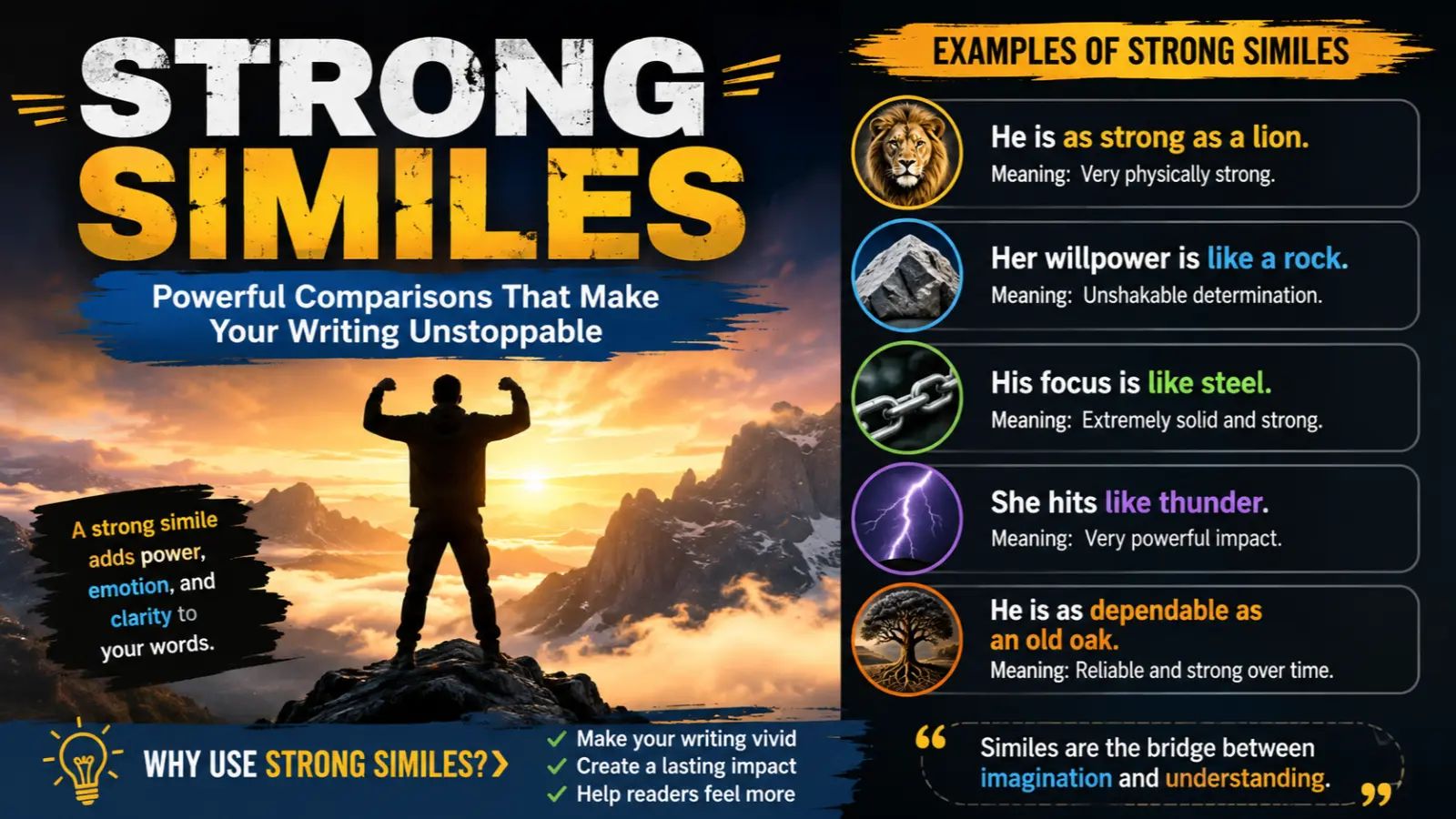
Strong similes help ordinary descriptions feel sharper, more emotional, and easier to picture. Instead of simply saying that someone is confident, tired, angry, or excited, a well-chosen comparison gives the reader something concrete to imagine.
A Strong Similes usually compares two different things using words such as “like” or “as.” For example, “Her determination was like a locked door that refused to open for doubt” creates a stronger image than simply saying “She was determined.”
Writers use similes in fiction, poetry, speeches, songs, essays, journalism, advertising, and everyday conversation. The best Strong Similes ones do more than decorate a sentence—they reveal character, establish mood, sharpen an image, or make an abstract feeling easier to understand.
This collection of strong similes focuses on fresh, adaptable comparisons and explains why they work. You can Similes them as inspiration, then reshape them to fit your own voice.
What Makes a Simile Strong?
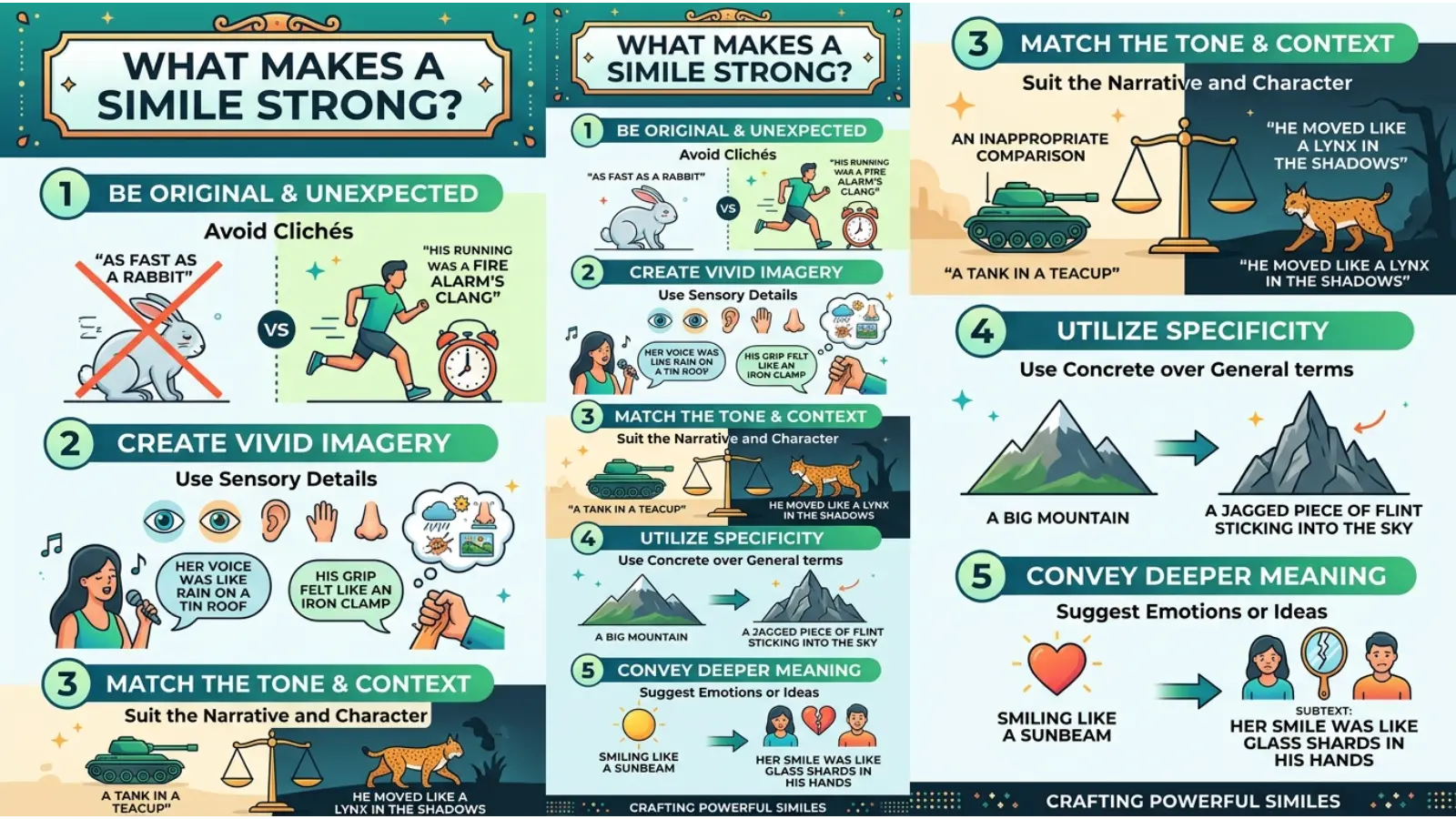
A strong simile connects two things in a way that feels both understandable and surprising.
Compare:
He was as fast as a cheetah.
The comparison is clear, but it is familiar. Now consider:
He moved like a match flame caught in a sudden wind.
The second image suggests speed, unpredictability, and restless movement. It gives the reader more than a measurement.
A useful simile usually has three qualities:
- Clarity: The reader understands the comparison.
- Specificity: The image contains a detail rather than a vague description.
- Purpose: The comparison adds emotion, atmosphere, character, or meaning.
A strong comparison should earn its place in the sentence.
30 Strong Similes for Better Writing
1. Her determination was like a key that kept turning after every lock had failed.
Meaning: She refused to give up even when one solution after another failed.
Why it works: The image turns persistence into a physical action. It is especially useful when describing someone facing repeated obstacles.
Example:
Her determination was like a key that kept turning after every lock had failed.
Writing tip: Use mechanical or physical images when you want determination to feel active rather than abstract.
2. His voice was as steady as a lighthouse in rough weather.
Meaning: He remained calm and reliable during a difficult situation.
The lighthouse suggests stability without making the comparison predictable. It works well in stories about leadership, emergencies, arguments, or uncertainty.
Even when everyone else panicked, his voice was as steady as a lighthouse in rough weather.
Best context: Leadership, suspense, conflict, and emotional scenes.
3. Her smile appeared like sunlight slipping beneath a closed door.
Meaning: Her smile brought unexpected warmth into a difficult or gloomy moment.
This simile works because the sunlight is partially hidden before suddenly becoming visible. That movement can mirror a character whose happiness briefly breaks through sadness.
Her smile appeared like sunlight slipping beneath a closed door.
Writing tip: Try describing emotions through changes in light when you want a scene to feel gentle or hopeful.
4. The old house stood like a forgotten thought at the edge of town.
Meaning: The house seemed neglected, distant, and almost erased from people’s memories.
The comparison gives the building psychological meaning rather than merely describing its appearance.
The old house stood like a forgotten thought at the edge of town.
Best context: Mystery, literary fiction, gothic scenes, and reflective writing.
5. His laughter burst out like popcorn over a hot pan.
Meaning: His laughter came suddenly and repeatedly.
The comparison creates movement and sound, making it useful for lively scenes.
His laughter burst out like popcorn over a hot pan.
Writing tip: For energetic scenes, compare an action with something that moves, pops, crashes, or expands.
6. The silence between them was as thick as unopened mail.
Meaning: The silence felt loaded with things neither person was willing to say.
This works because unopened mail suggests hidden information, anticipation, and unresolved communication.
The silence between them was as thick as unopened mail.
Best context: Arguments, awkward conversations, family drama, and emotional fiction.
7. Her ideas scattered like birds startled from a rooftop.
Meaning: She suddenly lost control of her thoughts.
The birds provide movement while suggesting that the thoughts may return later.
When the teacher called her name, her ideas scattered like birds startled from a rooftop.
Writing tip: Use comparisons involving movement when describing confusion or nervousness.
8. The city glowed like a circuit board waking after midnight.
Meaning: The city appeared bright, busy, and technologically alive at night.
This is more specific than saying the city was “bright.”
From the airplane window, the city glowed like a circuit board waking after midnight.
Best context: Travel writing, science fiction, urban description, and modern settings.
9. His apology landed like a stone dropped into still water.
Meaning: His apology disturbed an otherwise quiet emotional situation.
The image suggests consequences that continue spreading after the initial action.
His apology landed like a stone dropped into still water, and neither of them spoke for a while.
Writing tip: Use ripples and waves when an action has consequences that continue beyond the moment.
10. Her curiosity was like a flashlight searching every dark corner.
Meaning: She constantly wanted to discover hidden information.
The flashlight represents investigation without requiring the writer to explain the character’s personality directly.
Her curiosity was like a flashlight searching every dark corner of the abandoned theater.
Best context: Detectives, children, explorers, researchers, and adventurous characters.
11. The rain tapped on the windows like impatient fingers.
Meaning: The rain sounded persistent and restless.
This comparison gives the weather a human quality and creates a slightly uneasy mood.
Rain tapped on the windows like impatient fingers.
Related device: This also approaches personification because human behavior is being associated with nature.
12. His anger rose like steam trapped beneath a metal lid.
Meaning: His anger was building but had not yet been released.
The comparison creates pressure and suggests that an outburst may follow.
His anger rose like steam trapped beneath a metal lid.
Writing tip: Pressure-based images are effective when an emotion is building toward a turning point.
13. Her happiness spread like warm tea through cold hands.
Meaning: Her happiness created comfort and relief.
The physical sensation makes an abstract emotion easier to experience.
Her happiness spread like warm tea through cold hands when she heard the good news.
Best context: Reunion scenes, friendship, family moments, and emotional storytelling.
14. Their friendship was like two trails that kept meeting in the forest.
Meaning: The friends might have different lives but repeatedly find their way back to one another.
The forest allows the comparison to suggest distance, change, and reunion.
Their friendship was like two trails that kept meeting in the forest.
Writing tip: For relationships, compare people to paths, bridges, seasons, or places that naturally suggest connection.
15. The singer’s voice moved like a ribbon caught in a slow breeze.
Meaning: The voice sounded smooth, flowing, and graceful.
The comparison emphasizes movement rather than simply labeling the voice “beautiful.”
Her voice moved like a ribbon caught in a slow breeze.
Best context: Music reviews, poetry, performance writing, and artistic descriptions.
16. The melody curled through the room like smoke from an unseen fire.
Meaning: The music seemed to spread gradually and mysteriously.
This comparison works especially well when describing instrumental music or an atmospheric performance.
The melody curled through the room like smoke from an unseen fire.
Writing tip: When describing music, imagine that sound has a physical shape. Is it flowing, striking, curling, falling, or expanding?
17. The child’s excitement was like a kite pulling hard against its string.
Meaning: The child was eager and full of energy but had to remain controlled.
The image captures both excitement and restraint.
His excitement was like a kite pulling hard against its string as he waited for the doors to open.
Best context: Celebrations, competitions, birthdays, school events, and adventures.
18. The mountain looked like a sleeping giant beneath the clouds.
Meaning: The mountain appeared huge, powerful, and still.
The comparison gives the landscape a sense of personality and scale.
Beyond the village, the mountain looked like a sleeping giant beneath the clouds.
Writing tip: Large natural objects often become more memorable when you describe their implied movement or personality.
19. Her words cut like paper across an old wound.
Meaning: Her words caused emotional pain that reopened something unresolved.
The image combines physical sensation with emotional history.
Her words cut like paper across an old wound.
Best context: Serious dialogue, conflict, literary fiction, and emotional essays.
20. His confidence was like a well-built bridge over unfamiliar water.
Meaning: He trusted himself even when facing uncertainty.
The bridge suggests stability while the unfamiliar water represents risk.
His confidence was like a well-built bridge over unfamiliar water.
Writing tip: Strong similes can contain a small conflict—security against danger, warmth against cold, or movement against stillness.
21. The classroom buzzed like a beehive before the final bell.
Meaning: Students were talking, moving, and full of energy.
The image immediately creates sound and activity.
The classroom buzzed like a beehive before the final bell.
Best context: School writing, children’s stories, and energetic scenes.
22. Her memory faded like chalk beneath a steady rain.
Meaning: Her memory gradually became less clear.
This works because chalk disappearing in rain provides a visible model for something slowly being erased.
The details of that summer faded like chalk beneath a steady rain.
Writing tip: For memory, time, and loss, images of fading, weathering, or erasing can be especially effective.
23. The goalkeeper stood like a gate that refused every key.
Meaning: The goalkeeper was extremely difficult to defeat.
Rather than simply saying “excellent,” the simile creates a clear image of resistance.
The goalkeeper stood like a gate that refused every key.
Best context: Sports writing, action scenes, and competitive storytelling.
24. Her nervous thoughts fluttered like receipts caught in a ceiling fan.
Meaning: Her thoughts were scattered, uncontrolled, and difficult to organize.
The unusual image makes ordinary nervousness more vivid.
Her nervous thoughts fluttered like receipts caught in a ceiling fan before the interview.
Writing tip: Unexpected everyday objects can create memorable similes when their movement matches the emotion.
25. The lake was as smooth as glass waiting for a fingerprint.
Meaning: The lake was exceptionally still.
The “fingerprint” detail adds tension because it suggests that the stillness could be disturbed at any moment.
At dawn, the lake was as smooth as glass waiting for a fingerprint.
Best context: Nature writing, poetry, travel writing, and quiet scenes.
26. His secret sat between them like a suitcase neither wanted to carry.
Meaning: Both people were aware of an uncomfortable secret but did not want to confront it.
The suitcase suggests weight, responsibility, and the possibility of movement.
His secret sat between them like a suitcase neither wanted to carry.
Writing tip: When writing about emotional burdens, choose an object that can physically represent weight or responsibility.
27. The young tree bent like a student listening carefully to an old teacher.
Meaning: The tree leaned gently and attentively.
The human comparison creates a quiet, thoughtful mood.
The young tree bent like a student listening carefully to an old teacher.
Best context: Reflective poetry, nature writing, and peaceful scenes.
28. The news traveled through the office like a spark through dry grass.
Meaning: Information spread extremely quickly.
The comparison also suggests that the news could create excitement or trouble.
By lunchtime, the news had traveled through the office like a spark through dry grass.
Writing tip: Comparisons involving fire can imply speed, danger, excitement, or loss of control. Choose them according to the mood you want.
29. His patience was like a deep well that never seemed to empty.
Meaning: He could tolerate difficulties for a very long time.
The well represents an apparently endless supply of patience.
His patience was like a deep well that never seemed to empty.
Best context: Character descriptions, leadership, family stories, and reflective writing.
30. The sunset unfolded like a letter written slowly across the sky.
Meaning: The sunset developed gradually and beautifully.
The letter comparison makes the sky feel like a surface carrying a message.
The sunset unfolded like a letter written slowly across the sky.
Writing tip: When describing beautiful scenes, look for an action that mirrors what the scene is doing rather than simply comparing colors.
How to Make Your Similes More Vivid
A common beginner mistake is choosing the first comparison that comes to mind.
If you write:
She was happy like a flower.
the reader receives a general idea but not a strong experience.
Instead, ask what happiness does.
Does it brighten a room? Relax tense shoulders? Make someone speak faster? Change the way they see an ordinary object?
Then build the comparison around that behavior.
For example:
Her happiness spread through the kitchen like warm light under a door.
The emotion now has movement and atmosphere.
Use Specific Details
Specific nouns make comparisons stronger.
Compare:
He was as quiet as a thing.
with:
He was as quiet as snow settling on a windowsill.
The second sentence gives the reader a sensory experience.
Choose Images That Match the Emotion
A simile should support the feeling rather than fight against it.
For calmness, images such as still water, slow clouds, or quiet rooms may work naturally.
A panic, comparisons involving scattered movement, sudden noise, or unstable objects may be more appropriate.
For confidence, sturdy objects such as bridges, anchors, or walls can suggest strength.
The important question is not “What is similar?” but “What kind of similarity matters here?”
How Writers Avoid Cliché Similes
Clichés are familiar comparisons that have lost much of their original impact through constant use.
Examples include expressions such as:
- as busy as a bee
- as cold as ice
- as brave as a lion
- as fast as lightning
- as white as snow
These are not grammatically wrong. They can even be useful when simplicity is the goal. The problem appears when a familiar comparison adds nothing distinctive.
Try changing the angle.
Instead of:
She was as busy as a bee.
you might write:
She moved between three unfinished tasks like a conductor trying to keep four songs playing at once.
The new comparison gives the character a particular kind of busyness.
A useful test: If hundreds of characters could use the same simile without changing the sentence, consider making it more specific.
Strong Similes in Different Types of Writing
In Stories
Similes can reveal character without directly explaining personality.
Instead of:
Marcus was nervous.
try:
Marcus held the envelope like it might suddenly become heavier.
The reader sees nervousness through behavior.
In Poetry
Poetry often benefits from compressed images.
The moon hung like a silver button on the dark coat of night.
The comparison creates a visual image while leaving room for interpretation.
In Essays
Similes should usually clarify an idea rather than overwhelm it.
For example:
Learning a new language is like building a second set of roads in your mind; familiar destinations remain, but new routes become possible.
The comparison helps explain an abstract process.
In Music Writing
Similes can describe sound through movement, texture, shape, or atmosphere.
The guitar notes fell like small stones into a quiet pond.
This lets the reader imagine how the music behaves without needing technical musical vocabulary.
In Conversation
Everyday speech usually works best with short, immediately understandable comparisons.
That meeting was like trying to untangle headphones in the dark.
The comparison is casual, visual, and easy to understand.
Strong Simile vs. Metaphor
A simile makes an explicit comparison, usually with like or as.
Her voice was like rain on a roof.
A metaphor makes the comparison directly.
Her voice was rain on a roof.
Both can create imagery, but they produce slightly different effects.
Similes often feel more conversational and explanatory because the writer tells the reader that one thing resembles another. Metaphors can feel more immediate because they temporarily treat one thing as another.
Neither is automatically better. Choose the form that fits the sentence.
Simile, Imagery, and Personification
Strong similes often work together with other literary devices.
Imagery uses sensory details to help readers see, hear, smell, taste, touch, or experience something.
Personification gives human qualities to nonhuman things.
Alliteration repeats beginning sounds to create rhythm or emphasis.
Hyperbole deliberately exaggerates something for emphasis.
For example:
The impatient rain drummed on the roof like a thousand tiny fingers.
This sentence combines personification, imagery, and simile. The result feels more active than simply saying that it was raining.
The goal is not to pack every sentence with literary devices. Too many techniques can make prose feel artificial. Use them when they serve the scene.
How to Create Your Own Strong Similes
You do not need to wait for an unusual comparison to appear naturally. You can build one deliberately.
Step 1: Identify the exact quality
Don’t start with “What is this like?”
Start with:
What exactly am I describing?
Maybe the character is not simply angry. Perhaps the anger is:
- growing
- controlled
- sudden
- quiet
- explosive
- long-lasting
The more precise the quality, the easier it becomes to find a useful comparison.
Step 2: Brainstorm unrelated objects
For controlled anger, you might think of:
- a sealed container
- a storm behind glass
- a tightly wound spring
- steam beneath a lid
Choose the image that best matches the emotion.
Step 3: Add movement or sensory detail
Instead of:
His anger was like a storm.
try:
His anger gathered like dark clouds behind a window.
The second version gives the reader something to visualize.
Step 4: Test the comparison
Ask yourself:
- Is the connection clear?
- Is the image specific?
- Does it match the mood?
- Does it add something?
- Have I heard it too many times?
- Does it sound natural in my sentence?
If the answer is mostly yes, the simile is probably doing useful work.
Three Exercises for Writing Better Similes
Exercise 1: Replace a Flat Description
Take a sentence such as:
The room was quiet.
Write five different versions using different images.
One might emphasize peacefulness. Another could make the silence feel frightening. A third could make it feel awkward.
This teaches you that the same basic fact can create very different moods.
Exercise 2: Use an Ordinary Object
Choose something near you—a cup, backpack, phone, window, shoe, or notebook.
Describe an emotion using that object as your comparison.
For example, instead of describing someone as anxious, ask how an anxious person might resemble a phone vibrating with unanswered notifications.
The goal is to find fresh connections in familiar things.
Exercise 3: Transform a Cliché
Start with a familiar simile such as:
She was as quiet as a mouse.
Keep the idea of quietness, but replace the mouse with something less expected.
Think about snow, an empty hallway, a sleeping city, a closed book, or dust settling on a shelf.
Then choose the image that best matches your scene.
Common Mistakes Writers Make With Similes
Using Too Many Similes
A strong comparison loses power when every sentence contains one.
Let some sentences remain simple. A vivid simile becomes more noticeable when it has room to breathe.
Mixing Images
Avoid combining unrelated comparisons:
His anger was like a boiling storm that raced down the road on wings.
The reader has too many images competing for attention.
Choose one central image and develop it clearly.
Choosing a Comparison That Does Not Fit
A simile may sound poetic but still be wrong for the emotion.
For example, comparing terrifying silence to “soft cotton” creates a very different effect from comparing it to “an empty theater after midnight.”
Always check the emotional direction of the image.
Explaining Too Much
Sometimes writers create a strong comparison and then immediately explain it.
Her words were like arrows hitting a target. This means that her words were very direct and hurtful.
If the image already communicates the idea, the explanation may be unnecessary.
Trust the reader when the image is clear.
Confusing a Simile With a Metaphor
Remember the basic distinction:
Simile: The comparison is stated with words such as “like” or “as.”
Metaphor: The comparison is stated directly.
Understanding this difference helps you control the style and rhythm of your writing.
Frequently Asked Questions About Strong Similes
What is a strong simile?
A strong simile is a clear, specific, and purposeful comparison that helps readers visualize an idea, emotion, character, action, or setting. It should add meaning rather than simply decorate a sentence.
How do I make a simile more powerful?
Make the comparison specific and connected to the exact quality you want to show. Replace vague images with concrete objects, actions, textures, sounds, or movements.
What is an example of a strong simile?
Her determination was like a key that kept turning after every lock had failed.
It communicates persistence through a concrete image instead of simply naming the quality.
Are strong similes always original?
Not necessarily. Familiar similes can still work when they fit the context. However, original comparisons often make writing feel more distinctive because readers encounter a less predictable image.
What is the difference between a simile and a metaphor?
A simile explicitly compares two things, usually with “like” or “as.” A metaphor makes the comparison directly. For example, “His voice was like thunder” is a simile, while “His voice was thunder” is a metaphor.
Can similes be used in academic writing?
Yes, when they clarify a complicated idea. Academic writing generally benefits from precise comparisons that explain a concept rather than overly decorative imagery.
Can I use similes in everyday conversation?
Absolutely. Short comparisons are common in conversation because they make descriptions quicker, clearer, and more entertaining.
How many similes should I use in my writing?
There is no fixed number. Use a simile when it adds something that a straightforward description cannot. One memorable comparison can be more effective than several weak ones.
Conclusion
Strong similes give writers another way to turn ideas into experiences. Instead of telling readers that someone is nervous, determined, lonely, joyful, or angry, you can show the feeling through an image they can see and understand. The best comparisons are not necessarily the fanciest ones. They are the ones that fit the moment. Look closely at ordinary objects, sounds, movements, weather, places, and human behavior. Ask what they have in common with the feeling or idea you are trying to express. Then choose the comparison that adds the most meaning with the fewest words. A good simile can make a sentence memorable. A carefully chosen one can make an entire scene feel alive.

I am Helena Frost, a writer captivated by the beauty of language and the art of comparison. Through my words, I explore the world by turning ordinary moments into vivid similes and reflections. I enjoy crafting phrases that spark imagination, evoke emotion, and linger in the mind. My writing celebrates the subtle connections between people, nature, and the stories we live. For me, every sentence is an opportunity to reveal the extraordinary in the everyday.