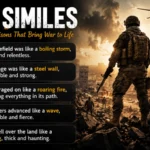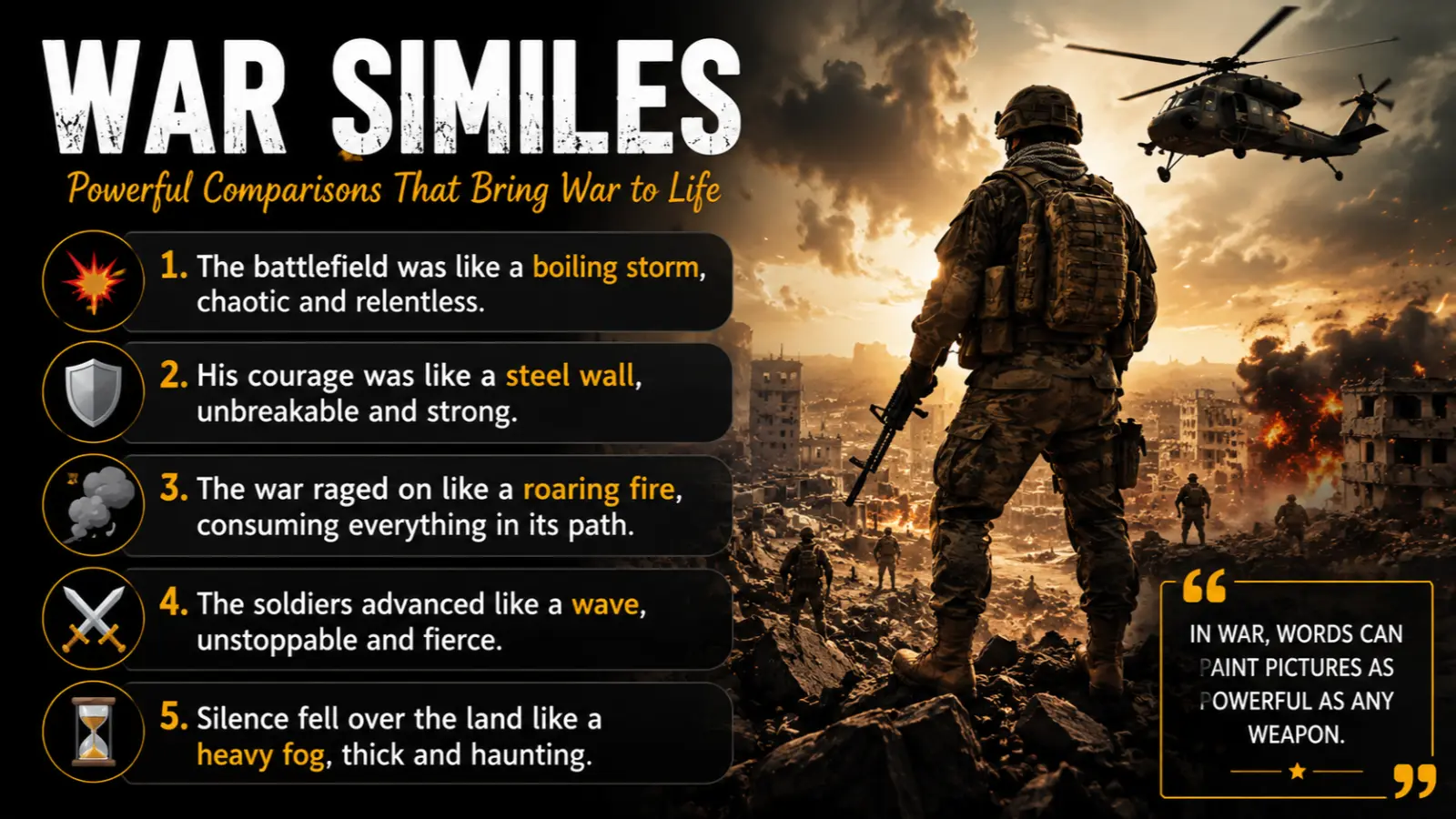
War is difficult to describe because it involves more than action. It can bring fear, confusion, courage, separation, destruction, uncertainty, and moments of unexpected hope. Writers often use war similes to communicate these complicated experiences through familiar images.
A simile compares two different things using words such as like or as. Instead of simply saying that a battlefield was chaotic, a writer might compare the confusion to a storm-tossed sea. The comparison gives readers something concrete they can imagine.
War similes can appear in novels, historical fiction, poetry, essays, journalism, speeches, and creative writing. The strongest comparisons do not merely make conflict sound dramatic. They help readers understand an atmosphere, emotion, or experience.
This collection offers original examples, explains why they work, and shows how you can create your own without relying on tired clichés.
What Are War Similes?
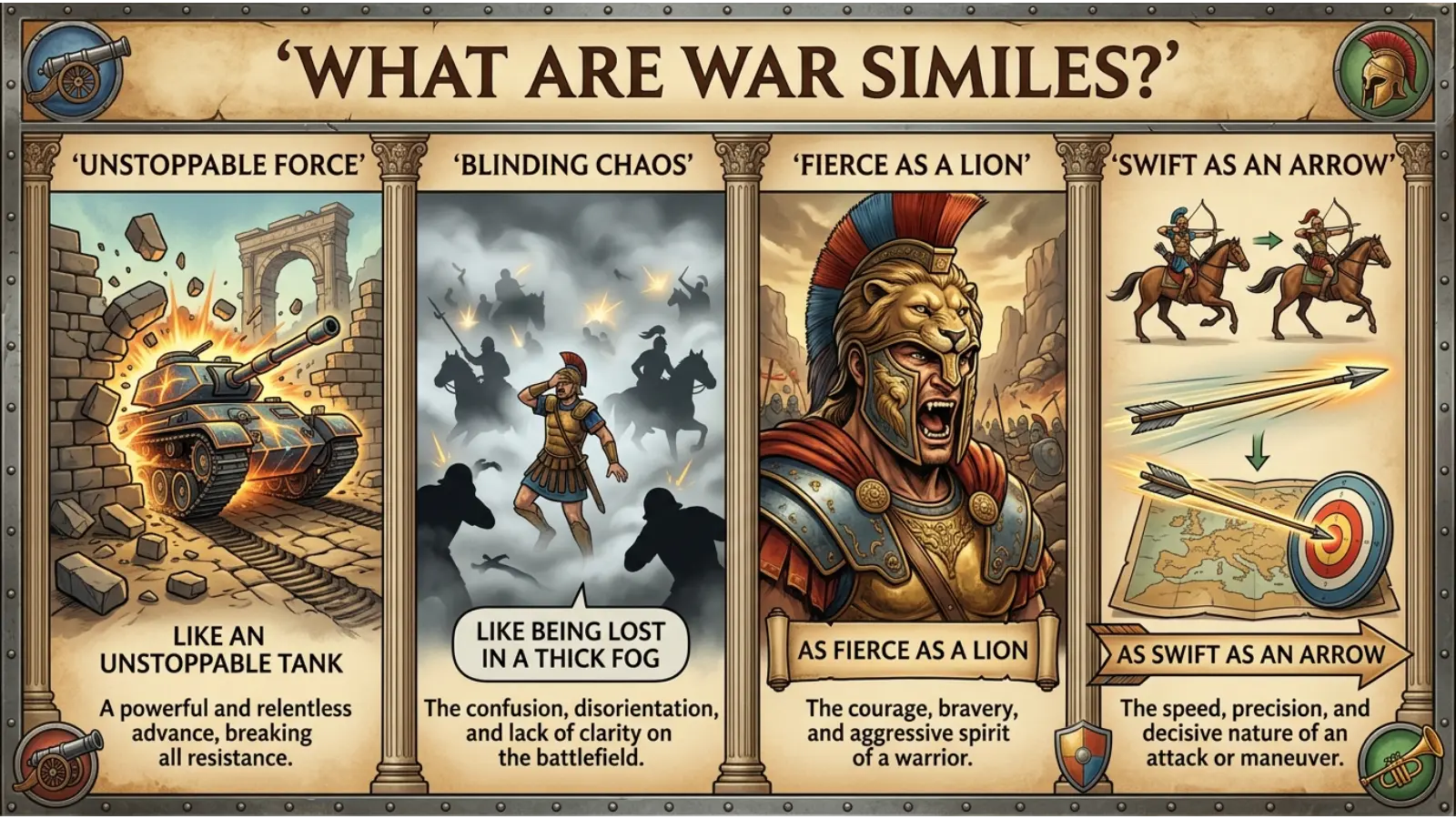
A war simile compares something connected with conflict to another image using like or as.
For example:
The battlefield was like a broken chessboard after the pieces had been scattered.
The comparison does more than describe a physical place. A chessboard suggests strategy, opposing sides, calculated moves, and disruption.
A useful war simile should add meaning rather than simply add intensity. Ask yourself: What does this comparison help the reader understand?
30 Original War Similes for Creative Writing
1. The battlefield was like a storm that had forgotten how to end.
This comparison emphasizes prolonged uncertainty. A storm normally passes, but this one seems endless.
Example:
The soldiers waited through another restless night, while the battlefield remained like a storm that had forgotten how to end.
Writing purpose: Use this when you want to emphasize exhaustion, uncertainty, or the feeling that conflict has no clear ending.
2. The distant explosions sounded like doors slamming in the sky.
This simile turns a frightening sound into a familiar image. The contrast makes the scene easier to visualize without relying on graphic description.
Example:
Across the valley, explosions sounded like doors slamming in the sky.
Best context: Atmospheric descriptions in historical fiction or war poetry.
3. The army moved like a dark river through the valley.
The image of a river suggests continuous movement and a large group traveling in one direction.
Example:
At dawn, the army moved like a dark river through the valley.
Writing tip: This works especially well when describing movement from a distant viewpoint.
4. Fear spread through the village like ink through water.
Ink quickly disperses and changes everything around it. The image makes fear feel gradual yet impossible to contain.
Example:
When the news arrived, fear spread through the village like ink through water.
Emotional effect: It creates an atmosphere of growing anxiety.
5. The soldiers stood as still as statues in the rain.
This comparison emphasizes stillness and tension.
Example:
Before sunrise, the soldiers stood as still as statues in the rain.
Writing purpose: Use it before an important event to create suspense.
6. The empty street looked like a stage after the audience had gone home.
An abandoned stage suggests that something once happened there but has now ended.
Example:
By morning, the empty street looked like a stage after the audience had gone home.
This simile is particularly effective for describing the aftermath of conflict because it focuses on absence rather than violence.
7. The silence was as heavy as a locked door.
Silence cannot literally have weight, but the comparison makes emotional pressure feel physical.
Example:
After the message arrived, the silence was as heavy as a locked door.
Best context: Family scenes, reflective passages, and emotional moments.
8. The radio crackled like an old window shaking in a storm.
The comparison creates sound and atmosphere at the same time.
Example:
The radio crackled like an old window shaking in a storm.
Writing tip: Sound-based similes can make scenes feel more immersive without adding unnecessary action.
9. Hope flickered like a candle in a long hallway.
The candle suggests something small but meaningful surrounded by darkness.
Example:
The promise of peace flickered like a candle in a long hallway.
Emotional effect: This creates cautious optimism rather than complete happiness.
10. The border stretched across the land like a scar drawn with a ruler.
This image suggests that borders created by conflict can leave lasting marks.
Example:
The border stretched across the land like a scar drawn with a ruler.
Writing purpose: Useful for historical, political, and reflective writing.
11. Confusion moved through the crowd like wind through tall grass.
Wind affects many blades at once, making this a useful comparison for collective uncertainty.
Example:
Confusion moved through the crowd like wind through tall grass.
Best context: Scenes involving civilians, crowds, or rapidly changing information.
12. The battlefield looked like a chessboard after an impatient player had swept across it.
Chess suggests strategy, while the disrupted board suggests that plans have collapsed.
Example:
From the hill, the battlefield looked like a chessboard after an impatient player had swept across it.
Writing insight: Familiar games can provide strong imagery when you want to communicate strategy without explaining every tactical detail.
13. The marching feet sounded like rain on a thousand windows.
This simile focuses on rhythm and sound.
Example:
Their marching feet sounded like rain on a thousand windows.
Writing purpose: Use it when describing a large group moving together.
14. The old fortress stood like a tired guardian at the edge of the town.
Giving the fortress the role of a guardian creates personification as well as a simile.
Example:
The old fortress stood like a tired guardian at the edge of the town.
Emotional effect: It gives the setting a sense of age, duty, and exhaustion.
15. The battlefield at dawn was as pale as a forgotten photograph.
A faded photograph suggests memory and distance.
Example:
At dawn, the battlefield was as pale as a forgotten photograph.
Best context: Reflective prose and historical fiction.
16. News of the attack traveled like a spark along dry grass.
The image communicates rapid movement.
Example:
News of the attack traveled like a spark along dry grass.
Writing tip: Choose a comparison whose natural behavior matches the action you are describing. Sparks spread quickly, so the reader immediately understands the speed.
17. The waiting felt like standing beside a clock with no hands.
A clock normally tells us when something will happen. A clock without hands creates uncertainty.
Example:
For the families waiting at home, every hour felt like standing beside a clock with no hands.
Emotional effect: This simile emphasizes helplessness and uncertainty.
18. The city seemed to hold its breath like a swimmer beneath the surface.
This comparison creates suspense and a sense of restrained movement.
Example:
Before the announcement, the city seemed to hold its breath like a swimmer beneath the surface.
Best context: Moments immediately before an important development.
19. The soldiers’ memories followed them like shadows at sunset.
Shadows suggest memories that remain close even when people move forward.
Example:
Years later, their memories followed them like shadows at sunset.
Writing purpose: Strong for reflective passages about the long emotional effects of conflict.
20. The abandoned camp looked like a classroom after the final bell.
A classroom after everyone leaves suggests emptiness and the sudden end of ordinary activity.
Example:
The abandoned camp looked like a classroom after the final bell.
Why it works: The familiar setting contrasts with the seriousness of the subject, making the emptiness more noticeable.
21. The commander’s voice was as sharp as a cracked bell.
A cracked bell produces a harsh, imperfect sound.
Example:
The commander’s voice was as sharp as a cracked bell across the courtyard.
Best context: Dialogue descriptions when you want to establish authority or tension.
22. The road disappeared into the distance like a question without an answer.
This simile connects physical distance with uncertainty.
Example:
The road disappeared into the distance like a question without an answer.
Writing purpose: Excellent for journeys, uncertainty, and stories about people who do not know what comes next.
23. The ceasefire felt like sunlight entering a room that had been dark for years.
The comparison presents peace as a gradual return of possibility.
Example:
For the families, the ceasefire felt like sunlight entering a room that had been dark for years.
Emotional effect: Hopeful and reflective.
24. The damaged town stood like a book with half its pages missing.
A book represents history, memory, and stories. Missing pages suggest experiences that can no longer be fully recovered.
Example:
The town stood like a book with half its pages missing.
Writing tip: Symbolic similes are especially useful when writing about historical memory.
25. The soldiers waited like travelers at a station where no train arrived.
This comparison captures prolonged waiting and uncertainty.
Example:
They waited like travelers at a station where no train arrived.
Best context: Scenes where characters have little control over what happens next.
26. The news struck the family like winter arriving in midsummer.
The unexpected arrival of winter creates a strong sense of shock and disruption.
Example:
The news struck the family like winter arriving in midsummer.
Emotional effect: Sudden sadness and disbelief.
27. The battlefield became as quiet as a library before sunrise.
This unusual comparison makes silence feel deliberate and tense.
Example:
After the movement stopped, the battlefield became as quiet as a library before sunrise.
Writing purpose: Use contrasting imagery to create atmosphere.
28. The old photographs were like small windows into a world that no longer existed.
Photographs allow characters to look into the past.
Example:
In the attic, the old photographs were like small windows into a world that no longer existed.
Best context: Historical fiction, memoir-style writing, and stories about families affected by war.
29. The peace agreement was as fragile as paper in the rain.
Paper can easily become damaged by water, making this a clear image of vulnerability.
Example:
The new peace agreement was as fragile as paper in the rain.
Writing purpose: This is useful when peace has been established but remains uncertain.
30. The returning soldiers entered the town like strangers walking into their childhood home.
This comparison explores how conflict can change a person’s relationship with a familiar place.
Example:
They returned to the town like strangers walking into their childhood home.
Emotional effect: It suggests distance, change, and complicated memories.
How to Make War Similes More Powerful
A strong simile begins with the quality you want to communicate.
Suppose you write:
The battlefield was chaotic.
That tells the reader what happened, but it gives little imagery.
You could instead focus on what chaos feels like:
The battlefield was like a storm with every direction changing at once.
The second version gives the reader movement and uncertainty.
Start With the Feeling
Before creating a comparison, identify the emotion or quality:
- fear
- confusion
- loneliness
- courage
- uncertainty
- exhaustion
- hope
- grief
- tension
- relief
Then search for something from everyday life that naturally behaves in a similar way.
For example:
Uncertainty → a road disappearing into fog
Fear → ink spreading through water
Hope → a small candle
Waiting → a clock without hands
This method produces more meaningful comparisons than simply searching for something that sounds dramatic.
Avoid Cliché War Comparisons
Some comparisons have been used so often that they can make writing feel predictable.
Expressions involving storms, fire, hell, thunder, or endless darkness can sometimes work, but they should not be your automatic choices.
Instead of asking:
What sounds dramatic?
ask:
What image has the same behavior or emotional quality?
A quiet comparison can sometimes be more powerful than an enormous one.
For example, comparing a damaged town to a book with missing pages can communicate loss, memory, and history without describing violence directly.
Why Unexpected Comparisons Work
Readers notice a comparison when the two things are different but share an important characteristic.
Consider:
The road disappeared like a question without an answer.
A road and a question are completely different. Yet both can lead toward an uncertain destination.
That distance between the two ideas creates interest.
When writing your own similes, look for unexpected similarities, not random differences.
Simile vs. Metaphor in War Writing
A simile uses a direct comparison, usually with like or as.
The city was like a sleeping giant.
A metaphor makes the comparison more directly.
The city was a sleeping giant.
Both can create strong imagery. The choice depends on the effect you want.
A simile often feels more observational, while a metaphor can sound more immediate and forceful.
Using Imagery Without Overwriting
War writing can become overly dramatic if every sentence contains intense imagery.
Compare:
The sky was like a wounded monster, the streets like a graveyard, the silence like death, and the wind like a scream.
The reader receives too many heavy comparisons at once.
A cleaner approach is:
By evening, the streets were almost empty. The silence was as heavy as a locked door.
One carefully chosen image can carry more weight than several competing ones.
Writing rule: Let important similes breathe. Give the reader enough plain description to understand the scene before adding another striking comparison.
Similes, Personification, and Symbolism
War similes often work alongside other literary devices.
Personification
Personification gives human qualities to nonhuman things.
The old fortress stood like a tired guardian.
The fortress is compared to a guardian, while the word tired gives it a human quality.
Symbolism
A physical object can represent a larger idea.
A candle might symbolize hope.
A broken clock might symbolize uncertainty.
An abandoned photograph might symbolize memory.
When a simile contains a symbolic object, the comparison can carry meaning beyond its literal description.
Imagery
Imagery uses sensory language to help readers see, hear, feel, smell, or otherwise experience a scene.
Instead of simply writing:
The army approached.
You might write:
The marching feet sounded like rain on a thousand windows.
The reader can now imagine the rhythm and scale of the movement.
Common Mistakes When Writing War Similes
Using Too Many Clichés
If every comparison involves fire, thunder, darkness, or storms, the writing can lose its individuality.
Try ordinary objects instead: clocks, books, windows, roads, photographs, classrooms, candles, or rivers.
Mixing Two Images
Avoid combining unrelated comparisons:
The army moved like a river and roared like a broken clock.
The first image describes movement, while the second does not naturally connect to sound or behavior.
Choose one clear image.
Forcing a Simile Into Every Sentence
Not every sentence needs figurative language.
Strong writing alternates between straightforward description and carefully selected imagery.
Choosing an Image That Does Not Match
A comparison should share a meaningful quality with its subject.
If you compare something slow to lightning, the reader may become confused unless the comparison refers to a different characteristic, such as sudden brightness.
Confusing a Simile With a Metaphor
Remember:
Simile: The city was like a sleeping animal.
Metaphor: The city was a sleeping animal.
Both are valid, but they create slightly different effects.
How to Create Your Own War Similes
Try this five-step process.
Step 1: Choose the Subject
Pick something specific:
- a marching army
- an empty street
- a radio
- a ruined building
- a waiting family
- a peace agreement
- a returning soldier
- a battlefield at dawn
Step 2: Choose One Quality
Ask what you want readers to notice.
Is it:
- silent?
- uncertain?
- crowded?
- fragile?
- distant?
- overwhelming?
- hopeful?
- lonely?
Step 3: Find an Unusual Everyday Image
Think beyond obvious war imagery.
For fragile, you might choose:
paper in rain
uncertain, you might choose:
a road without signs
For lonely, you might choose:
one chair in an empty room
Step 4: Connect Them With Like or As
For example:
The peace was as fragile as paper in the rain.
Step 5: Test the Comparison
Ask three questions:
- Does the comparison make sense?
- Does it create a clear picture?
- Does it add something that plain description cannot?
If the answer is yes, keep it.
Creative Exercises for Better Similes
Exercise 1: Replace a Plain Description
Start with:
The city was quiet.
Create three alternatives using different images.
For example:
- a library
- a sleeping animal
- an empty theater
Then decide which one best matches your scene.
Exercise 2: Use an Ordinary Object
Choose an object from your room and connect it to a war-related emotion.
Try:
- a clock → waiting
- a window → separation
- a backpack → travel
- a photograph → memory
- a candle → hope
The goal is to discover fresh imagery in familiar things.
Exercise 3: Write the Same Scene Three Ways
Describe a ceasefire using:
- a nature-based simile
- an object-based simile
- a place-based simile
Then compare the emotional effect of each version.
This teaches an important writing lesson: the comparison you choose changes how readers interpret the scene.
Frequently Asked Questions About War Similes
What is a good example of a war simile?
A good example is: “The battlefield was like a storm that had forgotten how to end.” It compares prolonged conflict with an endless storm to communicate uncertainty and exhaustion.
How do you write a simile about war?
Choose one specific aspect of war, such as fear, waiting, movement, uncertainty, or hope. Then compare it with something familiar that behaves in a similar way.
What words are used in war similes?
Common comparison words include like, as, as if, and similar to. The most recognizable similes generally use “like” or “as.”
Can war similes be used in poems?
Yes. Similes are particularly effective in poetry because they can compress complex emotions into a short, memorable image.
What is the difference between a war simile and a war metaphor?
A war simile makes the comparison explicit with words such as like or as. A metaphor makes the comparison directly without those words.
How can I avoid cliché similes about war?
Look beyond common images such as fire, thunder, and storms. Consider ordinary objects, places, sounds, memories, and natural processes that share the quality you want to describe.
Why do writers use similes when describing war?
Similes help readers understand difficult experiences through familiar images. They can communicate atmosphere, emotion, movement, uncertainty, and memory without relying only on literal description.
Conclusion
The best war similes do more than make writing sound dramatic. They give readers a way to understand an experience that may otherwise be difficult to express. A comparison between a peace agreement and paper in the rain can suggest fragility. A road compared with an unanswered question can communicate uncertainty. A damaged town compared with a book missing pages can turn physical change into an image of lost history. When creating your own similes, begin with the emotion or quality you want readers to feel. Then search for an image that shares that quality in an unexpected but believable way. The goal is not to make every sentence poetic. The goal is to choose the right image at the right moment. One original, carefully shaped simile can stay with a reader long after the paragraph ends.
I am Helena Frost, a writer captivated by the beauty of language and the art of comparison. Through my words, I explore the world by turning ordinary moments into vivid similes and reflections. I enjoy crafting phrases that spark imagination, evoke emotion, and linger in the mind. My writing celebrates the subtle connections between people, nature, and the stories we live. For me, every sentence is an opportunity to reveal the extraordinary in the everyday.