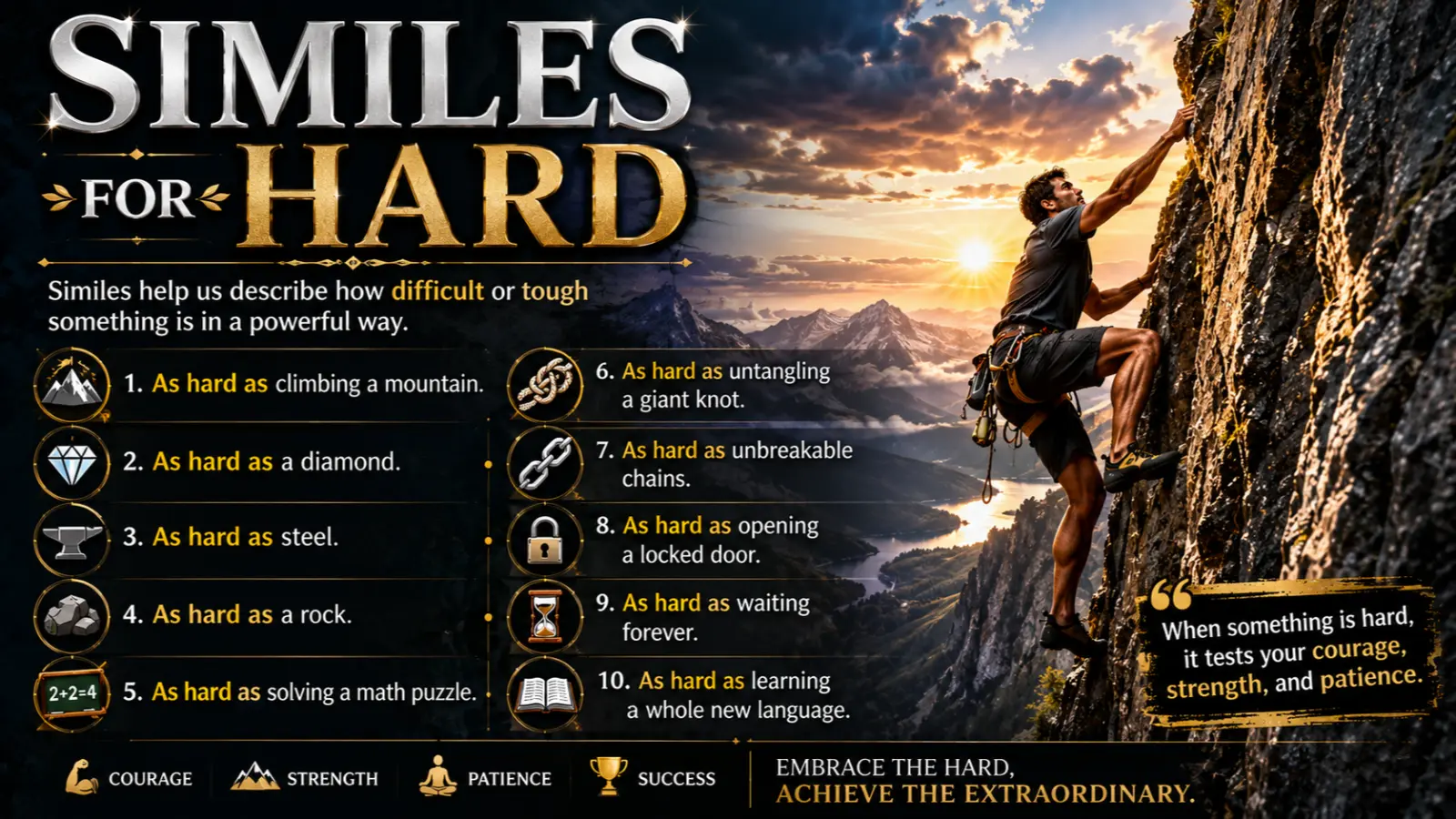
A Similes for Hard compares two different things using words such as like or as. Instead of simply saying, “The exam was hard,” you could write, “The exam was like a locked door with no handle.” The comparison gives the reader an image rather than just a label.
Similes for hard can describe difficult work, complicated decisions, physical effort, emotional struggles, harsh experiences, stubborn objects, or challenging situations. They work especially well in creative writing, essays, stories, poetry, speeches, and everyday conversation.
The examples below focus on fresh comparisons that communicate different kinds of difficulty without relying on worn-out clichés.
What Is a Simile for Hard?
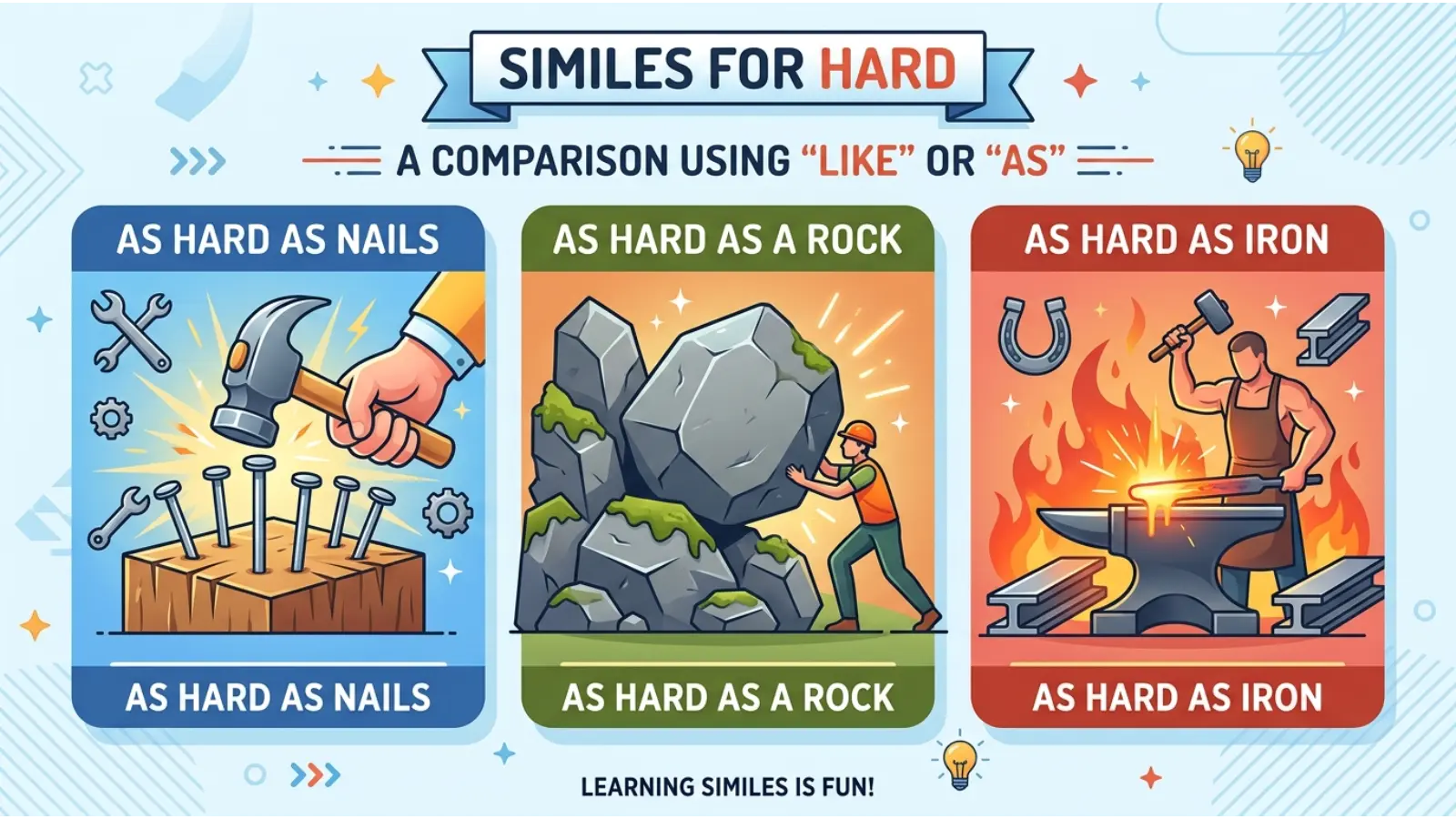
A simile for hard compares something difficult with another thing that feels demanding, resistant, exhausting, complicated, or difficult to overcome.
For example:
The problem was like a maze built without an exit.
The problem is not literally a maze. The comparison helps readers understand that it was confusing and difficult to solve.
A strong simile does more than say that something is hard. It tells readers what kind of hard it is.
The Best Similes for Hard Things
1. The task was like climbing stairs that kept adding steps.
Meaning: The work seemed to become more difficult instead of getting closer to completion.
This comparison works because the reader expects stairs to lead somewhere. When more steps continually appear, the frustration becomes clear.
Example:
The project was like climbing stairs that kept adding steps.
Writing purpose: Use it when describing an endless assignment, long project, or demanding responsibility.
2. The puzzle was like a door with a hundred invisible locks.
Meaning: The solution existed, but finding the way through it was extremely difficult.
Example:
The mystery was like a door with a hundred invisible locks, and every clue revealed another one.
This is useful for stories because it combines difficulty with mystery.
Writing tip: When creating your own simile, think about what makes the difficult thing difficult. Is it confusing, exhausting, frightening, slow, or resistant?
3. The homework felt like carrying a library up a hill.
Meaning: The amount of work felt overwhelming.
The image combines weight, effort, and distance, making the workload feel physically demanding.
Best context: School writing, student narratives, humorous descriptions, and personal essays.
4. His decision was like choosing a road in a storm with no signs.
Meaning: He had to make a difficult choice without knowing which option was correct.
Example:
Choosing between the two opportunities was like choosing a road in a storm with no signs.
This simile is particularly effective for describing uncertainty, rather than simple physical difficulty.
5. The final chapter was like pushing a heavy door against the wind.
Meaning: Finishing the work required persistent effort because resistance never seemed to disappear.
Emotional effect: Determination mixed with frustration.
Writing purpose: This fits stories about completing a novel, project, journey, or personal goal.
6. The problem sat before us like a knot made from steel wire.
Meaning: The problem was extremely complicated and difficult to untangle.
The comparison works because an ordinary knot can be difficult, but steel wire suggests something much more resistant.
Writing tip: Combining a familiar object with an unexpected material can make a simile feel fresh.
7. The workout was like teaching a mountain to move.
Meaning: The task required enormous effort.
Example:
Finishing the renovation was like teaching a mountain to move.
This comparison can also describe ambitious projects that seem almost impossible.
8. The conversation was like walking across ice covered in cracks.
Meaning: Every word felt risky, and one mistake could make the situation worse.
This is a useful simile for difficult conversations, especially when characters are nervous, angry, or uncertain.
9. The assignment was as stubborn as a locked box without a key.
Meaning: The assignment resisted every attempt to solve it.
Notice that this simile gives difficulty a personality. That makes it more expressive than simply saying “the assignment was hard.”
10. The old jar was like a tiny fortress refusing to open.
Meaning: Something simple, such as opening a jar, required surprising effort.
Best context: Humor, casual writing, children’s stories, and everyday descriptions.
A serious subject does not always require a serious simile. Humor can make ordinary difficulty memorable.
Similes for Hard Work
Hard work has many forms. Sometimes it is physically exhausting. Sometimes it requires patience, concentration, or repeated failure.
11. Hard work was like planting seeds in ground packed with stone.
Meaning: Progress was possible, but the conditions made it difficult.
Example:
Learning the new skill felt like planting seeds in ground packed with stone.
This works especially well when you want to show slow progress rather than impossible progress.
12. Studying was like building a bridge one brick at a time.
Meaning: Success required patience and consistent effort.
Unlike some of the darker comparisons in this collection, this simile presents difficulty with a hopeful feeling.
Writing purpose: Use it when the character is struggling but gradually improving.
13. The repair job was like stitching a torn sail during a storm.
Meaning: The task was difficult because it had to be completed under pressure.
The storm introduces urgency, while the torn sail gives the reader something concrete to imagine.
14. Training for the competition was like sharpening a blade with bare patience.
Meaning: Improvement required repeated, careful effort.
This simile emphasizes discipline rather than exhaustion.
Writing tip: If your character is hardworking, choose comparisons that show the process of effort instead of simply describing the person as determined.
15. The research was like digging through a field for one hidden coin.
Meaning: Finding the needed information took extensive searching.
This is useful for academic writing, detective stories, journalism-style narratives, or descriptions of complicated research.
Similes for Hard Decisions
Not everything that is hard is physically demanding. Some of the hardest experiences involve choosing between two uncertain options.
16. The choice was like holding two maps to places neither of us knew.
Meaning: Both options were uncertain.
Emotional effect: Confusion and hesitation.
This comparison is stronger than simply writing, “I didn’t know what to choose,” because the maps represent possible futures.
17. Her decision felt like cutting a thread that connected two doors.
Meaning: Choosing one option meant giving up another.
This simile captures the emotional cost of difficult decisions.
Best context: Fiction, reflective essays, and personal narratives.
18. Choosing what to do was like balancing a glass on a moving table.
Meaning: The situation was unstable, and a small mistake could change everything.
Writing purpose: Use it when describing high-pressure decisions.
Similes for Hard Emotions
Sometimes “hard” means emotionally painful or difficult to handle.
19. His disappointment settled over him like wet sand.
Meaning: The emotion felt heavy, uncomfortable, and difficult to escape.
The image works because wet sand is heavier and clings more than dry sand.
Example:
After hearing the result, disappointment settled over him like wet sand.
20. The apology was like trying to repair a cracked mirror with a single thread.
Meaning: Saying sorry might help, but it could not immediately fix the damage.
Emotional effect: Regret and helplessness.
This is particularly effective when writing about damaged relationships without directly explaining every emotion.
21. The memory was like a locked room he carried everywhere.
Meaning: The character could not easily escape a difficult memory.
This is a strong storytelling simile because the physical image represents an internal experience.
22. Grief felt like a heavy coat on a warm afternoon.
Meaning: The sadness remained uncomfortable and burdensome even when the surroundings seemed normal.
Writing tip: Emotional similes often become stronger when the comparison creates a contrast between the outside world and the character’s internal state.
Similes for Physically Hard Things
Sometimes you simply need to describe something that is genuinely difficult to move, break, carry, or change.
23. The rock was like a piece of the earth that had forgotten how to move.
Meaning: The rock seemed extremely heavy and immovable.
This gives a physical object a subtle sense of personality without turning the sentence into full personification.
24. The frozen ground was as hard as a clay floor baked beneath the sun.
Meaning: The ground had become extremely firm and resistant.
Best context: Nature writing, outdoor scenes, adventure stories, and descriptive essays.
25. The metal was like a stubborn wall between the tools and the answer.
Meaning: The material resisted every attempt to change it.
This simile is useful when describing mechanical work or a difficult physical task.
26. The packed soil was like a brick pretending to be earth.
Meaning: The soil was unusually hard.
Writing purpose: This is a playful comparison for nature descriptions.
The unexpected phrase “pretending to be earth” gives the sentence personality.
Similes for Hard Situations
Difficult situations often involve pressure, uncertainty, or obstacles rather than physical resistance.
27. The situation was like steering a boat through a river full of hidden rocks.
Meaning: Progress was possible, but danger was difficult to predict.
Example:
Managing the crisis was like steering a boat through a river full of hidden rocks.
This works particularly well when writing about leadership or pressure.
28. The week was like a staircase with every landing moved farther away.
Meaning: Relief or completion always seemed distant.
Emotional effect: Frustration and exhaustion.
This is stronger than simply saying “It was a difficult week” because it creates a sense of continually delayed relief.
29. The challenge stood before her like a wall built from unfinished questions.
Meaning: She could not move forward because too many things remained uncertain.
This is an excellent example of combining abstract difficulty with a physical image.
30. Starting over was like rebuilding a house while remembering where every old wall had stood.
Meaning: Beginning again was difficult because the person still remembered the previous situation.
Best context: Stories about change, setbacks, recovery, learning, or new beginnings.
The simile works because it contains both difficulty and history.
Why These Similes Work
A useful simile creates a bridge between something the reader understands and something the writer wants to explain.
Consider these two sentences:
The assignment was difficult.
The assignment was like carrying a library up a hill.
The first sentence tells the reader the conclusion. The second gives the reader an experience to imagine.
That difference is important in creative writing.
A strong simile usually does three things
It creates an image.
Readers can picture the comparison.
It adds a specific quality.
The assignment is not merely hard. It is heavy, demanding, and exhausting.
It supports the mood.
The same difficult situation could be compared to a mountain, a locked door, a storm, or a maze depending on the emotion you want.
The best comparison is therefore not necessarily the most dramatic one. It is the one that communicates the right kind of difficulty.
How to Make a Simile for Hard More Vivid
Start by identifying the exact type of difficulty.
Ask:
- Is it physically heavy?
- Is it mentally confusing?
- Is it emotionally painful?
- Is it slow and frustrating?
- Is it dangerous?
- Is it repetitive?
- Is it uncertain?
- Is it resistant to change?
Then find an object or situation that produces the same feeling.
For example:
Basic idea:
The exam was hard.
Type of difficulty:
Confusing and mentally demanding.
Possible comparison:
A maze.
Developed simile:
The exam was like a maze with every hallway leading to another question.
The improvement comes from adding a detail that matches the experience.
Avoid Similes That Are Too General
A comparison such as:
The job was as hard as a mountain.
is understandable, but it does not tell the reader much beyond “very difficult.”
A more specific image gives the reader additional information:
The job was like hauling stones up a mountain while the path kept disappearing.
Now the reader understands that the difficulty involves effort, uncertainty, and persistence.
Specificity is one of the easiest ways to improve a weak simile.
How Writers Avoid Cliché Similes
Common expressions can be useful in everyday speech, but predictable comparisons often lose their impact in creative writing.
If readers have heard a comparison hundreds of times, they may notice the phrase instead of the image.
Instead of automatically reaching for the first comparison that comes to mind, ask:
What unusual object behaves in the same way?
For example, difficulty can resemble:
- a door with invisible locks
- wet sand
- a damaged sail
- a bridge under construction
- a box without a key
- a staircase that keeps extending
The goal is not to make every comparison strange. It is to make the comparison specific and purposeful.
Simile vs. Metaphor: What’s the Difference?
A simile usually makes a comparison with like or as.
The problem was like a locked door.
A metaphor makes the comparison directly.
The problem was a locked door.
Both devices can create strong imagery. The choice depends on the effect you want.
A simile often makes the comparison feel exploratory or descriptive. A metaphor can sound more direct and forceful.
Simile vs. Hyperbole
Hyperbole deliberately exaggerates something.
I had a million pages to read.
That sentence does not literally mean a million pages. It emphasizes the speaker’s feeling of being overwhelmed.
A simile can also exaggerate, but its primary job is comparison:
The reading list was like a mountain stretching beyond the horizon.
The two techniques can work together, but they are not the same literary device.
How to Create Your Own Similes for Hard
You can create stronger comparisons by following a simple process.
1. Name the difficulty
Write a plain sentence first:
The interview was hard.
2. Identify why it was hard
Maybe the speaker felt nervous because every answer seemed important.
3. Find a matching experience
Think of something that requires careful movement under pressure.
For example:
Walking across thin ice.
4. Add a specific detail
Instead of stopping at:
The interview was like walking across thin ice.
Try:
The interview was like walking across thin ice while listening for every crack.
The added detail makes the emotional pressure clearer.
5. Remove unnecessary words
A simile should strengthen the sentence rather than bury it.
If the comparison becomes longer than the idea requires, simplify it.
Creative Exercises for Better Similes
Exercise 1: Change the Type of Hard
Write five versions of:
The assignment was hard.
Make each one communicate a different type of difficulty:
- confusing
- exhausting
- frightening
- frustrating
- emotionally difficult
This teaches you to choose comparisons based on meaning rather than decoration.
Exercise 2: Use an Ordinary Object
Choose one object from your room.
For example:
- a backpack
- a lamp
- a pencil
- a chair
- a window
Now use that object to describe something difficult.
The decision was like a backpack filled with questions.
The first attempt does not need to be perfect. Revise it until the connection feels natural.
Exercise 3: Make One Simile More Specific
Start with:
The test was like a maze.
Add one detail:
The test was like a maze where every wrong turn erased the map.
The second version gives the reader a stronger reason to imagine the test as difficult.
Common Mistakes When Writing Similes for Hard Things
Using the same comparison repeatedly
If every difficult situation becomes a mountain, your writing can start to feel predictable.
Experiment with different kinds of imagery.
Mixing unrelated images
Avoid combining comparisons that belong to completely different scenes unless the effect is intentional.
A sentence that begins with a storm and suddenly switches to a staircase can confuse the reader.
Making the comparison impossible to understand
Originality is useful, but a simile should still create a recognizable connection.
If readers have to solve the comparison before understanding the sentence, the imagery may be too obscure.
Explaining the simile too much
Trust the image.
If you write a strong comparison and then spend three sentences explaining exactly what every part represents, the imagery may lose its effect.
Using a simile only because it sounds impressive
A beautiful comparison that does not fit the emotion is still a weak comparison.
Ask whether the simile adds meaning.
Where Can You Use Similes for Hard?
These comparisons can fit many forms of writing:
Creative writing: Build stronger descriptions of obstacles and conflicts.
Poetry: Compress complicated emotions into memorable images.
Essays: Make abstract experiences easier to understand when used sparingly.
Stories: Reveal a character’s feelings without simply naming them.
Speeches: Give audiences an image they can remember.
Conversation: Add humor or emphasis to everyday complaints.
The context determines how elaborate the simile should be. A poem may welcome a surprising image, while a formal essay usually benefits from a clearer, more controlled comparison.
Frequently Asked Questions
What is a good simile for something hard?
A good simile depends on the type of difficulty. For example, “The problem was like a door with a hundred invisible locks” suggests something complicated and difficult to solve.
What is a simile for hard work?
One option is: “Hard work was like planting seeds in ground packed with stone.” It suggests that progress requires effort even when conditions are difficult.
What is a simile for a difficult situation?
“The situation was like steering a boat through a river full of hidden rocks” suggests uncertainty, pressure, and possible danger.
How do you describe something very difficult in a creative way?
First identify why it is difficult, then compare that quality with a concrete object or experience. A specific comparison is usually more effective than simply using words such as “very hard.”
Can a simile describe emotions?
Yes. Similes are particularly useful for emotions because feelings can be difficult to visualize. Comparing disappointment to wet sand, for example, gives the reader a physical image of emotional heaviness.
What makes a simile powerful?
A powerful simile creates a clear image, matches the intended emotion, and adds information that the original statement did not provide.
Should similes always use “like” or “as”?
Traditional similes commonly use “like” or “as,” although literary comparisons can take more varied forms. When teaching or writing a straightforward simile, like and as are the clearest choices.
Conclusion
The word hard can describe many different experiences. A difficult task, a painful memory, a stubborn object, and an uncertain decision may all be hard, but they do not feel hard in the same way. That is where similes become valuable. Instead of telling readers only that something is difficult, give them an image that lets them experience the difficulty. A locked door can suggest frustration. Wet sand can suggest emotional weight. A storm can suggest pressure. A bridge under construction can suggest slow progress. The strongest simile is not necessarily the most complicated. It is the one that makes the reader see something more clearly. So when you write your next sentence about something difficult, pause before using the word hard. Ask yourself: What does this kind of difficulty feel like? Then find an image that captures it.

I am Helena Frost, a writer captivated by the beauty of language and the art of comparison. Through my words, I explore the world by turning ordinary moments into vivid similes and reflections. I enjoy crafting phrases that spark imagination, evoke emotion, and linger in the mind. My writing celebrates the subtle connections between people, nature, and the stories we live. For me, every sentence is an opportunity to reveal the extraordinary in the everyday.