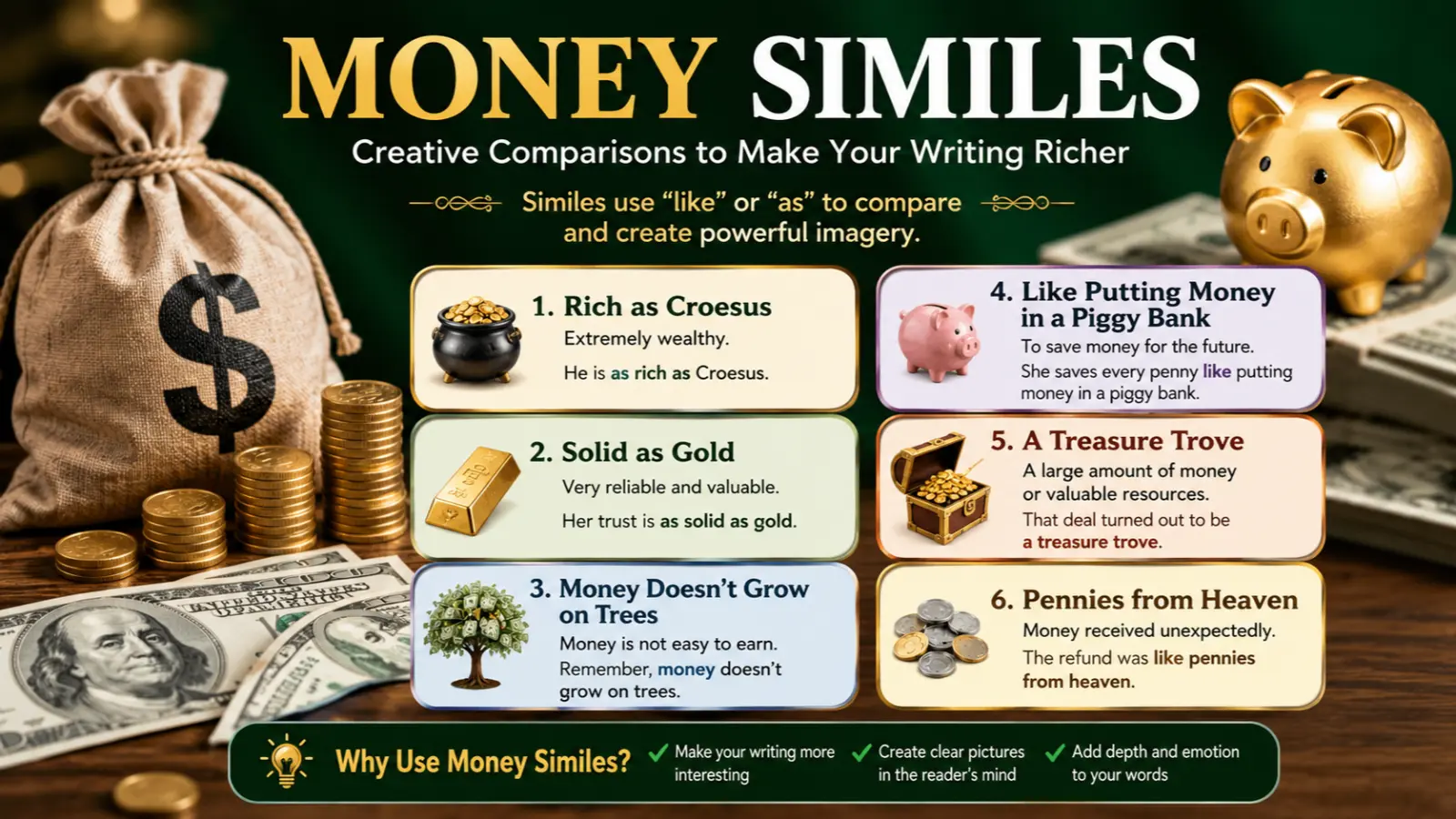
Money Similes influences nearly every part of life, making it a powerful source of comparison in creative writing. Whether you’re describing wealth, greed, opportunity, value, generosity, or financial struggles, the right simile can add personality and emotion to your words.
A simile compares two different things using words like “as” or “like.” Instead of saying someone is wealthy, you can create a stronger image by comparing their wealth to something unexpected.
This guide explores original money similes that work in stories, essays, speeches, poems, and everyday conversations. Along the way, you’ll also learn why certain comparisons feel memorable and how to create your own.
Quick Answer
Money similes compare money, wealth, value, or financial situations with other objects using words such as like or as. They help writers explain abstract ideas in vivid, memorable ways while adding emotion and imagery.
Why Money Makes Excellent Similes
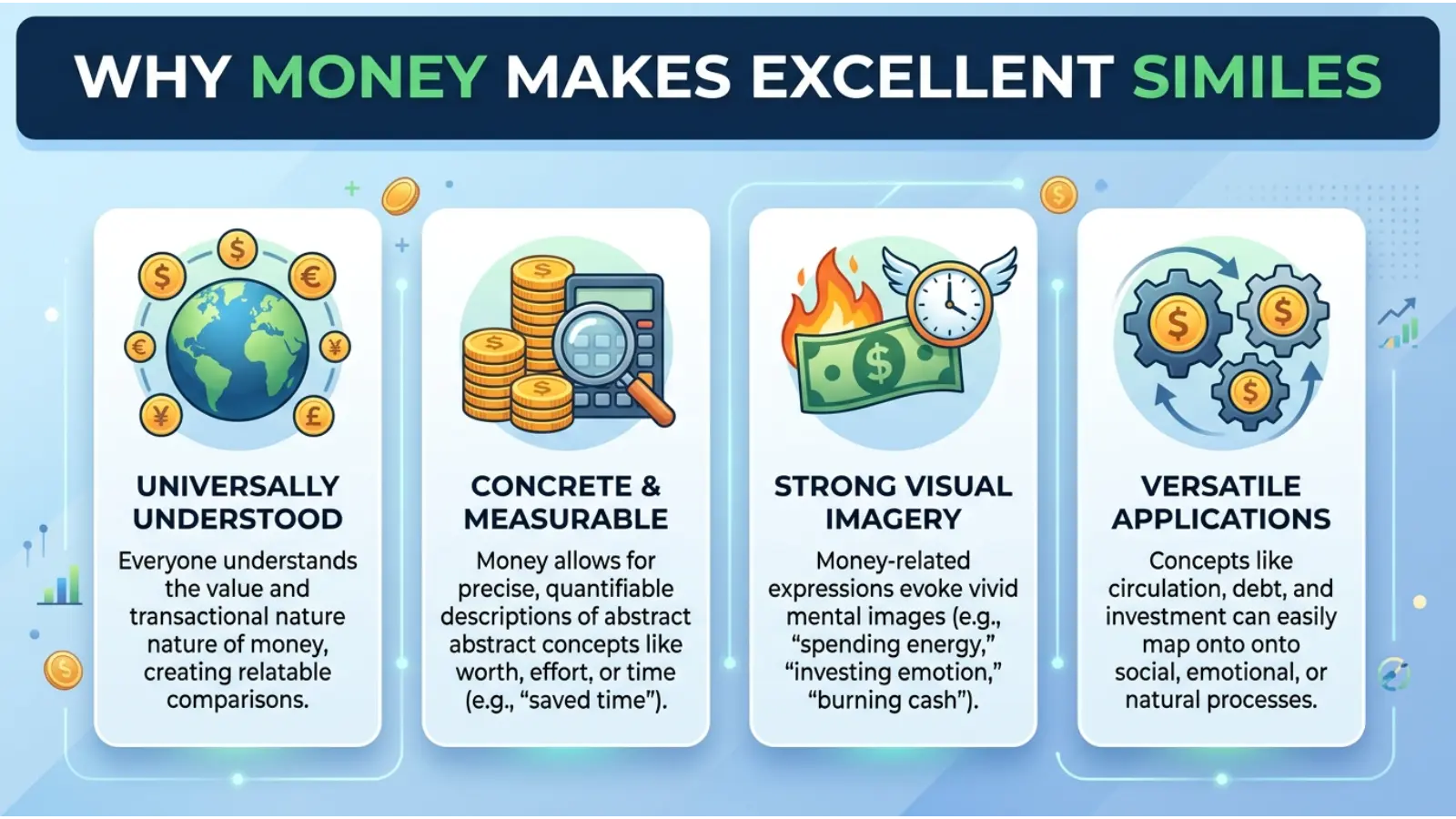
Money represents far more than coins and bills.
It can symbolize:
- Success
- Security
- Power
- Temptation
- Freedom
- Stress
- Opportunity
- Responsibility
Because money carries emotional meaning, comparisons involving it often connect with readers immediately.
30 Original Money Similes
1. As steady as a paycheck on payday
Meaning: Reliable and dependable.
Examples
- Her support was as steady as a paycheck on payday.
- His routine stayed as steady as a paycheck on payday.
Effect: Creates comfort and stability.
Best for: Character descriptions and business writing.
Writing Tip: Use it when describing consistency rather than wealth.
2. Like coins skipping across a river
Meaning: Money disappears quickly.
Examples
- Vacation expenses vanished like coins skipping across a river.
- His savings flew away like coins skipping across a river.
Storytelling
The inheritance lasted only weeks, disappearing like coins skipping across a river.
3. As valuable as the final puzzle piece
Meaning: Extremely important.
Examples
- Her advice was as valuable as the final puzzle piece.
- Honest feedback is as valuable as the final puzzle piece.
Writing Purpose
Shows emotional or practical value beyond money.
4. Like a wallet with wings
Meaning: Spending happens rapidly.
Examples
- My paycheck felt like a wallet with wings.
- Holiday shopping turned my savings into a wallet with wings.
Conversation
“My money has become like a wallet with wings this month.”
5. As rare as a forgotten dollar in an old jacket
Meaning: An unexpected surprise.
Examples
- Good news arrived as rare as a forgotten dollar in an old jacket.
- The opportunity felt as rare as a forgotten dollar in an old jacket.
6. Like sunlight on fresh gold
Meaning: Bright and attractive.
Examples
- Her smile shone like sunlight on fresh gold.
- The trophy glittered like sunlight on fresh gold.
Poetry
Hope sparkled like sunlight on fresh gold.
7. As heavy as a pocket full of silver
Meaning: Carrying responsibility.
Examples
- Leadership felt as heavy as a pocket full of silver.
- His promise became as heavy as a pocket full of silver.
8. Like finding change beneath the couch
Meaning: Small but joyful surprise.
Examples
- The compliment felt like finding change beneath the couch.
- The refund arrived like finding change beneath the couch.
9. As bright as a freshly minted coin
Meaning: New and full of promise.
Examples
- Her ideas were as bright as a freshly minted coin.
- The startup looked as bright as a freshly minted coin.
10. Like treasure hidden beneath old floorboards
Meaning: Secret value.
Examples
- His talent was like treasure hidden beneath old floorboards.
- The diary proved like treasure hidden beneath old floorboards.
11. As tempting as free money
Meaning: Difficult to resist.
Examples
- The sale looked as tempting as free money.
- The shortcut felt as tempting as free money.
12. Like rain filling an empty well
Meaning: Financial relief.
Examples
- The scholarship came like rain filling an empty well.
- The raise arrived like rain filling an empty well.
13. As thin as an empty wallet
Meaning: Nearly exhausted.
Examples
- My budget became as thin as an empty wallet.
- His patience was as thin as an empty wallet.
14. Like a coin balancing on its edge
Meaning: Uncertain outcome.
Examples
- The investment stood like a coin balancing on its edge.
- The decision felt like a coin balancing on its edge.
15. As quiet as money locked in a safe
Meaning: Silent and secure.
Examples
- The room stayed as quiet as money locked in a safe.
- Their agreement remained as quiet as money locked in a safe.
16. Like seeds planted for tomorrow
Meaning: Wise investing.
Examples
- Her savings grew like seeds planted for tomorrow.
- Every lesson became like seeds planted for tomorrow.
17. As precious as the first dollar earned
Meaning: Deep personal value.
Examples
- The handwritten letter was as precious as the first dollar earned.
- His first success felt as precious as the first dollar earned.
18. Like a market before sunrise
Meaning: Full of hidden potential.
Examples
- The neighborhood waited like a market before sunrise.
- The new project looked like a market before sunrise.
19. As smooth as polished gold
Meaning: Elegant and refined.
Examples
- Her speech flowed as smooth as polished gold.
- The melody sounded as smooth as polished gold.
20. Like bills caught in the wind
Meaning: Difficult to control.
Examples
- His thoughts scattered like bills caught in the wind.
- Opportunities drifted like bills caught in the wind.
21. As generous as an open treasure chest
Meaning: Extremely giving.
Examples
- She was as generous as an open treasure chest.
- His kindness remained as generous as an open treasure chest.
22. Like an investment growing in spring
Meaning: Gradual improvement.
Examples
- Confidence grew like an investment growing in spring.
- Their friendship developed like an investment growing in spring.
23. As fragile as a glass piggy bank
Meaning: Easily broken.
Examples
- Trust felt as fragile as a glass piggy bank.
- The agreement remained as fragile as a glass piggy bank.
24. Like a forgotten vault key
Meaning: Hidden opportunity.
Examples
- The old notebook became like a forgotten vault key.
- His idea proved like a forgotten vault key.
25. As rich as autumn orchards
Meaning: Abundant.
Examples
- The harvest looked as rich as autumn orchards.
- Her imagination was as rich as autumn orchards.
26. Like pennies building a castle
Meaning: Small efforts create big results.
Examples
- Daily savings worked like pennies building a castle.
- Practice grows like pennies building a castle.
27. As golden as earned success
Meaning: Truly rewarding.
Examples
- Graduation felt as golden as earned success.
- Their victory was as golden as earned success.
28. Like a compass made of gold
Meaning: Valuable guidance.
Examples
- Her mentor was like a compass made of gold.
- Good advice works like a compass made of gold.
29. As secure as money beneath a mountain
Meaning: Extremely safe.
Examples
- Their friendship felt as secure as money beneath a mountain.
- The documents stayed as secure as money beneath a mountain.
30. Like a coin reflecting the morning sun
Meaning: Filled with hope and possibility.
Examples
- His future shined like a coin reflecting the morning sun.
- The child’s dream sparkled like a coin reflecting the morning sun.
Poetry
Morning whispered across the fields, and hope rose like a coin reflecting the morning sun.
Why These Similes Work
Strong similes don’t simply compare two objects—they connect shared qualities.
Ask yourself:
- What feeling does money represent here?
- Is the comparison easy to imagine?
- Does it create emotion?
- Would a reader remember it?
The strongest similes are both surprising and believable.
How Professional Writers Create Memorable Money Similes
Instead of comparing money directly to wealth, experienced writers often compare its effects.
For example:
- Saving can resemble planting seeds.
- Spending can resemble water slipping through fingers.
- Opportunity can resemble discovering hidden treasure.
- Greed can resemble a fire that keeps growing.
The emotional meaning matters more than the object itself.
Related Literary Devices
Metaphor
A metaphor says one thing is another.
- Simile: His savings grew like a forest.
- Metaphor: His savings became a forest.
Imagery
Imagery appeals to the senses.
Instead of writing:
“The coins were shiny.”
Write:
“The coins flashed like tiny mirrors beneath the afternoon sun.”
Hyperbole
Hyperbole exaggerates for emphasis.
Example:
“I waited a million years to get paid.”
Personification
Money itself can seem alive.
Example:
“The dollar danced from one hand to another.”
Symbolism
Money often symbolizes freedom, responsibility, ambition, sacrifice, or power rather than simple wealth.
Create Your Own Money Similes
Follow these steps:
Step 1
Choose one quality.
Examples:
- Valuable
- Scarce
- Fast
- Safe
- Risky
Step 2
Think of another object with that same quality.
For example:
Patience → Growing tree
Savings → Quiet garden
Debt → Heavy backpack
Step 3
Connect them using like or as.
Example:
“His savings grew like ivy climbing an old wall.”
Creative Exercise
Write one simile for each of these ideas:
- Saving money
- Losing money
- Generosity
- Greed
- Financial freedom
Then rewrite each simile to make it more specific by adding sensory details.
Common Mistakes to Avoid
Using Overused Comparisons
Readers quickly forget familiar expressions. Look for fresh images instead.
Mixing Images
Avoid combining unrelated comparisons in the same sentence.
Making Similes Too Complicated
If readers need to stop and decode your comparison, simplify it.
Confusing Similes with Metaphors
Remember:
- Similes use like or as.
- Metaphors make direct comparisons.
Forgetting the Context
A playful simile may fit a children’s story but feel out of place in a serious novel or business article.
Frequently Asked Questions
What is a money simile?
A money simile compares money, wealth, value, or financial ideas with another object using like or as to create a clearer image.
Why should writers use money similes?
They make abstract financial ideas easier to understand while adding emotion, creativity, and memorable imagery.
Can money similes be used outside financial writing?
Yes. They also work well when describing success, generosity, responsibility, opportunity, and personal growth.
What makes a good money simile?
A strong money simile is original, easy to visualize, emotionally meaningful, and appropriate for the context.
Are money similes useful in poetry?
Absolutely. They create rhythm, symbolism, and vivid imagery that help poems leave a lasting impression.
How can I avoid cliché money similes?
Focus on specific experiences, emotions, and unexpected comparisons instead of relying on familiar sayings.
Conclusion
Money similes do far more than describe wealth. They reveal character, highlight emotions, and make ideas feel tangible. Whether you’re writing fiction, poetry, speeches, blog posts, or everyday conversations, fresh comparisons can transform ordinary sentences into memorable ones. The best similes come from observation. Notice how people earn, spend, save, celebrate, and worry about money. Those real-life moments often inspire the most original comparisons. Keep experimenting, revise your ideas, and don’t be afraid to replace a predictable simile with one that reflects your own creative voice.

I am Helena Frost, a writer captivated by the beauty of language and the art of comparison. Through my words, I explore the world by turning ordinary moments into vivid similes and reflections. I enjoy crafting phrases that spark imagination, evoke emotion, and linger in the mind. My writing celebrates the subtle connections between people, nature, and the stories we live. For me, every sentence is an opportunity to reveal the extraordinary in the everyday.