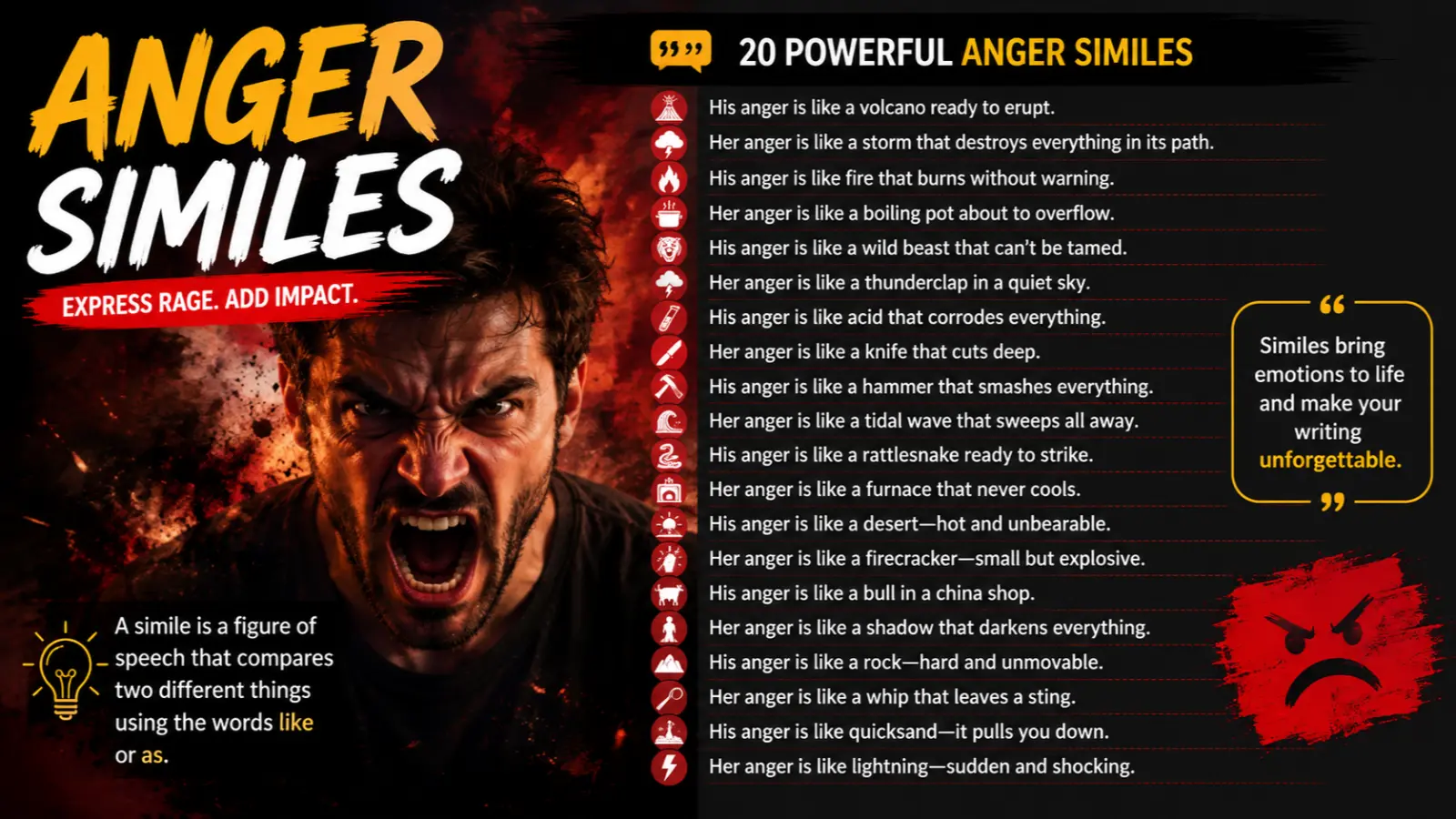
Anger Similes is one of the strongest emotions people experience, and describing it well can instantly make writing more believable. Instead of simply saying someone was “angry,” a carefully chosen simile paints a clearer picture that readers can see and feel.
A simile compares two different things using words such as like or as. Writers use similes in fiction, poetry, speeches, conversations, essays, and even songs to make emotions more vivid. The right comparison helps readers connect with a character’s feelings instead of simply being told what they feel.
This guide explores original anger similes, explains why they work, and shows you how to use them naturally in your own writing.
Quick Answer
Anger similes compare anger to another object, force, or experience using like or as. They help writers create stronger emotional imagery. For example, instead of writing “He was angry,” you might write, “His anger spread like cracks across frozen glass.” Original similes make emotions feel more vivid and memorable.
Why Writers Use Similes to Describe Anger
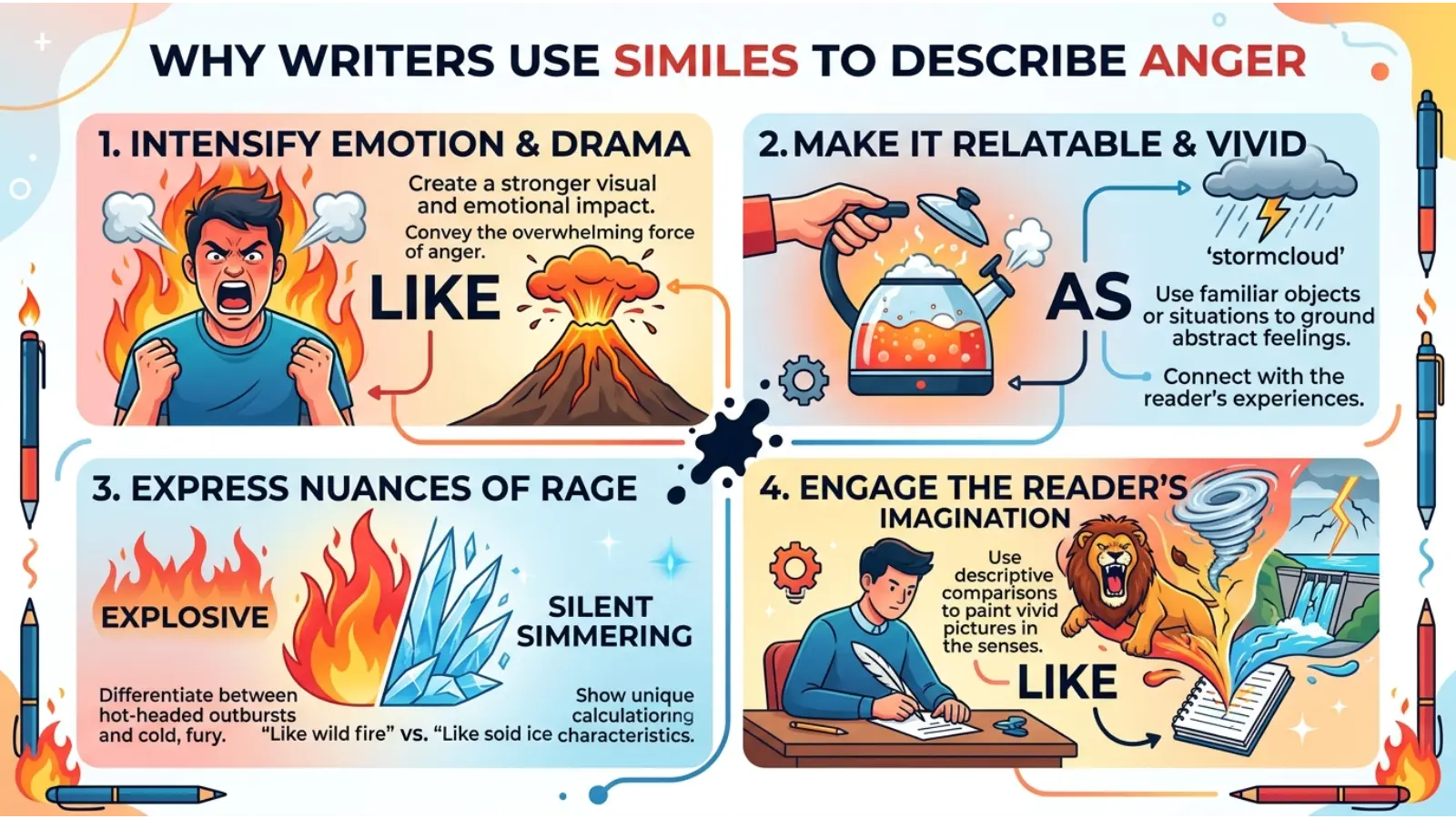
Anger comes in many forms. It can be quiet, explosive, controlled, or overwhelming.
A strong simile can reveal:
- How intense the anger feels
- Whether it is growing or fading
- How others react to it
- The personality of the character
- The atmosphere of a scene
Instead of explaining emotion directly, similes allow readers to experience it.
30 Original Anger Similes with Meanings and Examples
1. Like thunder trapped inside a bottle
Meaning: Anger that is powerful but restrained.
Example Sentences
- She stood silently, her anger like thunder trapped inside a bottle.
- His smile hid anger like thunder trapped inside glass.
Writing Effect
Perfect for characters trying to remain calm.
Conversation
“I know you’re upset—you look like thunder trapped inside a bottle.”
Storytelling
The room stayed quiet while his bottled storm waited.
Writing Tip
Use this for internal conflict.
2. As sharp as broken ice
Meaning: Harsh, cutting anger.
Examples
- Her reply was as sharp as broken ice.
- His words became as sharp as broken ice.
Best Context
Arguments and emotional dialogue.
3. Like wildfire chasing dry grass
Meaning
Anger spreads rapidly.
Examples
- Rumors made his anger spread like wildfire chasing dry grass.
- One insult was enough.
Writing Purpose
Shows emotions escalating quickly.
4. Like a storm pounding against locked doors
Meaning
Strong emotion seeking release.
Examples
- Her frustration pounded like a storm against locked doors.
- He struggled to stay calm.
Poetry
“My heart knocked like a storm against locked doors.”
5. As restless as lightning searching for ground
Meaning
Explosive anger waiting for an outlet.
Writing Tip
Ideal before a dramatic confrontation.
6. Like boiling metal beneath the surface
Meaning
Hidden but dangerous anger.
Examples
- He spoke politely while boiling metal hid beneath the surface.
- Everyone sensed danger.
7. As fierce as a hawk defending its nest
Meaning
Protective anger.
Best Context
Parents, leaders, loyal friends.
8. Like sparks racing through dry leaves
Meaning
Small irritation becoming major anger.
Examples
- Their disagreement spread like sparks through dry leaves.
- The tension grew within minutes.
9. As loud as crashing waves against cliffs
Meaning
Uncontrolled emotional outburst.
Storytelling
His voice crashed against the walls.
10. Like smoke filling every corner
Meaning
Anger slowly consuming everything.
Writing Effect
Creates suspense.
11. As heavy as iron chains
Meaning
Burdensome resentment.
12. Like a volcano beneath fresh snow
Meaning
Calm appearance hiding intense anger.
Formal Example
Despite his composed expression, his anger remained like a volcano beneath fresh snow.
13. As relentless as winter wind
Meaning
Anger that refuses to fade.
14. Like a cracked bell ringing endlessly
Meaning
Lingering emotional pain fueling anger.
15. As bright as molten copper
Meaning
Visibly intense anger.
16. Like waves crashing inside a cave
Meaning
Echoing emotional turmoil.
17. As tense as a drawn bow
Meaning
Ready to explode at any moment.
18. Like glass heating over fire
Meaning
Pressure building steadily.
19. As fierce as desert sunlight at noon
Meaning
Overwhelming intensity.
20. Like an engine running without brakes
Meaning
Impossible to control.
21. As stubborn as roots through stone
Meaning
Persistent resentment.
22. Like fire climbing old wood
Meaning
Growing emotional conflict.
23. As sudden as a falling tree
Meaning
Unexpected burst of anger.
24. Like waves pulling against the shore
Meaning
Recurring anger.
25. As bitter as burnt herbs
Meaning
Anger mixed with disappointment.
26. Like a cracked mirror reflecting every wound
Meaning
Old pain making anger stronger.
27. As hot as fresh lava beneath stone
Meaning
Hidden rage.
28. Like smoke curling through empty halls
Meaning
Quiet but noticeable anger.
29. As relentless as pounding rain
Meaning
Emotion that won’t stop.
30. Like a locked furnace glowing red
Meaning
Contained anger nearing its limit.
Examples
- His silence looked like a locked furnace glowing red.
- Nobody noticed until he finally spoke.
Writing Tip
Excellent for suspense before emotional release.
How to Make Anger Similes More Powerful
Strong similes do more than compare two things.
Think about:
- Movement instead of appearance.
- Sound as well as sight.
- Physical sensations such as heat, pressure, or weight.
- Emotional consequences.
- The personality of the character.
Rather than choosing the first comparison that comes to mind, ask yourself what makes this anger unique.
Avoiding Common Anger Simile Clichés
Many comparisons have been used so often that they no longer surprise readers.
Examples include:
- Mad as a hornet
- Red as a tomato
- Boiling with rage
- Mad as fire
Instead, focus on fresh imagery drawn from nature, weather, architecture, music, or everyday life.
Originality makes readers pause and imagine.
How Professional Writers Create Emotional Imagery
Experienced writers rarely stop at naming an emotion.
Instead, they combine:
- Body language
- Setting
- Dialogue
- Similes
- Sensory details
For example, instead of writing:
She was angry.
Write:
She folded the letter slowly, her anger moving like smoke through an abandoned house until every thought carried its scent.
The second version allows readers to experience the emotion.
Related Literary Devices
Metaphor
A metaphor says one thing is another.
- Metaphor: His anger was a wildfire.
- Simile: His anger spread like a wildfire.
Imagery
Imagery appeals to the senses through vivid description. Similes often strengthen imagery by making abstract emotions easier to picture.
Personification
Personification gives human qualities to non-human things.
Example:
“The storm refused to leave.”
This can work alongside anger similes.
Hyperbole
Hyperbole deliberately exaggerates emotion.
Example:
“I was angry enough to shake the mountains.”
Use it carefully to avoid sounding unrealistic.
Symbolism
Objects such as storms, broken glass, or volcanoes can symbolize anger throughout a story, adding deeper meaning.
Create Your Own Anger Similes
Building original similes becomes easier with practice.
Step 1
Choose the kind of anger.
- Quiet
- Explosive
- Bitter
- Protective
- Frustrated
Step 2
Think of something with similar behavior.
Examples:
- Weather
- Machines
- Animals
- Nature
- Music
- Light
- Fire
- Water
Step 3
Ask why they are similar.
Is it because they spread quickly?
Do they build pressure?
Do they make noise?
Step 4
Write the comparison using like or as.
Example:
Instead of:
“He was angry.”
Try:
“His anger gathered like rain behind dark mountains.”
Creative Exercises
Exercise 1
Describe a teacher becoming angry without using the words angry, mad, or furious.
Exercise 2
Write three similes showing:
- Quiet anger
- Sudden anger
- Protective anger
Exercise 3
Rewrite a scene using completely different imagery.
Compare anger to:
- Music
- Ice
- Wind
- Shadows
- Rivers
Common Mistakes When Writing Similes
Using Overused Comparisons
Readers notice fresh imagery more than familiar sayings.
Mixing Images
Avoid combining unrelated comparisons in one sentence.
Incorrect:
His anger burned like ice while roaring like silence.
The images conflict instead of strengthening each other.
Forcing a Comparison
Every simile should feel natural.
If readers stop to figure out the comparison, it probably needs revision.
Confusing Metaphors with Similes
Remember:
- Similes use like or as.
- Metaphors do not.
Describing Without Purpose
Every simile should reveal something about the emotion, character, or scene rather than simply decorating the sentence.
Frequently Asked Questions
What is an anger simile?
An anger simile compares anger to another object or experience using like or as to create stronger imagery.
Why are similes useful in emotional writing?
They help readers picture feelings more clearly and make scenes more engaging.
Can anger similes be used in formal writing?
Yes. Essays, speeches, and literary analysis can all benefit from carefully chosen similes when appropriate.
How do I avoid cliché anger similes?
Look for unexpected but believable comparisons based on movement, sound, or emotion instead of relying on common expressions.
What’s the difference between a simile and a metaphor?
A simile uses like or as, while a metaphor states that one thing is another.
Should every angry character use similes?
No. Similes are most effective when they highlight important emotional moments rather than appearing in every paragraph.
Can children learn anger similes?
Absolutely. Simple comparisons help young writers understand descriptive language and express emotions more creatively.
Conclusion
The best anger similes do more than describe emotion—they reveal personality, deepen scenes, and leave lasting impressions on readers. Rather than relying on familiar comparisons, experiment with fresh imagery inspired by nature, weather, sound, movement, and everyday experiences. As you practice creating original similes, you’ll discover new ways to make your writing more vivid, emotional, and unforgettable.

I am Helena Frost, a writer captivated by the beauty of language and the art of comparison. Through my words, I explore the world by turning ordinary moments into vivid similes and reflections. I enjoy crafting phrases that spark imagination, evoke emotion, and linger in the mind. My writing celebrates the subtle connections between people, nature, and the stories we live. For me, every sentence is an opportunity to reveal the extraordinary in the everyday.