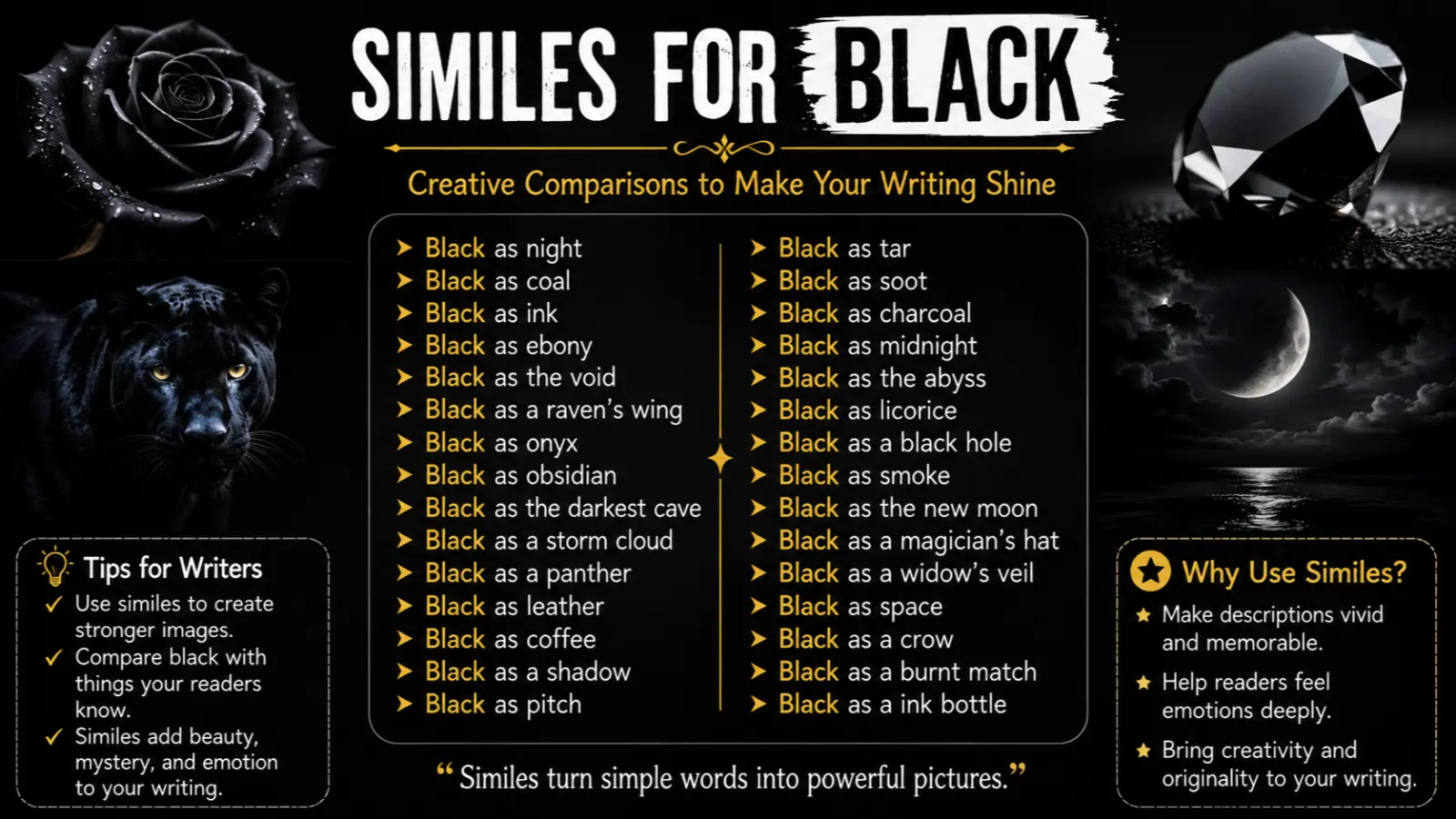
Similes for Black is one of the most expressive colors in the English language. Depending on the context, it can represent mystery, elegance, fear, power, silence, sadness, or the unknown. A well-crafted simile helps readers picture these emotions instead of simply being told about them.
A simile compares two different things using “like” or “as.” Writers use similes in fiction, poetry, speeches, conversations, and everyday descriptions because they create strong mental images and make writing more memorable.
In this guide, you’ll discover original similes for black, learn why each comparison works, see practical examples, and pick up professional writing techniques that will strengthen your own creative style.
Quick Answer
Similes for black compare darkness, color, or mood to another object using words like “like” or “as.” Effective similes make descriptions more vivid by connecting black with familiar images such as volcanic rock, a moonless sky, polished obsidian, or deep shadows.
Why Writers Use Similes for Black
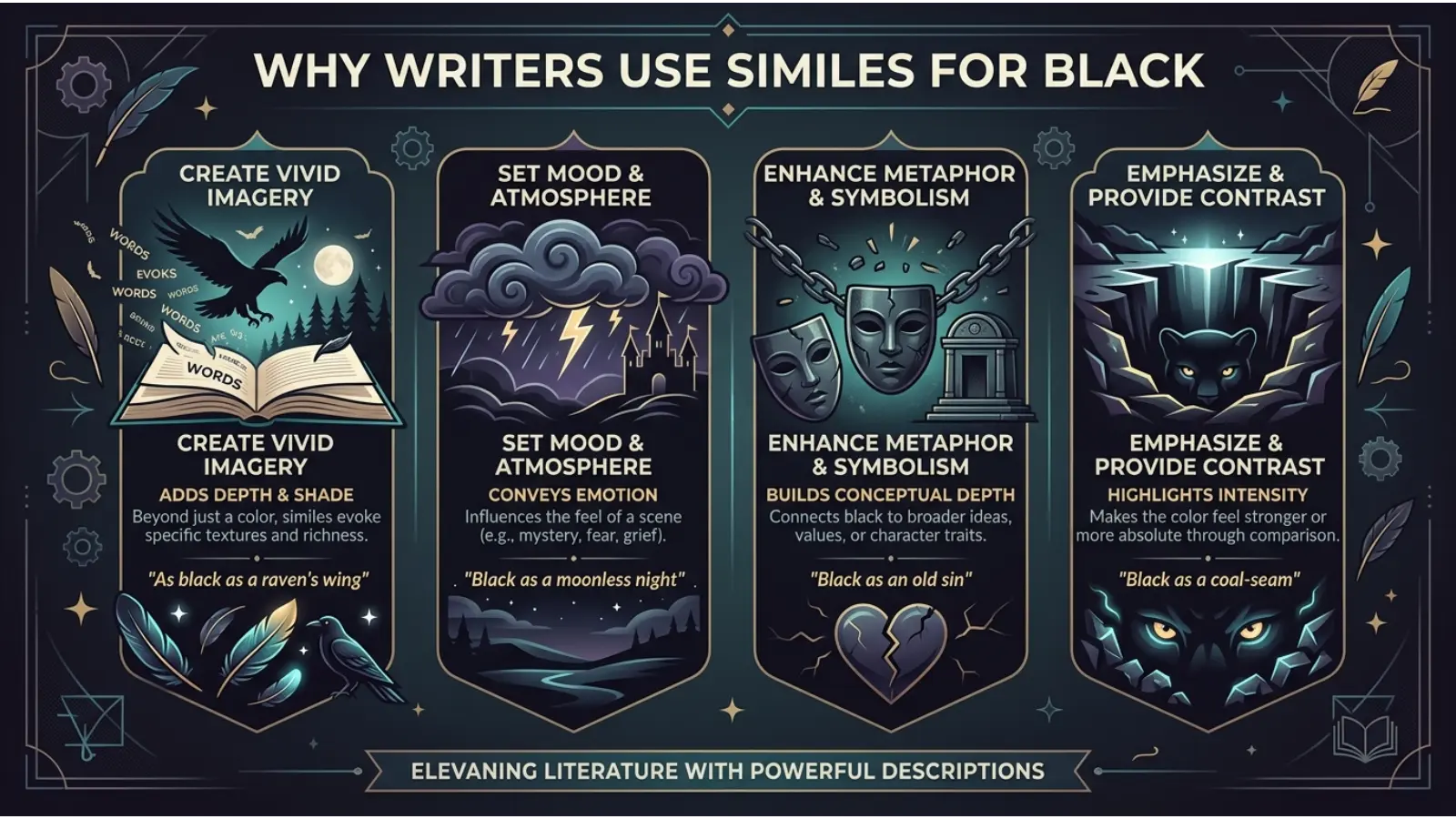
Black isn’t always negative. It can suggest:
- Mystery
- Sophistication
- Strength
- Silence
- Grief
- Luxury
- Endless space
- Hidden danger
- Calm nighttime scenes
Choosing the right comparison depends entirely on the feeling you want readers to experience.
35 Original Similes for Black
1. As black as polished obsidian
Meaning: Smooth, glossy black with elegance.
Examples
- Her dress was as black as polished obsidian.
- The lake reflected the night, as black as polished obsidian.
Writing Purpose
Excellent for luxury, fashion, jewelry, and fantasy settings.
Writing Tip
Use when describing reflective surfaces.
2. Like a moonless valley
Meaning: Deep natural darkness.
Examples
- The forest looked like a moonless valley.
- His eyes became like a moonless valley.
Emotional Effect
Mystery and quiet.
3. As black as cooled lava
Meaning: Dark, rough, and powerful.
Examples
- The cliffs stood as black as cooled lava.
- Smoke covered stones as black as cooled lava.
Best Context
Nature and adventure writing.
4. Like velvet at midnight
Meaning: Soft and luxurious darkness.
Examples
- Her hair flowed like velvet at midnight.
- The curtains hung like velvet at midnight.
Poetry Example
“The evening wrapped the hills like velvet at midnight.”
5. As black as an unopened ink bottle
Meaning: Rich, concentrated darkness.
Examples
- The liquid looked as black as an unopened ink bottle.
- Clouds gathered as black as an unopened ink bottle.
6. Like the shadow beneath ancient trees
Meaning: Cool, hidden darkness.
Examples
- The cave waited like the shadow beneath ancient trees.
- His cloak disappeared like the shadow beneath ancient trees.
7. As black as a raven’s hidden wing
Meaning: Natural deep black.
Examples
- Her feathers were as black as a raven’s hidden wing.
- His coat shimmered as black as a raven’s hidden wing.
8. Like charcoal after rain
Meaning: Dark with subtle texture.
Examples
- The bricks looked like charcoal after rain.
- His gloves were like charcoal after rain.
9. As black as a forgotten tunnel
Meaning: Complete darkness.
Examples
- The entrance became as black as a forgotten tunnel.
- The cellar remained as black as a forgotten tunnel.
10. Like midnight ink spreading across paper
Meaning: Darkness expanding naturally.
Examples
- Fog rolled over the hills like midnight ink spreading across paper.
- Smoke drifted like midnight ink spreading across paper.
11. As black as a sleeping volcano
Meaning: Quiet strength hiding beneath the surface.
Examples
- The mountain stood as black as a sleeping volcano.
- His expression became as black as a sleeping volcano.
12. Like soot on old stone
Meaning: Weathered dark color.
Examples
- The chimney looked like soot on old stone.
- The walls appeared like soot on old stone.
13. As black as the deepest cave pool
Meaning: Dark and mysterious.
Examples
- The water was as black as the deepest cave pool.
- Her eyes reflected as black as the deepest cave pool.
14. Like burnt cedar bark
Meaning: Earthy black.
Examples
- The wood looked like burnt cedar bark.
- Ash covered everything like burnt cedar bark.
15. As black as a hidden eclipse
Meaning: Dramatic darkness.
Examples
- The clouds became as black as a hidden eclipse.
- His mood turned as black as a hidden eclipse.
16. Like smoke trapped in glass
Meaning: Dark yet delicate.
Examples
- The vase shimmered like smoke trapped in glass.
- The sky looked like smoke trapped in glass.
17. As black as fresh graphite
Meaning: Clean, smooth darkness.
Examples
- The pencil marks were as black as fresh graphite.
- The sculpture gleamed as black as fresh graphite.
18. Like the silence before sunrise
Meaning: Calm darkness.
Examples
- The streets felt like the silence before sunrise.
- The room rested like the silence before sunrise.
19. As black as a storm-soaked cliff
Meaning: Powerful natural darkness.
Examples
- The rocks stood as black as a storm-soaked cliff.
- His boots were as black as a storm-soaked cliff.
20. Like folded night
Meaning: Darkness layered over itself.
Examples
- The cape flowed like folded night.
- Clouds gathered like folded night.
21. As black as an old camera lens
Meaning: Deep reflective black.
Examples
- The surface shone as black as an old camera lens.
- The helmet looked as black as an old camera lens.
22. Like an extinguished lantern
Meaning: Darkness after light disappears.
Examples
- The room became like an extinguished lantern.
- Hope faded like an extinguished lantern.
23. As black as winter branches after rain
Meaning: Sharp natural darkness.
Examples
- The trees stood as black as winter branches after rain.
- The fence looked as black as winter branches after rain.
24. Like deep ocean shadows
Meaning: Endless darkness.
Examples
- The water stretched like deep ocean shadows.
- The hallway felt like deep ocean shadows.
25. As black as polished basalt
Meaning: Solid and elegant.
Examples
- The countertop was as black as polished basalt.
- The monument stood as black as polished basalt.
26. Like the inside of an old theater after closing
Meaning: Quiet darkness.
Examples
- The auditorium rested like the inside of an old theater after closing.
- The room felt like the inside of an old theater after closing.
27. As black as burned oak
Meaning: Strong, textured black.
Examples
- The beams looked as black as burned oak.
- The sculpture appeared as black as burned oak.
28. Like an untouched midnight lake
Meaning: Peaceful darkness.
Examples
- The water lay like an untouched midnight lake.
- Her eyes seemed like an untouched midnight lake.
29. As black as a sealed treasure chest
Meaning: Hidden mystery.
Examples
- The box remained as black as a sealed treasure chest.
- The cave mouth looked as black as a sealed treasure chest.
30. Like quiet thunderclouds
Meaning: Darkness with tension.
Examples
- His expression gathered like quiet thunderclouds.
- The sky waited like quiet thunderclouds.
31. As black as ancient iron
Meaning: Strong and timeless.
Examples
- The gate stood as black as ancient iron.
- The armor looked as black as ancient iron.
32. Like a silent eclipse
Meaning: Dramatic yet peaceful darkness.
Examples
- The room dimmed like a silent eclipse.
- The valley rested like a silent eclipse.
33. As black as forgotten coal
Meaning: Rough, earthy darkness.
Examples
- The rocks looked as black as forgotten coal.
- Dust settled as black as forgotten coal.
34. Like shadows stitched together
Meaning: Dense layered darkness.
Examples
- The alley looked like shadows stitched together.
- His cloak hung like shadows stitched together.
35. As black as the edge of space
Meaning: Vast and endless darkness.
Examples
- The sky appeared as black as the edge of space.
- The background looked as black as the edge of space.
Writing Purpose
Ideal for science fiction and dramatic descriptions.
How to Make Similes for Black More Vivid
Great similes rely on specific images rather than familiar clichés. Instead of comparing something to “coal” every time, look for textures, places, or moments that naturally share the same quality.
Ask yourself:
- Is the black surface glossy or dull?
- Does it feel peaceful or threatening?
- Is it natural or man-made?
- Does it hide something or reveal elegance?
The answers will lead to more original comparisons.
Related Literary Devices
Metaphor
A metaphor states that one thing is another without using “like” or “as.”
Simile: Her hair was like velvet at midnight.
Metaphor: Her hair was midnight velvet.
Imagery
Imagery appeals to the senses. Combining visual details with sound, texture, or movement makes black descriptions feel alive.
Personification
Give darkness human qualities.
Example:
“The darkness quietly welcomed every traveler.”
Symbolism
Black often symbolizes:
- Mystery
- Authority
- Grief
- Elegance
- Protection
- The unknown
Its meaning changes with the story and culture.
Create Your Own Similes for Black
Follow this simple process:
Step 1
Choose the feeling you want to express.
Step 2
Find an object that naturally creates the same feeling.
Step 3
Compare them using “like” or “as.”
Step 4
Read the sentence aloud. If it sounds forced, simplify it.
Creative Exercise
Describe these using one original simile each:
- A black cat
- A winter night
- A leather jacket
- A cave entrance
- Storm clouds
Avoid using “coal” or “night” in every answer. Challenge yourself to create fresh imagery.
Common Mistakes
Overusing Famous Comparisons
Readers have seen the same comparisons countless times. Fresh imagery leaves a stronger impression.
Mixing Images
Avoid combining unrelated ideas.
Weak: As black as snow at midnight.
The comparison creates confusion instead of clarity.
Forgetting the Mood
Choose comparisons that match the emotion of your scene.
Confusing Similes and Metaphors
Remember:
- Simile = uses like or as
- Metaphor = direct comparison
Forcing Comparisons
If the image feels unnatural, readers will notice. The best similes seem effortless.
Frequently Asked Questions
What is a simile for black?
A simile for black compares something dark to another object using “like” or “as” to create a vivid image.
What emotions can black represent?
Black may symbolize mystery, elegance, fear, authority, grief, silence, or sophistication, depending on the context.
Are similes better than adjectives?
Not always. Similes add imagery, while adjectives describe directly. Using both thoughtfully creates stronger writing.
Can similes for black be positive?
Yes. Black often represents luxury, confidence, beauty, and timeless elegance in addition to mystery.
How do I avoid cliché similes?
Look closely at texture, light, mood, and setting. Create comparisons based on specific observations rather than relying on familiar phrases.
Should I use similes in academic writing?
Use them sparingly. Similes work best in creative writing, speeches, personal essays, and descriptive nonfiction.
How many similes should I use in one paragraph?
Only enough to strengthen the description. Too many comparisons can distract readers and reduce their impact.
Conclusion
The best similes for black do more than describe a color—they shape emotion, atmosphere, and imagination. By choosing fresh comparisons that match the mood of your scene, you can turn ordinary descriptions into memorable writing. Practice observing the world around you, experiment with unexpected yet believable images, and refine your comparisons until they feel natural. Over time, your similes will become one of the most powerful tools in your creative writing style.
I am Helena Frost, a writer captivated by the beauty of language and the art of comparison. Through my words, I explore the world by turning ordinary moments into vivid similes and reflections. I enjoy crafting phrases that spark imagination, evoke emotion, and linger in the mind. My writing celebrates the subtle connections between people, nature, and the stories we live. For me, every sentence is an opportunity to reveal the extraordinary in the everyday.