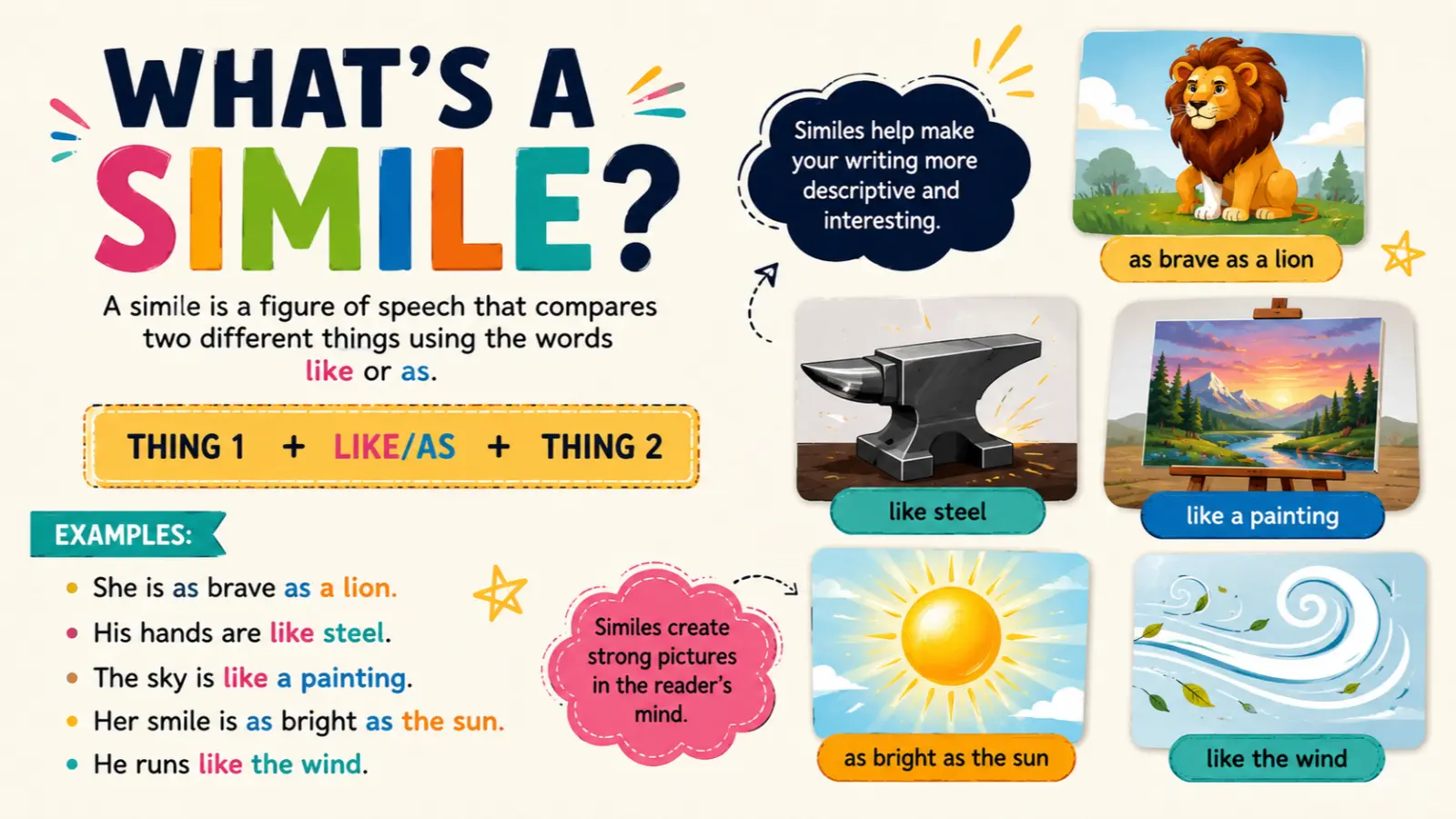
Whats Is a Simile is a comparison between two different things using words such as “like” or “as.” Writers use similes to make descriptions clearer, more vivid, and easier to imagine. Instead of simply saying someone is happy, for example, you can compare their happiness to something bright, energetic, or uplifting.
Similes appear everywhere: in stories, poems, everyday conversation, advertising, music, speeches, and school writing. You may have already used them without realizing it.
If you have ever wondered what’s a simile, this guide will give you a clear definition, original examples, explanations of why they work, and practical techniques for creating your own.
What Is a Simile?
A simile is a figure of speech that directly compares two unlike things, usually with like or as.
For example:
Her laughter was like sunlight spilling through an open window.
The laughter is not literally sunlight. The comparison helps the reader imagine it as warm, bright, and uplifting.
A simple formula is:
Subject + like/as + comparison
Examples:
- The baby slept like a leaf floating on still water.
- His voice was as gentle as a breeze through tall grass.
- The classroom became like a crowded train station before the bell.
- Her idea arrived like a spark in a dark room.
A strong simile does more than decorate a sentence. It gives the reader a picture, feeling, sound, movement, or impression.
Why Do Writers Use Similes?
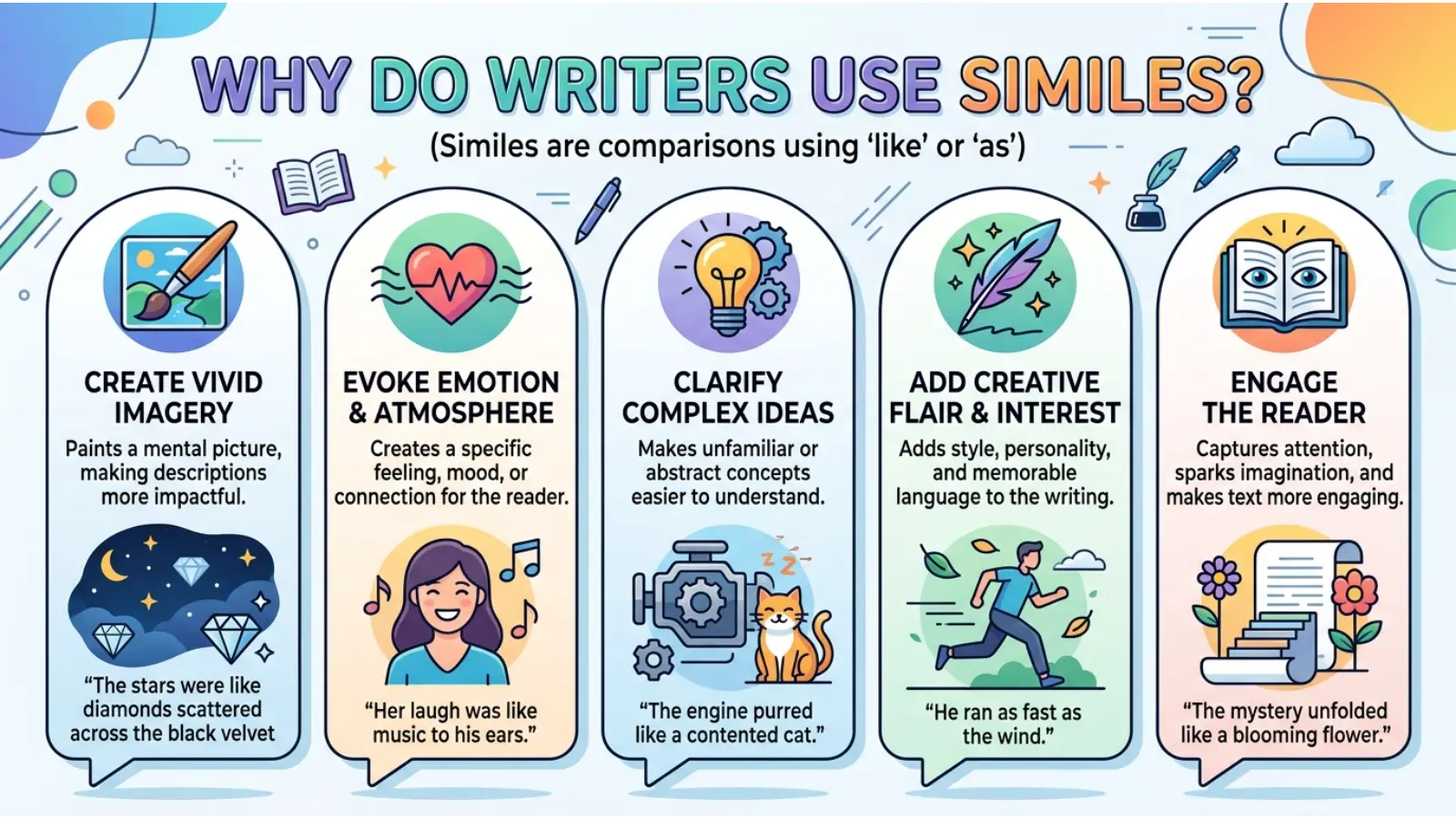
Similes can turn an ordinary description into something memorable.
Compare these sentences:
Plain:
The rain was heavy.
With a simile:
The rain fell like a curtain pulled across the entire sky.
The second sentence gives the reader a visual experience. The rain feels dense and continuous.
Writers use similes to:
- create vivid imagery
- communicate emotions
- describe people and places
- establish mood
- make abstract ideas easier to understand
- add personality to a narrator’s voice
- make poetry and storytelling more memorable
The best similes have a clear purpose. If removing the comparison makes the sentence stronger, the simile probably was not needed.
30 Original Simile Examples and What They Mean
1. Her Happiness Was Like a Window Full of Morning Light
Meaning: Her happiness feels bright, fresh, and difficult to hide.
Example:
Her happiness was like a window full of morning light, filling every conversation with warmth.
This works because the reader can connect emotional brightness with something visually familiar.
Best context: Happiness, friendship, family scenes, uplifting stories.
Writing tip: When describing an emotion, compare it to something that produces the same feeling rather than simply naming the emotion.
2. His Smile Spread Like Ripples Across a Quiet Pond
Meaning: One person’s smile gradually affects the people around them.
Example:
His smile spread like ripples across a quiet pond until everyone at the table was laughing.
This simile is especially useful when an emotion moves from one person to another.
Best context: Friendship, family, joyful scenes, storytelling.
3. Her Friendship Was Like a Lantern on a Foggy Road
Meaning: A dependable friend provides guidance and comfort during difficult moments.
Example:
Her friendship was like a lantern on a foggy road; I could not see far ahead, but I knew where to take the next step.
The lantern creates a feeling of safety without making the friendship sound unrealistic or overly sentimental.
Best context: Friendship essays, personal writing, reflective stories.
4. Their Friendship Grew Like Vines Around an Old Fence
Meaning: Their relationship developed gradually and became deeply connected over time.
Example:
Their friendship grew like vines around an old fence, slowly becoming part of everyday life.
The comparison emphasizes gradual growth rather than instant closeness.
Writing tip: Natural growth imagery works well when describing relationships that develop over time.
5. The Rain Tapped Like Fingertips on the Roof
Meaning: The rain made a rhythmic, gentle sound.
Example:
Rain tapped like fingertips on the roof while everyone settled down for the evening.
This simile appeals to the sense of hearing, making the weather feel present.
Best context: Rain descriptions, peaceful scenes, poetry, fiction.
6. The Storm Rolled In Like a Dark Curtain
Meaning: The storm quickly covered the landscape and changed its mood.
Example:
The storm rolled in like a dark curtain, turning the bright afternoon strangely quiet.
Unlike a simple statement that a storm arrived, the comparison gives the event movement and visual drama.
7. Her Voice Was Like Warm Tea on a Cold Evening
Meaning: Her voice felt comforting and soothing.
Example:
Her voice was like warm tea on a cold evening, calming everyone in the room.
This is effective because it combines sound with a physical feeling of comfort.
Best context: Character descriptions, emotional writing, reflective scenes.
8. His Anger Flared Like a Match in Dry Grass
Meaning: His anger appeared suddenly and became intense quickly.
Example:
His anger flared like a match in dry grass when he realized the mistake had been repeated.
The comparison emphasizes speed and intensity.
Writing tip: For strong emotions, choose an image that shows how the emotion behaves.
9. Her Frustration Hung Like a Heavy Coat
Meaning: Her frustration stayed with her and made everything feel difficult.
Example:
Her frustration hung like a heavy coat throughout the afternoon.
This works because frustration is invisible, while a heavy coat is something a reader can imagine carrying.
10. The Baby’s Laughter Sparkled Like Water in Sunlight
Meaning: The laughter sounded bright, lively, and joyful.
Example:
The baby’s laughter sparkled like water in sunlight whenever someone made a funny face.
This creates a cheerful visual image while connecting sound with brightness.
11. The Empty Street Stretched Like a Ribbon Between the Buildings
Meaning: The street appeared long, narrow, and continuous.
Example:
The empty street stretched like a ribbon between the buildings, disappearing around the corner.
Best context: Setting descriptions and travel writing.
12. The Old House Stood Like a Forgotten Photograph
Meaning: The house looked aged, still, and connected to the past.
Example:
The old house stood like a forgotten photograph at the edge of the field.
The comparison creates nostalgia rather than merely telling the reader that the house was old.
13. His Words Fell Like Stones Into the Conversation
Meaning: His words made the conversation suddenly serious, uncomfortable, or emotionally heavy.
Example:
His words fell like stones into the conversation, leaving everyone silent.
This is an example of using a physical object to represent emotional weight.
14. The Crowd Moved Like a River Through the Stadium
Meaning: A large group moved continuously in one direction.
Example:
The crowd moved like a river through the stadium gates after the game.
This simile helps readers imagine both the size and movement of the crowd.
15. Her Thoughts Buzzed Like Bees in a Jar
Meaning: She had many restless thoughts that would not settle.
Example:
Her thoughts buzzed like bees in a jar as she waited for the results.
The comparison communicates mental activity without explaining every thought individually.
Best context: Nervousness, confusion, anticipation, creative writing.
16. The Library Was Quiet Like Snow Before Footprints
Meaning: The library was exceptionally still and peaceful.
Example:
The library was quiet like snow before footprints, with only the faint turning of pages.
This comparison creates silence through an image rather than simply repeating the word “quiet.”
17. The New Idea Arrived Like a Key Finding a Lock
Meaning: The idea suddenly solved a problem.
Example:
The new idea arrived like a key finding a lock, and the confusing problem suddenly made sense.
Best context: Essays, problem-solving stories, creative nonfiction.
18. His Confidence Was Like a Balloon Losing Air
Meaning: His confidence gradually disappeared.
Example:
His confidence was like a balloon losing air as the questions became more difficult.
This is useful when describing a gradual emotional change.
19. The Music Moved Like a Wave Across the Room
Meaning: The music seemed to travel through and affect everyone present.
Example:
The music moved like a wave across the room, drawing even the quietest guests into the moment.
Similes in music often work best when they describe movement, texture, mood, or emotional impact rather than trying to explain the music technically.
20. The Piano Notes Fell Like Rain on Glass
Meaning: The notes sounded delicate, separate, and possibly reflective.
Example:
The piano notes fell like rain on glass, giving the quiet room a dreamlike mood.
Best context: Music writing, poetry, reviews, fictional scenes.
21. The Athlete Ran Like a Shadow Chasing the Sunset
Meaning: The runner moved quickly and continuously.
Example:
The athlete ran like a shadow chasing the sunset, never seeming to slow.
The comparison gives speed a visual form.
22. The Forest Was Like a Cathedral Built of Leaves
Meaning: The forest felt enormous, peaceful, and awe-inspiring.
Example:
The forest was like a cathedral built of leaves, with tall trees rising overhead.
This simile works because both spaces can create a feeling of scale and wonder.
23. Her Secret Sat Between Them Like an Unopened Letter
Meaning: Something important remained unspoken.
Example:
Her secret sat between them like an unopened letter, obvious but untouched.
This comparison creates tension without explaining exactly what the secret is.
24. The Sunset Burned Like Copper Along the Horizon
Meaning: The sunset had a rich, warm, metallic appearance.
Example:
The sunset burned like copper along the horizon as the boats returned to shore.
Writing tip: Color-based similes become stronger when you connect them with texture, light, or material.
25. His Excitement Bounced Like a Ball in an Empty Gym
Meaning: His excitement was energetic and difficult to contain.
Example:
His excitement bounced like a ball in an empty gym as he waited for the announcement.
The movement of the ball gives the emotion energy.
26. The News Hit Like a Door Slamming Shut
Meaning: The news created a sudden feeling of finality or shock.
Example:
The news hit like a door slamming shut, ending the possibility they had been hoping for.
This is particularly effective when a moment changes a story.
27. Her Memory Glowed Like an Old Lamp in the Attic
Meaning: The memory remained faint but meaningful.
Example:
The memory glowed like an old lamp in the attic, dim but still warm.
This creates a nostalgic tone without directly saying the character feels nostalgic.
28. The Question Floated Like a Feather Between Them
Meaning: The question remained gently present without being answered.
Example:
The question floated like a feather between them, too delicate for either person to touch.
This works well for quiet emotional tension.
29. The City Woke Like a Machine Turning on
Meaning: The city gradually became active and noisy.
Example:
At dawn, the city woke like a machine turning on, one sound after another joining the morning.
This simile is useful for urban descriptions because it focuses on gradual activity.
30. Hope Returned Like a Bird Finding Its Way Home
Meaning: Hope came back after being absent.
Example:
Hope returned like a bird finding its way home after weeks of uncertainty.
The comparison suggests that hope can disappear and later return naturally.
Best context: Inspirational stories, reflective writing, poetry, personal essays.
How to Make a Simile More Vivid
A weak simile often compares something with an image that has no specific connection.
For example:
The room was like a thing.
There is no useful image.
A stronger version identifies what the reader should notice:
The room was like a crowded train just before the doors opened.
Now the comparison communicates noise, movement, pressure, and anticipation.
Before writing a simile, ask:
What exactly do I want the reader to notice?
It might be:
- speed
- color
- sound
- texture
- warmth
- fear
- excitement
- loneliness
- confusion
- tension
- calmness
Then find an image that naturally carries that quality.
How Professional Writers Build Better Comparisons
Strong similes usually begin with observation.
Suppose you want to describe someone who is nervous. Instead of immediately writing:
He was as nervous as a rabbit.
Think about how nervousness actually behaves.
Maybe the character:
- checks the clock repeatedly
- avoids eye contact
- taps a pencil
- speaks too quickly
- forgets simple words
- keeps changing position
You could then create a more specific comparison:
His thoughts scattered like birds startled from a rooftop.
The simile works because the movement of startled birds resembles the character’s scattered mental state.
The secret is not finding the fanciest comparison. It is finding the most accurate one.
Avoid Cliché Similes
Some similes have been used so often that they no longer create a strong image.
Examples include familiar comparisons such as:
- as busy as a bee
- as cold as ice
- as white as snow
- as brave as a lion
These are not grammatically wrong. They are simply predictable.
A fresh comparison can make the same idea feel more personal.
Instead of:
She was as busy as a bee.
Try:
She moved from task to task like a conductor trying to keep an entire orchestra together.
The second version tells us more about the kind of busyness involved.
Use familiar similes when clarity matters. Use original similes when you want a distinctive voice.
Simile vs. Metaphor: What’s the Difference?
Both similes and metaphors compare different things, but they do it differently.
Simile:
The moon was like a silver coin above the trees.
Metaphor:
The moon was a silver coin above the trees.
The simile openly signals the comparison with like. The metaphor states the comparison more directly.
Neither device is automatically better.
Use a simile when you want to guide the reader toward a particular comparison. Use a metaphor when you want the comparison to feel more direct or powerful.
Simile, Imagery, and Personification
These literary devices can work together.
Simile makes a comparison:
The wind sounded like a distant train.
Imagery uses sensory details:
Cold wind slipped through the broken window, carrying the smell of wet pavement.
Personification gives human qualities to something nonhuman:
The wind whispered through the broken window.
A single passage can use all three:
The wind whispered through the window like a tired traveler asking to come inside.
The personification gives the wind a human action, while the simile develops the image.
Similes in Music
Songwriters and performers often use comparisons because music communicates feelings that can be difficult to describe literally.
A writer discussing music might say:
The melody rose like sunlight over a quiet field.
This does not describe the technical structure of the melody. Instead, it describes the experience of hearing it.
When writing about music, useful comparison categories include:
- movement
- texture
- atmosphere
- intensity
- emotional effect
- rhythm
- softness or sharpness
Avoid forcing a visual comparison onto every musical moment. Choose an image that matches what the listener actually experiences.
Similes for Happiness
Happiness can be described through images of light, movement, warmth, growth, or openness.
For example:
Her happiness opened like a flower after rain.
This suggests that the happiness was gradual and renewed.
Another possibility:
His excitement bounced like sunlight across a room.
Here, the comparison emphasizes energy.
When creating your own happiness simile, decide whether the feeling is quiet, playful, overwhelming, peaceful, sudden, or lasting. Your comparison should match that specific kind of happiness.
Similes for Friendship
Friendship similes work best when they reveal what the relationship provides.
Instead of simply saying:
My friend is like a star.
Consider the actual role of the friend:
Her friendship was like a porch light left on late at night.
Now the comparison suggests welcome, reliability, and comfort.
Ask yourself:
What does this friendship do?
Does it encourage you, protect you, challenge you, make you laugh, or help you feel understood?
The answer can become the foundation for a stronger simile.
Similes for Rain
Rain gives writers many sensory possibilities.
You can compare it through:
- sound
- movement
- appearance
- intensity
- mood
- smell
- effect on the landscape
For example:
Rain stitched silver lines across the window.
This creates a visual image of falling rain.
For a quieter scene:
The rain whispered like someone reading softly in the next room.
The comparison changes the mood completely.
Similes for Love
When writing about love, avoid relying only on familiar images. Think about what the relationship actually feels like.
For example:
Her presence was like a familiar song heard in a crowded place.
The comparison suggests recognition and comfort without describing love in an exaggerated way.
Another approach is to focus on everyday details:
Their conversations fit together like two pieces of a well-used puzzle.
This emphasizes compatibility rather than dramatic emotion.
Similes for Anger
Anger often involves heat, pressure, movement, noise, or sudden change.
For example:
His anger rose like steam trapped beneath a lid.
This suggests pressure building before release.
A quieter form of anger might need a different image:
Her anger sat like a closed door between them.
The second comparison creates distance rather than explosive energy.
Match the simile to the character’s version of anger.
Funny Similes
Funny similes usually work because the comparison is unexpected.
For example:
He walked into the meeting like a penguin wearing borrowed shoes.
The humor comes from the strange visual mismatch.
Another:
My alarm clock sounded like a tiny robot demanding a salary increase.
Funny similes are especially useful in:
- comedy
- casual conversation
- social posts
- humorous stories
- character dialogue
The key is surprise. A funny comparison should feel unexpected but still understandable.
Common Similes You May Already Know
Some comparisons are so common that they appear naturally in everyday speech.
Examples include:
- as quiet as a mouse
- as busy as a bee
- as strong as an ox
- as light as a feather
- as cold as ice
- as fast as lightning
These can be useful when you need quick, familiar communication. However, creative writing often benefits from more specific comparisons.
A useful editing question is:
Could another writer have written this exact simile?
If the answer is yes, consider making the image more personal or specific.
How to Create Your Own Simile
You do not need to wait for inspiration. You can build similes systematically.
Step 1: Choose the subject
Start with something you want to describe.
The classroom was noisy.
Step 2: Identify its strongest quality
Ask what makes it noisy.
Maybe students are talking, chairs are moving, and everyone is preparing for class.
Step 3: Find something with the same quality
Think beyond obvious choices.
A busy market, airport, train station, kitchen, or backstage area might have similar energy.
Step 4: Connect the images
The classroom buzzed like a market just before closing time.
Now the reader can imagine the noise and activity.
Step 5: Test the comparison
Ask:
- Does it make sense?
- Does it create a clear image?
- Does it fit the mood?
- Is it original enough?
- Does it add information?
If the answer is yes, keep it.
A Simple Exercise for Practicing Similes
Choose five ordinary sentences:
- The road was empty.
- She was nervous.
- The baby laughed.
- The room was dark.
- The food smelled good.
Rewrite each one using a different kind of image.
For example:
The road was empty like a stage after the audience has gone home.
Then try to make the next comparison completely different.
This exercise teaches an important writing skill: looking at ordinary experiences from unusual angles.
Another Exercise: Use the Five Senses
Choose one subject, such as rain.
Write one simile based on:
Sight:
The rain looked like silver threads against the window.
Sound:
The rain sounded like fingers drumming on a table.
Touch:
The rain felt like cool beads scattered across my hands.
Smell:
The wet pavement smelled like earth waking after a long sleep.
Movement:
The rain raced down the glass like tiny streams searching for the bottom.
This exercise prevents your writing from depending on visual comparisons alone.
Common Simile Mistakes Writers Should Avoid
Using an Overused Comparison
A familiar simile may communicate the idea, but it may not give your writing a distinctive voice.
Mixing Images
Avoid combining unrelated comparison systems.
For example, a sentence that begins with a sailing image and suddenly shifts into cooking imagery can confuse the reader.
Choose one clear image and develop it.
Forcing a Simile
Not every sentence needs one.
Too many similes can make prose feel crowded and distract readers from the story.
Making the Comparison Too Complicated
A simile should clarify rather than create a puzzle.
If readers need several sentences to understand the comparison, simplify it.
Choosing an Inaccurate Image
A beautiful comparison is still weak if it does not match the subject.
If a character is moving slowly, comparing them to lightning creates confusion unless the contrast is intentional.
Confusing Similes With Metaphors
Remember:
Simile:
The classroom was like a marketplace.
Metaphor:
The classroom was a marketplace.
The comparison is similar, but the grammatical structure differs.
How Long Should a Simile Be?
There is no fixed length.
A short simile can be powerful:
Her voice was like rain.
A longer one can provide more detail:
Her voice was like rain against a bedroom window, soft enough to disappear into the background but impossible not to notice.
The right length depends on what the sentence needs to accomplish.
If the comparison is already clear, stop. Do not explain an image that the reader has understood.
Where Can You Use Similes?
Similes are useful in many types of writing.
Fiction
They help readers visualize characters, settings, actions, and emotions.
Poetry
They can create compressed images and emotional associations.
Essays
They can make abstract ideas easier to understand when used carefully.
Speeches
A memorable comparison can help an audience understand an unfamiliar idea.
Music Writing
Similes can describe the emotional or sensory experience of sound.
Everyday Conversation
People naturally use comparisons to make explanations clearer or funnier.
Children’s Writing
Simple, vivid comparisons can make stories more engaging and easier to picture.
Frequently Asked Questions
What’s a simile in simple words?
A simile is a comparison between two different things using words such as like or as. For example, “The water was like glass” compares the appearance of water to glass.
What is an easy example of a simile?
An easy example is: “She ran like the wind.” The sentence compares her speed with the movement of wind.
What are the two words commonly used in similes?
The most common comparison words are like and as. However, the important feature is the direct comparison, not simply the presence of one particular word.
What is the difference between a simile and a metaphor?
A simile makes an explicit comparison, often using “like” or “as.” A metaphor makes a direct comparison without those words.
Can a simile be funny?
Yes. Funny similes often create humor by comparing something ordinary with an unexpected image.
For example:
He stared at the computer like a detective who had just discovered the keyboard was lying.
Are common similes bad?
No. Common similes are useful when they communicate an idea quickly. However, original comparisons are often more effective when you want your creative writing to stand out.
Can similes describe emotions?
Absolutely. In fact, emotions are often easier to communicate through comparison because feelings can be abstract.
Instead of writing:
She was extremely nervous.
You might write:
Her thoughts fluttered like birds trapped in a room.
How do I make my similes more original?
Start with observation. Identify the exact quality you want to describe, then search for an unexpected object, action, place, or experience that shares that quality. Specific observations usually produce stronger comparisons than random unusual words.
Conclusion
A good simile does not exist simply to make a sentence sound fancy. Its real purpose is to help the reader see, hear, feel, or understand something more clearly. When you write a simile, think beyond the words “like” and “as.” Think about the experience you want your reader to have. A comparison can reveal a character’s emotions, establish the mood of a scene, make an ordinary setting memorable, or turn an abstract idea into something concrete. Start by noticing the world around you. Listen to how rain sounds against a window. Watch how crowds move. Notice how sunlight changes a room. Pay attention to the small details of conversations, places, music, and emotions. Then ask one useful question: What does this remind me of—and why? That question is often where a memorable simile begins.
I am Helena Frost, a writer captivated by the beauty of language and the art of comparison. Through my words, I explore the world by turning ordinary moments into vivid similes and reflections. I enjoy crafting phrases that spark imagination, evoke emotion, and linger in the mind. My writing celebrates the subtle connections between people, nature, and the stories we live. For me, every sentence is an opportunity to reveal the extraordinary in the everyday.