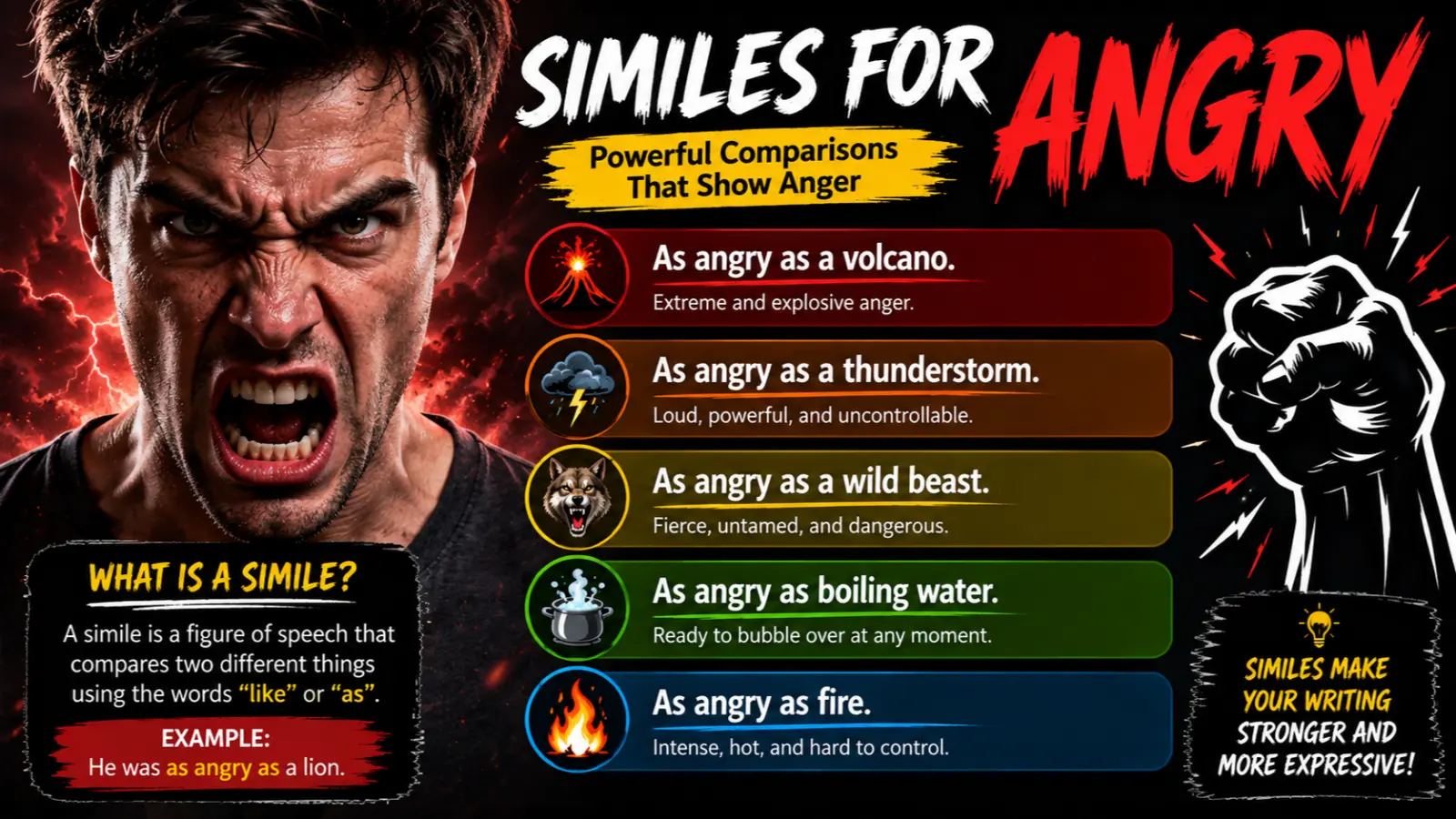
Similes for Angry can be difficult to describe because it is more than simply saying someone is “mad.” It can simmer quietly, flash suddenly, or build until a person struggles to control their words. Similes for angry feelings give writers a way to turn those invisible emotions into images readers can see and feel.
A Similes for Angry compares two different things using words such as like or as. Instead of writing, “She was angry,” you might write, “Her frustration spread through her like ink dropped into clear water.” The comparison creates a picture while revealing something about the character’s emotional state.
Writers use angry similes in novels, poems, essays, dialogue, personal writing, scripts, and everyday conversation. The right comparison can show whether anger is sudden, controlled, frightening, embarrassing, or quietly growing.
Below are original examples designed not only to give you ideas but also to show why each comparison works and how you can adapt it to your own writing.
What Are Similes for Angry Feelings?
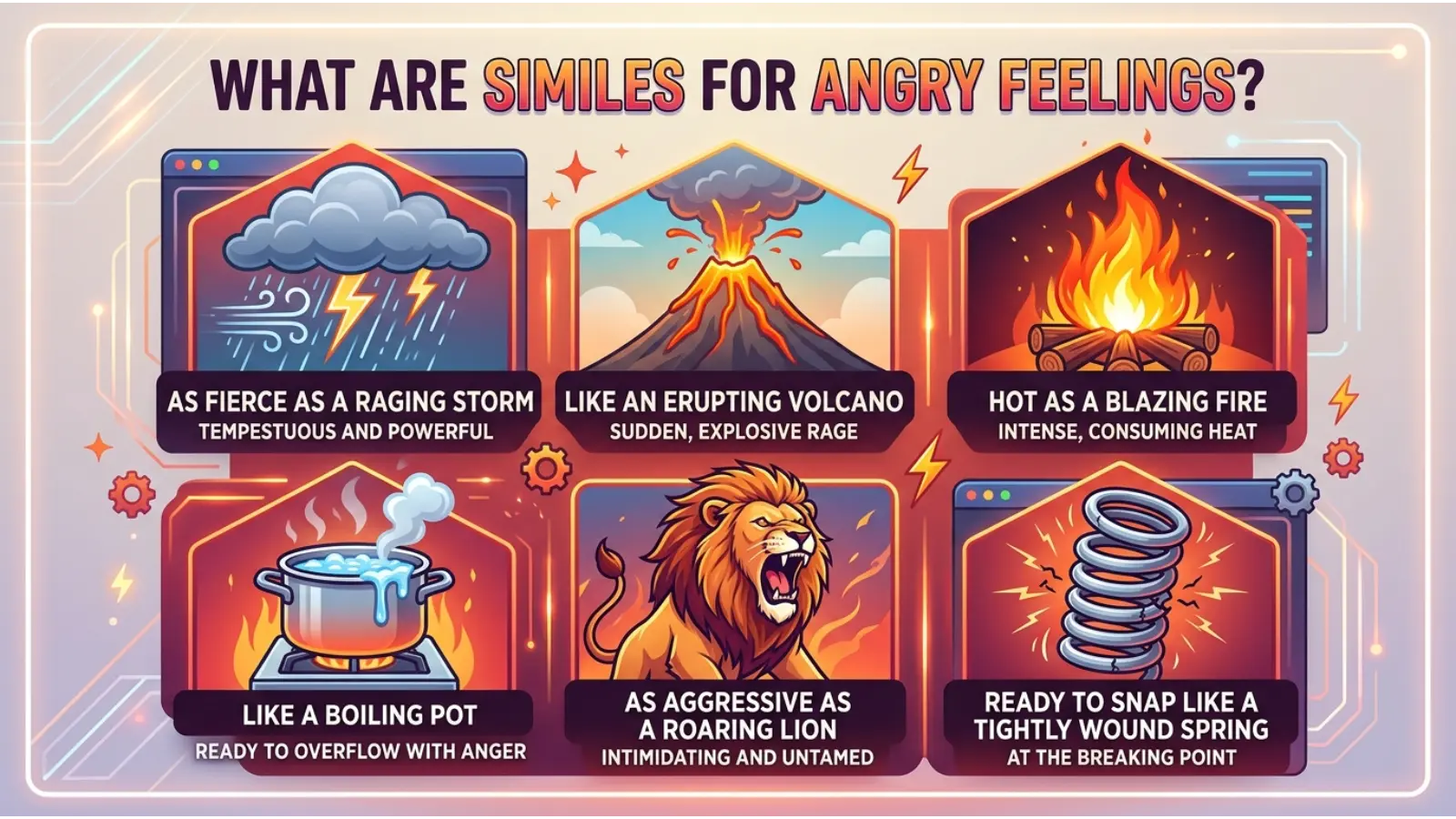
Similes for anger compare an angry emotion or reaction to something familiar.
For example:
His anger rose like a storm behind a closed window.
The comparison suggests that the anger is powerful but temporarily contained.
A strong anger simile does more than replace the word angry. It gives the reader information about the speed, intensity, appearance, or emotional texture of the anger.
30 Original Similes for Angry Feelings
1. His anger burned like a lantern left too close to dry paper.
Meaning: His anger is dangerous because it could quickly become destructive.
Example:
His anger burned like a lantern left too close to dry paper, waiting for one careless movement.
Writing purpose: This works especially well when a character appears controlled but is close to losing patience.
Writing tip: Use comparisons involving fire when anger is growing, but give the image a specific detail rather than relying on a familiar phrase such as “hot as fire.”
2. Her frustration spread like ink through clear water.
Meaning: Her irritation gradually affected her entire mood.
Example:
At first, she answered calmly. Then her frustration spread like ink through clear water.
This simile creates a quieter kind of anger. There is no explosion; instead, the emotion slowly changes everything around it.
Best context: Character descriptions, reflective fiction, and emotional essays.
3. His words snapped like dry branches under a heavy boot.
Meaning: His speech sounded sharp, sudden, and hostile.
Example:
“Leave me alone,” he said, his words snapping like dry branches under a heavy boot.
Emotional effect: The comparison makes dialogue feel abrupt and uncomfortable.
Writing tip: A simile can describe how someone speaks, not just how they feel.
4. Her temper flashed like sunlight on a broken mirror.
Meaning: Her anger appeared suddenly and intensely.
Example:
Her temper flashed like sunlight on a broken mirror when she saw the damaged project.
The image combines brightness with sharpness, making the anger feel sudden and unsettling.
Best context: Short stories and dramatic scenes.
5. His resentment sat inside him like a stone in a shoe.
Meaning: His anger was persistent and difficult to ignore.
Example:
He smiled through the meeting, but his resentment sat inside him like a stone in a shoe.
This is useful for characters who hide their emotions instead of expressing them openly.
6. Her irritation buzzed like a trapped fly.
Meaning: The feeling was small but persistent and increasingly annoying.
Example:
The unanswered message left an irritation buzzing in her mind like a trapped fly.
Writing purpose: This works better for mild anger than for rage.
Adapt it: Change the object to match the situation. A persistent noise, unfinished task, or repeated mistake can all become sources of comparison.
7. His anger gathered like thunder beyond the hills.
Meaning: His anger was developing before anyone could see its full force.
Example:
He said nothing, but his anger gathered like thunder beyond the hills.
Why it works: Thunder suggests something powerful approaching without showing the full event yet.
Best context: Suspenseful storytelling.
8. Her patience cracked like ice beneath a careless step.
Meaning: Her ability to remain calm suddenly disappeared.
Example:
After the third interruption, her patience cracked like ice beneath a careless step.
This simile focuses on the moment patience ends, rather than simply labeling the character angry.
9. His glare was sharp as a needle catching light.
Meaning: His look felt intense and uncomfortable.
Example:
He gave the room a glare as sharp as a needle catching light.
Writing tip: Physical details such as eyes, posture, gestures, and voice can communicate anger without directly naming the emotion.
10. Her frustration churned like clothes in a washing machine.
Meaning: Her thoughts and emotions were restless and tangled.
Example:
Questions churned through her mind like clothes in a washing machine.
Best context: Internal thoughts and modern conversational writing.
Why it works: The comparison emphasizes movement and mental confusion rather than aggression.
11. His temper rose like steam trapped beneath a lid.
Meaning: His anger was building while being restrained.
Example:
His temper rose like steam trapped beneath a lid, but he forced himself to stay quiet.
This is particularly useful when a character is deliberately controlling their reaction.
12. Her disappointment hardened like clay left in the sun.
Meaning: A temporary hurt gradually became a stronger, more lasting resentment.
Example:
At first, she wanted to forgive him, but the disappointment hardened like clay left in the sun.
Writing purpose: This comparison shows emotional change over time.
13. His voice rattled like a loose window during a storm.
Meaning: His voice revealed tension and emotional disturbance.
Example:
His voice rattled like a loose window during a storm as he demanded an explanation.
Best context: Arguments and dramatic dialogue.
14. Her anger moved through the room like a cold draft.
Meaning: Her mood affected everyone around her.
Example:
She never raised her voice, but her anger moved through the room like a cold draft.
Why it works: The comparison shows that anger can influence other people without loud behavior.
15. His frustration piled up like unopened mail.
Meaning: Small problems accumulated until they became overwhelming.
Example:
Every unanswered question added to his frustration, piling up like unopened mail.
Writing tip: Everyday objects can create relatable similes. Choose something readers immediately understand.
16. Her temper flickered like a faulty streetlight.
Meaning: Her anger appeared and disappeared unpredictably.
Example:
Her temper flickered like a faulty streetlight, calm one moment and furious the next.
Best context: Characters with unpredictable moods.
17. His resentment clung to him like wet clothes.
Meaning: He could not easily shake the feeling.
Example:
Even after the argument ended, his resentment clung to him like wet clothes.
Emotional effect: The comparison makes resentment feel uncomfortable and persistent.
18. Her words landed like stones dropped onto a quiet table.
Meaning: Her words disrupted an otherwise peaceful situation.
Example:
Her words landed like stones dropped onto a quiet table, leaving everyone silent.
Writing purpose: This is useful when anger changes the atmosphere of a scene.
19. His frustration rattled inside him like coins in an empty jar.
Meaning: His irritation was constant and noticeable to himself.
Example:
He tried to focus on the lesson, but frustration rattled inside him like coins in an empty jar.
Best context: School, workplace, or everyday situations.
20. Her anger curled around the conversation like smoke.
Meaning: Tension was present even though nobody directly discussed it.
Example:
Her anger curled around the conversation like smoke, making every sentence uncomfortable.
Why it works: Smoke is difficult to grasp but impossible to ignore, making it useful for hidden emotional tension.
21. His patience was thin as paper in the rain.
Meaning: He had almost no patience left.
Example:
By the end of the long meeting, his patience was thin as paper in the rain.
Writing tip: An effective simile often combines two things that share one important quality—in this case, fragility.
22. Her annoyance popped like corn in a hot pan.
Meaning: Small moments of irritation appeared quickly one after another.
Example:
Every new complaint made her annoyance pop like corn in a hot pan.
Best context: Lighthearted or humorous descriptions of frustration.
23. His anger stood between them like a locked door.
Meaning: Anger prevented communication or reconciliation.
Example:
His anger stood between them like a locked door, keeping every honest apology outside.
Writing purpose: This comparison focuses on the effect of anger on relationships.
24. Her frustration raced through her like a bicycle downhill.
Meaning: Her emotional reaction became increasingly difficult to slow down.
Example:
Once she started thinking about everything that had gone wrong, frustration raced through her like a bicycle downhill.
Best context: First-person narration and internal monologue.
25. His temper was brittle as a thin sheet of ice.
Meaning: His calmness could break easily.
Example:
His temper was brittle as a thin sheet of ice, and everyone around him knew to choose their words carefully.
Why it works: The image communicates both weakness and sudden danger.
26. Her resentment grew like weeds between paving stones.
Meaning: Negative feelings slowly developed despite attempts to ignore them.
Example:
Small disappointments became resentment that grew like weeds between paving stones.
Writing tip: Nature imagery is especially effective when showing emotions that develop gradually.
27. His reply came out like a door slammed in a quiet hallway.
Meaning: His response was abrupt and emotionally harsh.
Example:
“No,” he said, his reply coming out like a door slammed in a quiet hallway.
Best context: Dialogue-heavy fiction.
28. Her anger trembled like a glass balanced near the edge of a table.
Meaning: Her emotional control felt unstable.
Example:
She kept her voice steady, but her anger trembled like a glass balanced near the edge of a table.
Emotional effect: The reader senses that one small event could cause everything to collapse.
29. His frustration hung over him like a heavy backpack.
Meaning: The emotion made everything feel more difficult.
Example:
By Friday afternoon, his frustration hung over him like a heavy backpack.
Best context: Everyday writing, school stories, and personal essays.
Why it works: The comparison turns emotional weight into something physical.
30. Her anger faded like chalk beneath a steady rain.
Meaning: Her anger gradually disappeared.
Example:
After they talked honestly, her anger faded like chalk beneath a steady rain.
This example is useful because not every anger simile needs to describe intensity. Writers can also use similes to show anger changing or disappearing.
How to Make Angry Similes More Vivid
The strongest similes usually have a clear reason for the comparison.
Compare these two sentences:
He was angry like fire.
This is understandable, but it is vague and familiar.
Now consider:
His temper rose like steam trapped beneath a lid.
The second sentence gives the reader a more specific idea: the anger is building, contained, and potentially explosive.
When creating your own simile, ask:
- Is the anger sudden or gradual?
- Is it loud or quiet?
- Is it controlled or uncontrolled?
- Does it disappear quickly or linger?
- Does it affect only the character or everyone nearby?
Your answers will help you choose a more precise image.
Match the Simile to the Type of Anger
Not all anger feels the same.
Sudden anger
Use images involving flashes, cracks, sparks, collisions, or abrupt movement.
Example:
Her temper flashed like sunlight on a broken mirror.
Quiet anger
Use images involving shadows, smoke, pressure, cold air, or something hidden.
Example:
His anger moved through the room like a cold draft.
Growing anger
Use images that suggest accumulation or pressure.
Example:
His anger gathered like thunder beyond the hills.
Lingering resentment
Use images that suggest weight, stains, roots, or something difficult to remove.
Example:
His resentment clung to him like wet clothes.
Fading anger
Use images involving rain, melting, disappearing light, or gradually weakening sounds.
Example:
Her anger faded like chalk beneath a steady rain.
Choosing the right image makes your writing more precise.
How Professional Writers Avoid Cliché Similes
Some comparisons become so common that readers barely notice them. Familiar expressions can still have a place in everyday speech, but original writing becomes more memorable when the image feels specific to the situation.
Instead of immediately reaching for fire, storms, or boiling liquids, look around the scene.
If your character is angry in a kitchen, you might compare the emotion to:
- a pressure cooker
- a drawer that will not close
- a knife tapping against a cutting board
If the scene takes place outside, you might explore:
- wind pushing against a door
- branches scraping a window
- clouds covering the last light
The goal is not to make the comparison strange just for the sake of being different. The image should still reveal something meaningful about the emotion.
Common Mistakes When Writing Anger Similes
Using too many similes
A paragraph packed with comparisons can become distracting.
Choose the strongest image and allow the surrounding details to do the rest.
Explaining the simile too much
If you write:
His resentment clung to him like wet clothes, meaning that he could not get rid of it.
The explanation may be unnecessary in a story. Let the image communicate naturally.
Mixing unrelated imagery
Avoid jumping rapidly from fire to ocean waves to machinery to flowers unless there is a deliberate artistic reason.
A consistent image can make a scene feel more controlled.
Choosing an image that does not match the emotion
A playful comparison may weaken a serious confrontation. Likewise, an extremely dramatic image can make a minor annoyance sound excessive.
Think about emotional scale.
Telling instead of showing
“Daniel was angry” tells the reader the emotion.
“Daniel’s reply came out like a door slammed in a quiet hallway” gives the reader something to interpret.
Good writing can use both. The goal is not to eliminate direct emotional words but to use imagery when it adds something valuable.
Simile vs. Metaphor: What’s the Difference?
A simile makes a comparison using words such as like or as.
Her anger spread like smoke.
A metaphor makes the comparison more directly.
Her anger was smoke filling the room.
Both can create strong imagery, but they produce slightly different effects.
Similes often make a comparison feel more observational, while metaphors can make the comparison feel more immediate or absolute.
Using Imagery to Strengthen Angry Scenes
A simile is one part of a larger descriptive toolkit.
You can combine it with imagery by describing sounds, movements, surroundings, and physical sensations.
For example:
His anger gathered like thunder beyond the hills. He stopped tapping his pen. The room suddenly seemed too quiet.
The simile establishes the emotional pressure, while the surrounding details make the scene believable.
You can also use personification when an abstract emotion behaves like a living thing:
Anger followed him down the hallway.
This can work well when the emotion seems difficult for a character to escape.
How to Create Your Own Similes for Anger
Try this simple process.
Step 1: Name the exact emotion
Do not stop at angry. Decide whether the character is irritated, furious, resentful, impatient, offended, frustrated, or disappointed.
Step 2: Identify the intensity
Is the emotion barely noticeable, steadily increasing, or overwhelming?
Step 3: Find a physical experience
Think about something that behaves similarly.
For example:
Anger: building pressure
Possible image: steam trapped inside a container
Step 4: Add a specific detail
Instead of:
His anger was like steam.
Try:
His temper rose like steam trapped beneath a lid.
The added detail tells readers exactly how the anger behaves.
Step 5: Read it aloud
A simile should sound natural inside the sentence. If the comparison feels like it was inserted only to sound poetic, simplify it.
Creative Exercises for Better Angry Similes
Exercise 1: Change the intensity
Write three similes for the same character:
- slightly annoyed
- seriously frustrated
- completely furious
Make each comparison different.
Exercise 2: Use the setting
Choose a location such as a classroom, kitchen, bus stop, office, or sports field.
Create an angry simile using something naturally found there.
Exercise 3: Show anger without using “angry”
Write five sentences describing an angry character without using:
- angry
- mad
- furious
- upset
- rage
Use actions, sounds, facial expressions, and similes instead.
Exercise 4: Turn a cliché into something fresh
Start with a familiar comparison involving fire or storms.
Then ask:
What specific object behaves similarly in this situation?
Replace the familiar image with that object.
How Angry Similes Improve Characterization
A character’s choice of imagery can reveal personality.
A calm person who compares anger to a distant storm may view emotion as something to observe and control.
A character who compares anger to a broken machine may think in practical or mechanical terms.
Someone who uses nature-based imagery may notice changes in weather, light, or landscape.
This means similes can do more than describe emotions. They can quietly tell readers how a character sees the world.
FAQ About Similes for Angry Feelings
What is a good simile for anger?
A good simile for anger depends on the type of anger you want to show. For growing anger, you could write, “His anger gathered like thunder beyond the hills.” For lingering resentment, “His resentment clung to him like wet clothes” creates a stronger sense of persistence.
What is a simile for someone being very angry?
For intense anger, use an image that communicates pressure, sudden movement, heat, or instability. For example: “Her anger trembled like a glass balanced near the edge of a table.”
What is a simile for being annoyed?
Milder irritation can use smaller, persistent images. For example: “Her irritation buzzed like a trapped fly.” The comparison suggests an annoyance that is difficult to ignore but not overwhelming.
How do you describe anger creatively?
Focus on what the anger does rather than simply naming it. Describe the person’s voice, movements, thoughts, posture, or effect on the surrounding atmosphere. Then choose a simile that matches those details.
What are some similes for rage?
Rage can be compared to powerful or uncontrollable forces, but the image should fit the scene. Pressure, violent weather, breaking objects, or sudden movement can communicate intensity without relying on the same familiar comparisons repeatedly.
Can similes make angry dialogue stronger?
Yes. A well-placed simile can describe the sound or impact of dialogue. For example, “His words snapped like dry branches under a heavy boot” makes the character’s speech feel sharp and hostile.
Should I use “like” or “as” in a simile?
Both can work. Like is often used for direct comparisons, while as commonly appears in structures such as “as sharp as a needle.” Choose whichever sounds most natural in the sentence.
Conclusion
The best similes for angry feelings do not simply tell readers that someone is angry. They reveal what that anger feels like, how quickly it develops, whether it is controlled, and what effect it has on the people around it. When writing your own comparisons, start with the emotion’s exact quality. Then search for an image that behaves in the same way. A quiet resentment may need a completely different comparison from sudden frustration. Most importantly, do not chase originality by making every image bizarre. A fresh simile should still feel clear, believable, and connected to the scene. Experiment with ordinary objects, natural events, sounds, movement, and physical sensations. When the comparison fits the emotion precisely, a simple sentence can become an image readers remember.

I am Helena Frost, a writer captivated by the beauty of language and the art of comparison. Through my words, I explore the world by turning ordinary moments into vivid similes and reflections. I enjoy crafting phrases that spark imagination, evoke emotion, and linger in the mind. My writing celebrates the subtle connections between people, nature, and the stories we live. For me, every sentence is an opportunity to reveal the extraordinary in the everyday.