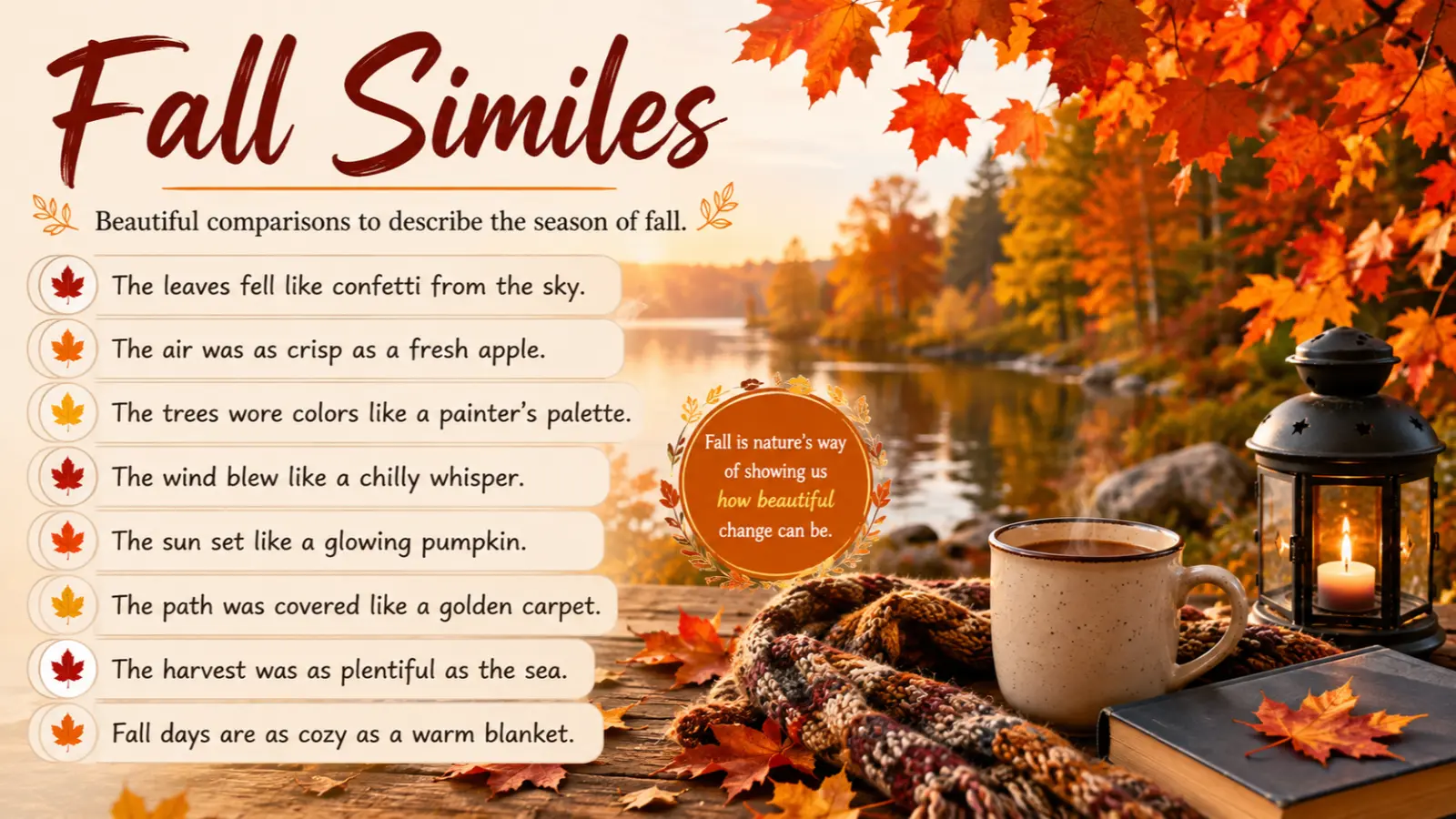
Fall similes belong to the world of nature and creative writing. They help writers describe autumn by comparing one thing to another using words such as like or as. Instead of simply saying, “The leaves were colorful,” a writer might say, “The leaves scattered across the sidewalk like tiny stained-glass tiles.”
That small comparison gives the reader something to see.
Fall is especially rich with imagery. Leaves change color, mornings become cooler, daylight fades earlier, rain taps against windows, and familiar landscapes take on a quieter mood. A well-chosen simile can turn these ordinary seasonal details into memorable writing.
This collection of fall similes offers fresh comparisons for essays, poems, short stories, descriptions, classroom assignments, captions, and everyday conversation. More importantly, it shows how to create your own comparisons instead of relying on familiar phrases.
What Is a Fall Simile?
A fall simile is a comparison that describes an autumn-related person, object, scene, feeling, sound, or action by comparing it to something else, usually with like or as.
For example:
The autumn leaves fluttered like colorful scraps of paper caught in the wind.
The leaves are not actually scraps of paper. The comparison helps the reader imagine how lightly and unpredictably they move.
A strong fall simile does more than decorate a sentence. It can communicate color, movement, temperature, sound, atmosphere, emotion, or personality.
Quick Answer: What Are Some Good Fall Similes?
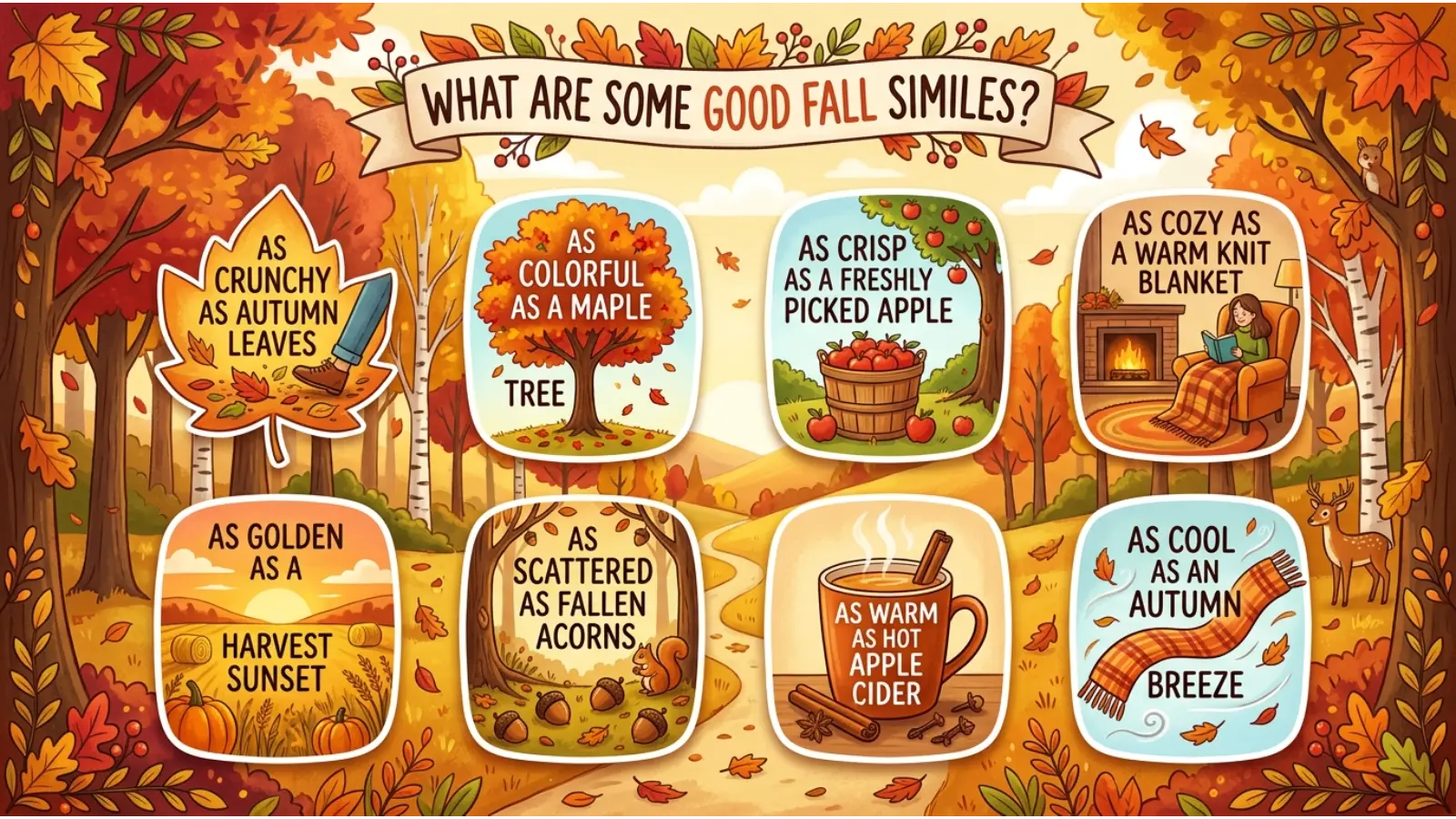
Some original fall similes include:
- The leaves glowed like little lanterns beneath the trees.
- The October wind slipped through the branches like a whispered secret.
- The morning fog rested over the field like a soft gray blanket.
- The red maple stood in the yard like a flame that refused to go out.
- Rain tapped against the window like impatient fingertips.
- The leaves covered the path like a patchwork quilt sewn by the wind.
- The autumn sky looked like faded blue silk stretched across the horizon.
- The empty playground felt as quiet as a closed theater after the final show.
These comparisons work because they give abstract or ordinary autumn details a concrete image readers can picture.
Fresh Fall Similes for Creative Writing
1. The Leaves Glowed Like Tiny Lanterns
Meaning: This comparison describes brightly colored autumn leaves, especially yellow, orange, or red ones.
Example:
The leaves glowed like tiny lanterns along the forest path.
At sunset, the maple trees looked like they had switched on hundreds of warm lights.
Why it works: Lanterns suggest warmth and brightness, making the autumn landscape feel inviting rather than merely colorful.
Best context: Nature descriptions, poems, children’s stories, and peaceful autumn scenes.
2. The October Wind Slipped Through the Trees Like a Whispered Secret
This simile gives the wind a quiet, mysterious quality.
Example:
The October wind slipped through the trees like a whispered secret.
Nobody spoke as the cool air moved between the branches.
Writing purpose: Use it when you want fall weather to feel gentle, mysterious, or slightly magical.
Writing tip: Notice that the comparison describes both movement and sound. Strong similes often communicate more than one sensory detail.
3. The Red Maple Stood Like a Flame Against the Gray Sky
A red maple can become the visual center of an autumn scene with this comparison.
Example:
One red maple stood like a flame against the gray sky.
Among the bare branches, the tree looked like a bright fire on the hillside.
Emotional effect: The image creates contrast and energy.
Best context: Descriptions where one autumn color needs to stand out dramatically.
4. The Morning Fog Lay Over the Field Like a Soft Gray Blanket
Fog can make a familiar landscape feel distant and quiet.
Example:
Morning fog lay over the field like a soft gray blanket.
The farmhouse appeared through the mist like a shape in an unfinished painting.
Why it works: A blanket suggests something that covers and settles gently over a surface.
Adapt it: Replace field with lake, meadow, road, or valley depending on your scene.
5. The Leaves Covered the Sidewalk Like a Patchwork Quilt
This comparison focuses on the mixture of autumn colors.
Example:
Leaves covered the sidewalk like a patchwork quilt.
Red, gold, and brown pieces formed a shifting pattern beneath our feet.
Writing lesson: When creating a simile, look at the shape or pattern of your subject, not only its color.
6. The Autumn Sky Was Like Faded Blue Silk
This simile creates a softer image of the fall sky.
Example:
The autumn sky was like faded blue silk above the quiet neighborhood.
Thin clouds stretched across it like loose threads.
Emotional effect: It gives the scene a delicate, slightly nostalgic quality.
Best context: Poetry, reflective writing, and calm descriptions.
7. The Rain Tapped the Window Like Impatient Fingertips
Autumn rain often becomes more noticeable indoors.
Example:
Rain tapped the window like impatient fingertips.
I listened to the steady rhythm while the afternoon grew darker.
Why it works: The comparison turns a natural sound into something almost human.
Related device: This also creates a touch of personification, because the rain seems to behave like a person.
8. The Cold Morning Air Felt Like a Splash of Clear Water
This comparison emphasizes freshness rather than discomfort.
Example:
The cold morning air felt like a splash of clear water against my face.
After the long summer, the crispness felt refreshing.
Writing purpose: Use this when autumn’s coolness is energizing.
Tip: Avoid automatically describing cold weather as unpleasant. The same temperature can create different emotions depending on the scene.
9. The Bare Branches Reached Upward Like Thin Fingers
This simile draws attention to the shape of trees after their leaves fall.
Example:
Bare branches reached upward like thin fingers against the evening sky.
Their shadows stretched across the road.
Why it works: The comparison gives the branches a recognizable shape and creates a slightly eerie atmosphere.
Best context: Mystery, suspense, gothic-inspired, or nighttime fall scenes.
10. The Acorns Fell Like Little Wooden Marbles
This comparison highlights the size, shape, and movement of acorns.
Example:
Acorns fell from the oak like little wooden marbles.
They bounced across the porch whenever the wind shook the branches.
Writing lesson: A useful simile can come from asking, “What else has this shape?”
Similes for a Peaceful Fall Day
Not every autumn scene needs dramatic imagery. Some of the best fall writing is quiet.
11. The Park Was Quiet Like a Library Before Opening
Example:
The park was quiet like a library before opening.
Only the rustle of leaves disturbed the empty paths.
The comparison establishes silence without simply saying very quiet.
Best context: Reflective essays, peaceful stories, and atmospheric descriptions.
12. The Sunlight Fell Through the Trees Like Honey
This comparison gives sunlight a warm, golden quality.
Example:
Sunlight fell through the trees like honey.
Golden patches rested on the trail beneath the branches.
Why it works: Honey suggests warmth, richness, and a slow, glowing appearance.
Writing tip: Comparisons become stronger when the second image shares several qualities with the first.
13. The Evening Settled Over the Town Like a Wool Blanket
Example:
Evening settled over the town like a wool blanket.
Porch lights began appearing one by one.
Emotional effect: The scene feels cozy and sheltered.
Best context: Family stories, autumn evenings, and comforting descriptions.
14. The Fireplace Glowed Like a Small Heart in the Dark
Example:
The fireplace glowed like a small heart in the dark room.
Everyone gathered closer as the rain continued outside.
Why it works: The comparison connects physical warmth with emotional warmth.
Best context: Cozy fiction, family scenes, and sentimental poetry.
15. The Harvest Moon Hung Like a Copper Coin
Example:
The harvest moon hung like a copper coin above the fields.
Its warm color seemed to echo the dry grasses below.
Writing purpose: This simile focuses on the moon’s shape and color.
Tip: When describing the moon, don’t limit yourself to comparisons involving circles. Its color, position, glow, and mood can all inspire different imagery.
Fall Similes for Wind, Rain, and Weather
Autumn weather gives writers opportunities to describe movement and sound.
16. The Wind Raced Through the Yard Like a Child Late for School
Example:
The wind raced through the yard like a child late for school.
Leaves spun behind it in messy circles.
Emotional effect: This creates playful, energetic movement.
Best context: Lively stories and descriptions of stormy autumn afternoons.
17. The Leaves Spun Through the Air Like Colorful Confetti
Example:
Leaves spun through the air like colorful confetti.
The children chased them across the yard.
Writing lesson: Movement is one of the easiest ways to make nature writing feel alive.
Tip: If your subject is moving, choose a comparison that also suggests movement.
18. The Drizzle Fell Like Fine Threads
Example:
The drizzle fell like fine threads across the garden.
Everything looked blurred behind the curtain of rain.
Why it works: The comparison emphasizes how thin and continuous the rain appears.
Best context: Quiet rainy scenes rather than heavy storms.
19. The Wind Whistled Like an Old Train
Example:
The wind whistled like an old train beyond the hills.
Its sound grew louder whenever it passed the chimney.
Emotional effect: The comparison gives ordinary wind a distant, haunting quality.
Writing tip: For sound-based similes, choose another sound that has a similar pitch, rhythm, volume, or mood.
20. The Clouds Gathered Like Dark Curtains
Example:
Clouds gathered like dark curtains above the town.
By late afternoon, the first drops of rain had begun to fall.
Why it works: Curtains suggest something closing or covering the sky.
Best context: Weather transitions and scenes that build anticipation.
Fall Similes for Leaves and Trees
Autumn leaves are familiar imagery, so originality matters.
21. Golden Leaves Drifted Down Like Notes From a Silent Song
Example:
Golden leaves drifted down like notes from a silent song.
They landed softly around the bench.
Emotional effect: This creates a poetic and slightly nostalgic atmosphere.
Best context: Poetry and reflective prose.
Writing insight: An unusual comparison can make familiar seasonal imagery feel fresh again.
22. The Oak Tree Looked Like a Giant With Rust-Colored Hair
Example:
The old oak looked like a giant with rust-colored hair.
Its branches stretched across the roof.
Why it works: The comparison turns the tree into a character.
Related device: This leans toward personification, because a human image is used to describe the tree.
23. The Leaves Crunched Underfoot Like Thin Crackers
Example:
The leaves crunched underfoot like thin crackers.
Every step announced our arrival on the trail.
Writing purpose: This is a sound-and-texture simile.
Tip: Sensory comparisons are especially useful when the reader cannot see the subject clearly.
24. The Bare Forest Looked Like a Sketch Drawn in Charcoal
Example:
The bare forest looked like a sketch drawn in charcoal.
Dark branches crossed the pale November sky.
Why it works: Charcoal suggests dark lines, contrast, and simplicity.
Best context: Late fall and winter-transition descriptions.
25. The Maple Leaves Shimmered Like Pieces of Polished Glass
Example:
The maple leaves shimmered like pieces of polished glass in the afternoon sun.
Every gust made the branches sparkle.
Emotional effect: This gives the landscape a bright, almost magical appearance.
Writing lesson: The best comparison often comes from observing what light does to an object.
Fall Similes for Feelings and Memories
Fall can also represent change, nostalgia, loneliness, excitement, or comfort.
26. The Memory Returned Like a Familiar Song
Example:
The memory returned like a familiar song when I walked beneath the old trees.
For a moment, the years between then and now seemed to disappear.
Why it works: A familiar song can suddenly bring back an old feeling or moment.
Best context: Personal essays, reflective stories, and emotional poetry.
27. The Empty Playground Felt Like a Stage After the Audience Leaves
Example:
The empty playground felt like a stage after the audience leaves.
The swings moved gently in the cold wind.
Emotional effect: This comparison creates quietness and nostalgia without directly saying the place feels lonely.
Writing insight: Instead of naming an emotion, show the situation that produces it.
28. The First Cool Evening Arrived Like an Unexpected Visitor
Example:
The first cool evening arrived like an unexpected visitor.
By sunset, everyone had started looking for jackets.
Why it works: The comparison makes seasonal change feel sudden and noticeable.
Best context: Stories about the transition from summer to fall.
29. Nostalgia Spread Through the House Like the Smell of Cinnamon
Example:
Nostalgia spread through the house like the smell of cinnamon.
Old photographs and familiar recipes brought childhood memories rushing back.
Writing purpose: This connects an abstract emotion with a strong sensory experience.
Tip: Abstract nouns such as nostalgia, fear, excitement, and hope become more vivid when compared with something readers can see, hear, smell, touch, or taste.
30. The Last Warm Day Felt Like a Door Slowly Closing
Example:
The last warm day felt like a door slowly closing.
We stayed outside until the fading light sent us home.
Emotional effect: This creates a sense of transition and gentle loss.
Best context: Reflective writing about seasonal change, growing older, or endings.
How to Make Fall Similes More Vivid
A weak simile usually tells the reader very little.
For example:
The leaves were like beautiful things.
The comparison does not give the reader a useful image.
A stronger version might be:
The leaves scattered across the lawn like scraps of stained glass.
Now the reader can imagine color, shape, and distribution.
When creating a fall simile, ask yourself:
- What exactly am I describing?
- What is its most noticeable quality?
- What else has that same quality?
- What emotion should the comparison create?
- Does the comparison fit the scene?
The final question is especially important. A funny comparison may work perfectly in a children’s story but feel distracting in a serious poem.
How to Avoid Cliché Fall Similes
Autumn writing often relies on familiar images: fire, gold, blankets, jewels, and flames.
These ideas are not automatically bad. They become weak when the writer uses them without adding anything specific.
Instead of writing:
The leaves were like jewels.
Think more precisely:
The wet leaves flashed like coins whenever the headlights passed.
The second comparison creates a particular moment, not just a generic image.
A useful technique is to observe your setting and ask:
What does this autumn object remind me of that most writers would not immediately choose?
That question encourages more original imagery.
How Professional Writers Build Better Comparisons
Good similes usually begin with observation.
Suppose you notice leaves moving across a street. Don’t immediately write the leaves danced like dancers. Look closer.
Are they:
- spinning?
- scraping?
- tumbling?
- sliding?
- collecting?
- separating?
- moving in circles?
Each observation suggests different comparisons.
A leaf that spins might resemble a coin tossed into the air.
A leaf that scrapes across pavement might resemble a paper envelope dragged by a breeze.
A pile of leaves might resemble folded fabric pushed into a corner.
The more specific your observation, the more specific your simile becomes.
Use the Five Senses to Create Fall Similes
Visual imagery is common in autumn writing, but fall offers much more.
Sight
The sunset looked like warm copper spread across the clouds.
Sound
The leaves crackled like dry paper beneath our shoes.
Touch
The morning air felt like cool silk against my hands.
Smell
The scent of wet earth rose like fresh bread from the garden.
Taste
The cider tasted like a warm orchard after the first frost.
Using different senses keeps seasonal descriptions from becoming visually repetitive.
Fall Similes vs. Metaphors
A simile makes a comparison using words such as like or as.
The leaves moved like birds across the road.
A metaphor makes the comparison directly.
The leaves were birds crossing the road.
Both can create imagery, but they produce different effects.
Similes often make comparisons feel more explicit and accessible. Metaphors can feel more direct and transformative.
Choose the form that best suits the voice of your writing.
Fall Similes and Imagery
Imagery is the broader use of descriptive language that helps readers experience a scene through their senses.
A simile is one tool for creating imagery.
For example:
The fog rested over the lake like a sheet of frosted glass.
The simile creates visual imagery, but the sentence also establishes atmosphere.
This distinction matters because a good writer does not use similes simply to add comparisons. The comparison should serve the larger scene.
Fall Similes and Personification
Personification gives human qualities to nonhuman things.
Consider:
The autumn wind whispered through the trees.
The wind is being given a human action.
Now compare:
The autumn wind moved through the trees like a child sneaking through a sleeping house.
This is a simile.
You can also combine the techniques:
The autumn wind whispered through the trees like a nervous visitor.
The result can make a landscape feel more alive.
Common Mistakes When Writing Fall Similes
Using Too Many Similes
A paragraph filled with comparisons can become exhausting.
If every sentence contains like or as, none of the images has enough room to stand out.
Use your strongest comparison and let the surrounding sentences support it.
Choosing a Comparison That Does Not Fit
A peaceful autumn morning probably does not need an aggressive comparison.
Always consider the emotional atmosphere before choosing your image.
Mixing Images
Be careful when combining unrelated comparisons.
For example, if leaves are first compared with ocean waves and then with burning paper in the same sentence, the reader may struggle to visualize the scene.
Choose one dominant image.
Confusing Similes and Metaphors
Remember:
Simile: The leaves were like flames.
Metaphor: The leaves were flames.
Both are literary comparisons, but they are structured differently.
Explaining the Simile Too Much
Once the image is clear, trust the reader.
Instead of:
The leaves were like tiny golden coins, meaning they were round-looking, bright, and yellow like coins.
Simply write:
Golden leaves spun across the pavement like coins caught in a gust.
The image can do the work.
How to Create Your Own Fall Similes
Try this simple process.
Step 1: Choose an autumn subject
Pick something specific:
leaf, acorn, fog, rain, pumpkin, wind, tree, sunset, moon, road, sweater, fireplace
Step 2: Identify one quality
Don’t describe everything at once.
Choose:
color, sound, movement, shape, texture, temperature, smell, or emotion.
Step 3: Find an unexpected match
For example:
Fog → blanket
Leaves → confetti
Wind → train
Branches → fingers
Then push the idea further.
Step 4: Make the comparison specific
Instead of:
The leaves were like paper.
Try:
The dry leaves scraped across the pavement like crumpled paper pulled by a string.
Specificity creates stronger imagery.
Step 5: Read it aloud
A simile may look clever on the page but sound awkward when spoken.
If it feels forced, simplify it.
Creative Exercises for Writing Fall Similes
Exercise 1: One Object, Five Comparisons
Choose one object, such as a leaf.
Write five comparisons based on:
- color
- sound
- movement
- texture
- emotion
You will quickly discover that one object can produce many different images.
Exercise 2: Replace a Weak Description
Start with:
The autumn evening was beautiful.
Rewrite it without using beautiful.
Try describing the sky, temperature, light, sounds, or landscape instead.
Exercise 3: Build a Simile From Sound
Listen to an autumn sound.
It might be rain, wind, leaves, or a fireplace.
Ask:
What other sound does this remind me of?
Use that answer to create your comparison.
Exercise 4: Write the Opposite Mood
Create a peaceful fall simile first.
Then rewrite it so the same subject feels mysterious or unsettling.
This teaches you how word choice changes atmosphere.
When Should You Use Fall Similes?
Fall similes can work in many types of writing.
Poetry
Use them to create compressed imagery and emotional resonance.
Short Stories
Use them to make settings feel vivid without long descriptions.
School Essays
Use carefully chosen comparisons when describing nature, seasons, literature, or personal experiences.
Children’s Writing
Use playful comparisons that are easy to visualize.
Creative Nonfiction
Use sensory similes to make memories and real experiences more vivid.
Everyday Conversation
A simple comparison can make ordinary speech more expressive.
The key is purpose. A simile should strengthen the sentence rather than exist simply because the writer wants to sound creative.
Frequently Asked Questions About Fall Similes
What is a good simile for fall?
A good fall simile compares an autumn detail with something that shares its color, movement, sound, texture, or emotional quality. For example, “The leaves glowed like tiny lanterns” creates a clear image of bright autumn foliage.
What are some similes for autumn leaves?
You can compare autumn leaves to lanterns, confetti, coins, stained glass, paper, or musical notes depending on the effect you want. The strongest comparison depends on what the leaves are doing in your scene.
How do you describe fall in a creative way?
Focus on specific sensory details instead of simply using words such as beautiful or cold. Describe the sound of leaves, the smell of wet soil, the color of trees, the texture of the air, or the changing light.
What is a simile for a fall tree?
A fall tree could be described as “like a flame against a gray sky,” “like a giant with rust-colored hair,” or “like a painting touched with copper.” Choose the comparison according to the tree’s color, shape, and surrounding atmosphere.
What are some fall similes for kids?
Kid-friendly examples include “The leaves spun like colorful confetti,” “The wind raced like a child late for school,” and “Acorns bounced like wooden marbles.” Simple, concrete comparisons are easiest for young readers to visualize.
Can fall similes be used in poems?
Absolutely. Similes are particularly useful in poetry because they can communicate an image and emotion in very few words. A carefully chosen comparison can also create rhythm and reinforce a poem’s central theme.
How can I make my autumn similes more original?
Start with close observation and avoid choosing the first comparison that comes to mind. Look for unusual similarities in movement, sound, texture, shape, or emotion, then make the comparison specific to your scene.
Conclusion
The best fall similes do not simply tell readers that autumn is colorful, cold, beautiful, or quiet. They give readers a new way to experience those qualities. A leaf can become a lantern, a coin, a musical note, or something entirely different depending on what the writer notices. Rain can sound impatient, gentle, distant, or playful. A bare tree can suggest fingers, charcoal lines, or a completely unexpected image. That is the real value of a simile: it changes the way readers see something familiar. When writing your own fall descriptions, look closely before reaching for a comparison. Notice one detail, find a surprising connection, and make that connection specific. The more carefully you observe autumn, the more original your writing will become.
I am Helena Frost, a writer captivated by the beauty of language and the art of comparison. Through my words, I explore the world by turning ordinary moments into vivid similes and reflections. I enjoy crafting phrases that spark imagination, evoke emotion, and linger in the mind. My writing celebrates the subtle connections between people, nature, and the stories we live. For me, every sentence is an opportunity to reveal the extraordinary in the everyday.