Similes using like belong primarily to Creative Writing and Poetry, but writers also use them in storytelling, conversation, advertising, music, essays, and everyday speech. A simile compares two different things to create a clearer or more memorable image. When the comparison uses like, the connection is stated directly:
Her laugh was like sunlight through a window.
The reader knows that her laugh is not literally sunlight. The comparison helps communicate its warmth, brightness, and uplifting effect.
Similes matter because readers often remember images better than plain descriptions. Compare these two sentences:
- The room was quiet.
- The room was quiet like a library after closing.
The second sentence gives the reader something to imagine.
This guide focuses specifically on similes using like. You will find original examples, explanations of why they work, practical writing advice, common mistakes, and exercises that can help you create stronger comparisons of your own.
What Are Similes Using “Like”?
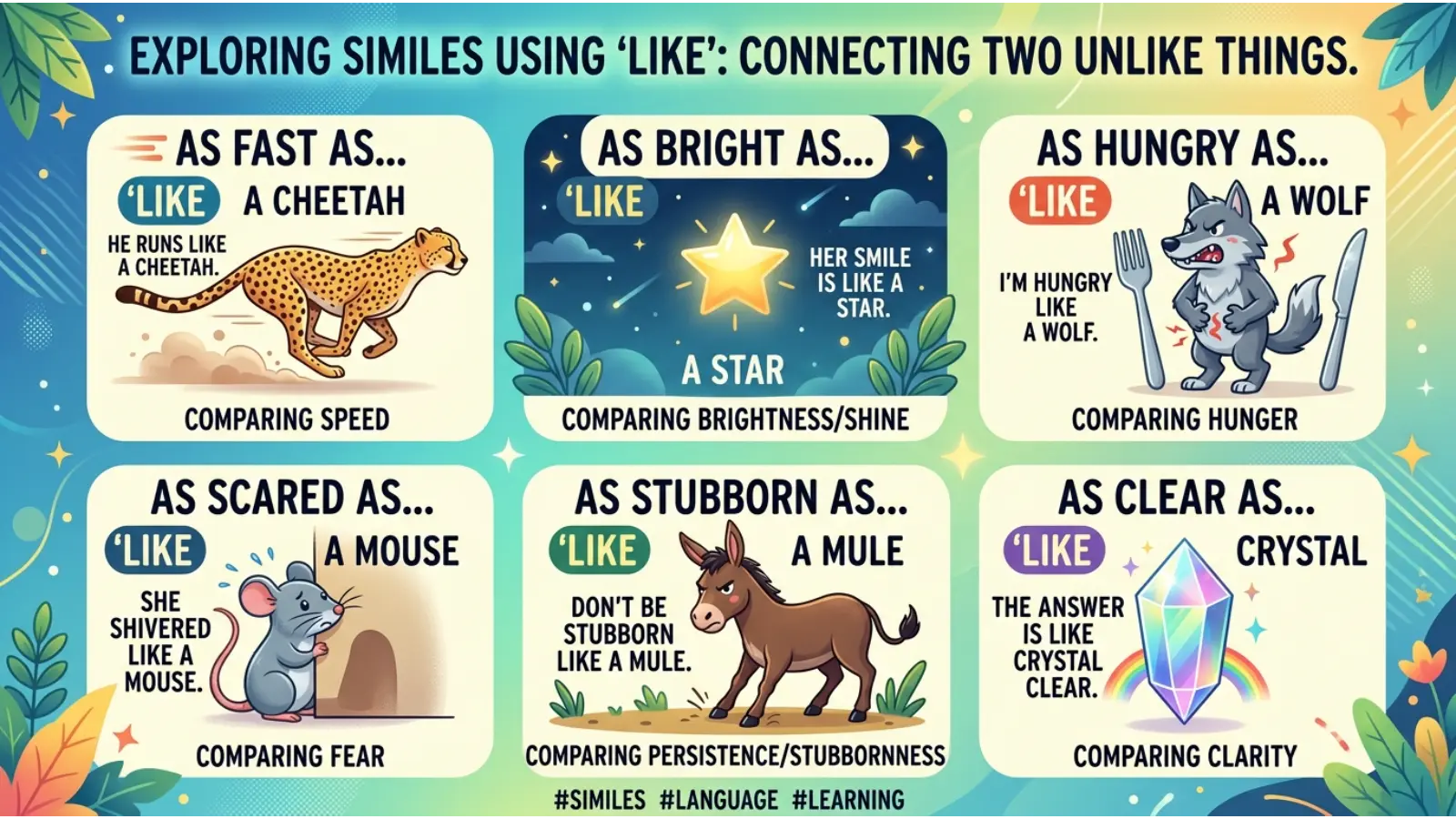
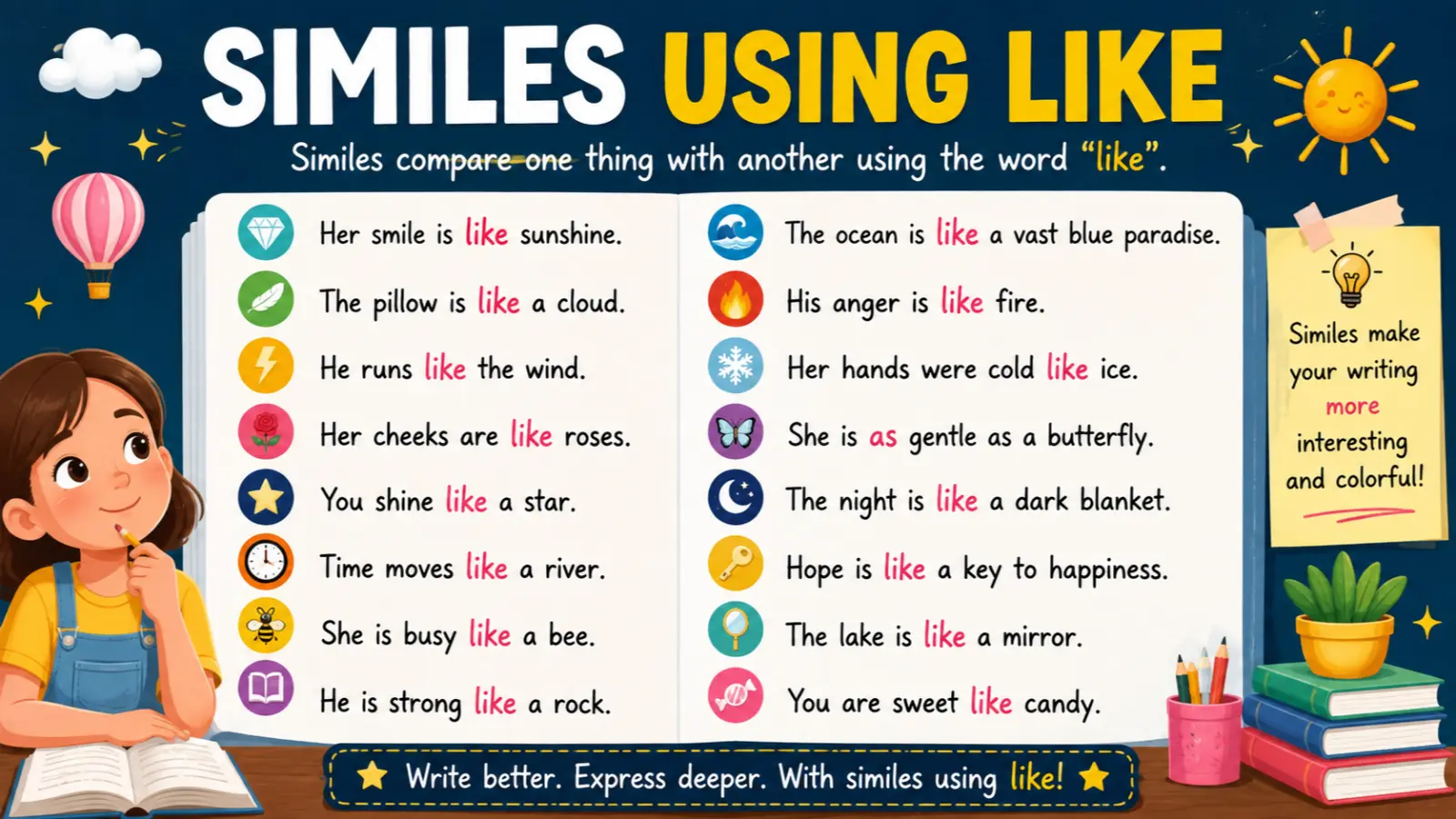
A simile using like compares one thing with another using the word like.
A simple structure is:
Subject + verb + like + comparison
For example:
- The river moved like a silver ribbon.
- His words landed like small stones.
- She entered the room like a sudden breeze.
The comparison should add meaning rather than simply decorate a sentence.
Simile vs. Metaphor
A simile usually signals its comparison with words such as like or as.
Simile:
The moon looked like a lantern above the trees.
Metaphor:
The moon was a lantern above the trees.
The distinction is useful when revising your writing. A simile lets you show the connection openly, while a metaphor makes the comparison more direct.
30 Original Similes Using “Like”
1. Her Smile Was Like a Window Opening After a Storm
Meaning: Her smile suggests relief, warmth, and renewed hope.
Example sentences:
- Her smile was like a window opening after a storm.
- One grin from him made the tense room feel easier to breathe in.
Why it works:
The comparison connects a human expression with the feeling of fresh air and returning light.
Best context: Happiness, friendship, family scenes, and emotional storytelling.
Writing tip: When writing about happiness, compare it with something that changes the atmosphere rather than simply saying someone is happy.
2. His Friendship Was Like a Bench Beneath a Shade Tree
Meaning: His friendship provided comfort, rest, and a dependable place to belong.
The image works because a shaded bench is useful without demanding attention. It suggests a friend who is simply there when needed.
Example:
Her friendship was like a bench beneath a shade tree; I could sit there without explaining why I was tired.
Best context: Friendship essays, personal narratives, and reflective writing.
3. The Rain Fell Like Fingers Tapping on a Window
Meaning: The rain sounded steady and rhythmic.
This comparison is especially effective because it appeals to sound, not just sight.
Example:
Rain fell like fingers tapping on a window while I finished my homework.
Writing lesson: Strong similes often engage one of the five senses. Ask yourself whether your reader can hear, smell, taste, touch, or see the comparison.
4. Her Happiness Rose Like Bread in a Warm Oven
Meaning: Her happiness gradually grew until it became impossible to ignore.
This is more interesting than simply writing she became very happy. The comparison suggests growth that happens naturally over time.
Best context: Character development and storytelling.
5. His Anger Spread Like Ink in Clear Water
Meaning: His anger quickly moved through the situation and affected everything around him.
Example:
His anger spread like ink in clear water, darkening every conversation at the table.
Why it works:
Ink changing clear water gives the emotion a visible shape. Abstract feelings become easier to imagine.
Writing tip: For emotions such as anger, fear, or jealousy, look for physical processes that behave similarly.
6. Her Voice Was Like a Candle in a Dark Hallway
Meaning: Her voice brought comfort or guidance during an uncertain moment.
Example:
Her voice was like a candle in a dark hallway, giving everyone a reason to keep moving.
This works particularly well in serious or emotional storytelling.
7. The Child Ran Like a Kite Freed From Its String
Meaning: The child moved with sudden freedom and excitement.
The image suggests both speed and a feeling of release.
Best context: Childhood, adventure, celebrations, and energetic scenes.
8. His Excitement Buzzed Like a Phone Full of New Messages
Meaning: He was intensely excited and unable to settle down.
This comparison uses a familiar modern experience to make an emotion immediately recognizable.
Example:
His excitement buzzed like a phone full of new messages before the competition began.
Writing lesson: Contemporary comparisons can feel fresh when they reflect experiences your audience actually knows.
9. The Old House Stood Like a Forgotten Photograph
Meaning: The house looked frozen in another time and seemed connected to the past.
The comparison creates a nostalgic, slightly mysterious atmosphere.
Best context: Historical fiction, descriptions, mystery, and reflective writing.
10. Her Tears Fell Like Rain on Dry Soil
Meaning: Her tears suggested deep emotion after a long period of holding feelings inside.
Example:
Her tears fell like rain on dry soil, quietly soaking into the silence.
Why it works:
The comparison connects tears with something desperately needing moisture.
Writing tip: Avoid using a comparison simply because it sounds poetic. Make sure the second image contributes a specific emotional meaning.
11. His Joke Landed Like a Feather on a Sleeping Cat
Meaning: The joke had almost no impact.
This is a deliberately playful comparison.
Example:
He told the joke with confidence, but it landed like a feather on a sleeping cat.
Best context: Funny writing, dialogue, casual storytelling, and humorous essays.
12. The Classroom Became Like a Beehive Before the Bell
Meaning: The room became noisy, active, and crowded with movement.
Instead of merely saying the classroom was noisy, the comparison gives the reader a lively picture.
Best context: School stories and children’s writing.
13. Her Memory Flickered Like a Porch Light in Heavy Wind
Meaning: She could remember pieces of something but could not hold the memory clearly.
Example:
The memory flickered like a porch light in heavy wind, bright for a moment and then gone.
Writing lesson: Similes can describe mental experiences as well as physical objects.
14. The Secret Sat Between Them Like an Unopened Letter
Meaning: Something important remained unspoken.
This comparison creates tension without explaining everything directly.
Best context: Mystery, drama, romance-free emotional storytelling, and suspense.
15. His Confidence Was Like Shoes That Had Not Been Broken In
Meaning: His confidence looked present but felt uncomfortable and unnatural.
This is useful for describing someone who is trying to appear confident.
Example:
His confidence was like new shoes: polished, noticeable, and slightly painful.
Why it works:
The comparison contains a small contradiction, which makes it more interesting.
16. The City Glittered Like Coins Scattered Across a Table
Meaning: Lights across the city appeared bright and numerous.
Example:
From the hilltop, the city glittered like coins scattered across a table.
Best context: Travel writing, landscape descriptions, and fiction.
17. Her Ideas Arrived Like Birds Landing on a Wire
Meaning: Ideas came one after another, briefly and unpredictably.
This comparison is especially useful when describing creativity.
Writing tip: When describing thought, avoid always using comparisons involving clouds, storms, or rivers. Unexpected but believable images can make abstract writing stronger.
18. His Silence Was Like a Door Left Half Open
Meaning: His silence suggested that something remained unresolved or undisclosed.
Example:
His silence was like a door left half open; nobody knew whether to enter.
Best context: Suspense, conflict, emotional scenes, and literary fiction.
19. The New Idea Spread Like Chalk Dust Across a Blackboard
Meaning: The idea quickly reached many parts of a group or conversation.
The comparison creates a visual sense of something expanding across a surface.
Best context: School writing, group projects, business storytelling, and essays.
20. The Sunset Burned Like Copper Beneath the Clouds
Meaning: The sunset had a rich orange-red appearance.
Example:
The sunset burned like copper beneath the clouds.
Writing lesson: Color comparisons become stronger when they identify a particular material rather than relying on vague words such as beautiful.
21. Her Laughter Bounced Like a Ball Down an Empty Hall
Meaning: Her laughter was lively, energetic, and echoed through the space.
Best context: Character descriptions and scenes involving joy.
22. The News Hit Him Like Cold Water
Meaning: The news caused sudden shock or emotional awakening.
This is a compact comparison because the physical sensation of cold water communicates surprise immediately.
Writing tip: Short similes can be powerful. A comparison does not need to be elaborate to work.
23. The Road Curved Like a Question Mark Through the Hills
Meaning: The road twisted unpredictably through the landscape.
Example:
The road curved like a question mark through the hills, disappearing around every bend.
Best context: Adventure, travel writing, and descriptive fiction.
24. Her Hope Glowed Like a Small Lamp on a Winter Night
Meaning: Her hope was modest but persistent during a difficult period.
The word small is important. It keeps the image believable and makes the hope feel fragile rather than overwhelming.
Writing lesson: Specific limitations can make an image more emotionally powerful.
25. The Crowd Moved Like Leaves Caught in a River
Meaning: The crowd moved together without much individual control.
Best context: Sports events, concerts, festivals, and busy public places.
26. His Apology Arrived Like a Package Long Overdue
Meaning: The apology came late but was still significant.
This comparison adds an idea of waiting and delay.
Example:
His apology arrived like a package long overdue—unexpected, but still worth opening.
27. The Song Stayed in Her Mind Like a Footprint in Wet Sand
Meaning: She could not easily forget the song.
Why it works:
A footprint remains visible for a while, but it is not permanent. That gives the comparison a subtle sense of memory and passing time.
Best context: Music writing, reflective essays, and storytelling.
28. The Wind Moved Through the Grass Like Someone Whispering a Secret
Meaning: The grass moved gently and quietly.
Example:
The wind moved through the grass like someone whispering a secret.
Writing lesson: Person-like comparisons can make natural scenes feel intimate without requiring full personification.
29. His Determination Held Like a Knot Pulled Tight
Meaning: His determination remained firm despite pressure.
Best context: Sports stories, achievement narratives, and motivational writing.
30. The Morning Arrived Like a Fresh Page
Meaning: Morning represented a new beginning or opportunity.
Example:
Morning arrived like a fresh page, waiting for someone brave enough to write on it.
Best context: Beginnings, personal essays, reflective writing, and inspirational storytelling.
How to Make a Simile Using “Like” More Vivid
A strong simile does more than identify a resemblance. It gives the reader a specific reason to connect two things.
Consider:
The girl was nervous like an animal.
The comparison is too broad. What animal? Nervous in what way?
A stronger version might be:
She watched the doorway like a rabbit listening for footsteps.
Now the reader can imagine alertness, uncertainty, and tension.
Give the Comparison a Specific Feature
When choosing the second image, ask:
What exactly do these two things have in common?
Maybe both are:
- unusually quiet
- quick and unpredictable
- fragile
- bright
- restless
- difficult to control
- comforting
- temporary
That shared quality is the engine of the simile.
Use Unexpected Comparisons Carefully
Originality is valuable, but a strange comparison is not automatically a good one.
A useful test is:
Can I explain why these two things belong together?
If you cannot identify the shared quality, the comparison may feel forced.
Build Similes From the Five Senses
Instead of writing:
The bakery smelled wonderful.
Try identifying the specific sensation:
The bakery smelled like warm cinnamon drifting through an open kitchen.
The image gives the reader something sensory to experience.
How Writers Avoid Cliché Similes
Some comparisons become clichés because they have been used so often that readers barely visualize them.
For example, familiar comparisons can sometimes work perfectly in ordinary conversation. The problem occurs when a writer depends on them for every description.
If you are writing creatively, ask:
Have readers seen this comparison many times before?
Then consider replacing it with an image connected to the character, setting, or situation.
Instead of automatically comparing anger with fire, think about what anger actually does:
- Does it spread?
- Tighten?
- Shake?
- Interrupt?
- Distort someone’s judgment?
- Make a room feel smaller?
That question can lead to a much more personal comparison.
How Similes Make Abstract Ideas Easier to Understand
Some of the hardest things to describe are invisible:
- happiness
- loneliness
- fear
- confidence
- confusion
- hope
- memory
- jealousy
A simile can give these ideas a physical form.
For example:
Her confusion was like a drawer filled with keys, none of them labeled.
The reader understands that there are many possibilities but no obvious answer.
This technique is useful in essays as well as fiction. A carefully chosen comparison can make an abstract explanation easier to remember.
Similes for Different Writing Situations
Similes in Music
Songwriters and poets often use comparisons to communicate emotions and atmosphere quickly.
A fresh comparison might describe a song as:
The melody moved like sunlight traveling across a bedroom wall.
The image focuses on movement and mood rather than simply calling the song beautiful.
Similes for Happiness
Happiness often works best when described through movement, light, warmth, sound, or expansion.
For example:
His happiness rose like a window shade pulled open at dawn.
The comparison suggests a change from darkness to brightness.
Similes for Friendship
Friendship comparisons become more meaningful when they show what the relationship provides.
Instead of saying:
My friend is like a star.
You might write:
Her friendship was like a familiar road home; I never had to wonder where it led.
The second version communicates trust and familiarity.
Similes for Rain
Rain provides opportunities for sound, movement, texture, and atmosphere.
Try focusing on the specific type of rain:
The first drops tapped the roof like impatient fingertips.
The comparison creates a different mood from:
Rain fell like a curtain.
Choosing the image according to the scene is what makes the description effective.
Similes for Love
When writing about love, avoid automatically reaching for familiar images. Think about the relationship’s particular qualities.
For example:
Their affection grew like two trees leaning toward the same patch of sunlight.
This emphasizes gradual growth and mutual movement rather than simply declaring that the relationship is strong.
Similes for Anger
Anger can be described through pressure, movement, sound, heat, or spreading.
For example:
Her anger tightened like a rope pulled from both ends.
The comparison suggests increasing pressure.
How to Create Your Own Similes Using “Like”
You do not need to wait for a brilliant comparison to appear.
Try this five-step process.
Step 1: Name the Thing
Start with what you want to describe.
Example:
The character is nervous.
Step 2: Identify Its Behavior
Ask what the nervousness actually does.
Maybe the character:
- checks the clock repeatedly
- avoids eye contact
- moves constantly
- speaks too quickly
- listens for every sound
Step 3: Find a Physical Match
Look for something outside the original situation that behaves similarly.
For example:
Nervous character → bird hearing a strange noise
Step 4: Connect Them With “Like”
He kept checking the doorway like a bird listening for an unfamiliar sound.
Step 5: Remove Anything Unnecessary
Revise the sentence until the comparison feels natural.
Good similes are usually specific without becoming overloaded.
Three Creative Exercises for Better Similes
Exercise 1: Replace a Plain Description
Take five simple sentences:
- The room was quiet.
- She was happy.
- He was angry.
- The road was long.
- The music was beautiful.
Rewrite each one using like.
Then ask whether the comparison gives the reader information that the original sentence did not.
Exercise 2: Start With an Object
Choose an ordinary object such as:
- a spoon
- a backpack
- a window
- a key
- a bicycle
Now describe an emotion using that object.
For example:
His uncertainty was like a key that fit every lock except the one he needed.
The goal is not to create a perfect sentence immediately. Write several possibilities and keep the strongest one.
Exercise 3: Make One Simile More Specific
Start with:
The rain sounded like music.
Improve it three times.
For example, think about:
- What kind of music?
- What instrument does it resemble?
- What mood does it create?
- Where is the sound happening?
The final comparison will usually be more memorable because you have identified the exact quality you want the reader to notice.
Common Mistakes With Similes
Using a Comparison That Adds Nothing
The blue sky was like a blue sky.
There is no meaningful comparison.
A simile should create a new association.
Mixing Two Images
Be careful when combining comparisons:
Her voice was like a candle and roared like a thunderstorm.
The two images pull the reader in opposite directions unless the contradiction is intentional.
Choose the image that best serves the scene.
Choosing an Unrelated Comparison
An unusual comparison can be creative, but it still needs a logical connection.
If readers have to spend more time figuring out the comparison than experiencing it, revise it.
Explaining the Simile Too Much
Sometimes writers create a good comparison and then immediately explain every part of it.
For example:
Her voice was like a candle in a dark hallway because candles give light and her voice made everyone feel better.
The comparison may be stronger when the surrounding prose lets the reader discover its meaning naturally.
Using Too Many Similes
A paragraph packed with comparisons can become exhausting.
If every sentence says something is like something else, none of the images gets enough attention.
Use similes where they sharpen an important detail.
Simile and Other Literary Devices
Metaphor
A metaphor makes a direct comparison:
The classroom was a beehive.
A simile makes the comparison explicit:
The classroom was like a beehive.
Imagery
Imagery uses descriptive language to create sensory experience.
A simile is one tool for creating imagery.
Personification
Personification gives human qualities to nonhuman things:
The wind whispered through the trees.
A simile can be combined with personification:
The wind moved like a child whispering a secret.
Hyperbole
Hyperbole deliberately exaggerates:
I waited forever.
A simile can contain exaggeration, but the two devices are not the same.
Alliteration
Alliteration repeats beginning sounds in nearby words.
For example:
The soft, silver stream slipped silently.
Alliteration can strengthen the sound of a simile, but it does not create the comparison itself.
How to Tell Whether Your Simile Works
Before publishing a piece of writing, test each important simile with four questions:
- What two things am I comparing?
- What specific quality connects them?
- Does the image fit the mood?
- Does the comparison give the reader something new?
If the answer to all four is yes, the simile is probably doing useful work.
If the sentence sounds decorative but does not deepen the description, consider removing it.
Frequently Asked Questions About Similes Using “Like”
What is a simile using “like”?
A simile using like compares two different things by explicitly connecting them with the word like. For example, The moon looked like a lantern.
What are some examples of similes with “like”?
Examples include:
- The road curved like a question mark.
- Her hope glowed like a small lamp.
- His anger spread like ink in clear water.
- The crowd moved like leaves caught in a river.
Does every sentence with “like” contain a simile?
No. The word like can have other functions.
For example, I like chocolate expresses a preference, not a comparison.
A simile uses like to establish a meaningful resemblance between two things.
Can similes using “like” be used in essays?
Yes. Similes can work well in essays when they clarify an idea or make an explanation more memorable. They should support the point rather than distract from it.
Are similes common in poetry and music?
Yes. Poetry and songwriting frequently use comparisons because a compact image can communicate emotion, atmosphere, or an abstract idea quickly.
How do I make a simile less cliché?
Start by identifying the exact quality you want to describe. Then brainstorm several unusual but believable objects, actions, places, or experiences that share that quality. Choose the comparison that best fits your particular scene.
Is a simile better than a metaphor?
Neither is automatically better. A simile makes the comparison explicit, while a metaphor presents the comparison more directly. Choose the form that produces the effect your writing needs.
How many similes should I use in my writing?
There is no fixed number. Use enough to make important descriptions vivid, but avoid filling every sentence with a comparison. Strong writing depends more on purposeful imagery than quantity.
Conclusion
A good simile does not merely make writing sound poetic. It changes what the reader can see, hear, feel, or understand. The most effective similes using like begin with careful observation. how an emotion behaves. Notice how light moves across a room. Notice the sound of rain, the movement of a crowd, or the way a memory returns. Then look for something else that behaves in a similar way. That is where original comparisons begin. When you write your next paragraph, do not ask only, What can I compare this to? Ask the more useful question: What does this really feel, sound, look, or move like? The answer may lead you to a simile your readers remember long after they finish the sentence.
I am Helena Frost, a writer captivated by the beauty of language and the art of comparison. Through my words, I explore the world by turning ordinary moments into vivid similes and reflections. I enjoy crafting phrases that spark imagination, evoke emotion, and linger in the mind. My writing celebrates the subtle connections between people, nature, and the stories we live. For me, every sentence is an opportunity to reveal the extraordinary in the everyday.