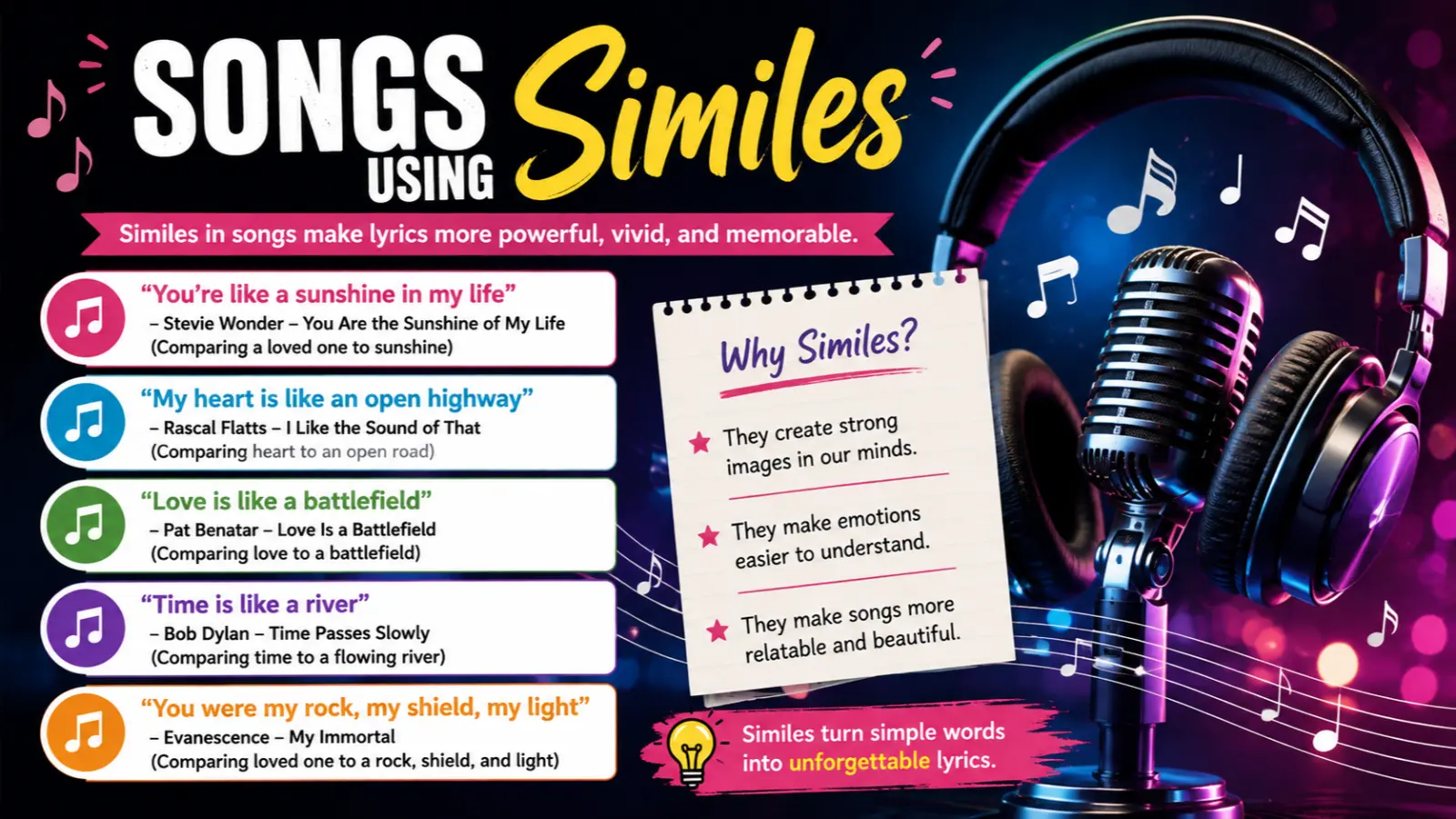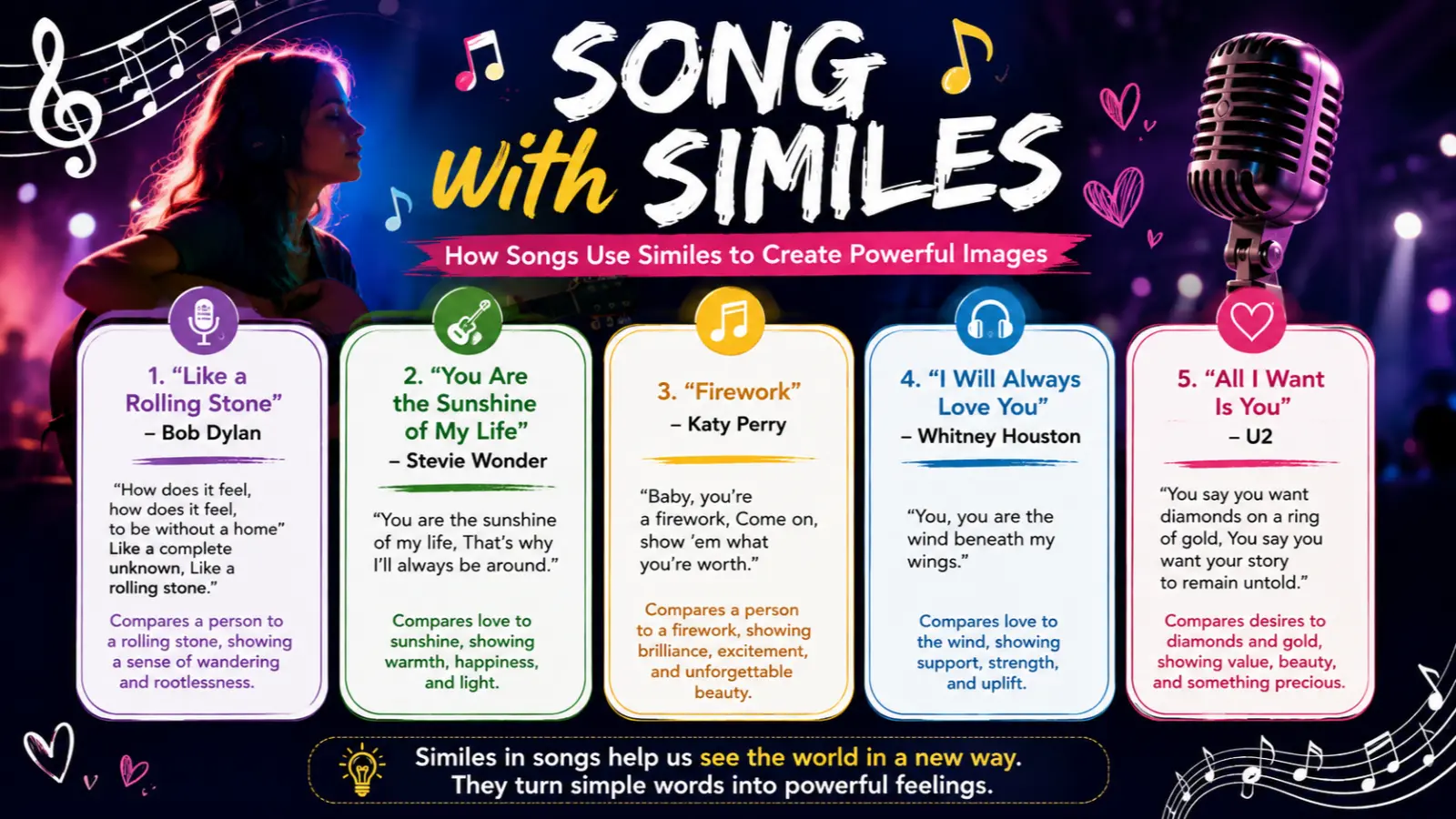
Song with Similes have a natural connection. A Song with Similes can describe heartbreak, excitement, friendship, freedom, or hope in just a few words, but a well-crafted comparison can make those feelings much easier to imagine.
A Song with Similes compares two different things using words such as “like” or “as.” Instead of simply saying that a singer feels happy, a lyric might compare that happiness to sunlight spilling through an open window. The comparison gives the emotion shape, color, and movement.
Writers use similes in songs, poems, stories, speeches, and everyday conversation. They can make an abstract feeling feel physical and turn an ordinary description into memorable imagery.
This guide focuses on songs with similes while also showing how the technique can help anyone write more expressive lyrics, poems, or creative descriptions.
What Is a Simile in a Song?
A simile in a song is a direct comparison between two unlike things, usually using like or as.
For example:
“Your voice moves through the room like rain across a quiet roof.”
The voice is not literally rain. The comparison suggests a gentle, steady, soothing quality.
A strong Song with Similes does more than decorate a line. It helps listeners feel, picture, or understand something that might otherwise be difficult to express.
Why Do Songwriters Use Similes?
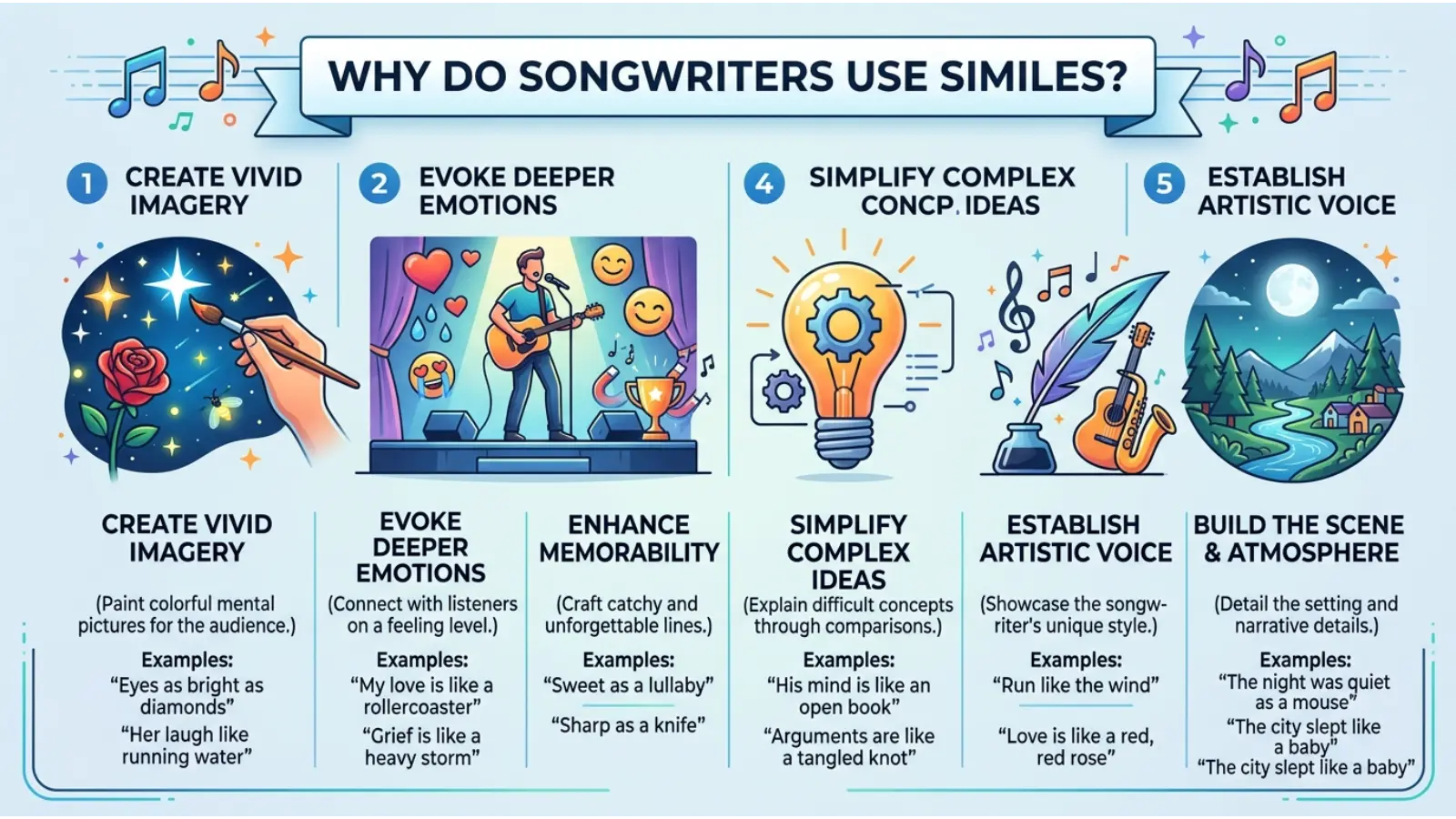
Songwriters often work with emotions and experiences that are difficult to describe literally. Song with Similes provide a shortcut to an image the listener already understands.
Compare these two sentences:
- “I miss you very much.”
- “I miss you like a street misses its lights after midnight.”
The Song with Similes first statement communicates information. The second creates a scene.
A useful simile can:
- make an emotion easier to visualize
- create atmosphere
- strengthen a song’s voice
- make a line more memorable
- communicate emotion without explaining it directly
- give listeners an image they can interpret for themselves
The best Song with Similes comparisons feel connected to the song’s world rather than inserted simply because the writer wanted a figure of speech.
30 Original Similes for Songs and Lyrics
The following examples are original writing prompts rather than quotations from existing songs. They can help illustrate how similes work in different musical moods.
1. “Your laughter rises like sunlight over a quiet street.”
Meaning: Someone’s laughter brings warmth and brightness.
Why it works: Sunlight creates an immediate visual image, while the quiet street gives the comparison a peaceful setting.
Best context: A joyful song about friendship, family, or affection.
Writing tip: Pair a sound with a visual image when you want listeners to experience it through more than one sense.
2. “My heart beats like a drum beneath a restless sky.”
Meaning: The speaker feels intense excitement or nervous energy.
Why it works: The drum suggests rhythm and movement, while the restless sky adds tension.
Best context: Anticipation, romance, performance, or a major life decision.
Try adapting it: Replace “drum” with an object that fits your song’s setting.
3. “Your memory lingers like smoke beneath a closed door.”
Meaning: A memory remains present even when the person tries to move beyond it.
Emotional effect: It creates a feeling of persistence and unease.
Best context: Reflective or bittersweet songwriting.
The important lesson here is that a simile can imply an emotion instead of naming it. The writer never has to say “I cannot forget you.”
4. “Hope flickers like a porch light in the rain.”
Meaning: Hope remains alive despite difficult circumstances.
Why it works: The small porch light contrasts with the surrounding rain, creating a visual image of persistence.
Best context: Inspirational songs or songs about overcoming uncertainty.
5. “The city glows like a stage waiting for its first song.”
Meaning: The city feels alive, dramatic, and full of possibility.
Writing purpose: This comparison turns an ordinary urban scene into something theatrical.
Best context: Travel songs, nighttime songs, or music about chasing dreams.
6. “Your goodbye fell like a stone into still water.”
Meaning: A goodbye creates an emotional disturbance that spreads outward.
Why it works: The image captures both sudden impact and lasting consequences.
Best context: Breakup or farewell songs.
This is stronger than simply saying “your goodbye hurt” because the image gives the listener a physical sense of the emotional event.
7. “We danced like sparks escaping a winter fire.”
Meaning: Two people move with energy, freedom, and excitement.
Emotional effect: The comparison feels lively but slightly fleeting.
Best context: Celebration, youth, adventure, or a night-out song.
8. “Her courage stood like a lighthouse against the fog.”
Meaning: Her courage provides direction during confusion or difficulty.
Best context: Songs about resilience or admiration.
Writing tip: When writing about courage, avoid automatically reaching for words such as “strong” or “brave.” Find an image that demonstrates those qualities.
9. “The old road curled like a ribbon through the hills.”
Meaning: The road winds gracefully through a natural landscape.
Best context: Travel songs, folk-inspired writing, or nostalgic storytelling.
Why it works: The ribbon comparison communicates shape without requiring a technical description.
10. “Your promise shone like a coin beneath clear water.”
Meaning: The promise appears valuable but may be difficult to reach or hold onto.
Emotional effect: It creates ambiguity. The promise is attractive, but something separates the speaker from it.
Best context: Songs about trust, uncertainty, or complicated relationships.
11. “My thoughts race like trains leaving every platform.”
Meaning: The speaker cannot slow down their thoughts.
Best context: An anxious, energetic, or introspective song.
Writing lesson: Movement-based comparisons are particularly effective when describing restless emotions.
12. “The morning opened like a window after a storm.”
Meaning: A new day brings relief and possibility after hardship.
Best context: Hopeful songs.
Why it works: “Opened” gives the morning a sense of movement, while the storm establishes what came before it.
13. “Her voice was soft like paper folding in the dark.”
Meaning: Her voice feels quiet, delicate, and intimate.
Best context: Gentle songs or reflective verses.
This example also demonstrates that unusual comparisons can be effective when the sensory connection is clear.
14. “We were like two lanterns crossing the same empty field.”
Meaning: Two people share a journey through an uncertain environment.
Emotional effect: The image suggests companionship without making the relationship explicit.
Best context: Friendship, family, travel, or reflective songwriting.
15. “Anger burned like red paint across the walls of my thoughts.”
Meaning: Anger dominates the speaker’s thinking.
Best context: Songs dealing with conflict or frustration.
Writing tip: Abstract emotions become stronger when you give them a physical environment.
16. “Her smile arrived like spring through a cracked door.”
Meaning: Happiness appears unexpectedly during a difficult period.
Why it works: The cracked door suggests an imperfect situation, making the arrival of happiness more meaningful.
Best context: Songs about recovery, friendship, or unexpected joy.
17. “The silence stretched like a road with no street signs.”
Meaning: The silence feels long, uncertain, and directionless.
Best context: Emotional conversations, separation, or uncertainty.
Writing lesson: A comparison can communicate multiple qualities at once. Here, the road suggests both distance and confusion.
18. “His dreams floated like paper boats down a summer stream.”
Meaning: His dreams move gently forward but may also be fragile.
Best context: Childhood, ambition, nostalgia, or coming-of-age songs.
19. “Your words hit like hail against a window.”
Meaning: The words feel sharp, sudden, and unpleasant.
Emotional effect: The comparison creates sound as well as emotional impact.
Best context: Arguments or emotionally intense songs.
20. “Freedom felt like running barefoot across warm sand.”
Meaning: Freedom feels natural, unrestricted, and joyful.
Best context: Adventure songs, personal-growth songs, or summer-themed music.
Writing tip: Physical sensations are powerful tools for describing abstract concepts.
21. “The crowd moved like one river beneath the lights.”
Meaning: Many people move together as one flowing mass.
Best context: Concerts, celebrations, festivals, and performance scenes.
Why it works: “River” communicates both movement and unity.
22. “Loneliness sat beside me like an uninvited passenger.”
Meaning: Loneliness feels like something that has joined the speaker without permission.
Best context: Reflective or melancholy songwriting.
Writing lesson: Personifying an emotion through a simile can make it feel like a character in the song.
23. “Our memories glow like photographs left near a window.”
Meaning: Memories remain vivid but may gradually change with time.
Best context: Nostalgic songs.
The image works because photographs preserve moments while also suggesting age and fading.
24. “The beat rolled through the room like thunder under the floor.”
Meaning: The music feels powerful and physical.
Best context: Dance, rock, electronic, or energetic songwriting.
Writing tip: When describing music inside a song, use sensory comparisons that let the listener almost feel the sound.
25. “Her kindness spread like tea warming cold hands.”
Meaning: Her kindness provides comfort.
Best context: Friendship, family, gratitude, or gentle storytelling.
Why it works: The comparison uses temperature and touch rather than simply saying that kindness is comforting.
26. “The stars hung like scattered notes above the town.”
Meaning: The night sky resembles musical notation.
Best context: Songs about music, nighttime, creativity, or dreams.
Writing lesson: A particularly effective simile can connect two parts of the same artistic world.
27. “My fear followed like footsteps behind an empty hallway.”
Meaning: Fear feels persistent and difficult to escape.
Best context: Suspenseful, introspective, or dramatic writing.
Note: The comparison focuses on atmosphere rather than explaining the emotion directly.
28. “Our friendship grew like vines around an old fence.”
Meaning: The friendship gradually became strong and deeply connected.
Best context: Songs about long-term friendship.
Writing tip: Growth-based imagery works well for relationships because it suggests time and development.
29. “The final note disappeared like a bird beyond the rooftops.”
Meaning: A musical moment ends and vanishes into the distance.
Best context: Songs about endings, performances, memories, or change.
Why it works: The comparison mirrors the fading quality of a musical note.
30. “Tomorrow waited like an unopened letter on the table.”
Meaning: The future contains information or possibilities that have not yet been revealed.
Best context: Hopeful, uncertain, or reflective songs.
Writing lesson: A good simile can create curiosity. The listener wants to know what is inside the “letter.”
How Similes Create Emotion in Music
A song doesn’t always need to name an emotion directly.
Instead of writing:
“I am lonely.”
A songwriter might create an image such as:
“Loneliness sat beside me like an uninvited passenger.”
The second version gives loneliness a presence. The reader or listener can imagine sitting beside something unwanted but impossible to ignore.
This technique is especially useful with emotions such as:
- happiness
- sadness
- anger
- fear
- hope
- loneliness
- excitement
- nostalgia
- love
- disappointment
The key is to choose an image that shares the emotional quality of the feeling.
Similes for Happiness in Songs
Happy songs benefit from images involving light, movement, warmth, color, sound, and openness.
For example:
“Joy moved through me like sunlight finding every room.”
This works because sunlight naturally suggests brightness and expansion.
Another approach is to use movement:
“We laughed like leaves dancing in a sudden breeze.”
The comparison creates energy rather than simply labeling the characters as happy.
When writing happiness, ask yourself:
What does happiness do?
Does it rise, glow, burst, dance, open, warm, spread, or race?
The answer can become the foundation for your simile.
Similes for Friendship
Friendship similes often work best when they communicate trust, familiarity, support, or shared history.
Consider:
“Our friendship was like a path worn smooth by years of footsteps.”
The comparison suggests that the relationship became familiar through repeated experiences.
For a lighter song, you could write:
“We laughed like two radios tuned to the same station.”
That image emphasizes shared humor and understanding.
A useful friendship simile should reveal what makes the relationship special, rather than merely saying that the friends are close.
Similes for Rain and Nature Songs
Nature gives songwriters an enormous vocabulary of images.
Rain can be:
- gentle
- heavy
- restless
- rhythmic
- cleansing
- gloomy
- comforting
- unpredictable
Instead of writing “the rain was loud,” try creating an image that demonstrates its sound:
“Rain rattled like tiny stones against the roof.”
For gentle rain:
“The rain whispered like someone reading softly behind a wall.”
The comparison changes the emotional atmosphere even though both sentences describe rain.
Similes for Love Songs
Love songs frequently use similes because love is an abstract experience.
Instead of saying:
“You make me feel safe.”
A writer might say:
“Your presence feels like a porch light waiting at the end of a long road.”
The comparison gives safety a physical destination.
Love similes become more interesting when they avoid generic comparisons. Rather than automatically comparing love to stars, roses, or fire, consider specific experiences:
- arriving home
- hearing a familiar voice
- sharing food
- walking through a familiar place
- finding shelter during rain
- remembering an ordinary afternoon
Specific details make emotional writing feel personal.
Similes for Anger
Anger often works well with images involving heat, pressure, noise, motion, or sudden impact.
For example:
“My anger rose like steam trapped beneath a locked lid.”
The comparison suggests pressure building without release.
Another possibility is:
“His words struck like hail against the roof.”
This focuses on repeated impact.
When writing about anger, don’t make every image explosive. Quiet anger can be more interesting:
“Her silence was like a match held carefully between two fingers.”
The reader senses danger without being told exactly what will happen.
How to Make a Song Simile More Vivid
A strong simile usually contains more than two nouns connected by “like.”
Compare:
“The night was like a blanket.”
This is understandable but generic.
Now consider:
“The night settled like a heavy quilt over the sleeping neighborhood.”
The second version provides:
- movement: “settled”
- weight: “heavy”
- texture: “quilt”
- setting: “sleeping neighborhood”
The comparison becomes part of a scene.
Use Specific Details
Instead of comparing something to “a flower,” consider the qualities you actually need.
Is it:
- a bright sunflower?
- a delicate wildflower?
- a closed tulip?
- a stubborn flower growing through pavement?
Specificity gives your comparison a personality.
Match the Image to the Emotion
A cheerful song and a sorrowful song should not necessarily use the same kind of imagery.
A bright image can reinforce joy, while a confined or fading image can reinforce sadness.
The goal is not to find the most beautiful comparison. The goal is to find the comparison that fits the emotional purpose of the line.
Let the Verb Do Some Work
Weak:
“Your voice is like rain.”
Stronger:
“Your voice falls like rain through the quiet room.”
The verb “falls” creates movement and atmosphere.
How Professional Songwriters Avoid Clichés
Clichés are expressions that have been used so frequently that they often lose their original force.
Comparing every beautiful person to a rose or every romantic feeling to a burning flame can make a song sound predictable.
That doesn’t mean familiar images are forbidden. Sometimes a traditional comparison is exactly right. The problem occurs when the writer chooses it automatically.
Try asking:
What specific experience does this feeling remind me of?
For example, instead of:
“My heart is broken like glass.”
You might think about what heartbreak actually feels like:
“Every familiar room feels like a house with one light missing.”
That image is less literal and gives the listener something new to interpret.
Simile vs. Metaphor in Songs
Similes and metaphors both create comparisons, but they usually do so differently.
A simile commonly uses like or as:
“The beat moved like thunder.”
A metaphor makes the comparison directly:
“The beat was thunder.”
Both can be effective.
Similes often leave a little distance between the two ideas, while metaphors can feel more immediate and forceful.
When writing lyrics, choose the form that best fits your voice and rhythm.
Simile vs. Imagery
Imagery is the broader technique of creating sensory pictures through language.
A simile can be one tool for creating imagery.
For example:
“The streetlights trembled like candles in the wind.”
This contains a simile, but it also creates visual and atmospheric imagery.
Good songwriting often combines several techniques rather than treating each literary device as an isolated trick.
Simile and Personification
Personification gives human qualities to nonhuman things.
A songwriter can combine it with a simile:
“The old house waited like a tired traveler for someone to return.”
The house is treated as if it can wait, while “like a tired traveler” creates the comparison.
This combination can be particularly useful in storytelling songs.
How to Write Your Own Song Similes
You don’t need to begin with the word “like.”
Start with the emotion or image you want the listener to experience.
Step 1: Name the feeling
Choose something specific:
nervous anticipation
rather than simply:
emotion
Step 2: List physical experiences
Ask what nervous anticipation feels like.
Maybe:
- tapping fingers
- quick breathing
- waiting for a message
- standing before a stage
- hearing a clock
- watching a door
Step 3: Find a surprising connection
Now look for an object or scene with a similar quality.
For example:
“My thoughts tick like an old clock in an empty room.”
Step 4: Test the comparison
Ask:
- Does the image make sense?
- Does it fit the emotion?
- Is it specific?
- Does it sound natural when spoken aloud?
- Does it fit the song’s setting?
Step 5: Read it aloud
Songs are heard rather than simply read.
A simile that looks impressive on a page may sound awkward when sung. Check its rhythm, syllables, and surrounding words.
A Simple Exercise for Better Song Similes
Choose one emotion.
Write five objects connected with that emotion.
For example, for hope:
- window
- sunrise
- candle
- road
- seed
Now create five rough comparisons:
- Hope is like a window opening.
- Hope is like sunrise after rain.
- Hope is like a candle in a hallway.
- Hope is like a road appearing through fog.
- Hope is like a seed beneath winter soil.
Don’t stop at the first idea. The fifth or sixth comparison is often more interesting than the first because you have moved beyond the obvious.
Common Simile Mistakes in Songwriting
Using Too Many Similes
A song doesn’t become more poetic simply because every line contains a comparison.
Too many similes can compete for attention and make the writing feel crowded.
Use them where they contribute something meaningful.
Choosing an Image That Doesn’t Fit
A peaceful verse can be weakened by a comparison that suddenly introduces an aggressive or unrelated image.
Keep the imagery connected to the song’s emotional world.
Mixing Images
Be careful when combining incompatible comparisons.
For example, a single line shouldn’t jump between a storm, a kitchen, a spaceship, and a garden unless there is a deliberate artistic reason.
Consistent imagery creates stronger atmosphere.
Explaining the Simile Too Much
If the image already communicates the emotion, you usually don’t need to explain it immediately afterward.
Let the listener participate in the meaning.
Choosing a Comparison Only Because It Rhymes
Rhyme matters in songwriting, but forcing an image simply to make a rhyme can weaken the writing.
Meaning should come first. Find the rhyme afterward when possible.
Confusing Similes With Metaphors
If you write:
“The city is a sleeping giant.”
that’s a metaphor.
If you write:
“The city rests like a sleeping giant.”
that’s a simile.
Knowing the difference helps you control the effect of your language.
How to Make Your Similes Sound Natural When Sung
A written sentence and a lyric do not always behave the same way.
When creating a simile for a song, listen for:
Rhythm: Does the line flow naturally?
Stress: Do the important words land where you want them?
Length: Is the comparison too complicated for the melody?
Sound: Do repeated consonants or vowels create a pleasant musical effect?
Meaning: Does the image support the emotion?
Sometimes the best lyric is not the most elaborate sentence. A simple, precise image can be far more memorable.
FAQ About Songs With Similes
What is an example of a simile in a song?
An original example is: “Hope flickers like a porch light in the rain.” The simile compares hope with a small light that continues shining despite difficult conditions.
Why are similes important in songwriting?
Similes help songwriters turn abstract emotions into concrete images. They can make lyrics easier to visualize, more emotionally expressive, and more memorable.
What are some good similes for love songs?
Useful love-song comparisons can involve warmth, shelter, familiarity, journeys, light, music, or everyday experiences. For example, “Your presence feels like a porch light waiting at the end of a long road.”
How do you write a simile for a song?
Start with the emotion or scene you want to communicate. Identify its physical qualities, find an object or experience with similar qualities, connect them with “like” or “as,” and then read the line aloud to test its rhythm.
What is the difference between a simile and a metaphor in lyrics?
A simile usually makes the comparison explicitly with “like” or “as,” while a metaphor makes the comparison directly. Both can create strong imagery in lyrics.
How can I avoid clichés when writing song similes?
Think about specific personal or fictional experiences connected to the emotion instead of reaching for familiar comparisons. Specific places, objects, sounds, and actions often produce fresher imagery.
Can similes be used in every type of song?
Yes. Similes can work in pop, rock, country, folk, hip-hop, musical theater, children’s music, ballads, and many other forms. The comparison simply needs to fit the song’s voice and purpose.
Do song similes have to use the word “like”?
No. “Like” and “as” are common signals, but comparisons can sometimes be expressed through structures such as “as bright as” or “as quiet as.” What matters is the comparison itself.
Conclusion
A memorable song does not need a simile in every line. It needs the right image at the right moment. The strongest song similes make listeners pause because they recognize an emotion in an unexpected form. A feeling becomes sunlight, a memory becomes smoke, hope becomes a porch light, and uncertainty becomes an unopened letter. When you write your own comparisons, look beyond the obvious. Notice ordinary objects, sounds, places, weather, movement, and small human experiences. Those details often contain better material than the most familiar poetic images. Start with one feeling, find one surprising physical connection, and shape it into a line that sounds natural when spoken or sung. With practice, your similes can do more than make lyrics sound poetic—they can give listeners something they can actually see, hear, and feel.

I am Helena Frost, a writer captivated by the beauty of language and the art of comparison. Through my words, I explore the world by turning ordinary moments into vivid similes and reflections. I enjoy crafting phrases that spark imagination, evoke emotion, and linger in the mind. My writing celebrates the subtle connections between people, nature, and the stories we live. For me, every sentence is an opportunity to reveal the extraordinary in the everyday.