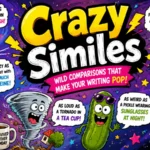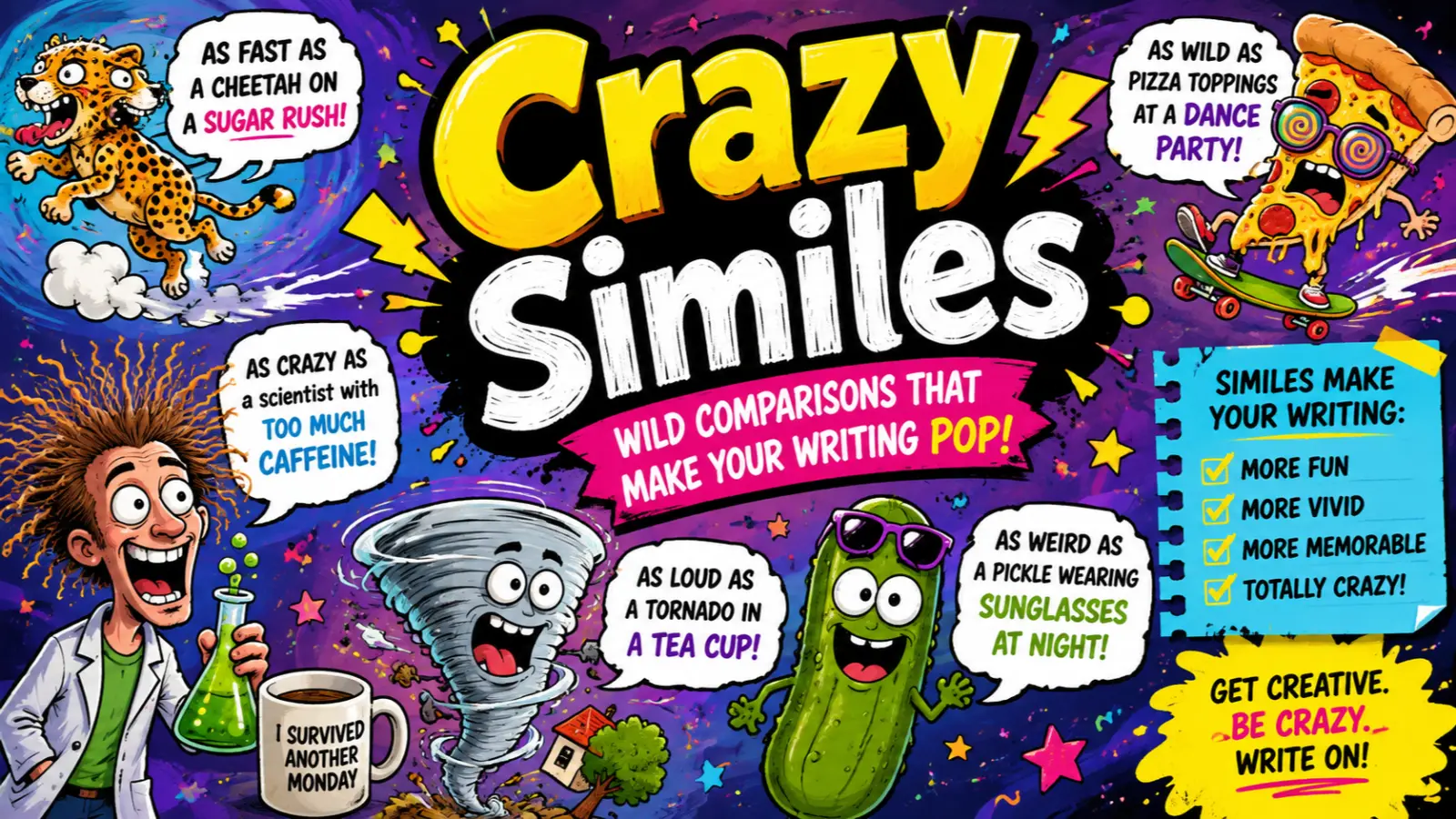
A Crazy Similes compares two different things using words such as like or as. A crazy simile takes that familiar technique somewhere unexpected. Instead of saying someone is very nervous, for example, you might write, “He was like a squirrel guarding a suitcase full of acorns.”
The comparison does more than describe a feeling. It creates a tiny picture in the reader’s mind.
Crazy similes are especially useful in creative writing, storytelling, poetry, dialogue, comedy, captions, and personal essays. They can make ordinary descriptions feel surprising and give characters a distinctive voice.
The best crazy similes are not random just for the sake of being strange. They connect two unusual ideas in a way that still makes emotional or visual sense.
Quick Answer: What Is a Crazy Simile?
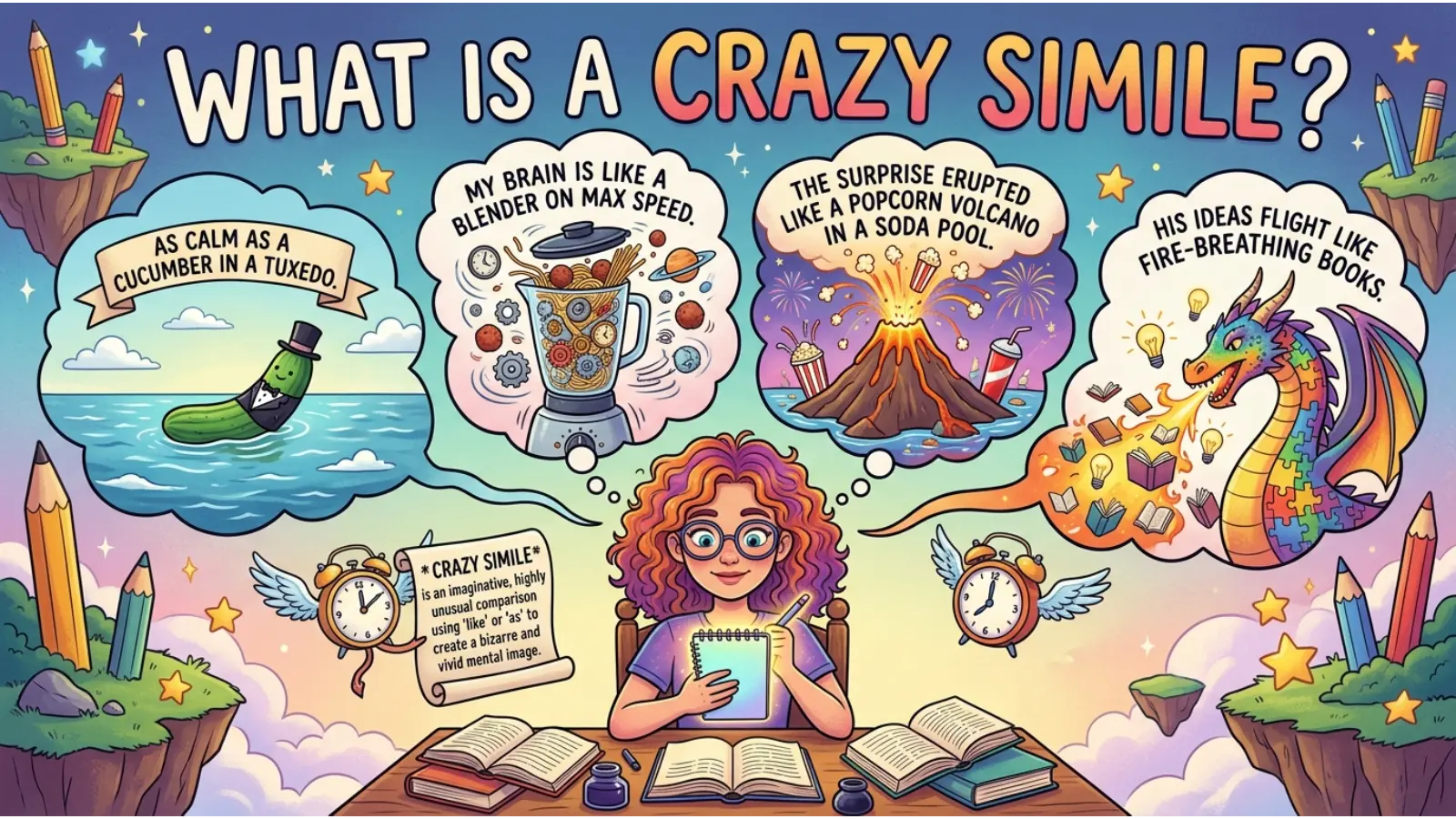
A crazy simile is an imaginative, unusual, exaggerated, or funny comparison that uses words such as like or as to create a vivid image.
For example:
The baby’s laughter bounced around the room like popcorn in a tin can.
The comparison is unexpected, but the reader can imagine the sound jumping rapidly from one place to another.
30 Crazy Similes to Make Writing More Imaginative
1. As Nervous as a Cat in a Room Full of Balloons
This comparison turns nervousness into a visual scene. The balloons suggest unpredictable movement, while the cat suggests alertness.
Example:
Before the audition, Maya was as nervous as a cat in a room full of balloons.
Best context: Stories, dialogue, school writing, and character descriptions.
Writing tip: When describing an emotion, think about what physical situation would produce the same feeling.
2. His Hair Stood Up Like Grass After a Thunderstorm
This simile gives a funny description of messy or startled hair.
Example:
He looked in the mirror, and his hair stood up like grass after a thunderstorm.
The comparison works because both images suggest something suddenly pushed upward.
Best context: Humor and character description.
3. The Crowd Roared Like a Refrigerator Full of Angry Lions
This deliberately absurd comparison makes a loud crowd feel enormous and chaotic.
Example:
When the final goal went in, the crowd roared like a refrigerator full of angry lions.
The image is intentionally impossible, which gives the sentence comic energy.
Writing tip: Crazy similes work particularly well when the comparison is exaggerated but the emotion is clear.
4. Her Smile Spread Like Sunshine Escaping Through Curtains
Not every crazy simile needs to be funny. Some can be dreamy or poetic.
Example:
Her smile spread like sunshine escaping through curtains.
This comparison creates warmth and suggests that happiness is gradually filling a space.
Best context: Poetry, fiction, friendship, and emotional writing.
5. He Ran Like a Homework Deadline Had Grown Legs
This simile combines a familiar school experience with a ridiculous image.
Example:
He ran like a homework deadline had grown legs and was chasing him down the hallway.
The humor comes from turning an abstract problem into something physically threatening.
Best context: Funny stories and school-related writing.
6. The Old Car Coughed Like a Dragon With a Cold
The verbs are important here. “Coughed” prepares the reader for the comparison.
Example:
The old car coughed like a dragon with a cold before finally starting.
The simile gives the machine a personality without directly calling it alive.
Writing purpose: Making objects feel memorable.
7. Her Ideas Spilled Out Like Marbles From a Broken Pocket
This comparison describes someone speaking quickly and sharing many ideas.
Example:
Her ideas spilled out like marbles from a broken pocket.
The reader can imagine the ideas arriving quickly and in different directions.
Writing tip: Use movement-based comparisons when describing fast thoughts or speech.
8. The Baby Slept Like a Phone With One Hundred Notifications Ignored
This unusual comparison creates a modern, humorous image of deep sleep.
Example:
After the long trip, the baby slept like a phone with one hundred notifications ignored.
The simile works because both images suggest complete unawareness of everything happening nearby.
Best context: Humor, modern storytelling, and casual writing.
9. The Moon Hung Like a Silver Button on the Night’s Coat
This is more poetic than ridiculous.
Example:
The moon hung like a silver button on the night’s coat.
The comparison gives the night sky a simple visual structure.
Writing purpose: Creating atmospheric imagery.
10. His Excuse Was Like a Balloon With a Hole in It
This simile describes an excuse that quickly loses credibility.
Example:
His excuse was like a balloon with a hole in it—it sounded impressive for about three seconds.
The physical image communicates weakness without simply saying “his excuse was bad.”
Best context: Humor, dialogue, opinion writing, and storytelling.
11. The Classroom Buzzed Like a Beehive on a Sugar Rush
This exaggerates the energy of a noisy classroom.
Example:
Before the teacher arrived, the classroom buzzed like a beehive on a sugar rush.
The familiar beehive image establishes noise, while “sugar rush” adds a playful twist.
Writing tip: Add one unexpected detail to a familiar comparison to make it feel fresher.
12. His Backpack Was Like a Portable Black Hole
This works when a bag seems to swallow everything placed inside it.
Example:
His backpack was like a portable black hole; nobody could find a pencil once it disappeared inside.
The comparison exaggerates the backpack’s ability to hide objects.
Best context: Funny descriptions and school stories.
13. The Rain Fell Like Thousands of Tiny Drummers
This comparison focuses on sound rather than appearance.
Example:
Rain fell on the roof like thousands of tiny drummers practicing at once.
The image makes ordinary rain feel energetic and musical.
Writing purpose: Sensory description.
14. Her Anger Flared Like a Microwave Left Running on Metal
This is an intentionally dramatic comparison for sudden anger.
Example:
Her anger flared like a microwave left running on metal.
The strange image immediately suggests danger and sudden intensity.
Best context: Fiction, dramatic storytelling, and exaggerated humor.
15. The Dog Looked at the Sandwich Like It Had Just Discovered Treasure
This simile captures intense interest without simply saying the dog was hungry.
Example:
The dog stared at my sandwich like it had just discovered treasure.
The comparison gives the moment a playful sense of adventure.
Writing tip: Animals are excellent subjects for humorous similes because their behavior can be connected to human situations.
16. His Voice Was as Rough as a Bicycle Riding Over Gravel
This simile describes a harsh or scratchy voice through sound and movement.
Example:
After shouting all afternoon, his voice was as rough as a bicycle riding over gravel.
The reader can almost hear the texture being described.
Best context: Character description.
17. The Little Boat Rocked Like a Cradle Made of Jelly
This exaggerated comparison communicates unstable movement.
Example:
The little boat rocked like a cradle made of jelly.
The image is impossible, but the reader immediately understands that the movement is unsteady.
Writing purpose: Describing motion with humor.
18. Her Happiness Burst Out Like Confetti From a Torn Pillow
This simile turns happiness into something physical and energetic.
Example:
Her happiness burst out like confetti from a torn pillow.
The comparison creates movement, color, and excitement.
Best context: Celebrations, friendship stories, and joyful scenes.
19. The Silence Was Like a Library Holding Its Breath
This comparison makes silence feel active.
Example:
After the principal entered, the classroom became as quiet as a library holding its breath.
The phrase suggests that the silence contains tension.
Writing tip: To make quiet scenes interesting, compare silence to something that seems capable of action.
20. His Confidence Was Like a Peacock Wearing Roller Skates
This is deliberately ridiculous.
Example:
He walked onto the stage with the confidence of a peacock wearing roller skates.
The image suggests flamboyant confidence mixed with possible instability.
Best context: Comedy, character introductions, and playful descriptions.
21. The City Glowed Like a Giant Arcade After Midnight
This comparison connects city lights with the colorful energy of an arcade.
Example:
At night, the city glowed like a giant arcade after midnight.
The simile creates a modern visual atmosphere without describing every individual light.
Writing purpose: Setting description.
22. My Brain Was Like a Browser With Fifty Tabs Open
This is useful for describing mental overload.
Example:
During the exam, my brain was like a browser with fifty tabs open.
The comparison is easy to understand because the reader recognizes the feeling of too many things competing for attention.
Best context: Casual writing, dialogue, blogs, and humorous essays.
23. The Wind Whistled Like a Stranger Practicing the Same Tune
This gives the wind a mysterious quality.
Example:
The wind whistled through the windows like a stranger practicing the same tune all night.
The comparison creates atmosphere while suggesting repetition.
Best context: Mystery, suspense, and descriptive fiction.
24. The Cake Looked Like a Castle Built by Someone With a Sweet Tooth
This simile turns an impressive cake into a miniature fantasy structure.
Example:
The birthday cake looked like a castle built by someone with a serious sweet tooth.
The comparison combines visual description with personality.
Writing purpose: Making food descriptions more imaginative.
25. His Laugh Was Like a Squeaky Door Trying to Tell a Joke
This comparison is useful for an unusual or awkward laugh.
Example:
His laugh was like a squeaky door trying to tell a joke.
The personification makes the sound funny without insulting the character directly.
Best context: Comedy and character development.
26. The Storm Arrived Like an Uninvited Guest With a Megaphone
This simile makes the storm feel sudden, loud, and intrusive.
Example:
The storm arrived like an uninvited guest with a megaphone.
The comparison gives the weather a strong personality.
Writing tip: Person-like comparisons are especially effective when you want nature to influence the mood of a scene.
27. Her Friendship Was Like a Lantern in a House With No Electricity
This comparison presents friendship as a source of comfort and guidance.
Example:
Their friendship was like a lantern in a house with no electricity.
The image suggests that friendship provides warmth and direction during difficult moments.
Best context: Personal essays, stories, and reflective writing.
28. His Secret Sat in His Pocket Like a Hot Potato
This simile describes something uncomfortable that a person wants to get rid of.
Example:
The secret sat in his mind like a hot potato he couldn’t stop tossing around.
The familiar physical sensation makes the emotional tension easier to understand.
Writing purpose: Showing discomfort indirectly.
29. The Sunset Looked Like the Sky Had Spilled a Box of Paint
This comparison turns a natural scene into an artistic accident.
Example:
The sunset looked like the sky had spilled a box of paint across the horizon.
It works because it transforms color into action.
Best context: Poetry, travel writing, and nature descriptions.
30. My Motivation Disappeared Like a Sock Under a Teenager’s Bed
This intentionally comic comparison describes motivation that vanishes mysteriously.
Example:
My motivation disappeared like a sock under a teenager’s bed.
The humor comes from taking an ordinary mystery and applying it to an abstract feeling.
Best context: Humor, personal writing, social captions, and informal essays.
Why Do Crazy Similes Work So Well?
A strong simile creates a bridge between something the reader understands and something they have not considered in that particular way.
Consider the difference:
Plain:
He was very nervous.
More vivid:
He was as nervous as a cat in a room full of balloons.
The second sentence gives the reader something to visualize. Instead of merely receiving information, the reader experiences an image.
Crazy similes are particularly powerful because surprise attracts attention. When two unrelated ideas suddenly fit together, the reader pauses for a moment and processes the connection.
That pause can make a sentence memorable.
Surprise Is More Important Than Randomness
A common mistake is assuming that a crazy simile must make absolutely no sense.
It should still have a recognizable connection.
For example:
She was like a purple refrigerator flying through Tuesday.
This is unusual, but the reader has little idea what quality the comparison is supposed to communicate.
A stronger version would be:
She moved through the meeting like a hummingbird trapped inside a library.
Now the comparison suggests restless movement in a quiet environment.
The goal is controlled weirdness.
How to Make a Crazy Simile More Vivid
Start With the Quality You Want to Show
Do not begin by searching for two random objects.
First identify the quality.
Is your character:
- nervous?
- energetic?
- lonely?
- stubborn?
- cheerful?
- confused?
- impatient?
- exhausted?
Then search for something that behaves in a similar way.
For example:
Quality: impatience
Behavior: tapping, pacing, checking repeatedly
Possible comparison: He was like a drummer waiting for the song to start.
The comparison grows from the emotion instead of being randomly attached to it.
Use Specific Details
Compare:
The room was noisy like an animal.
with:
The room buzzed like a kitchen full of kettles that had all decided to whistle at once.
The second image gives the reader a clearer sensory experience.
Specific objects, actions, textures, and sounds usually create stronger imagery than vague nouns.
Add One Unexpected Twist
A familiar comparison can become more original when you add one fresh element.
Instead of:
The classroom was like a beehive.
Try:
The classroom was like a beehive after someone announced free pizza.
The second version keeps the basic idea of noise but gives it a new personality.
Crazy Similes for Different Emotions
Crazy similes can make abstract emotions easier to visualize.
Happiness
Her happiness bounced around her like a puppy discovering a room full of tennis balls.
This makes happiness energetic and difficult to contain.
Anger
His anger rose like soup that had suddenly remembered it was supposed to boil.
The absurdity softens the description while still showing escalation.
Sadness
His sadness followed him like a gray balloon tied to his wrist.
The image suggests that the feeling remains present even when he moves forward.
Friendship
Their friendship fit together like two puzzle pieces from completely different boxes that somehow belonged together.
This suggests an unexpected but meaningful connection.
Love
Her affection grew like a small window garden that nobody noticed until it filled the room with green.
This emphasizes gradual growth rather than instant intensity.
Fear
Fear crawled through his thoughts like a mouse exploring an unfamiliar kitchen.
The image makes fear feel persistent and unpredictable.
Crazy Similes in Dialogue
Similes can reveal personality when characters speak.
A serious character might say:
“The situation is unstable.”
A playful character might say:
“This situation is wobbling like a shopping cart with one angry wheel.”
Both communicate instability, but the second character sounds more distinctive.
This is an important lesson for fiction writers: a simile can describe the speaker as much as it describes the subject.
A teenager, comedian, detective, poet, and professor might all describe the same event differently.
Use that difference.
How Writers Can Avoid Cliché Similes
Some comparisons have been used so frequently that they no longer create a strong image.
Examples include:
- as busy as a bee
- as cold as ice
- as brave as a lion
- as white as snow
- as quiet as a mouse
These are not grammatically wrong. They are simply familiar.
When a familiar comparison appears, ask:
What specific image would this character notice instead?
Instead of:
She was as quiet as a mouse.
Try:
She moved through the room like a bookmark nobody wanted to disturb.
The second comparison creates a stranger and more specific image.
The “Three Questions” Test
Before keeping a crazy simile, ask:
- What exactly does it compare?
- Can the reader picture it?
- Does it fit the mood or character?
If all three answers are yes, the simile probably has a useful purpose.
Common Mistakes With Crazy Similes
Making the Comparison Too Complicated
A simile can become weaker when it contains several unrelated images.
For example, stacking animals, machines, weather, food, and outer space into one sentence may confuse the reader.
Give the comparison room to breathe.
Mixing Images
Avoid starting with one image and accidentally switching to another.
Weak:
His anger was a boiling kettle that raced like a wild horse and exploded like a volcano.
There are too many competing pictures.
A cleaner version might be:
His anger was a kettle forgotten on the stove, growing louder by the second.
One strong image often beats three weak ones.
Using “Crazy” as an Excuse for Meaninglessness
Unusual does not automatically mean effective.
A successful crazy simile should help the reader understand something about:
- emotion
- movement
- appearance
- sound
- personality
- atmosphere
- behavior
If removing the simile makes the sentence clearer and more powerful, the comparison may not be doing enough work.
Confusing Similes With Metaphors
A simile normally uses a comparison word such as like or as:
The classroom was like a beehive.
A metaphor makes the comparison directly:
The classroom was a beehive.
Both create imagery, but they create it through different structures.
Crazy Similes vs. Other Literary Devices
Simile
A simile explicitly compares two things.
The clouds moved like ships.
Metaphor
A metaphor directly identifies one thing with another.
The clouds were ships sailing across the sky.
Personification
Personification gives human qualities to something nonhuman.
The clouds marched across the sky.
Hyperbole
Hyperbole uses deliberate exaggeration.
There were a million clouds in the sky.
Imagery
Imagery uses descriptive language to help readers experience a scene through their senses.
Crazy similes are one tool for creating imagery, but they are not the same thing as imagery itself.
Using several devices together can make prose stronger, provided each one has a purpose.
How to Create Your Own Crazy Similes
You do not need to wait for inspiration. Try this simple process.
Step 1: Choose an ordinary subject
Pick something simple:
rain, homework, traffic, laughter, hunger, silence, excitement.
Step 2: Identify its strongest quality
Ask what it does.
For example:
Rain: taps, falls, surrounds, floods, whispers.
Step 3: Find an unrelated object with similar behavior
For tapping rain, you might choose:
someone drumming on a table.
Step 4: Add an unexpected detail
Instead of:
The rain tapped like a drummer.
Try:
The rain tapped the roof like a drummer who had forgotten the concert was over.
Step 5: Read it aloud
If the sentence sounds awkward, shorten it.
Good similes often have a natural rhythm.
Creative Exercises for Writing Better Similes
Exercise 1: Turn Five Plain Sentences Into Images
Rewrite these:
- The boy was scared.
- The room was messy.
- She was happy.
- The teacher was angry.
- The wind was loud.
Your goal is not to make the comparisons merely strange. Make each one reveal a specific quality.
Exercise 2: Combine Unrelated Objects
Choose one item from each column:
| Emotion or Subject | Unexpected Object |
|---|---|
| Happiness | fireworks |
| Confusion | tangled headphones |
| Anger | pressure cooker |
| Silence | empty theater |
| Excitement | roller coaster |
Now create a comparison using like or as.
For example:
His excitement was like a roller coaster that had forgotten where the brakes were.
Exercise 3: Write One Simile in Three Voices
Describe the same rainy afternoon as:
- a comedian
- a mystery writer
- a child
The comparison should change because the speaker changes.
This exercise teaches an important storytelling skill: imagery can reveal point of view.
When Should You Use a Crazy Simile?
Crazy similes are especially effective when ordinary wording feels flat.
Use them in:
- creative stories
- poetry
- humorous essays
- character descriptions
- dialogue
- social captions
- personal narratives
- children’s writing
- descriptive paragraphs
They may be less appropriate when clarity and precision are the primary goals, such as technical instructions or formal definitions.
The question is not whether a simile is crazy enough.
The better question is:
Does the comparison make the writing more memorable without making the meaning harder to understand?
Frequently Asked Questions About Crazy Similes
What is an example of a crazy simile?
An example is: “He ran like a homework deadline had grown legs.” It is unusual and humorous while clearly communicating urgency.
Are crazy similes supposed to be funny?
No. They can be funny, strange, dramatic, emotional, poetic, or surreal. “Crazy” mainly refers to the unexpected nature of the comparison.
How do I make a simile more creative?
Start with the quality you want to describe, then find an unexpected object or situation that behaves similarly. Add a specific detail to make the image your own.
Can crazy similes be used in school writing?
Yes. They can strengthen descriptive writing, stories, poems, and personal narratives. The comparison should still fit the assignment and remain understandable.
What is the difference between a crazy simile and a metaphor?
A simile generally signals comparison with like or as, while a metaphor makes the comparison directly. For example, “Her thoughts raced like cars” is a simile; “Her thoughts were racing cars” is a metaphor.
Why are unusual similes memorable?
Unexpected comparisons make readers pause and form a mental image. When the connection is clear and fresh, that image can stay with the reader longer than a plain description.
Can I invent my own crazy similes?
Absolutely. In fact, creating original comparisons is one of the best ways to develop a personal writing style. Start with an emotion, behavior, sound, or appearance and connect it to a surprising but understandable image.
Conclusion
Crazy similes give ordinary language a spark of personality. They can turn nervousness into a room full of balloons, motivation into a missing sock, rain into a team of tiny drummers, or a noisy classroom into a sugar-rushed beehive. The strongest comparisons are not simply bizarre. They are specific, purposeful, visual, and connected to the feeling or idea being described. So when your next sentence feels dull, stop and look at the subject from an unexpected angle. Ask what it moves like, sounds like, behaves like, or reminds you of. Then make the comparison strange enough to surprise the reader—and clear enough to make them smile, feel, or see the scene differently.

I am Helena Frost, a writer captivated by the beauty of language and the art of comparison. Through my words, I explore the world by turning ordinary moments into vivid similes and reflections. I enjoy crafting phrases that spark imagination, evoke emotion, and linger in the mind. My writing celebrates the subtle connections between people, nature, and the stories we live. For me, every sentence is an opportunity to reveal the extraordinary in the everyday.