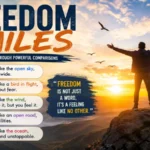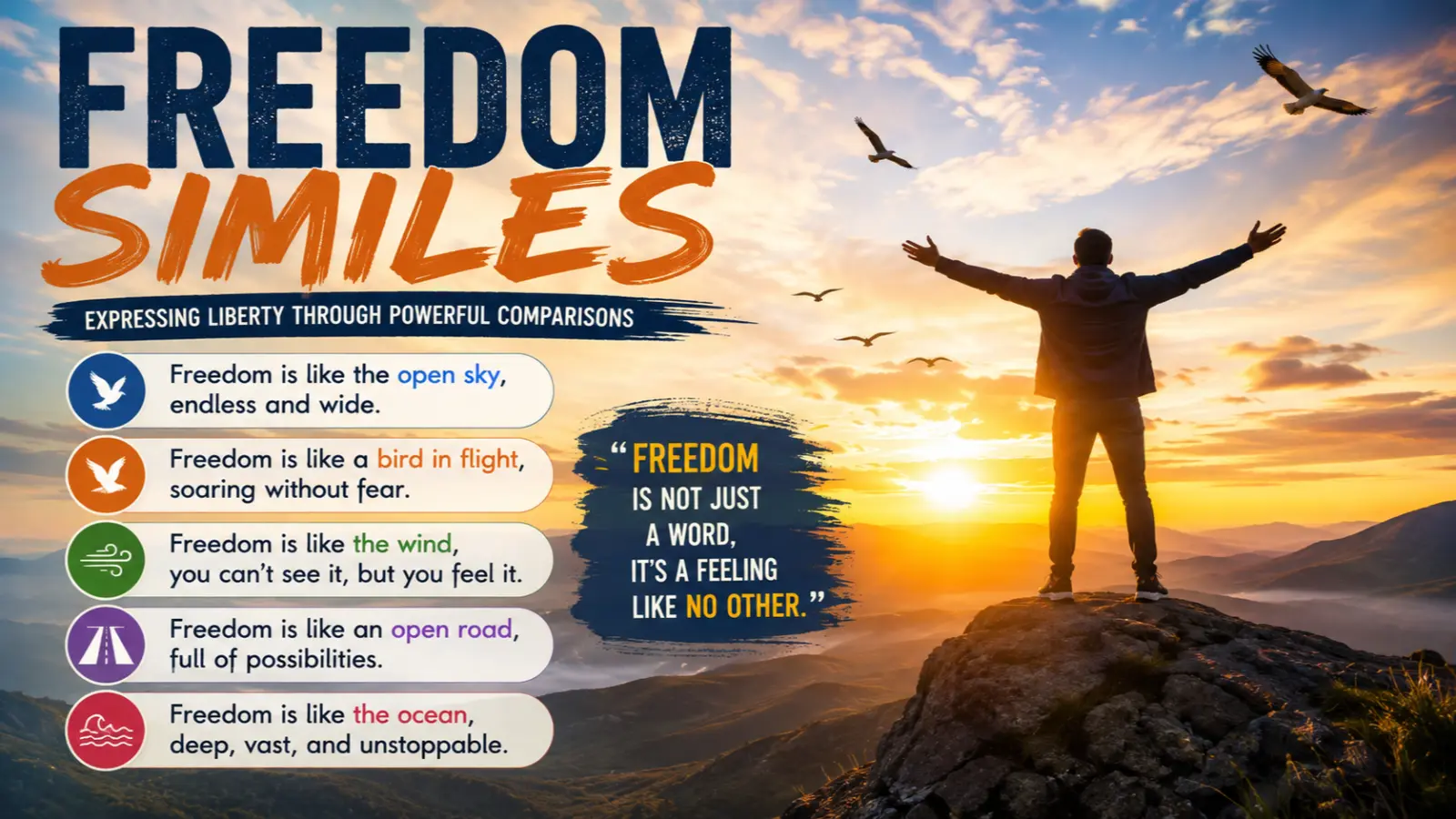
Freedom Similes is one of the most powerful ideas in writing because it can describe much more than being physically unrestricted. It can mean escaping fear, discovering independence, breaking away from expectations, or finally having room to choose your own path.
A simile makes that idea easier to picture by comparing one thing with another using words such as “like” or “as.” Instead of simply saying “She felt free,” a writer might say, “She felt like a kite finally released from its string.” The comparison gives the emotion a shape readers can imagine.
Writers use freedom similes in poems, novels, speeches, personal essays, songs, stories, and everyday conversation. In this collection of freedom similes, you’ll find fresh comparisons for independence, escape, confidence, possibility, and emotional release—along with practical advice for creating your own.
What Is a Simile for Freedom?
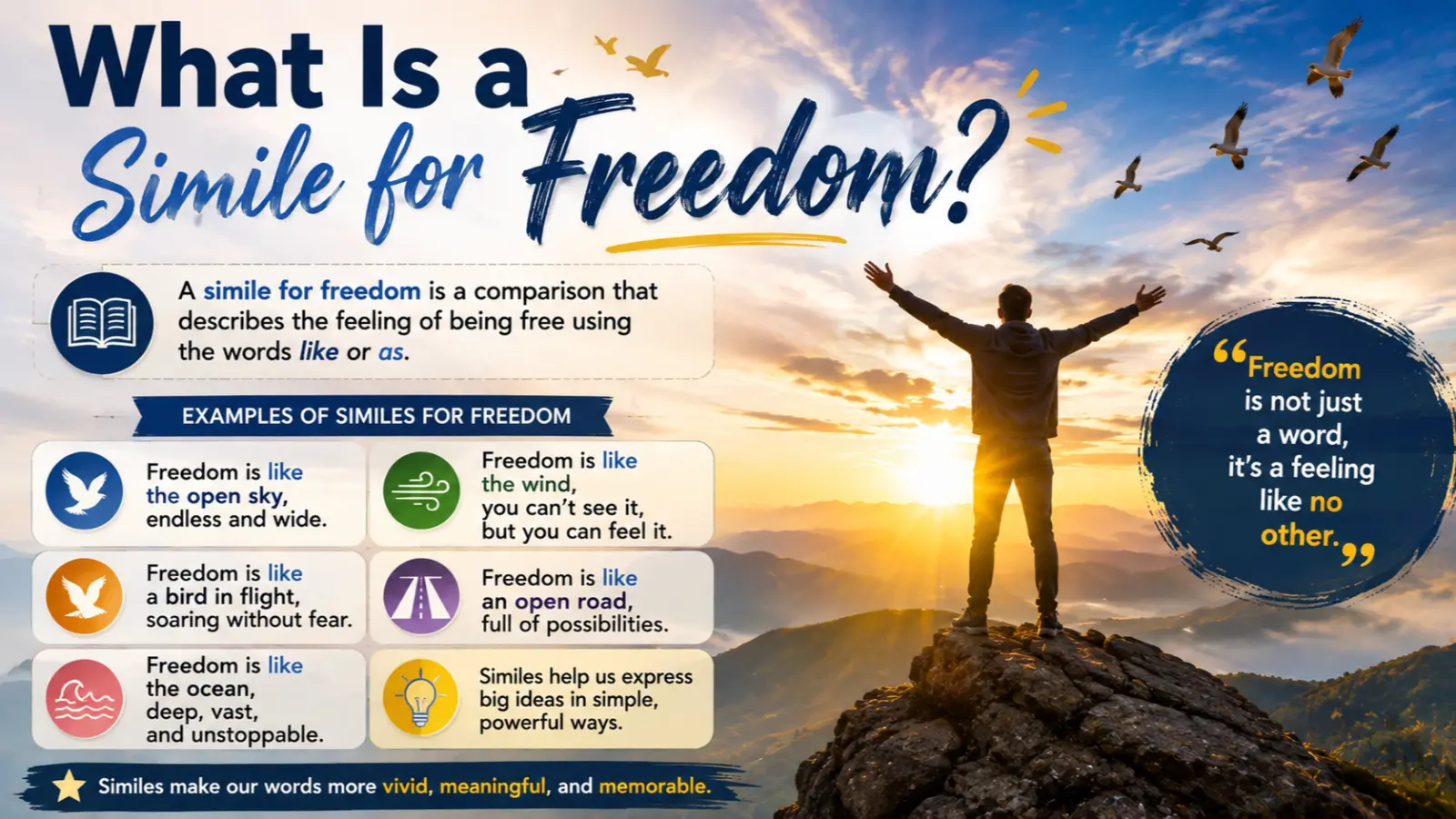
A simile for freedom compares the feeling or experience of being free to something familiar and vivid. For example, “He moved like a bird released from a cage” compares freedom with unrestricted movement.
The strongest freedom similes do more than say that someone is free. They show what freedom feels like—light, expansive, peaceful, energetic, adventurous, or even overwhelming.
30 Original Freedom Similes for Creative Writing
1. Free Like a Kite After Its String Snaps
Simile: She felt free like a kite suddenly beyond the reach of its string.
Meaning: This describes a dramatic feeling of release after being controlled or restricted.
Example:
After making her own decision, she felt free like a kite suddenly beyond the reach of its string.
Writing purpose: Use this when freedom feels exciting but slightly unpredictable.
Best context: Personal stories, coming-of-age writing, and emotional scenes.
2. Freedom Like an Open Window
Simile: Freedom arrived like an open window in a room that had grown too small.
Meaning: Freedom creates space, fresh possibilities, and relief.
Example:
The new opportunity felt like an open window in a room that had grown too small.
This works particularly well when a character has felt trapped by circumstances rather than physically confined.
3. Like a Bird Crossing an Empty Sky
Simile: He traveled like a bird crossing an empty sky, owing no road an explanation.
Meaning: The comparison emphasizes independence and the ability to choose one’s direction.
Emotional effect: It creates a sense of adventure and self-determination.
Writing tip: Pair a freedom simile with an unusual detail, such as the bird’s destination or the landscape below it, to make the image more personal.
4. As Light as a Leaf on Moving Water
Simile: After telling the truth, she felt as light as a leaf carried across moving water.
Meaning: This describes emotional freedom after releasing a burden.
Example:
The secret was finally spoken, and he felt as light as a leaf on moving water.
Unlike a freedom comparison based on speed, this one emphasizes relief and surrender.
5. Like a Door Without a Lock
Simile: His future stood before him like a door without a lock.
Meaning: Nothing appears to prevent him from moving forward.
Best context: Stories about opportunity, independence, education, travel, or personal growth.
The comparison works because a door usually suggests a boundary, while the missing lock removes the sense of restriction.
6. Freedom Like Wind Through Tall Grass
Simile: Her freedom moved through her like wind through tall grass.
Meaning: Freedom is portrayed as something energetic that reaches every part of a person.
Poetry example:
Freedom moved through the valley like wind through tall grass.
Writing purpose: This is useful when you want freedom to feel natural rather than dramatic.
7. Like a Runner Leaving the Starting Line
Simile: He felt like a runner leaving the starting line with no finish line in sight.
Meaning: The comparison focuses on possibility rather than escape.
Emotional effect: It creates excitement, momentum, and anticipation.
Use this when your character is beginning a new chapter rather than escaping an old one.
8. As Wide as a Horizon Without Fences
Simile: Her choices suddenly seemed as wide as a horizon without fences.
Meaning: The character sees many possible directions.
Writing tip: Abstract ideas become stronger when the physical image contains a clear contrast. Here, the horizon suggests openness while fences suggest limitation.
9. Like a Road With Every Direction Open
Simile: For the first time, his life felt like a road with every direction open.
Meaning: Freedom means having genuine choices.
Best context: Character development, life changes, and reflective essays.
This comparison is especially effective when the writer wants to emphasize choice, not merely escape.
10. Like a Sailboat Beyond the Harbor
Simile: She felt like a sailboat finally beyond the harbor walls.
Meaning: The person has moved beyond a protected but limiting environment.
Emotional effect: The image combines freedom with uncertainty.
That combination can make a scene more realistic. Freedom does not always feel completely safe; sometimes it means facing unfamiliar conditions.
11. As Unburdened as a Cloud After Rain
Simile: He walked away as unburdened as a cloud after rain.
Meaning: A heavy emotional burden has passed.
Example:
After forgiving himself, he felt as unburdened as a cloud after rain.
This is a good choice for quiet, reflective writing.
12. Like a Horse Released Into an Open Field
Simile: She ran toward the opportunity like a horse released into an open field.
Meaning: The person embraces newfound freedom with energy.
Writing purpose: Use this when freedom produces action rather than stillness.
13. Freedom Like Sunlight Through Blinds
Simile: Hope entered the room like sunlight slipping through opened blinds.
Meaning: Freedom or possibility gradually reaches someone who has lived with limitations.
Best context: Emotional fiction and inspirational writing.
The image suggests that freedom can arrive gradually instead of appearing all at once.
14. Like a Page Before the First Word
Simile: His future felt like a page before the first word had been written.
Meaning: Nothing has been decided yet.
Emotional effect: This can communicate both freedom and uncertainty.
Writing tip: Blank-page imagery works well for beginnings, but make the surrounding details specific so the comparison does not feel generic.
15. As Open as a Field After Harvest
Simile: Her mind felt as open as a field after harvest.
Meaning: Old obligations or restrictions have been cleared away, leaving room for something new.
This is particularly useful when describing mental freedom rather than physical freedom.
16. Like a Window Looking Out Over the Sea
Simile: The new idea felt like a window looking out over the sea.
Meaning: A new possibility expands someone’s sense of what exists beyond their current situation.
Best context: Creative writing, reflective essays, and descriptions of discovery.
17. Freedom Like Shoes Finally Taken Off
Simile: The evening felt like shoes finally taken off after a long day.
Meaning: Freedom can be simple, comfortable, and deeply relieving.
Why it works: Instead of using a huge image such as an endless sky, this comparison makes freedom physical and familiar.
That is an important writing lesson: small sensory images can express large emotions.
18. Like a River Choosing Its Own Course
Simile: She moved through life like a river choosing its own course.
Meaning: She refuses to let others completely determine her direction.
Writing purpose: This works especially well for characters who value independence.
19. As Restless as Wind Before a Storm
Simile: His new freedom made him as restless as wind before a storm.
Meaning: Freedom can create uncertainty, energy, and impatience.
This is useful because freedom is not always peaceful. A writer can use a simile to show its complicated side.
20. Like a Map With the Edges Torn Away
Simile: The world looked like a map with the edges torn away.
Meaning: The character feels that old boundaries no longer define what is possible.
Best context: Adventure stories and moments of transformation.
21. Freedom Like Music Without a Conductor
Simile: Their conversation moved like music without a conductor, following its own rhythm.
Meaning: The interaction feels spontaneous and unrestricted.
This shows that freedom similes do not always need to describe a person directly. They can describe movement, conversation, creativity, or atmosphere.
22. Like a Lock Turning Open Inside Him
Simile: Something felt like a lock turning open inside him.
Meaning: The person experiences internal freedom.
Writing purpose: Use this when the restriction is emotional, psychological, or personal rather than physical.
The image turns an invisible emotional change into something readers can visualize.
23. As Expansive as a Sky Without Clouds
Simile: Her possibilities seemed as expansive as a sky without clouds.
Meaning: She sees an unusually broad range of choices.
Writing tip: Use expansive imagery when you want freedom to feel powerful and almost limitless.
24. Like a Backpack Set Down at the Trailhead
Simile: Forgiveness felt like a backpack set down at the trailhead.
Meaning: The person no longer carries an emotional burden into the future.
Best context: Personal essays, reflective writing, and stories about healing or growth.
25. Freedom Like a Song Finding Its Own Rhythm
Simile: His creativity returned like a song finding its own rhythm.
Meaning: Freedom allows natural expression to return.
Best context: Writing about art, music, creativity, or self-expression.
26. Like a Door Opening Onto an Unfamiliar Garden
Simile: Independence felt like a door opening onto an unfamiliar garden.
Meaning: Freedom reveals possibilities that are beautiful but unknown.
Emotional effect: Wonder mixed with uncertainty.
This is a strong choice when you want to avoid portraying freedom as completely effortless.
27. As Sudden as Birds Rising From a Field
Simile: Their sense of possibility was as sudden as birds rising from a field.
Meaning: Freedom can appear unexpectedly and transform a moment.
Writing purpose: Use this for sudden emotional changes or surprising opportunities.
28. Like a Compass Finally Allowed to Turn
Simile: Her imagination was like a compass finally allowed to turn.
Meaning: Once restrictions disappear, creativity can explore different directions.
This is especially effective in writing about artists, students, inventors, or characters discovering their own voice.
29. Freedom Like Fresh Air After a Long Walk
Simile: The decision felt like fresh air after a long walk.
Meaning: Freedom brings immediate relief and renewed energy.
Best context: Everyday writing and conversational descriptions.
30. Like a Story That Refuses to End on One Page
Simile: His future felt like a story that refused to end on one page.
Meaning: There are still countless possibilities ahead.
Writing purpose: This comparison works well as a closing image because it connects freedom with imagination and an unfinished future.
How to Make Freedom Similes More Powerful
A weak simile simply attaches an attractive image to an emotion:
She was free like a bird.
The meaning is understandable, but the comparison has been used so often that it may not give readers anything new.
A stronger approach is to ask what kind of freedom you are describing.
Is it:
- freedom after fear?
- freedom from responsibility?
- freedom to make a choice?
- freedom to travel?
- freedom to speak?
- creative freedom?
- emotional release?
- freedom mixed with uncertainty?
Once you identify the specific feeling, choose an image that behaves in a similar way.
For example:
General:
He felt free.
More specific:
He felt like a backpack finally set down at the trailhead.
The second sentence suggests that freedom comes from putting down a burden.
Why Specific Images Make Better Similes
Good similes create connections between two experiences.
Imagine writing:
Her freedom was like the sky.
The image is broad, but it does not tell readers much about the experience.
Compare it with:
Her choices seemed as wide as a horizon without fences.
Now the comparison communicates space, possibility, and the removal of boundaries.
The lesson is simple: don’t choose an image merely because it is beautiful. Choose it because it shares a meaningful quality with the thing you’re describing.
Freedom Can Feel Peaceful, Exciting, or Uncertain
One common mistake is treating freedom as though it always produces happiness.
In real storytelling, freedom can create conflicting emotions.
A character might be:
- relieved but nervous,
- excited but uncertain,
- independent but lonely,
- hopeful but overwhelmed,
- confident but inexperienced.
That complexity gives your similes more depth.
For example:
His new freedom made him as restless as wind before a storm.
This doesn’t present freedom as calm. It shows that having choices can be exhilarating and unsettling at the same time.
How Professional Writers Avoid Cliché Similes
Clichés aren’t automatically wrong, but they often lose their impact because readers have encountered them repeatedly.
Instead of immediately reaching for a familiar comparison, ask:
What would this character actually notice?
A sailor might compare freedom to an open sea.
A musician might compare it to finding a personal rhythm.
A student might compare it to a blank page.
A traveler might compare it to a road with no fixed destination.
The character’s world can determine the imagery.
That makes the simile feel like part of the story rather than something pasted onto it.
Simile vs. Metaphor: What’s the Difference?
A simile makes an explicit comparison, usually with like or as.
Her imagination moved like a compass finally allowed to turn.
A metaphor makes the comparison more directly.
Her imagination was a compass finally allowed to turn.
Both can create strong imagery. The difference is mainly in how directly the comparison is expressed.
Choose a simile when you want readers to clearly see the connection between two things.
Using Imagery to Show Freedom
Freedom is an abstract concept, so imagery is especially useful.
Instead of explaining:
He finally felt independent.
You can show the experience through movement, space, sound, texture, or light:
He walked toward the station like a road had opened beneath his feet.
The reader doesn’t just receive information. The reader experiences an image.
That is one of the central purposes of figurative language: turning an idea into something the imagination can see.
How to Create Your Own Freedom Similes
Try this simple process.
1. Name the exact feeling
Don’t start with “freedom.”
Start with a more precise emotion:
relief, independence, excitement, possibility, release, confidence, curiosity, uncertainty.
2. Think of physical experiences
Ask:
What physical experience feels similar?
For relief, you might think about setting down something heavy.
A independence, you might think about choosing a road.
For possibility, you might think about an open landscape.
3. Add a surprising detail
Instead of:
Freedom is like an open door.
Try:
Freedom felt like an unlocked door at the end of a hallway he had never noticed before.
The additional detail creates a story.
4. Test the comparison
Ask yourself:
Does the image actually share a quality with the emotion?
If not, replace it.
A beautiful image is not automatically an effective simile.
5. Read it aloud
Similes are especially important in poetry and creative prose, where rhythm matters.
If the sentence feels awkward when spoken, simplify it.
Three Creative Exercises for Writing Freedom Similes
Exercise 1: Change the Emotion
Write one simile for each version of freedom:
- peaceful freedom
- exciting freedom
- frightening freedom
- creative freedom
- emotional freedom
Notice how the image changes when the emotion changes.
Exercise 2: Use Your Character’s World
Choose a character and give them a profession or interest.
For example:
- musician
- farmer
- photographer
- athlete
- student
- sailor
Now describe freedom using something that character understands deeply.
This creates more believable imagery.
Exercise 3: Ban the Obvious Images
Write five freedom similes without using:
- birds
- cages
- open skies
- doors
- chains
This forces your imagination to search for less predictable comparisons.
Common Mistakes When Writing Freedom Similes
Using the Same Freedom Image Too Often
Birds, cages, chains, and open skies are recognizable symbols of freedom. They can work, but repeated use makes writing predictable.
Try grounding the comparison in a specific setting or character.
Mixing Two Unrelated Images
Avoid combining images that compete with each other.
For example, don’t begin with a river comparison and suddenly introduce a mechanical engine unless there is a clear reason.
A simile should help the reader visualize, not make them stop to decode the sentence.
Choosing Beauty Over Meaning
A comparison can sound poetic while communicating almost nothing.
Ask what the image reveals about the character’s experience.
Explaining Too Much
Once the simile clearly communicates the idea, you usually don’t need several sentences explaining exactly what it means.
Trust the image.
Confusing Similes With Metaphors
If you write:
Her freedom was a bird.
you are using a metaphor.
If you write:
Her freedom felt like a bird lifting into the morning air.
you are using a simile.
Both are useful, but they create slightly different effects.
Frequently Asked Questions About Freedom Similes
What is a good simile for freedom?
A good freedom simile should match the specific kind of freedom you want to express. For example, “She felt like a backpack finally set down at the trailhead” works well for emotional relief, while “He moved like a bird crossing an empty sky” emphasizes independence.
What is a simile for feeling free?
You could write, “I felt as light as a leaf carried across moving water.” This suggests that a burden has disappeared and the person feels emotionally unburdened.
What are some creative similes for freedom?
Creative possibilities include comparing freedom to a compass finally allowed to turn, a page before the first word, a sailboat beyond the harbor, or a song finding its own rhythm.
How do you describe freedom in creative writing?
Use sensory details and specific comparisons rather than simply naming the emotion. Show what freedom allows the character to see, hear, feel, choose, or do.
What is a metaphor for freedom?
A metaphor could describe freedom directly as something else, such as “Freedom was an unlocked horizon.” Unlike a simile, it does not use like or as to make the comparison.
Can freedom similes be used in poetry?
Absolutely. Similes are particularly effective in poetry because they can compress a complex emotion into a memorable image. Pay attention to rhythm, sound, and the emotional weight of each comparison.
Why are freedom similes useful in storytelling?
They help readers experience an abstract idea through a concrete image. Instead of merely telling readers that a character is free, a well-chosen simile can reveal whether that freedom feels peaceful, exciting, uncertain, or overwhelming.
Conclusion
The best freedom similes do not simply decorate a sentence. They reveal what freedom means to a particular person in a particular moment. Sometimes freedom feels like stepping into an enormous landscape. it feels like putting down a heavy burden. Sometimes it feels like choosing a direction for the first time. When you write your own similes, move beyond the obvious comparison. Start with the exact emotion, think about a physical experience that shares its qualities, and then add a detail that belongs naturally to your character or setting. A strong simile gives an abstract idea somewhere to live. When readers can see, feel, or imagine freedom instead of merely reading the word freedom, your writing becomes more vivid and memorable.
I am Helena Frost, a writer captivated by the beauty of language and the art of comparison. Through my words, I explore the world by turning ordinary moments into vivid similes and reflections. I enjoy crafting phrases that spark imagination, evoke emotion, and linger in the mind. My writing celebrates the subtle connections between people, nature, and the stories we live. For me, every sentence is an opportunity to reveal the extraordinary in the everyday.