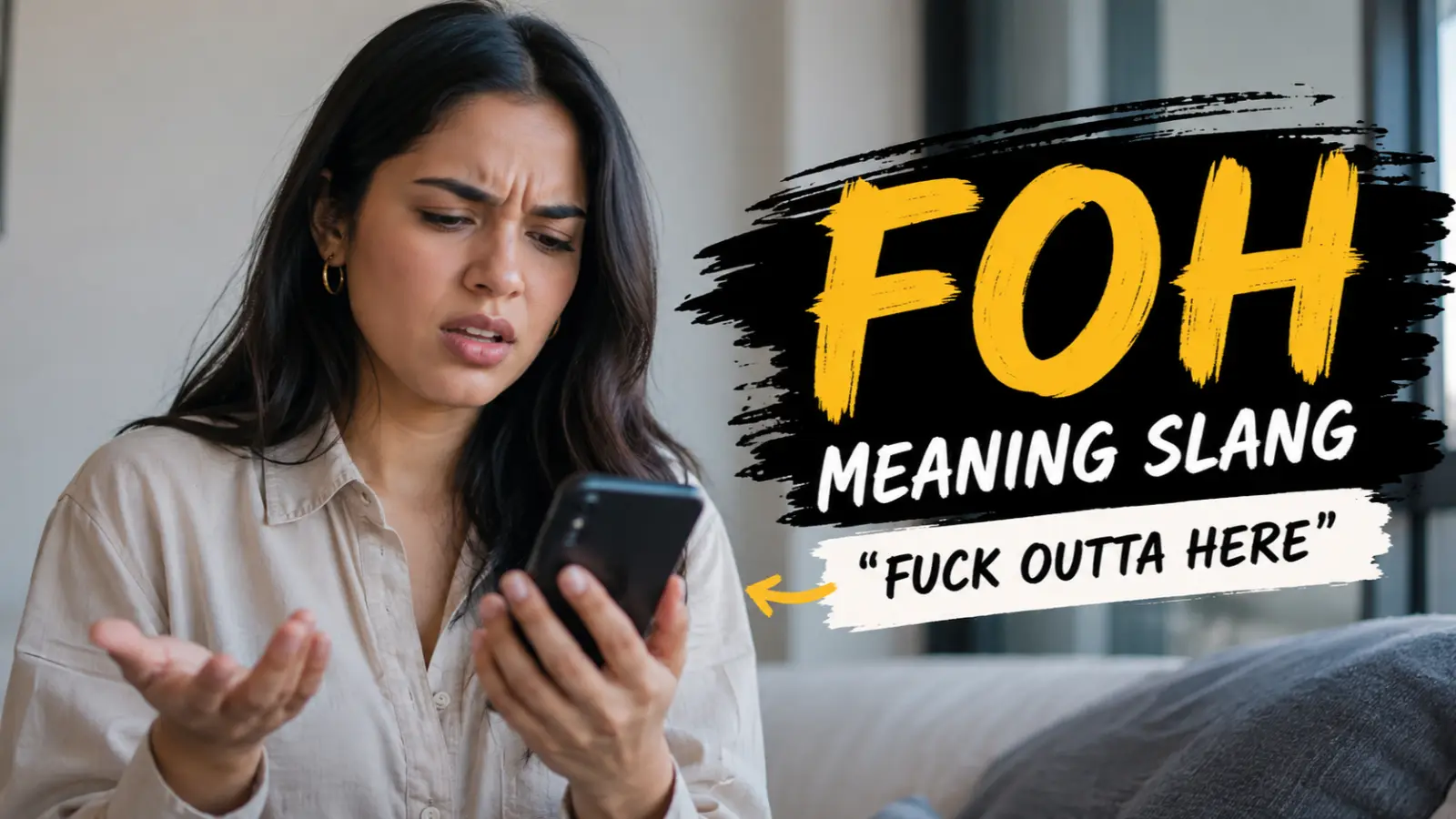
FOH meaning slang is a common search for people who see “FOH” in text messages, comments, TikTok posts, or online conversations and are unsure what the three letters mean.
Slang can be confusing because the same abbreviation may sound funny between friends but rude during an argument.
In slang and texting, FOH most commonly stands for “fuck outta here,” a shortened, vulgar way of saying “get out of here.” Depending on the context, it can also express disbelief, rejection, annoyance, or playful teasing.
It is important to look at the relationship between the people, the conversation, and the tone before deciding what someone means by FOH.
Quick Answer
FOH usually means “fuck outta here.” In texting, it can mean “go away,” “I don’t believe you,” or “you must be joking,” depending on the context. It is informal and contains profanity.
What Does FOH Mean in Text?
The most common FOH meaning in text is “fuck outta here.”
The phrase is usually used to dismiss something or someone. A person may type FOH when they:
- Do not believe what someone said
- Think a statement is ridiculous
- Want someone to stop
- Are annoyed
- Are jokingly rejecting an idea
- Want to express strong disbelief
For example:
Friend: “I can beat you at basketball without even trying.”
You: “FOH 😂”
Here, FOH may not mean that the speaker literally wants their friend to leave. It can simply mean, “Come on, you can’t be serious!”
The exact meaning depends heavily on tone and context. Slang references consistently describe FOH as a dismissive expression that can range from playful disbelief to genuine annoyance.
FOH Full Form
The most common FOH full form in slang is:
F = Fuck
O = Outta
H = Here
So:
FOH = Fuck Outta Here
“Outta” is an informal spelling of “out of.”
A less vulgar equivalent would be:
- “Get out of here.”
- “Go away.”
- “No way!”
- “You must be joking.”
- “I don’t believe you.”
The phrase is vulgar because it contains the F-word, so FOH is best treated as informal language.
FOH Meaning in Different Contexts
FOH does not always carry exactly the same emotional meaning.
1. FOH as Disbelief
Someone may use FOH when they think a claim is unbelievable.
Example:
“He said he finished the whole project in ten minutes.”
“FOH, that’s impossible.”
Here, FOH means something close to “I don’t believe that.”
2. FOH as Rejection
FOH can also reject a suggestion or request.
Example:
“Give me your last slice of pizza.”
“FOH 😂”
This could mean “No way!” rather than an angry command.
3. FOH During an Argument
In a serious argument, FOH can sound much harsher.
Example:
“You never listen to me.”
“FOH. I’m done talking.”
In this situation, the expression is dismissive and confrontational.
4. FOH as a Joke
Friends sometimes use FOH dramatically for humor.
Example:
“I know you’re secretly a famous singer.”
“FOH 😂😂”
The person may be joking rather than genuinely angry.
Is FOH Rude, Offensive, or Neutral?
FOH is generally considered rude or vulgar slang.
It is not a neutral abbreviation because its most common slang expansion contains profanity.
However, the emotional impact can change depending on the situation.
| Situation | Likely Tone |
|---|---|
| Close friends joking | Playful |
| Social media comment | Dismissive or humorous |
| Online argument | Rude or aggressive |
| Workplace conversation | Inappropriate |
| Formal writing | Not recommended |
| Serious disagreement | Confrontational |
If someone you know well says “FOH 😂,” they may simply be joking. If a stranger says “FOH” during an argument, it is more likely to be insulting or dismissive.
Where Is FOH Commonly Used?
FOH is mainly found in informal digital communication, including:
- Text messages
- Group chats
- Social media comments
- TikTok
- X
- Online forums
- Gaming chats
- Memes
- Casual conversations
Slang references specifically identify FOH with online chat, social media, and text messaging.
You may also see extended versions such as “fohhh” or “FOHHH.” Adding extra letters can emphasize the reaction, especially in humorous or expressive online conversations. The extended “fohhh” form has appeared in internet meme culture as well.
FOH Origin and Background
The phrase behind FOH is “fuck outta here,” which is itself a shortened informal form of “get the fuck out of here.”
The acronym has been documented online for many years. Know Your Meme traces an early Urban Dictionary definition of “foh” to 2003 and documents its later spread through online meme culture.
FOH also became recognizable in internet and social-media conversations where people used it to dismiss exaggerated claims, jokes, or opinions.
It is worth remembering that slang changes quickly. The meaning can stay the same while its popularity, spelling, and tone change across different online communities.
Emotional and Psychological Meaning of FOH
FOH can communicate more than the literal words suggest.
Depending on the situation, it may express:
- Disbelief: “I can’t believe you said that.”
- Annoyance: “Stop bothering me.”
- Rejection: “Absolutely not.”
- Surprise: “No way!”
- Humor: “You’re kidding!”
- Anger: “Leave me alone.”
This is why reading only the abbreviation is not enough. Emojis, punctuation, previous messages, and the relationship between the speakers can completely change its meaning.
For example:
“FOH 😂” may sound playful.
“FOH.” may sound much more serious.
“FOHHHH 😭😂” may be an exaggerated humorous reaction.
FOH vs. Similar Slang
FOH is related to several expressions, but they are not always interchangeable.
| Slang | General Meaning | Tone |
|---|---|---|
| FOH | Go away / I don’t believe you | Rude, playful, or dismissive |
| GTFO | Get the fuck out | Strong and vulgar |
| Get outta here | Go away / No way | Can be playful or neutral |
| No way! | I don’t believe it | Usually less offensive |
| SMH | Shaking my head | Disappointed or amused |
| BS | That’s nonsense / not true | Informal and sometimes vulgar |
If you want to express disbelief without profanity, “No way!” or “You must be joking!” is usually safer.
Real-Life FOH Conversation Examples
Friendly Example
Alex: “I ate three burgers by myself.”
Sam: “FOH 😂”
Here, Sam probably means, “No way, I don’t believe you!”
Casual Example
Mia: “I’m not sharing my fries.”
Jay: “FOH, give me two!”
This may be playful between friends.
Argumentative Example
Person A: “You don’t know what you’re talking about.”
Person B: “FOH. I’m not arguing with you.”
Here, FOH is clearly dismissive and aggressive.
Social Media Example
Post: “I learned this entire language in one week.”
Comment: “FOH 😂”
The commenter is probably expressing disbelief.
Gaming Example
Player 1: “I beat that level on my first try.”
Player 2: “FOH 😭”
The expression may simply mean, “You’re kidding!”
Common Misunderstandings About FOH
One common mistake is assuming that FOH always means “go away.”
In online conversations, it can instead mean:
“I don’t believe you.”
Another misunderstanding happens when people assume that every use of FOH is seriously offensive. Sometimes friends use it jokingly.
However, because the underlying phrase is vulgar, it is still safer to treat FOH as an informal and potentially offensive expression.
There is also another important point: FOH can have non-slang meanings. In workplaces, particularly restaurants and hospitality, FOH commonly means “front of house,” referring to customer-facing staff or areas.
So context matters.
Variations and Types of FOH
You may encounter several forms online:
- FOH — standard abbreviated form
- foh — lowercase texting style
- FOHHH — exaggerated reaction
- fohhh — informal or humorous spelling
- FOH 😂 — often playful
- FOH! — stronger emphasis
- FOH with that — dismissing an idea or statement
The basic slang meaning usually remains connected to “fuck outta here.”
When Should You Avoid Using FOH?
Avoid FOH when speaking or writing to:
- Your boss
- A teacher
- A customer
- A client
- A professional contact
- Someone you do not know well
- Someone who may not understand internet slang
It is also a poor choice for:
- Formal emails
- School assignments
- Business documents
- Job applications
- Professional presentations
Even when intended as a joke, profanity can easily be misunderstood in written communication because readers cannot always hear your tone.
Polite Alternatives to FOH
If you want to express the same general idea without profanity, try:
- “No way!”
- “You must be joking!”
- “I don’t believe you.”
- “Come on!”
- “Seriously?”
- “Get out of here!” — when used playfully
- “That’s not true.”
- “Please stop.”
- “I’m not interested.”
These alternatives are much safer when you are unsure how the other person will react.
Why Do People Use FOH?
People often use FOH because it is short, expressive, and emotionally strong.
Instead of typing:
“I don’t believe what you just said, and I think you’re joking.”
Someone can simply write:
“FOH 😂”
The abbreviation saves time while also communicating attitude.
Internet slang often works this way. A few letters can communicate humor, disbelief, frustration, or rejection without requiring a long explanation.
Is FOH Safe for Social Media?
FOH is commonly used on social media, but “safe” depends on what you mean by safe.
It is generally understandable as informal slang, but it contains profanity and can sound aggressive.
If you are posting publicly, consider your audience. A phrase that seems funny among friends may look disrespectful to employers, teachers, customers, or other professional audiences.
For family-friendly or professional content, a phrase such as “No way!” is a better choice.
How to Respond When Someone Says FOH
Your response should depend on the person’s tone.
If they are joking, you can respond playfully:
“😂 I’m serious!”
If they seem surprised:
“Yes, really!”
If they are angry:
“Let’s keep this respectful.”
If you are unsure what they mean:
“Do you mean you’re joking or you’re upset?”
Understanding the surrounding conversation is usually more useful than interpreting FOH by itself.
Regional and Cultural Usage
FOH is primarily associated with informal English-language slang and internet communication. Its meaning can vary slightly across communities.
Online slang can also spread between different social and cultural groups, where expressions may take on different tones. FOH has appeared in internet communities and meme culture, including contexts associated with Black Twitter and African American online culture.
Because slang can have cultural context, it is better to understand how a community uses an expression rather than copying it simply because it is popular online.
Frequently Asked Questions
What does FOH stand for in slang?
FOH most commonly stands for “fuck outta here.” It is used to dismiss someone, reject an idea, or express disbelief.
What does FOH mean in text?
In texting, FOH can mean “go away,” “I don’t believe you,” “no way,” or “you must be joking.” The intended meaning depends on context.
Is FOH a bad word?
FOH is vulgar slang because its full form contains profanity. It is best avoided in formal or professional communication.
Is FOH rude?
It can be. Among close friends, it may be playful, but during an argument it can sound disrespectful or aggressive.
What is a polite alternative to FOH?
You can say “No way!”, “I don’t believe you,” “Are you serious?”, or “You must be joking!” depending on the situation.
Does FOH have other meanings?
Yes. In non-slang contexts, FOH can mean “front of house,” especially in hospitality and restaurant settings. It can also have technical or organizational meanings.
Conclusion
The foh meaning slang users most commonly encounter is “fuck outta here.” In texts and social media, FOH can express disbelief, rejection, annoyance, surprise, or playful teasing.
The most important thing to remember is context. “FOH 😂” between close friends may be a joke, while “FOH!” during an argument can sound openly hostile.
Because FOH contains profanity, it is best kept to informal conversations where you know the audience and understand the tone. In professional or formal situations, safer alternatives such as “No way,” “Seriously?” or “I don’t believe you” are better choices.
So, when someone writes FOH, don’t automatically assume they are telling you to leave. Look at the conversation around it—their words, punctuation, emojis, and relationship with you usually reveal what they really mean.