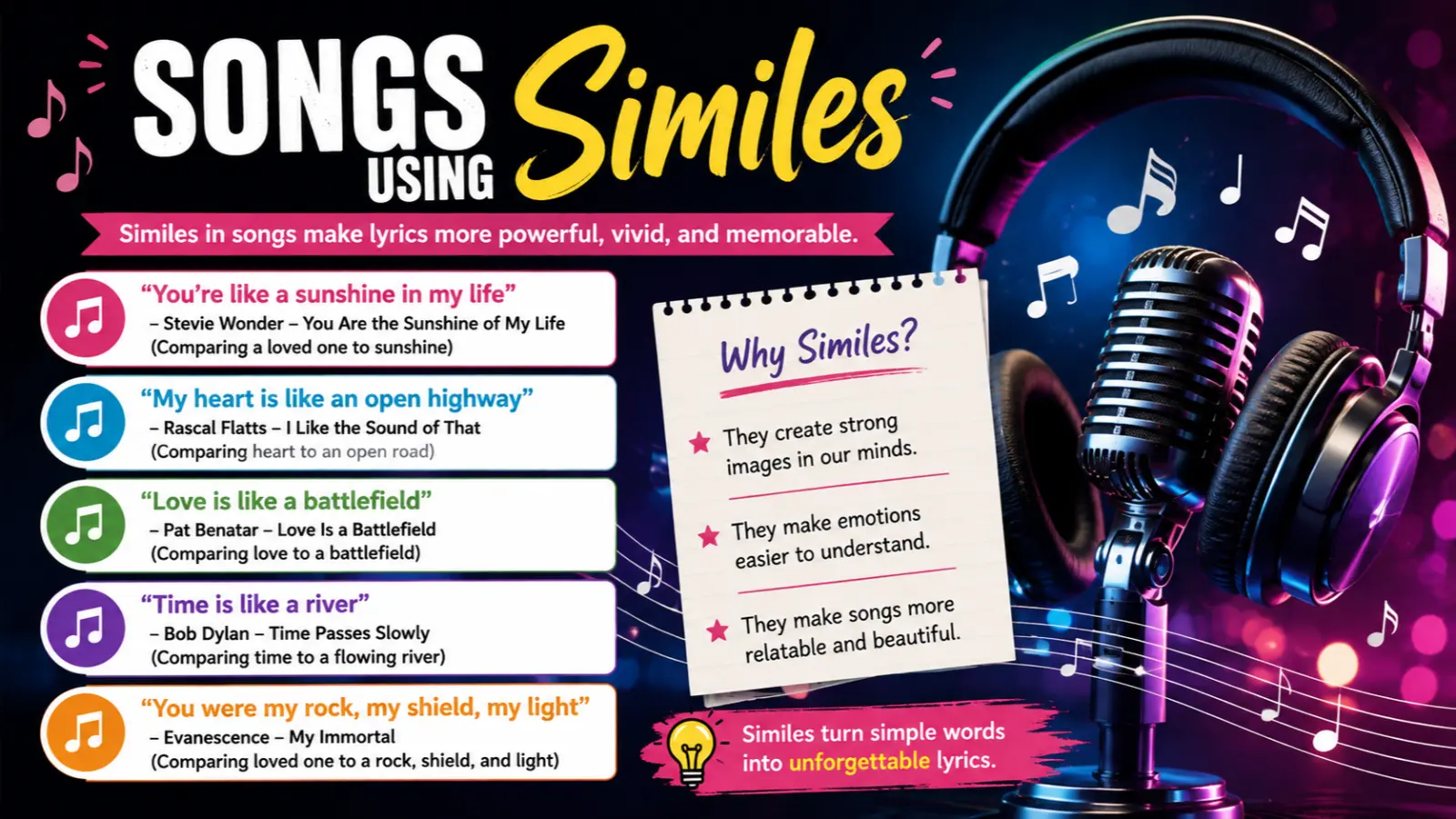
Songs Using Similes has a special way of making emotions feel visible. A songwriter can describe sadness, excitement, love, freedom, or confusion in just a few words by comparing one thing with another. That is where similes in music become especially powerful.
A Songs Using Similes is a comparison between two different things using words such as “like” or “as.” In songwriting, Songs Using Similes help listeners picture an emotion instead of simply being told what the singer feels. A lonely night can become “like an empty station,” while happiness can feel “like sunlight spilling through an open window.”
This guide explores songs using similes, explains why these comparisons work, and gives you original examples you can adapt for your own lyrics, poems, stories, captions, and creative writing.
What Is a Simile in a Song?
A Songs Using Similes compares one idea, feeling, person, place, or experience with something else using like or as.
For example:
Her laughter rose like sparks from a quiet fire.
The laughter is not literally sparks. The comparison helps the reader or listener imagine something bright, sudden, and energetic.
Songwriters often use similes because music already carries emotion through melody, rhythm, and voice. A strong comparison adds another layer of imagery.
Why Do Songwriters Use Similes?
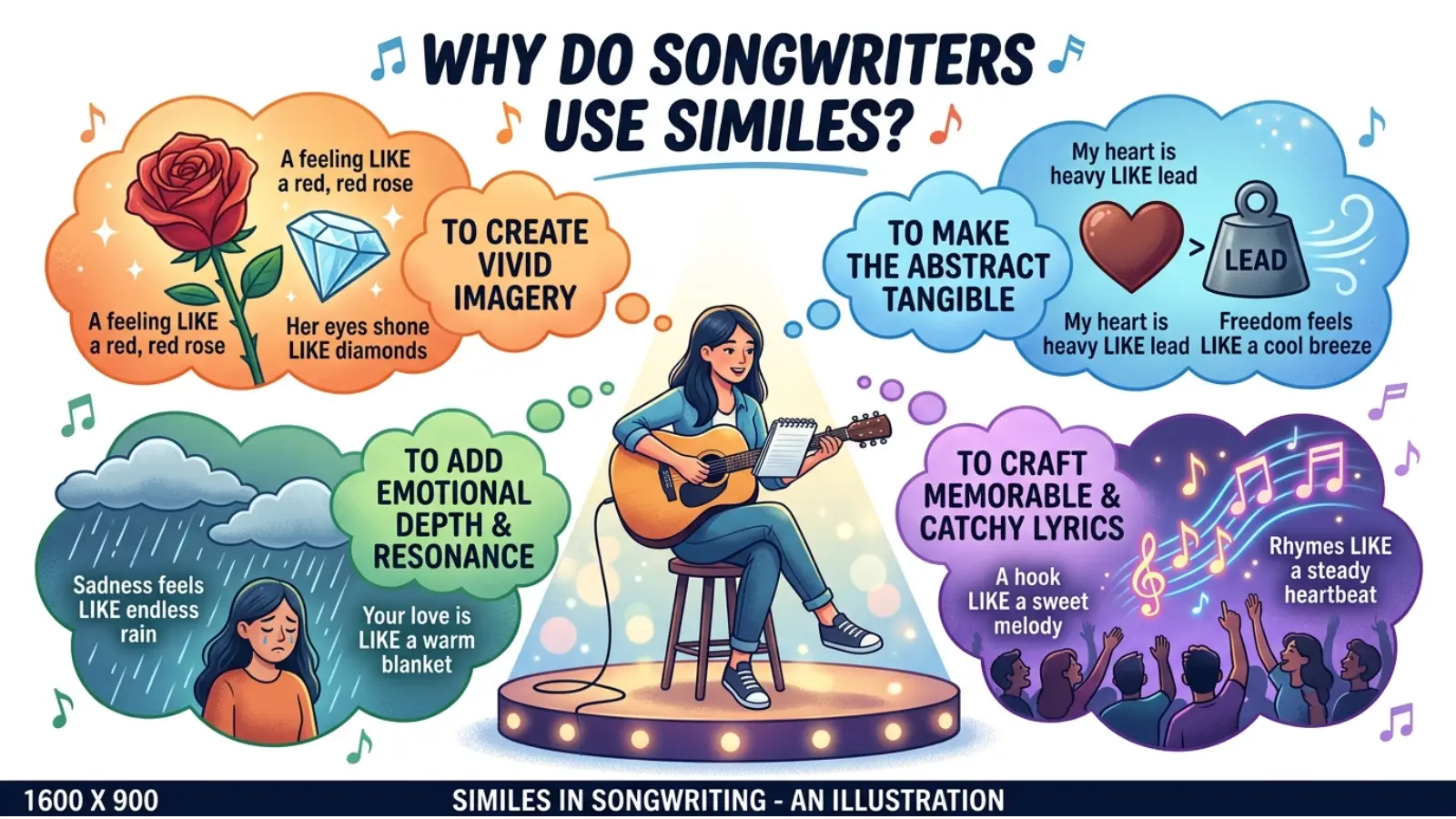
Songs Using Similes can make lyrics easier to visualize and remember. Instead of saying “I feel nervous,” a songwriter might compare nervousness to a bird trapped inside a room.
That comparison gives the emotion movement.
Similes can also:
- Make abstract emotions concrete
- Create memorable images
- Establish the mood of a song
- Strengthen emotional expression
- Give lyrics a poetic quality
- Help listeners connect personal experiences with familiar images
- Add rhythm and personality to a line
The best Songs Using Similes usually does more than decorate a sentence. It reveals something about the feeling being described.
How Similes Work in Music
A good songwriting simile often connects an emotion with an image that has a similar quality.
For example, if a character feels overwhelmed, you might compare the feeling to:
Thoughts crowding in like waves around a small boat.
The important connection is not simply “thoughts + waves.” Both create a sense of pressure, movement, and difficulty finding stability.
That is the secret behind effective comparisons: the two things should share a meaningful quality.
30 Original Similes for Songs
The following examples are original songwriting ideas. They are designed to demonstrate different emotions, moods, and lyrical situations without copying existing song lyrics.
1. Happiness Like Sunlight Through Curtains
Her happiness spilled like sunlight through half-open curtains.
Meaning: Her happiness feels warm, bright, and impossible to contain.
Why it works: Sunlight entering a dark room suggests sudden positivity.
Best context: Upbeat songs, celebrations, friendship, new beginnings.
Writing tip: When writing about happiness, avoid always using words such as bright or sunny. Find an action that shows happiness instead.
2. A Heart Like a Paper Boat
My heart drifted like a paper boat after the rain.
This comparison creates a delicate and vulnerable feeling. A paper boat can float, but it is also easily damaged.
Best for: Emotional songs about uncertainty, separation, or fragile hope.
Try changing the object while keeping the emotion:
My heart floated like a leaf on a restless stream.
The new image creates a different kind of vulnerability.
3. Her Voice Like a Distant Radio
Her voice sounded like a distant radio fading between stations.
This suggests emotional distance and uncertainty.
The comparison is especially useful when a song is about remembering someone whose presence is becoming less clear.
Writing purpose: It creates atmosphere without directly explaining the emotion.
4. Memories Like Dust in Sunlight
Old memories moved like dust in a quiet beam of light.
The image feels gentle and reflective. Dust becomes a symbol of something that has been left undisturbed but still exists.
Best context: Nostalgic songs, reflective verses, and stories about childhood.
Tip: Notice how the comparison uses movement. A static image can become more vivid when you give it an action.
5. Anger Like a Locked Engine
His anger shook like an engine locked in place.
This creates a feeling of restrained energy.
Instead of simply saying that someone is angry, the comparison suggests that powerful energy is trapped and unable to move forward.
Best context: Conflict, frustration, determination, or dramatic songwriting.
6. Hope Like a Match in the Wind
Hope flickered like a small match in a restless wind.
The comparison presents hope as fragile but still alive.
Emotional effect: It creates tension because the reader senses that the hope could disappear.
This kind of simile works well when a song moves between despair and optimism.
7. A Crowd Like a Rising Tide
The crowd surged like a rising tide around the stage.
This comparison focuses on movement and energy.
A tide does not simply stand still; it advances and surrounds things. That makes it useful for describing concerts, celebrations, protests, or exciting events.
Writing tip: Similes involving natural forces can make scenes feel larger and more energetic.
8. Silence Like Snow
The room settled into silence like snow covering an empty road.
This creates a quiet, almost cinematic mood.
The comparison works because fresh snow can soften sound and transform a familiar place.
Best context: Slow songs, reflective moments, loneliness, and peaceful scenes.
9. Friendship Like an Old Jacket
Your friendship stayed like an old jacket that still fit after every winter.
This is an unusual comparison because friendship is connected with comfort, familiarity, and reliability rather than something traditionally romantic.
Emotional effect: Warm and reassuring.
Best context: Songs about longtime friends or relationships that survive difficult periods.
10. Love Like a Train at Midnight
Their love arrived like a midnight train, sudden and impossible to ignore.
This comparison creates movement and anticipation.
It could describe a relationship that appears unexpectedly and changes everything.
Writing tip: Transportation imagery is useful when your song involves journeys, changes, departures, or new beginnings.
11. Sadness Like Rain on Glass
Sadness gathered like rain on a cold window.
This comparison makes an internal emotion visible.
The rain does not need to be dramatic. Its slow gathering suggests a sadness that gradually becomes noticeable.
Best context: Quiet verses and reflective songwriting.
12. Dreams Like Birds at Dawn
Her dreams scattered like birds at dawn.
This can suggest freedom, possibility, or the sudden movement of many ideas.
The emotional meaning depends on context. If the birds fly away happily, the comparison feels hopeful. If they disappear beyond reach, it can feel lonely.
Lesson: A single simile can create different emotions depending on the surrounding lyrics.
13. Fear Like Footsteps Upstairs
Fear followed him like footsteps on an empty staircase.
This creates suspense without describing fear directly.
The reader hears the imagined sound and becomes curious about what is coming next.
Best context: Darker songs, suspenseful storytelling, or songs about anxiety and uncertainty.
14. Her Smile Like a Window Opening
Her smile felt like a window opening in a room that had been closed for years.
This comparison connects a smile with relief and fresh possibility.
Why it works: A window opening changes the environment. It allows light, air, and movement into the room.
That makes the image stronger than simply calling the smile “beautiful.”
15. Time Like a River Under Ice
Time moved like a river hidden beneath winter ice.
This simile suggests that time continues even when everything appears still.
Best context: Songs about change, waiting, aging, or memories.
Writing lesson: Strong similes can contain a small contradiction. The river moves while the surface appears frozen.
16. A Secret Like a Stone in a Pocket
The secret sat like a stone in his pocket all day.
The image suggests something small but constantly noticeable.
Emotional effect: Pressure, guilt, or discomfort.
This is useful for songwriting because it turns an invisible burden into a physical object.
17. Laughter Like Bells in an Empty Hall
Their laughter rang like bells in an empty hall.
The contrast between laughter and emptiness creates a memorable atmosphere.
Best context: Songs about friendship, childhood memories, or remembering someone who is no longer present.
18. Confusion Like Fog on a Highway
My thoughts twisted like fog across a midnight highway.
This comparison communicates uncertainty and difficulty seeing the way forward.
Writing tip: When writing about confusion, choose an image that affects direction or visibility.
19. Courage Like a Door Left Open
Her courage stood like a door left open during a storm.
The comparison suggests vulnerability and bravery at the same time.
Courage does not always mean feeling fearless. Sometimes it means remaining open despite difficult circumstances.
20. A Memory Like a Photograph in Water
His memory remained like a photograph slowly fading in water.
This creates an image of something once clear becoming harder to recognize.
Best context: Nostalgia, loss, childhood memories, and reflective songs.
21. Excitement Like Fireworks Beneath the Skin
Excitement burst like fireworks beneath my skin.
This creates a strong sense of physical energy.
Best context: Celebratory songs, first adventures, competitions, or moments before a major event.
22. Loneliness Like One Chair at a Full Table
Loneliness felt like one empty chair at a crowded table.
This works because loneliness does not always require physical isolation. A person can feel disconnected even when surrounded by others.
Writing insight: Contrasts often produce stronger similes than simple descriptions.
23. Regret Like an Echo
Regret followed like an echo through an empty hallway.
An echo repeats something that has already happened. That makes it a natural comparison for thoughts that keep returning.
Best context: Reflective songs and emotional storytelling.
24. A New Beginning Like a Road After Rain
The new beginning stretched like a road after rain, clean and unfamiliar.
This comparison creates a sense of possibility.
The road represents movement, while the rain suggests that something difficult has already passed.
25. Rhythm Like Footsteps on a Wooden Floor
The rhythm moved like footsteps across an old wooden floor.
This simile connects sound with physical movement.
Best context: Songs about dancing, memories, home, family, or traditional music.
26. A Whisper Like a Feather
Her whisper landed like a feather against the silence.
The comparison makes the whisper feel light and delicate.
Writing tip: Match the softness of the comparison with gentle verbs such as landed, drifted, or settled.
27. Determination Like a Lighthouse
His determination stood like a lighthouse through the storm.
This creates an image of stability when everything else feels uncertain.
Best context: Inspirational songs and stories about overcoming obstacles.
28. A Broken Promise Like a Cracked Mirror
The broken promise remained like a crack across a mirror.
A cracked mirror changes how everything is seen. This makes the comparison useful for describing how betrayal can affect future relationships.
Writing purpose: It connects one event with a lasting emotional consequence.
29. Peace Like a Garden After Rain
Peace settled like a garden after rain.
This comparison creates a calm and renewed atmosphere.
It is particularly effective after a dramatic section of a song because the imagery creates a noticeable emotional shift.
30. Freedom Like Wind Through an Open Field
Freedom rushed like wind through an open field.
The image suggests movement without barriers.
Best context: Songs about independence, personal growth, travel, or breaking away from limitations.
What Makes a Song Simile Memorable?
Not every comparison deserves a place in a lyric. A memorable simile usually has three qualities: clarity, emotional connection, and originality.
Consider this basic line:
I am very sad.
It communicates the emotion, but it gives the listener little to imagine.
Now consider:
Sadness gathered like rain against the window.
The second version creates a visual scene. The listener can picture the rain and connect its slow movement with the speaker’s emotional state.
The goal is not to make every lyric complicated. Sometimes the simplest image is the strongest.
Choose Images With Emotional Meaning
Do not choose an object simply because it sounds poetic.
Instead, ask:
What does this object naturally make people feel?
A locked door may suggest exclusion.
A warm lamp may suggest comfort.
An empty road may suggest uncertainty.
A crowded room may suggest energy—or loneliness.
The emotional associations make the simile do more work.
Avoid Familiar Comparisons When You Can
Some comparisons have been used so often that they no longer create a strong picture.
For example, expressions involving hearts, stars, roses, fire, and oceans can become predictable when used without a fresh angle.
You do not have to avoid every familiar image. Instead, give it an unexpected relationship.
Rather than:
Her love was like a rose.
Try creating a more specific image:
Her kindness unfolded like a garden nobody expected to find behind the old wall.
The second comparison gives the reader a situation to imagine.
How to Write Better Similes for Lyrics
Start With the Emotion
Before searching for a comparison, identify the feeling.
Is the character:
- Excited?
- Lonely?
- Hopeful?
- Jealous?
- Relieved?
- Confused?
- Nostalgic?
- Determined?
Then ask what physical experience resembles that emotion.
For example:
Emotion: Nervousness
Physical experience: A phone vibrating unexpectedly
Simile: Nervousness buzzed like a phone that would not stop vibrating.
The process makes the comparison more specific.
Use the Five Senses
Strong songwriting imagery is not limited to what something looks like.
Try building comparisons around:
Sound:
Her voice moved like a distant train through the fog.
Touch:
His words felt like cold coins against my palm.
Smell:
The memory returned like rain on warm pavement.
Taste:
The goodbye lingered like bitter tea.
Sight:
Hope appeared like a single window glowing across the valley.
Sensory details give lyrics a physical presence.
Give Your Simile a Job
Before keeping a comparison, ask:
What does this simile add?
If it only makes the sentence longer, remove it.
If it establishes mood, reveals character, creates imagery, or strengthens the emotion, it is earning its place.
Similes, Metaphors, and Other Literary Devices in Music
Songwriters rarely depend on one literary device. Similes often work alongside metaphors, imagery, symbolism, personification, and hyperbole.
Simile vs. Metaphor
A simile makes an explicit comparison:
Her voice was like rain.
A metaphor makes the comparison directly:
Her voice was rain.
Both can be effective. The choice depends on the style and rhythm you want.
Imagery
Imagery creates sensory pictures.
A simile is one technique for creating imagery, but imagery can exist without a comparison.
For example:
Wet pavement reflected the orange streetlights.
There is imagery here even though there is no “like” or “as.”
Personification
Personification gives human qualities to nonhuman things.
For example:
The old house listened to every song.
This can work especially well in storytelling songs.
Hyperbole
Hyperbole is deliberate exaggeration.
For example:
I waited a thousand years for that call.
The statement is not meant literally. It emphasizes how long the wait felt.
Symbolism
Symbolism allows an object, place, or action to represent a larger idea.
A road might symbolize change.
A locked door might represent an obstacle.
A sunrise might represent a new beginning.
A simile can strengthen that symbolism by connecting the object to an emotional experience.
How to Create Your Own Song Similes
You can develop original comparisons with a simple process.
Step 1: Choose the emotion
Write down one feeling.
For example:
Hope.
Step 2: Describe the feeling physically
Ask what hope feels like.
Maybe it feels:
- Small
- Warm
- Fragile
- Persistent
- Bright
Step 3: Find ordinary objects with those qualities
Think about:
- A candle
- A window
- A seed
- A lantern
- A bird
Step 4: Create several rough comparisons
For example:
Hope was like a candle.
That is understandable but familiar.
Try changing the image:
Hope flickered like a candle someone kept shielding from the wind.
Now the comparison has tension and a story.
Step 5: Make the image specific
Specific details make comparisons more memorable.
Instead of:
She ran like the wind.
Try:
She ran like a child racing the last bus home.
The second image gives the reader a situation, not just speed.
Step 6: Read the line aloud
Songs have an important requirement that ordinary prose does not always have: sound.
A simile can be beautiful on paper but awkward when sung.
Read it aloud and listen for:
- Rhythm
- Syllable count
- Repeated sounds
- Awkward wording
- Natural speech patterns
If the line feels difficult to say, simplify it.
A Creative Exercise for Songwriters
Choose one emotion and write five comparisons without using the obvious images.
For example, choose loneliness.
Instead of immediately writing about darkness, rain, or empty rooms, explore unexpected objects:
Loneliness was like a second cup of coffee nobody touched.
Loneliness waited like a coat hanging on the wrong chair.
Loneliness sounded like a door closing two rooms away.
The exercise forces your imagination beyond familiar poetic language.
After writing five, choose the one that reveals the most about the speaker.
Common Mistakes When Using Similes in Songs
Using Too Many Similes
A lyric does not need a comparison in every line.
Too many similes can make a song feel crowded. Give your strongest images room to breathe.
Mixing Images
Avoid combining unrelated comparisons unless the effect is deliberate.
For example, if one line establishes an ocean image and the next suddenly introduces a mechanical engine without a reason, the listener may lose the emotional thread.
Choosing an Image That Does Not Fit
A beautiful comparison can still be wrong for the song.
A playful image may weaken a serious verse. A dark image may feel inappropriate in a joyful chorus.
Always consider the mood.
Explaining the Simile Too Much
If the comparison already communicates the idea, you usually do not need to explain it afterward.
Trust the image.
Making Every Simile Extraordinary
Not every line needs to sound profound.
Natural comparisons can be powerful because they sound believable.
The goal is not to impress the reader with complexity. The goal is to make the feeling clearer.
How Professional Songwriters Make Comparisons Feel Natural
Strong writers observe ordinary life.
They notice how sunlight falls across a kitchen table, how a bus sounds at night, how an unopened message changes someone’s mood, or how a familiar street feels different after an argument.
Those observations become raw material for lyrics.
Instead of asking:
“What sounds poetic?”
ask:
“What have I actually seen, heard, touched, or experienced that feels like this?”
That question often produces more original writing.
Use Character to Shape the Simile
Different people would describe the same emotion differently.
A mechanic might compare determination to an engine starting after several attempts.
A student might compare nervousness to a test paper appearing upside down.
A traveler might compare loneliness to a station after the final train leaves.
The comparison becomes more believable when it matches the character’s world.
Frequently Asked Questions About Songs Using Similes
What is a simile in a song?
A simile in a song compares two different things, usually with words such as like or as, to make an emotion or idea easier to imagine.
Why are similes important in music?
Similes give listeners concrete images for abstract emotions. They can make lyrics more vivid, memorable, emotional, and descriptive.
What is an example of a simile for happiness in a song?
An original example is:
Happiness spilled like sunlight through half-open curtains.
The comparison connects happiness with warmth, brightness, and a feeling of openness.
What is a good simile for love?
A useful songwriting simile is:
Love arrived like a midnight train, sudden and impossible to ignore.
It presents love as unexpected, powerful, and capable of changing someone’s direction.
Can similes make lyrics more emotional?
Yes. A carefully chosen comparison can transform an abstract feeling into something listeners can see, hear, or physically imagine.
What is the difference between a simile and a metaphor in music?
A simile makes a comparison using words such as like or as, while a metaphor states the comparison more directly.
Should every song contain similes?
No. Similes are a tool, not a requirement. A song can be powerful through direct language, metaphor, imagery, storytelling, rhythm, or other techniques.
How can I make my song similes more original?
Start with specific observations from everyday life instead of reaching immediately for familiar poetic images. Connect the emotion to something your character would realistically notice.
Conclusion
Songs using similes show how a simple comparison can turn an invisible feeling into something listeners can picture. The strongest examples do not merely sound poetic—they reveal emotion, character, atmosphere, or movement. When writing your own lyrics, begin with the feeling you want to communicate. Then look for an ordinary object, action, sound, or scene that shares that feeling. Make the comparison specific, read it aloud, and remove it if it does not add anything meaningful. A memorable simile does not need complicated language. Sometimes one fresh image can say what several ordinary sentences cannot. So experiment. Compare emotions with places, sounds with memories, people with unexpected objects, and moments with scenes from everyday life. The more closely you observe the world around you, the more original your songwriting imagery can become.

I am Helena Frost, a writer captivated by the beauty of language and the art of comparison. Through my words, I explore the world by turning ordinary moments into vivid similes and reflections. I enjoy crafting phrases that spark imagination, evoke emotion, and linger in the mind. My writing celebrates the subtle connections between people, nature, and the stories we live. For me, every sentence is an opportunity to reveal the extraordinary in the everyday.