Similes About Time is one of the hardest things to describe because you cannot see it, hold it, or stop it. You can only notice its effects. A morning disappears, a childhood changes, a deadline approaches, and a long wait seems to stretch far beyond the clock.
That is why writers often turn to comparison. A well-crafted simile can make an invisible idea feel concrete by connecting time to something familiar. Instead of simply saying that time passed quickly, you might compare it to a page turning before you are ready.
A simile uses words such as like or as to compare two different things. Similes about time are especially useful in poetry, fiction, personal essays, speeches, storytelling, and everyday conversation.
The examples below are designed not just to give you phrases to use, but to show why particular comparisons work and how you can create your own.
What Are Similes About Time?
Similes about time compare the passage, speed, feeling, or effect of time to something else.
For example:
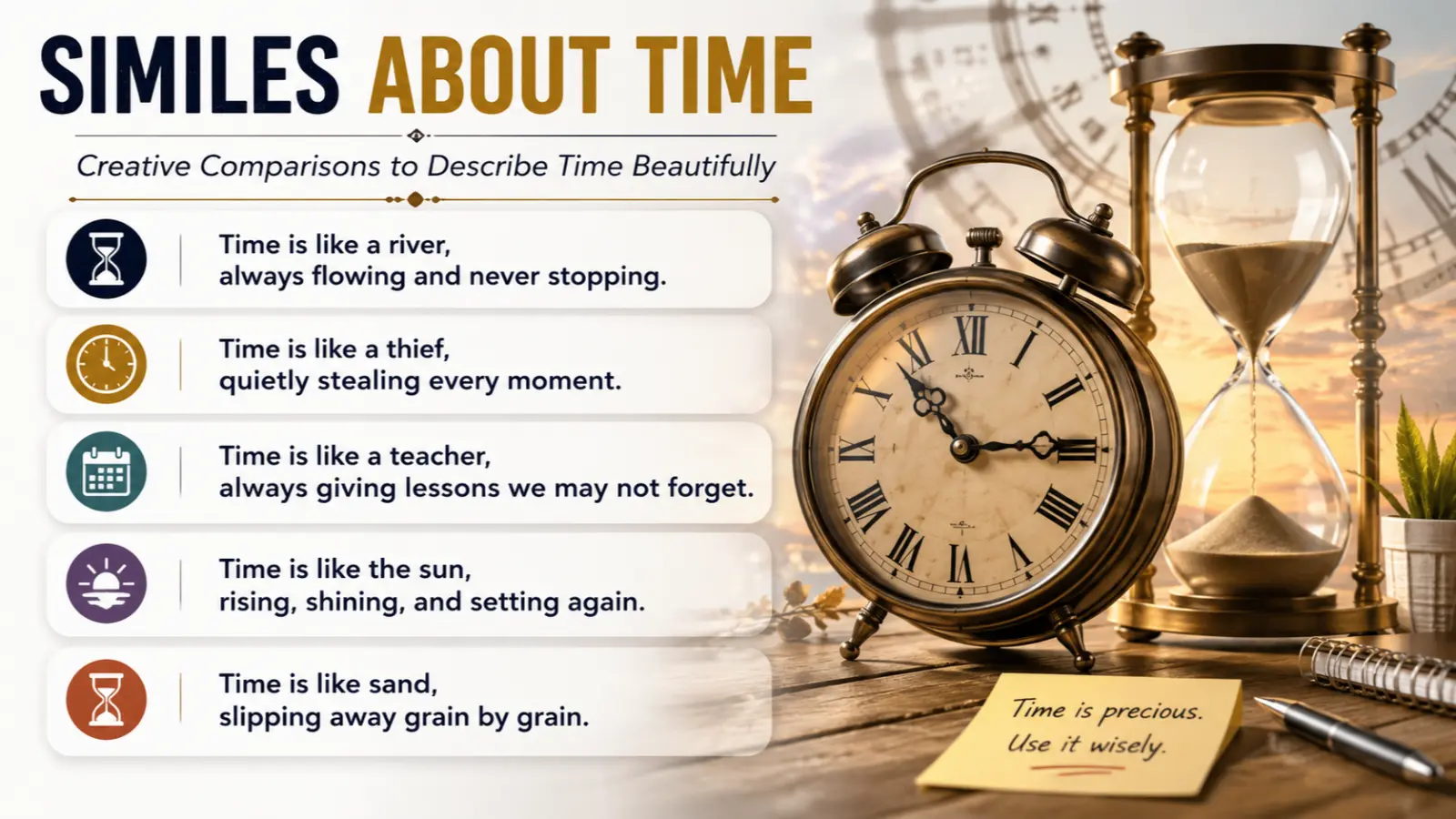
Time slipped away like sand through an open hand.
The comparison makes time feel difficult to control. The image of sand disappearing between your fingers gives the reader something physical to imagine.
A strong time simile can communicate more than speed. It can suggest nostalgia, pressure, patience, regret, excitement, aging, change, or anticipation.
Quick Answer: What Is a Good Simile for Time?
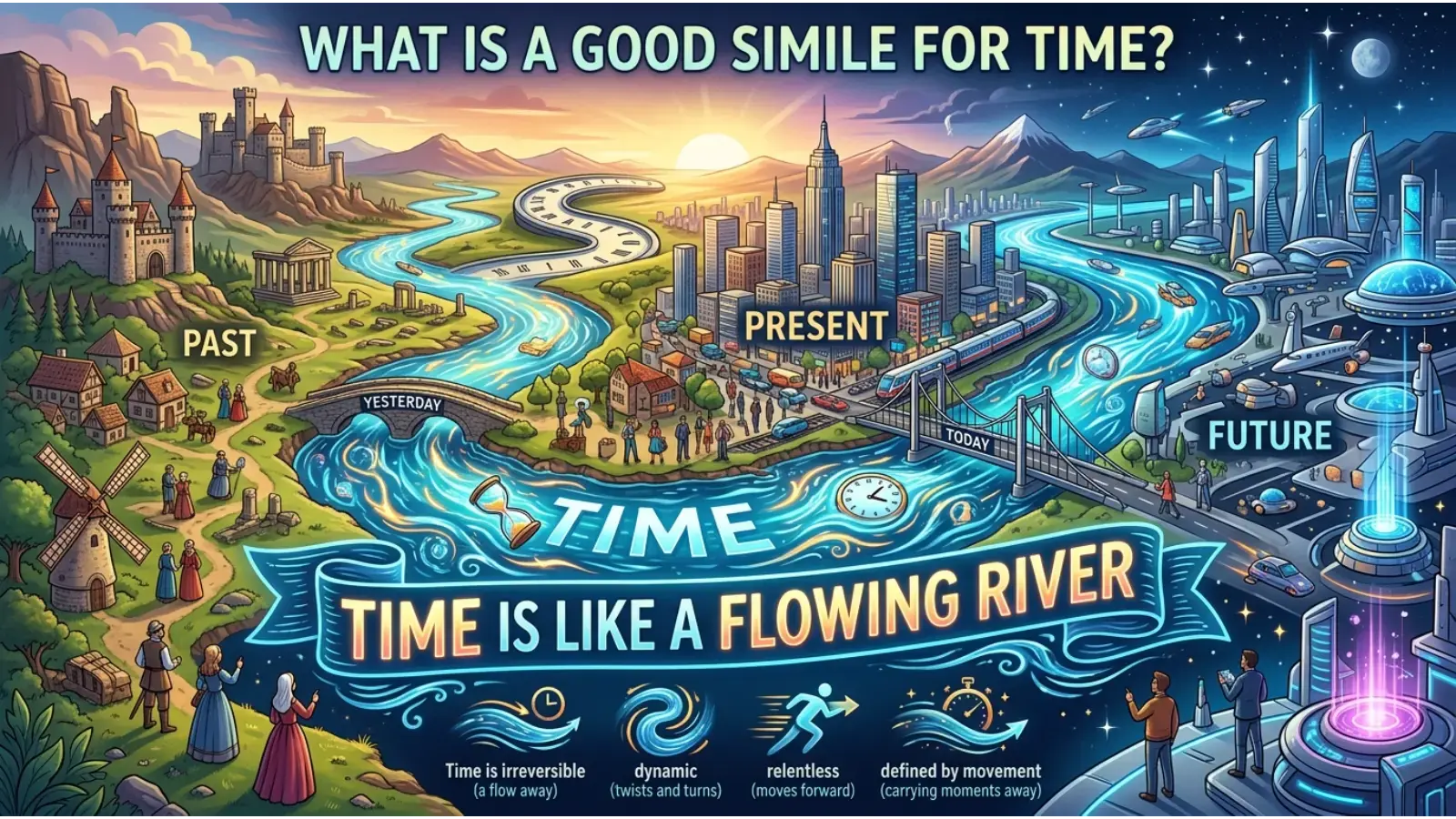
A good simile for time connects an abstract experience to a vivid, familiar image. For example, “Time moved like a quiet river beneath the bridge” suggests steady, unavoidable movement.
The best comparison depends on what you want the reader to feel. Time can move like water, race like a runner, stretch like a road, disappear like smoke, or gather like layers of dust.
30 Original Similes About Time
1. Time slipped away like rainwater between my fingers.
Meaning: Time can disappear before you realize it is gone.
This comparison works because rainwater cannot easily be held. The image creates a feeling of helplessness and makes passing time seem almost physical.
Example:
By the time summer ended, time had slipped away like rainwater between my fingers.
Best context: Nostalgia, childhood memories, endings, and reflective writing.
Writing tip: Use this kind of comparison when your character wishes they could have held on to a particular moment.
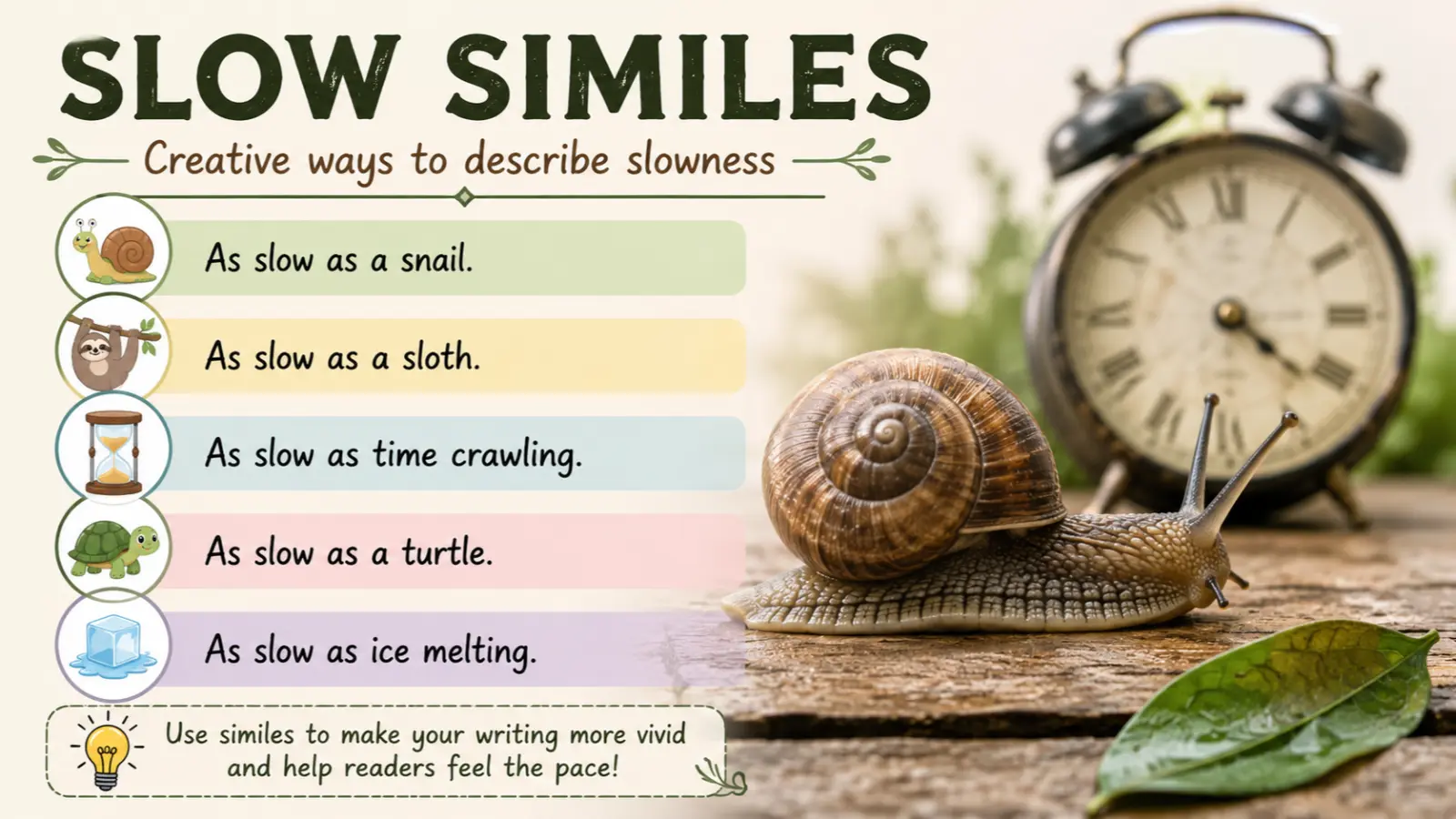
2. Time crawled like a snail across a dusty road.
Meaning: Time feels extremely slow.
Unlike a comparison that emphasizes speed, this image gives the reader a sense of frustration and waiting.
Example:
During the final ten minutes of the exam, time crawled like a snail across a dusty road.
Emotional effect: Impatience, boredom, anxiety.
Best context: Waiting rooms, exams, difficult days, or moments of uncertainty.
3. Time raced like a bicycle downhill.
Meaning: Time can suddenly feel extremely fast.
The comparison combines speed with a loss of control. Once a bicycle begins rushing downhill, slowing it can take effort.
Example:
The vacation raced like a bicycle downhill, and suddenly it was time to pack.
Writing purpose: Showing how enjoyable moments seem to pass quickly.
4. Time stretched like warm taffy.
Meaning: A short period can feel much longer than it actually is.
The physical image of taffy being pulled makes the idea of stretched time easy to visualize.
Example:
The silence before the announcement stretched like warm taffy.
Best context: Suspense and anticipation.
Writing tip: Choose comparisons that have movement. A physical action can make an abstract idea more vivid.
5. Time folded like a letter tucked into an old drawer.
Meaning: Memories can make distant moments feel close again.
This is less about the speed of time and more about how memory changes our relationship with it.
Example:
When she opened the old notebook, time folded like a letter tucked into an old drawer.
Emotional effect: Nostalgia and tenderness.
6. Time marched like boots across a wooden floor.
Meaning: Time moves steadily and cannot easily be stopped.
The sound of marching boots creates rhythm and inevitability.
Example:
Time marched like boots across a wooden floor while the town changed around him.
Best context: Aging, historical fiction, life transitions, and serious reflection.
7. Time flickered like a candle in a drafty room.
Meaning: A moment can feel fragile and temporary.
The candle image suggests that a moment exists briefly and could disappear at any instant.
Example:
Their peaceful afternoon flickered like a candle in a drafty room.
Writing purpose: Creating a delicate, uncertain mood.
8. Time gathered like snow on a forgotten doorstep.
Meaning: Time can accumulate quietly without anyone noticing.
Snow builds layer by layer. This makes it useful for describing years, memories, neglect, or gradual change.
Example:
Years gathered like snow on a forgotten doorstep.
Best context: Stories about old homes, relationships, memories, and aging.
9. Time hummed like a distant refrigerator.
Meaning: Time can continue quietly in the background.
This comparison is intentionally ordinary. It suggests something constant that you may barely notice until you pay attention.
Example:
While everyone argued, time hummed like a distant refrigerator.
Writing tip: Not every simile needs to be grand. Ordinary objects can create surprisingly believable imagery.
10. Time spun like a coin on a tabletop.
Meaning: A moment can feel uncertain, unpredictable, and temporary.
The coin is constantly moving but will eventually stop.
Example:
For the young athlete, time spun like a coin on a tabletop before the final decision.
Emotional effect: Suspense and uncertainty.
11. Time drifted like a paper boat on a slow stream.
Meaning: Time can move gently without demanding attention.
The paper boat creates a softer image than comparisons involving racing or marching.
Example:
That quiet afternoon passed as time drifted like a paper boat on a slow stream.
Best context: Peaceful memories and reflective scenes.
12. Time snapped like a rubber band.
Meaning: A long period of waiting can suddenly seem to end.
The sudden movement of a rubber band makes the transition feel abrupt.
Example:
After weeks of preparation, the final day arrived, and time snapped like a rubber band.
Writing purpose: Showing a sudden shift from preparation to action.
13. Time wandered like a traveler without a map.
Meaning: Time can feel directionless during uncertain periods.
The traveler has no clear route, making this useful when life feels confusing or unpredictable.
Example:
After graduation, time wandered like a traveler without a map.
Best context: Transitional moments.
14. Time glowed like the last light on a winter window.
Meaning: The final moments of something can feel beautiful and fleeting.
The fading light creates an image of something slowly disappearing.
Example:
Their final evening together glowed like the last light on a winter window.
Emotional effect: Bittersweetness and nostalgia.
15. Time knocked like a neighbor who refused to leave.
Meaning: Time keeps demanding attention.
This comparison gives time a human-like presence without turning it into a direct metaphor.
Example:
The deadline knocked like a neighbor who refused to leave.
Best context: Deadlines, responsibilities, and pressure.
16. Time turned like pages beneath a restless hand.
Meaning: Moments can pass one after another, especially when life feels busy.
The page image connects time with reading and storytelling.
Example:
Time turned like pages beneath a restless hand, carrying the children from one summer to another.
Writing purpose: Particularly effective in memoir and narrative writing.
17. Time settled like dust on an unused piano.
Meaning: Long periods of neglect can leave visible traces.
Dust accumulates slowly, so the comparison emphasizes gradual change rather than sudden passing.
Example:
Years settled like dust on an unused piano.
Emotional effect: Sadness, loneliness, and abandonment.
18. Time leaped like a startled deer.
Meaning: Time can suddenly seem to jump forward.
The startled deer gives the comparison energy and surprise.
Example:
I looked away for a moment, and time leaped like a startled deer.
Best context: Childhood, vacations, family memories, and personal reflection.
19. Time curled like smoke beneath a closed door.
Meaning: Time can enter our lives gradually and almost invisibly.
Smoke moves quietly and changes shape, making it a useful image for subtle change.
Example:
Years curled like smoke beneath a closed door, leaving the house almost unrecognizable.
Writing tip: Use this when you want time to feel mysterious rather than fast or slow.
20. Time marched like a train that never checked its schedule.
Meaning: Time keeps moving regardless of whether we are ready.
The train creates a strong sense of direction and inevitability.
Example:
Time marched like a train that never checked its schedule, carrying everyone toward the future.
Best context: Major life changes.
21. Time melted like ice beneath a spring sun.
Meaning: Time can disappear gradually but noticeably.
The melting ice suggests that something once solid is becoming impossible to preserve.
Example:
The final weeks of school melted like ice beneath a spring sun.
Emotional effect: Nostalgia and the awareness of change.
22. Time circled like a hawk above an empty field.
Meaning: Time can feel as though it is watching and waiting.
This creates a more tense and observant image.
Example:
Time circled like a hawk above an empty field as the family waited for news.
Best context: Suspense and emotionally charged waiting.
23. Time flicked past like streetlights outside a moving car.
Meaning: Moments can pass rapidly while you are focused on something else.
The repeated lights create a visual rhythm.
Example:
The city flicked past like streetlights outside a moving car.
Writing purpose: Excellent for travel scenes and fast-paced narratives.
24. Time rooted itself like an old tree.
Meaning: Some moments or memories seem to stay firmly in our minds.
This comparison shifts attention from passing time to lasting memory.
Example:
That summer rooted itself like an old tree in my memory.
Best context: Childhood, family stories, and meaningful experiences.
25. Time rolled like a marble across a classroom floor.
Meaning: Time can move unpredictably, sometimes slowly and sometimes quickly.
The marble also suggests that once movement begins, you cannot easily predict exactly where it will stop.
Example:
The afternoon rolled like a marble across a classroom floor.
Writing tip: Unexpected objects can produce fresher similes than familiar nature imagery.
26. Time hung like a coat on an empty hook.
Meaning: Time can feel suspended during periods of inactivity.
The empty hook creates a quiet image of absence.
Example:
During the long winter break, time hung like a coat on an empty hook.
Emotional effect: Stillness and loneliness.
27. Time rushed like water through a broken dam.
Meaning: Once events begin moving quickly, they may feel impossible to control.
The comparison creates urgency and momentum.
Example:
After the first announcement, time rushed like water through a broken dam.
Best context: Action scenes and moments when events accelerate.
28. Time softened like a photograph left in sunlight.
Meaning: Memories can become less sharp as years pass.
The image suggests fading details rather than complete disappearance.
Example:
The details of that afternoon softened like a photograph left in sunlight.
Writing purpose: Showing how memory changes rather than simply saying, “I forgot.”
29. Time whispered like wind through a half-open window.
Meaning: Time can pass quietly enough that you barely notice it.
The soft sound creates a calm, reflective atmosphere.
Example:
Time whispered like wind through a half-open window while we talked until midnight.
Best context: Quiet conversations, nighttime scenes, and reflective poetry.
30. Time climbed like ivy over an abandoned wall.
Meaning: Time gradually covers and changes everything.
Ivy grows slowly, making the comparison especially useful for long periods of change.
Example:
Time climbed like ivy over the abandoned house, hiding pieces of its former life.
Emotional effect: Age, mystery, and transformation.
How to Choose the Right Simile for Time
The strongest simile is not necessarily the prettiest one. It is the one that matches the specific experience of time you are trying to communicate.
Ask yourself three questions:
Is time moving quickly or slowly?
For fast time, choose images involving motion:
- a bicycle racing downhill
- streetlights passing a car
- water rushing through a dam
For slow time, choose images involving resistance or gradual movement:
- a snail crossing a road
- taffy being stretched
- snow accumulating
Does the moment feel happy, sad, tense, or peaceful?
Your comparison should reinforce the emotion.
A peaceful afternoon might use a drifting paper boat.
A stressful deadline might use a persistent knock.
A painful memory might be compared to fading light.
The image should support the feeling rather than fight against it.
Can the reader picture it?
A concrete comparison usually works better than an abstract one.
Weak:
Time passed like something important.
Stronger:
Time passed like streetlights flickering beyond a moving car.
The second version gives the reader something visible.
Why Some Similes About Time Feel More Powerful
A memorable simile usually contains more than a comparison. It contains movement, texture, emotion, or consequence.
Consider:
Time moved quickly like a fast object.
It communicates speed, but the image is vague.
Now consider:
Time flicked past like streetlights outside a moving car.
The reader can see repeated lights rushing by. The comparison creates a setting, a rhythm, and a feeling of speed.
This is one of the most useful principles in creative writing: specific images carry more emotional weight than general descriptions.
How to Make Time Similes More Vivid
Give the comparison an action
Instead of comparing time to a static object, consider what that object does.
Time can:
- slip
- crawl
- race
- fold
- gather
- melt
- whisper
- march
- drift
- snap
These verbs make the image dynamic.
Use sensory details
Think beyond what something looks like.
Ask:
- What would it sound like?
- Could you touch it?
- Does it have weight?
- Does it move?
- Does it make a smell?
- Does it change temperature?
For example, comparing time to a ticking clock gives sound. Comparing it to melting ice gives temperature and movement.
The more senses your image activates, the more memorable it can become.
Match the scale of the image
A tiny moment does not always need a huge comparison.
For an intimate scene, an ordinary object can be powerful:
Time hummed like a distant refrigerator.
For a dramatic historical scene, a larger image might fit:
Time marched like boots across a wooden floor.
Good writers choose images that belong naturally to the scene.
How Professional Writers Avoid Cliché Similes
Some comparisons become so common that readers barely notice them.
Expressions such as “time flies” and “time is like a river” are understandable, but they are familiar enough to have lost much of their surprise.
That does not mean every familiar simile is wrong. Sometimes a conventional expression is exactly what a character would naturally say.
But if your goal is vivid literary writing, look for a more specific connection.
Instead of asking:
What is time usually compared with?
Ask:
What does time feel like in this particular scene?
If your character is waiting for a difficult conversation, perhaps time feels like a door that will not open.
If someone is remembering childhood, perhaps time feels like pages turning in an old notebook.
The scene should generate the comparison.
Create Your Own Similes About Time
You can create original similes without searching for lists of comparisons. Start with the experience rather than the word time.
Step 1: Identify the feeling
Choose one:
- excitement
- boredom
- fear
- nostalgia
- peace
- pressure
- regret
- anticipation
- loneliness
- joy
Step 2: Describe what time is doing
Is it:
- racing?
- dragging?
- disappearing?
- returning?
- accumulating?
- changing things?
- waiting?
- repeating?
Step 3: Find a physical experience
Think of something that behaves similarly.
For example:
Feeling: anticipation
Time: stretching
Physical experience: taffy being pulled
Result:
Time stretched like warm taffy.
Step 4: Make the image specific
Instead of:
Time moved like water.
Try asking what kind of water.
A stream? A leaking faucet? A flooded street? Rain on glass? A waterfall?
Specificity gives you more possibilities.
Step 5: Test the emotional effect
Read your simile and ask:
Does this comparison create the feeling I intended?
If you want sadness but your image feels playful, replace it.
Creative Exercises for Better Time Similes
Exercise 1: The Five-Minute Test
Write one simile describing five minutes that feels:
- Extremely fast
- Extremely slow
- Peaceful
- Frightening
- Exciting
This teaches you how the same amount of time can feel completely different depending on emotion.
Exercise 2: Use an Ordinary Object
Choose an object near you right now.
It might be:
- a cup
- a keyboard
- a shoe
- a window
- a lamp
- a notebook
Create a simile connecting that object to time.
For example:
Time waited like a notebook closed halfway through a sentence.
The goal is not perfection. The goal is discovering unusual connections.
Exercise 3: Rewrite a Cliché
Start with:
Time flies.
Now replace “flies” with a more precise image.
Think about what kind of movement you actually mean.
Does time:
- disappear?
- accelerate?
- drift?
- rush?
- escape?
- leap?
Then find an object or action that behaves that way.
Similes vs. Metaphors About Time
Similes and metaphors both create comparisons, but they do it differently.
A simile usually signals the comparison with like or as:
Time moved like a river beneath the bridge.
A metaphor states the comparison more directly:
Time was a river beneath the bridge.
The simile leaves a little more distance between the two ideas. The metaphor can sound more direct and forceful.
Neither is automatically better. Choose the form that suits your sentence.
Other Literary Devices That Work With Time Similes
Imagery
Imagery gives readers sensory details. A time simile becomes stronger when it creates something readers can see, hear, touch, or feel.
Personification
You can give time human behavior:
Time knocked impatiently at the door.
This makes time feel like an active presence.
Hyperbole
Hyperbole deliberately exaggerates:
That ten-minute wait lasted a thousand years.
It is useful when the character’s emotional experience matters more than literal accuracy.
Symbolism
An object can represent more than its physical meaning. An old clock, fading photograph, or changing season can symbolize aging or the passage of time.
These devices can work together, but avoid adding too many at once. One clear image is often stronger than several competing ones.
Common Mistakes When Writing Similes About Time
Using the same comparison everyone knows
A familiar phrase may communicate the idea, but it rarely creates a fresh image.
Better approach: Start with the specific scene.
Making the comparison too complicated
A simile should clarify or enrich an idea, not make the reader solve a puzzle.
If the reader has to spend too much time figuring out the comparison, simplify it.
Mixing unrelated images
Avoid sentences that begin with one visual idea and suddenly switch to another.
For example, comparing time to a river and then describing it as a bird in the same sentence can create confusing imagery.
Choose one central image and develop it.
Choosing an image that does not match the emotion
A cheerful comparison can weaken a serious scene.
Always consider the emotional atmosphere before selecting your image.
Explaining the simile too much
Once the comparison works, trust the reader.
For example:
Time slipped away like rainwater between my fingers, which means that I could not hold on to the moments because rainwater is difficult to hold.
The second part is unnecessary.
Let the image do its work.
Frequently Asked Questions
What are some good similes about time?
Good similes depend on the feeling you want to express. Examples include comparing time to rainwater slipping through fingers, pages turning, snow gathering, or streetlights passing outside a moving car.
What is a simile for time going quickly?
You could write:
Time raced like a bicycle downhill.
Other possibilities include comparing time to streetlights passing a moving car or water rushing through a broken dam.
What is a simile for time going slowly?
A useful example is:
Time crawled like a snail across a dusty road.
You can also compare time to something being stretched, such as warm taffy.
What is a simile for time passing?
One option is:
Time turned like pages beneath a restless hand.
This works especially well in reflective or storytelling contexts.
What is a simile for waiting?
Try:
Time stretched like warm taffy.
The comparison suggests that waiting makes a short period feel unusually long.
How do you write a unique simile about time?
Start with the emotion or situation rather than the word “time.” Decide how time feels, find a physical object or action that behaves similarly, and then make the comparison specific.
Are “time flies” and “time is like a river” similes?
“Time flies” is generally treated as a metaphor or idiomatic expression rather than a simile because it does not use like or as. “Time is like a river” is a simile because it explicitly compares time with a river using like.
Conclusion
Time may be invisible, but writing gives you countless ways to make it tangible. You can make it crawl across a road, disappear between your fingers, gather like snow, flicker like candlelight, or drift like a paper boat. Each comparison changes the reader’s experience because each one carries its own emotion and movement. The most effective similes about time are not simply decorative phrases. They reveal something about the person, memory, or moment being described. When you create your own, begin with the experience. Ask what the moment feels like, what time is doing, and what physical image behaves in the same way. Then choose the clearest, most specific comparison you can find. That is how a simple comparison becomes memorable writing.
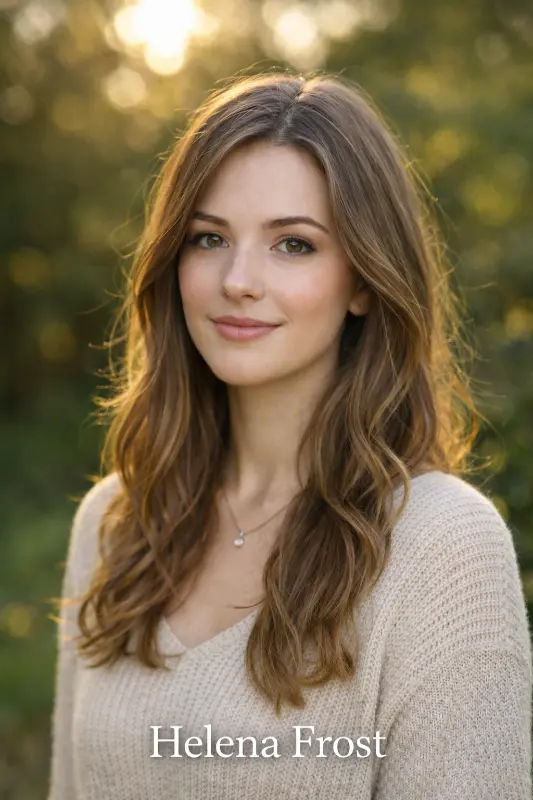
I am Helena Frost, a writer captivated by the beauty of language and the art of comparison. Through my words, I explore the world by turning ordinary moments into vivid similes and reflections. I enjoy crafting phrases that spark imagination, evoke emotion, and linger in the mind. My writing celebrates the subtle connections between people, nature, and the stories we live. For me, every sentence is an opportunity to reveal the extraordinary in the everyday.