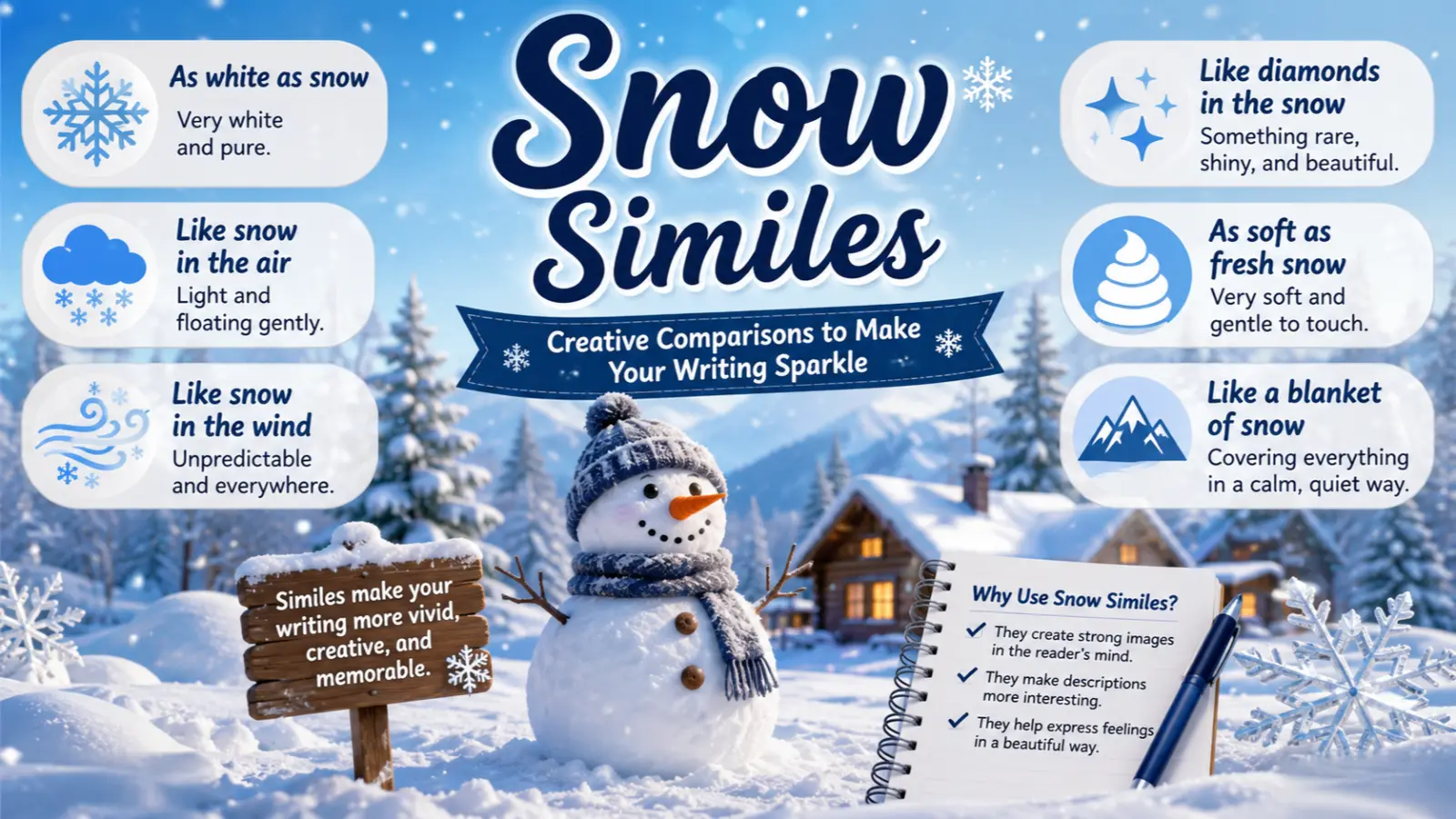
Snow has inspired writers for centuries because it can feel peaceful, dangerous, magical, lonely, or joyful depending on the moment. One well-crafted simile can transform an ordinary winter scene into something readers can picture instantly. A simile compares two different things using “like” or “as.” Instead of simply saying, “The snow was beautiful,” you might describe it in a way that paints a stronger picture. Whether you’re writing a story, poem, school assignment, holiday card, or descriptive essay, learning how to create original snow similes will make your writing richer and more memorable. This guide introduces fresh, imaginative comparisons while also explaining why they work and how you can create your own.
What Are Snow Similes?
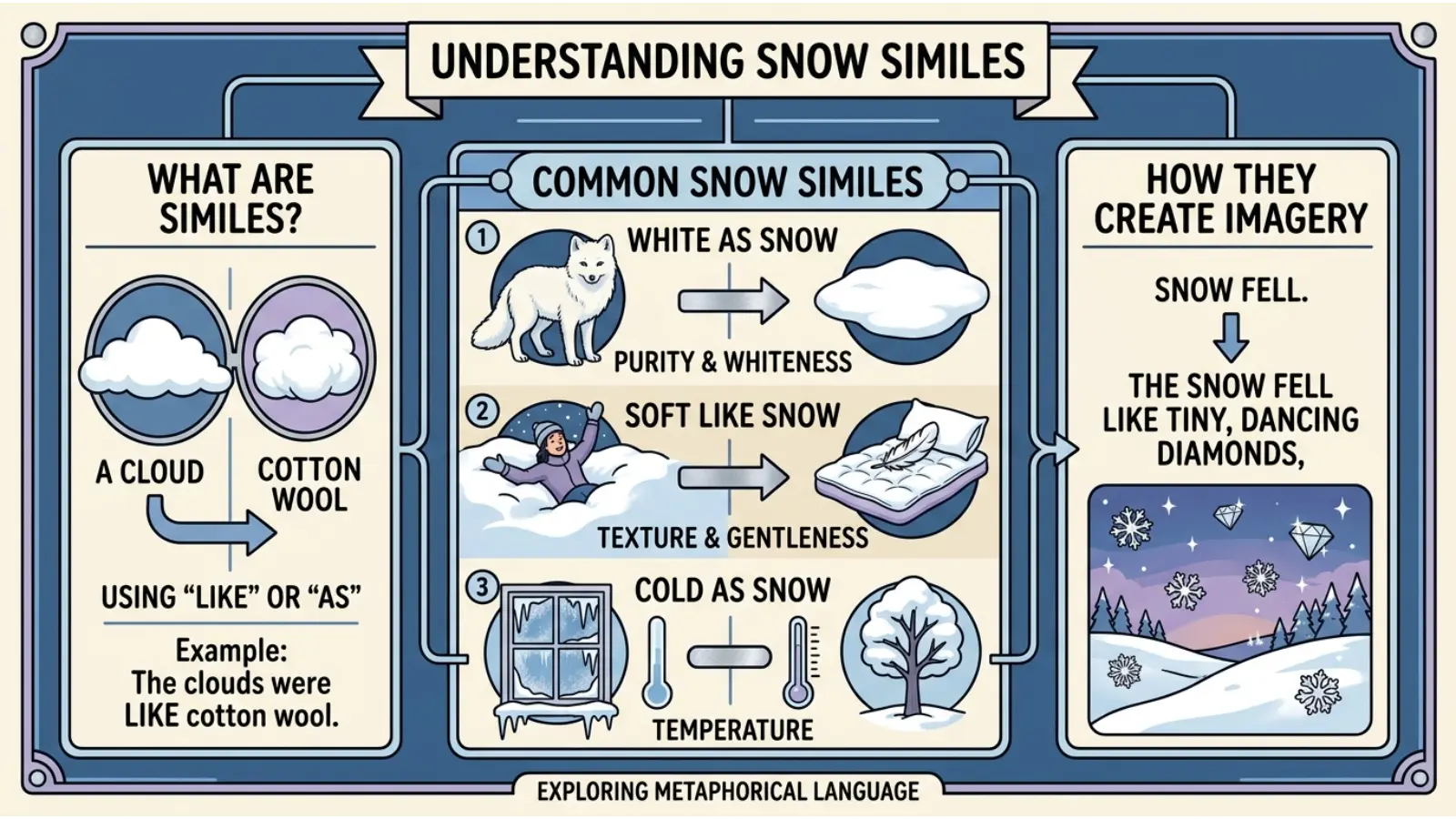
A snow simile compares snow—or something related to snow—to another object or experience using the words like or as.
The goal is not simply to sound poetic. A good simile helps readers experience a scene through sight, sound, touch, or emotion.
Example:
The snow drifted across the field like forgotten letters searching for a home.
Instead of only describing movement, the comparison adds mystery and emotion.
30 Original Snow Similes
1. As gentle as snow settling on sleeping trees
Meaning: Quiet and peaceful.
Examples
- The evening became as gentle as snow settling on sleeping trees.
- Her voice was as gentle as snow settling on sleeping trees.
Writing Tip: Perfect for calm emotional scenes.
2. Like feathers escaping the winter sky
Meaning: Soft, floating snowfall.
Examples
- Snow fell like feathers escaping the winter sky.
- Tiny flakes drifted like feathers escaping the winter sky.
Best Context: Nature writing and poetry.
3. As bright as fresh snow beneath the morning sun
Meaning: Extremely bright or pure.
Examples
- His smile was as bright as fresh snow beneath the morning sun.
- The valley looked as bright as fresh snow beneath the morning sun.
4. Like powdered glass catching daylight
Meaning: Sparkling beauty.
Examples
- The hillside shimmered like powdered glass catching daylight.
- Frost glittered like powdered glass catching daylight.
Writing Purpose: Creates vivid visual imagery.
5. As quiet as snow covering old footsteps
Meaning: Complete silence.
Examples
- The room became as quiet as snow covering old footsteps.
- The forest waited as quiet as snow covering old footsteps.
6. Like white paint spilled across the hills
Meaning: Thick snowfall covering everything.
Examples
- Snow spread like white paint spilled across the hills.
- The rooftops looked like white paint spilled across the town.
7. As light as a snowflake riding the wind
Meaning: Weightless movement.
Examples
- She danced as light as a snowflake riding the wind.
- The scarf floated as light as a snowflake riding the wind.
8. Like tiny stars falling to earth
Meaning: Beautiful snowfall.
Examples
- Snowflakes drifted like tiny stars falling to earth.
- The storm looked like tiny stars falling to earth.
9. As clean as untouched snow
Meaning: Pure and unspoiled.
Examples
- His intentions were as clean as untouched snow.
- The page looked as clean as untouched snow.
10. Like soft cotton covering the fields
Meaning: Thick, fluffy snow.
Examples
- The valley looked like soft cotton covering the fields.
- The garden rested like soft cotton covering the ground.
11. As crisp as frozen snow under boots
Meaning: Sharp and refreshing.
Examples
- The morning air felt as crisp as frozen snow under boots.
- Her words were as crisp as frozen snow under boots.
12. Like whispers floating through winter air
Meaning: Quiet snowfall.
Examples
- Snowflakes arrived like whispers floating through winter air.
- Silence settled like whispers floating through winter air.
13. As peaceful as a snowy mountain at sunrise
Meaning: Deep calm.
Examples
- The cabin felt as peaceful as a snowy mountain at sunrise.
- His thoughts became as peaceful as a snowy mountain at sunrise.
14. Like silver dust scattered across the earth
Meaning: Sparkling snow.
Examples
- Frost shone like silver dust scattered across the earth.
- The fields glowed like silver dust scattered across the earth.
15. As soft as snow resting on pine needles
Meaning: Gentle texture.
Examples
- The blanket felt as soft as snow resting on pine needles.
- Her touch was as soft as snow resting on pine needles.
16. Like tiny dancers twirling through the wind
Meaning: Graceful snowfall.
Examples
- Snowflakes moved like tiny dancers twirling through the wind.
- Leaves drifted like tiny dancers twirling through the breeze.
17. As silent as a frozen lake after snowfall
Meaning: Complete stillness.
Examples
- The town became as silent as a frozen lake after snowfall.
- The hallway remained as silent as a frozen lake after snowfall.
18. Like a blanket stitched from clouds
Meaning: Thick snow cover.
Examples
- The fields looked like a blanket stitched from clouds.
- Snow rested like a blanket stitched from clouds.
19. As delicate as crystal snowflakes
Meaning: Fragile beauty.
Examples
- The ornament was as delicate as crystal snowflakes.
- Her artwork appeared as delicate as crystal snowflakes.
20. Like pearls scattered across white silk
Meaning: Elegant winter scenery.
Examples
- Ice sparkled like pearls scattered across white silk.
- The frozen garden looked like pearls scattered across white silk.
21. As still as snowfall before dawn
Creates anticipation and serenity.
22. Like moonlight woven into winter
Adds a magical atmosphere to fantasy and poetry.
23. As smooth as snow untouched by footprints
Excellent for describing flawless surfaces.
24. Like sugar drifting from invisible hands
Works well in children’s stories.
25. As pale as winter’s first snowfall
Ideal for emotional or dramatic descriptions.
26. Like folded paper covering the earth
Suggests neat, even snowfall.
27. As calm as snow after the storm
Useful for scenes of relief or resolution.
28. Like lace spread across frozen branches
Highlights intricate winter beauty.
29. As cold as snow hiding beneath moonlight
Emphasizes both temperature and atmosphere.
30. Like tiny lanterns sparkling beneath winter sunshine
Creates an image of dazzling reflected light.
Why These Snow Similes Work
Strong similes do more than compare two things. They invite readers to experience a scene with multiple senses.
The strongest snow comparisons often focus on:
- Movement
- Texture
- Brightness
- Silence
- Emotion
- Temperature
- Light
When readers can imagine several of these at once, the description becomes much more memorable.
How to Create Your Own Snow Similes
Professional writers rarely settle for the first comparison that comes to mind.
Instead, they follow a simple process.
Step 1: Choose one quality
Ask yourself:
- Is the snow soft?
- Bright?
- Cold?
- Silent?
- Heavy?
- Fast?
Step 2: Think beyond winter
Look for similar qualities elsewhere.
Soft → feathers, velvet, petals
Bright → mirrors, diamonds, stars
Silent → libraries, sleeping forests, empty theaters
Step 3: Make the comparison specific
Instead of:
Like cotton
Try:
Like cotton drifting from invisible clouds.
Specific details make imagery feel fresh.
Related Literary Devices
Metaphor
A metaphor states that one thing is another rather than comparing them with “like” or “as.”
Simile: Snow fell like feathers.
Metaphor: The sky released feathers.
Imagery
Snow similes naturally strengthen imagery because they appeal to sight, sound, touch, and even emotion.
Personification
Snow can also be described with human actions.
Example:
The snow greeted the village before sunrise.
Symbolism
In literature, snow often symbolizes:
- Peace
- Renewal
- Isolation
- Innocence
- Silence
- Change
The meaning depends entirely on the story.
Common Mistakes When Writing Snow Similes
Using overused comparisons
Readers have seen familiar comparisons many times. Challenge yourself to find something more personal or unexpected.
Mixing unrelated imagery
Avoid combining ideas that clash.
Poor example:
The snow fell like fire across the frozen field.
Unless used intentionally, conflicting images confuse readers.
Comparing everything
Too many similes in one paragraph reduce their impact. Choose one memorable comparison instead of several weaker ones.
Forgetting the mood
A playful comparison fits a children’s story, while a darker one suits a mystery or thriller.
Creative Practice Exercises
Exercise 1
Describe snow using only sound.
Exercise 2
Write three similes that never mention white.
Exercise 3
Create one joyful, one mysterious, and one frightening snow simile.
Exercise 4
Rewrite a plain sentence.
Original:
Snow covered the road.
Improved:
Snow covered the road like a soft quilt stitched by the winter wind.
Frequently Asked Questions
What is a snow simile?
A snow simile compares snow to another object or experience using “like” or “as” to create vivid imagery.
Why are snow similes useful?
They make descriptions more engaging, emotional, and memorable by helping readers picture a winter scene.
Can snow similes be used in stories?
Yes. They work well in fiction, poetry, essays, speeches, and even everyday creative writing.
How do I avoid cliché snow similes?
Focus on a specific quality of snow—such as silence, sparkle, texture, or movement—and compare it with something unexpected but believable.
What’s the difference between a simile and a metaphor?
A simile uses words such as “like” or “as,” while a metaphor directly states that one thing is another.
Are snow similes appropriate for children’s writing?
Absolutely. Simple, imaginative comparisons make stories easier for young readers to visualize and enjoy.
How many similes should I use in one paragraph?
Usually one or two strong similes are enough. Too many comparisons can distract readers from the main idea.
Conclusion
Snow offers endless opportunities for creative description because it changes the way the world looks, sounds, and feels. The best snow similes don’t simply compare one thing to another—they help readers step into the scene and experience it for themselves. As you practice, pay attention to the small details that make each snowfall unique. Observe the light, the silence, the texture, and the emotions it creates. Then turn those observations into fresh, believable comparisons. With time, you’ll develop your own distinctive style and create similes that readers remember long after the last snowflake has fallen.
I am Helena Frost, a writer captivated by the beauty of language and the art of comparison. Through my words, I explore the world by turning ordinary moments into vivid similes and reflections. I enjoy crafting phrases that spark imagination, evoke emotion, and linger in the mind. My writing celebrates the subtle connections between people, nature, and the stories we live. For me, every sentence is an opportunity to reveal the extraordinary in the everyday.