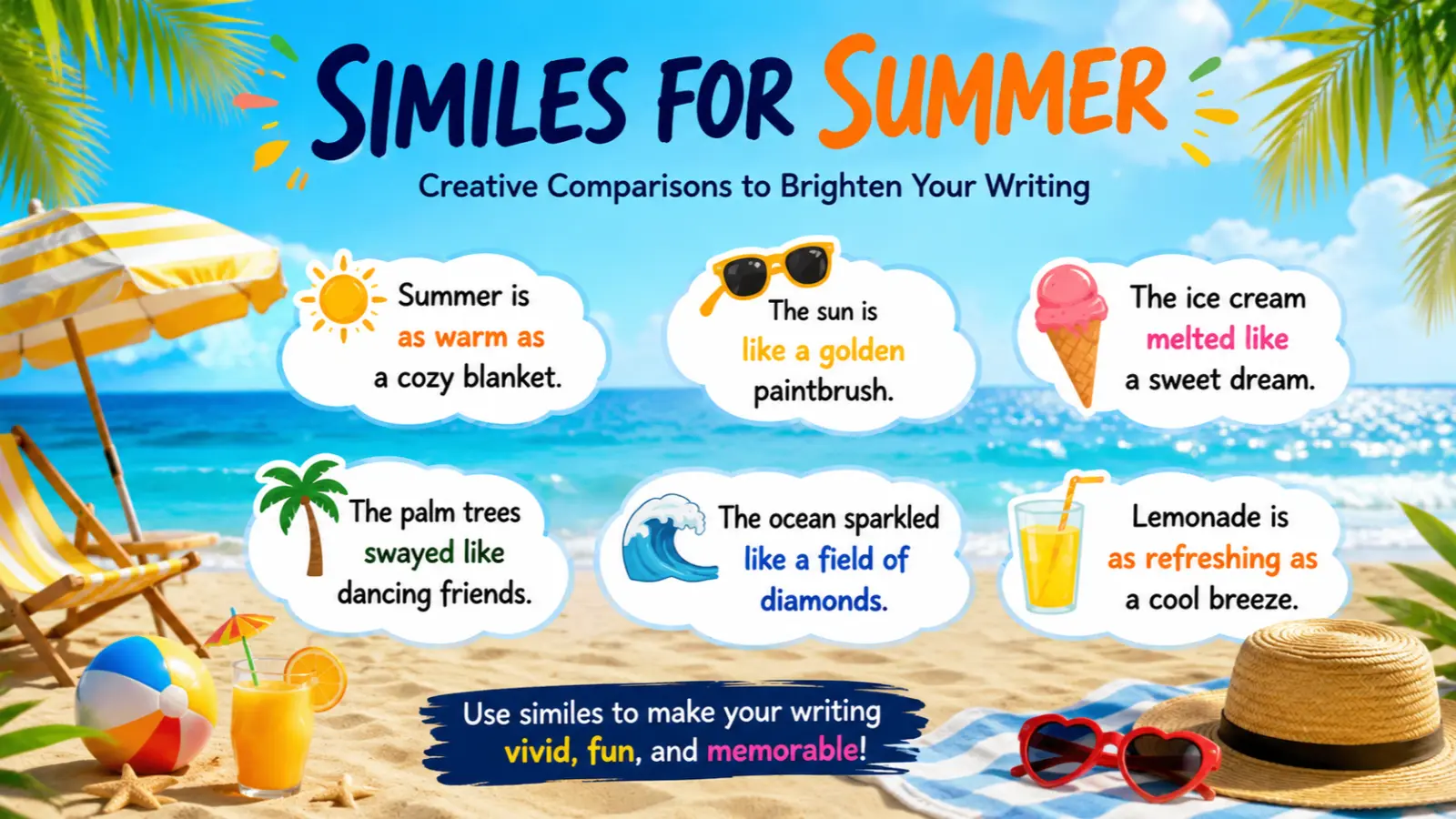
Summer is more than a season. It carries warmth, long afternoons, family vacations, buzzing insects, colorful sunsets, and memories that often stay with us for years. Writers frequently turn to summer when they want to describe joy, freedom, heat, energy, or even exhaustion. A simile is one of the simplest ways to bring those moments to life. By comparing one thing to another using “like” or “as,” a simile helps readers picture a scene instead of merely reading about it. Whether you’re writing stories, poems, essays, speeches, or social media captions, the right simile can transform an ordinary sentence into something readers remember. This guide explores original similes for summer, explains why they work, and shows you how to create your own vivid seasonal comparisons.
Quick Answer
Similes for summer compare summer or summer-related experiences to something familiar using “like” or “as.” They make descriptions more colorful and memorable by helping readers imagine the warmth, light, sounds, colors, and emotions of the season. Examples include “The afternoon shimmered like liquid gold” and “The breeze felt as gentle as a feather drifting across a lake.”
Why Summer Inspires So Many Similes
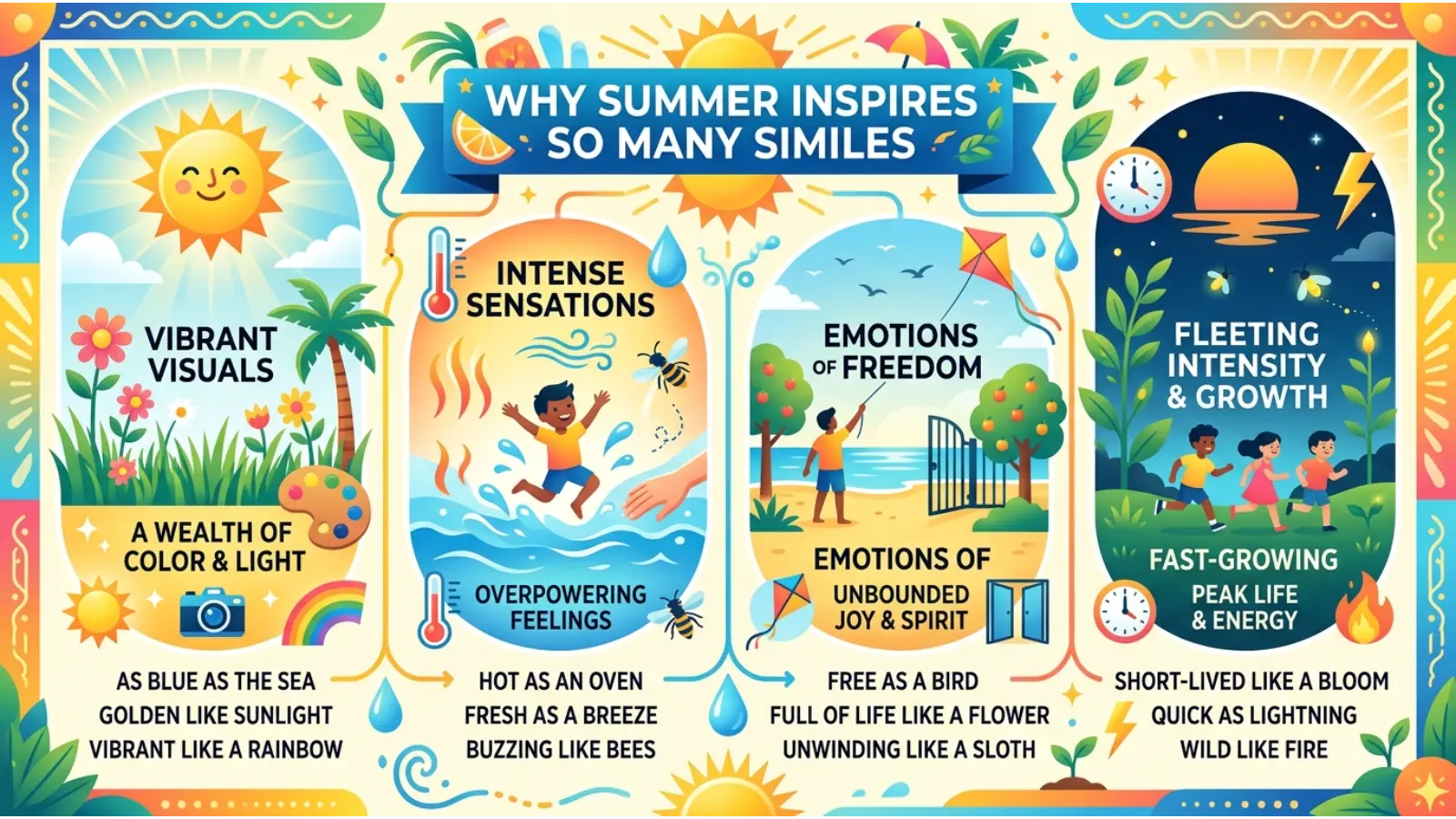
Summer appeals to nearly every sense.
You can describe:
- Blazing sunshine
- Warm evenings
- Ocean waves
- Green landscapes
- Fresh fruit
- Vacation adventures
- Thunderstorms
- Children’s laughter
- Fireflies
- Star-filled nights
Because the season is rich in sensory details, it naturally lends itself to creative comparisons.
Good summer similes don’t simply mention heat—they help readers feel it.
30 Original Similes for Summer
1. Summer spread across the hills like a golden quilt.
Meaning: Warm sunlight covering the landscape.
Examples
- Summer spread across the hills like a golden quilt before sunrise.
- The valley looked peaceful as summer wrapped it like a golden quilt.
Writing Purpose: Landscape description.
Storytelling: Creates a calm opening scene.
Writing Tip: Use for peaceful mornings instead of hot afternoons.
2. The afternoon shimmered like melted glass.
Meaning: Extreme heat creating shimmering air.
Examples
- The road shimmered like melted glass beneath the sun.
- Heat waves danced like melted glass above the pavement.
Emotional Effect: Intensity and stillness.
Best Context: Describing hot weather.
3. The sunshine poured down like warm honey.
Meaning: Gentle, rich warmth.
Examples
- Sunshine poured over the garden like warm honey.
- The porch glowed as sunlight flowed like warm honey.
Poetry Example
The sunshine flowed like warm honey through the quiet morning.
4. Children’s laughter bounced like colorful beach balls.
Meaning: Joyful, playful energy.
Examples
- Children’s laughter bounced like colorful beach balls around the park.
- The campsite echoed with laughter like colorful beach balls skipping across sand.
Conversation Example
“The kids are laughing like colorful beach balls bouncing everywhere.”
5. The breeze drifted like a whispered promise.
Meaning: Soft and comforting wind.
Examples
- A breeze drifted through the trees like a whispered promise.
- Evening air arrived like a whispered promise after the heat.
Writing Tip: Excellent for emotional scenes.
6. Summer mornings felt as fresh as dew on mint leaves.
Meaning: Refreshing beginning to the day.
Examples
- The campsite felt as fresh as dew on mint leaves.
- Summer mornings smelled as fresh as dew on mint leaves.
7. The sunset burned like glowing embers in a fireplace.
Meaning: Brilliant orange and red sky.
Examples
- The horizon burned like glowing embers.
- Clouds glowed like embers fading into night.
8. The lake sparkled like scattered diamonds.
Meaning: Bright reflections on water.
Examples
- The lake sparkled like scattered diamonds beneath the afternoon sun.
- Every ripple flashed like scattered diamonds.
Writing Purpose: Scenic description.
9. Summer days stretched like an endless ribbon.
Meaning: Long daylight hours.
Examples
- Summer days stretched like an endless ribbon.
- Vacation afternoons unfolded like an endless ribbon.
10. The picnic buzzed like a cheerful beehive.
Meaning: Busy and lively gathering.
Examples
- The family picnic buzzed like a cheerful beehive.
- The park hummed like a cheerful beehive.
11. Fireflies floated like tiny lanterns.
Meaning: Gentle glowing lights at night.
Examples
- Fireflies floated like tiny lanterns above the grass.
- The meadow sparkled with fireflies like tiny lanterns.
12. The watermelon tasted like chilled sunshine.
Meaning: Refreshing and sweet.
Examples
- Every bite tasted like chilled sunshine.
- Fresh fruit felt like chilled sunshine after the hike.
13. The ocean rolled like a sleeping giant.
Meaning: Calm but powerful waves.
Examples
- The ocean rolled like a sleeping giant.
- Gentle waves moved like a sleeping giant breathing.
14. Summer storms arrived like drummers on parade.
Meaning: Loud, energetic thunderstorms.
Examples
- Thunder arrived like drummers on parade.
- Rain marched across the valley like drummers on parade.
15. The flowers smiled like painted umbrellas.
Meaning: Bright colorful blossoms.
Examples
- The flowers smiled like painted umbrellas.
- The garden bloomed like painted umbrellas after the rain.
16. The sand felt as soft as fresh flour.
Meaning: Fine, smooth sand.
Examples
- The beach sand felt as soft as fresh flour.
- Bare feet sank into sand as soft as fresh flour.
17. The sky opened like a giant blue curtain.
Meaning: Wide open summer sky.
Examples
- The sky opened like a giant blue curtain.
- Above the mountains, the sky spread like a blue curtain.
18. The barbecue smelled like a welcoming campfire.
Meaning: Warm and inviting aroma.
Examples
- The backyard smelled like a welcoming campfire.
- Dinner drifted through the neighborhood like a welcoming campfire.
19. Summer memories clung like seashells in a pocket.
Meaning: Lasting memories.
Examples
- Those summer memories clung like seashells in a pocket.
- Vacation moments stayed like seashells tucked away.
20. The hammock swayed like a slow song.
Meaning: Relaxing movement.
Examples
- The hammock swayed like a slow song.
- Afternoon naps came easily as the hammock moved like a slow song.
21. The heat wrapped around us like a thick blanket.
Meaning: Overwhelming warmth.
Examples
- The heat wrapped around us like a thick blanket.
- Noon felt like wearing a blanket under the sun.
22. Ice cream disappeared like snow in spring.
Meaning: Eaten very quickly.
Examples
- The ice cream vanished like snow in spring.
- Popsicles disappeared like snow in spring.
23. The garden glowed like a painter’s palette.
Meaning: Bright variety of colors.
Examples
- The garden glowed like a painter’s palette.
- Every flower added another color like a painter’s palette.
24. The campsite rested like a hidden treasure.
Meaning: Peaceful, secluded place.
Examples
- The campsite rested like a hidden treasure among the trees.
- The clearing felt like hidden treasure.
25. The river danced like silver ribbon.
Meaning: Sparkling flowing water.
Examples
- The river danced like silver ribbon in the sunlight.
- Water curved like silver ribbon through the valley.
26. The evening cooled like an open window.
Meaning: Pleasant relief after heat.
Examples
- Sunset cooled the air like an open window.
- Evening arrived like an open window after a hot day.
27. Vacation felt like opening a favorite storybook.
Meaning: Exciting beginning.
Examples
- Summer vacation felt like opening a favorite storybook.
- Every trip began like opening a favorite storybook.
28. The orchard smelled like sweet memories.
Meaning: Nostalgic fragrance.
Examples
- The orchard smelled like sweet memories.
- Fresh peaches carried the scent like sweet memories.
29. The stars appeared like tiny campfire sparks.
Meaning: Bright stars emerging at night.
Examples
- Stars appeared like tiny campfire sparks.
- The sky filled with tiny campfire sparks.
30. Summer faded like the last note of a beautiful song.
Meaning: A gentle ending to the season.
Examples
- Summer faded like the last note of a beautiful song.
- Vacation ended like the final note of a beautiful melody.
Writing Purpose: Emotional endings.
How Strong Writers Create Better Summer Similes
Professional writers usually begin with observation rather than comparison.
Instead of thinking, “What is summer like?”, they ask:
- What does it smell like?
- How does it move?
- What emotions does it create?
- What colors dominate the scene?
- What sounds stand out?
The comparison comes naturally after noticing those details.
For example, rather than saying “hot as fire,” notice shimmering roads, buzzing insects, melting ice cream, or warm wooden docks. These observations lead to fresher imagery.
Related Literary Devices That Strengthen Summer Writing
Metaphor
Unlike similes, metaphors make direct comparisons.
- Simile: The sunset glowed like glowing embers.
- Metaphor: The sunset was a fire across the horizon.
Imagery
Imagery appeals to the senses.
Instead of writing:
It was hot.
Write:
The air shimmered like melted glass while cicadas filled the trees with steady music.
Personification
Give nature human qualities.
Example:
The breeze danced through the leaves.
Combined with similes, personification creates richer descriptions.
Alliteration
Repeating beginning sounds makes descriptions memorable.
Example:
Sunny skies shimmered softly.
Symbolism
Summer often symbolizes:
- Freedom
- Growth
- Adventure
- Youth
- Happiness
- Change
Understanding symbolism helps writers choose comparisons with greater emotional depth.
Create Your Own Summer Similes
Follow these simple steps:
Step 1: Pick one summer detail.
Examples:
- Sun
- Beach
- Heat
- Lemonade
- Sunset
- Fireflies
Step 2: Focus on one quality.
Ask:
- Bright?
- Warm?
- Quiet?
- Loud?
- Colorful?
- Relaxing?
Step 3: Compare it with something readers recognize.
Example:
Warm sunshine → warm honey
Step 4: Read it aloud.
If the comparison feels forced or confusing, simplify it.
Creative Practice Exercises
Exercise 1
Write a simile describing:
- A summer thunderstorm
- A beach sunrise
- A family picnic
Exercise 2
Describe your favorite summer memory using three different similes.
Exercise 3
Replace three ordinary adjectives such as hot, bright, or beautiful with original similes.
Common Mistakes to Avoid
Using Overused Comparisons
Readers have seen phrases like “hot as the sun” countless times. Look for fresh observations instead.
Mixing Images
Avoid combining unrelated comparisons.
Poor example:
The lake sparkled like diamonds and roared like velvet.
Choose imagery that works together.
Confusing Similes with Metaphors
Remember:
- Similes use like or as.
- Metaphors make direct comparisons.
Forcing Comparisons
A simile should clarify an image, not distract from it.
If readers stop to figure out the comparison, it may be too complicated.
Forgetting the Emotion
Great similes don’t only describe appearance. They also communicate feeling, mood, and atmosphere.
Frequently Asked Questions
What is a simile for summer?
A simile for summer compares the season to something familiar using like or as to create vivid imagery.
Why are summer similes useful in writing?
They help readers picture scenes more clearly, making stories, poems, and essays more engaging.
Can summer similes be used in poetry?
Yes. Poetry often relies on similes to create emotional and sensory experiences with just a few carefully chosen words.
How do I make my summer similes original?
Observe real moments, focus on one strong quality, and avoid comparisons you’ve heard many times before.
What’s the difference between a simile and a metaphor?
A simile uses like or as, while a metaphor states that one thing is another.
Are similes appropriate for school assignments?
Absolutely. They make descriptive writing more expressive and demonstrate strong language skills when used naturally.
Can I use summer similes in everyday conversation?
Yes. A well-chosen simile can make casual conversations, speeches, and presentations more vivid and memorable.
Conclusion
Summer offers endless inspiration for creative comparisons, from glowing sunsets and quiet lakes to lively picnics and warm evening breezes. The strongest similes for summer don’t rely on familiar phrases—they grow from careful observation and thoughtful word choice. As you write, pay attention to the colors, sounds, textures, and emotions around you. With practice, you’ll create comparisons that feel fresh, natural, and uniquely your own, giving readers scenes they can easily picture and remember long after they’ve finished reading.
I am Helena Frost, a writer captivated by the beauty of language and the art of comparison. Through my words, I explore the world by turning ordinary moments into vivid similes and reflections. I enjoy crafting phrases that spark imagination, evoke emotion, and linger in the mind. My writing celebrates the subtle connections between people, nature, and the stories we live. For me, every sentence is an opportunity to reveal the extraordinary in the everyday.