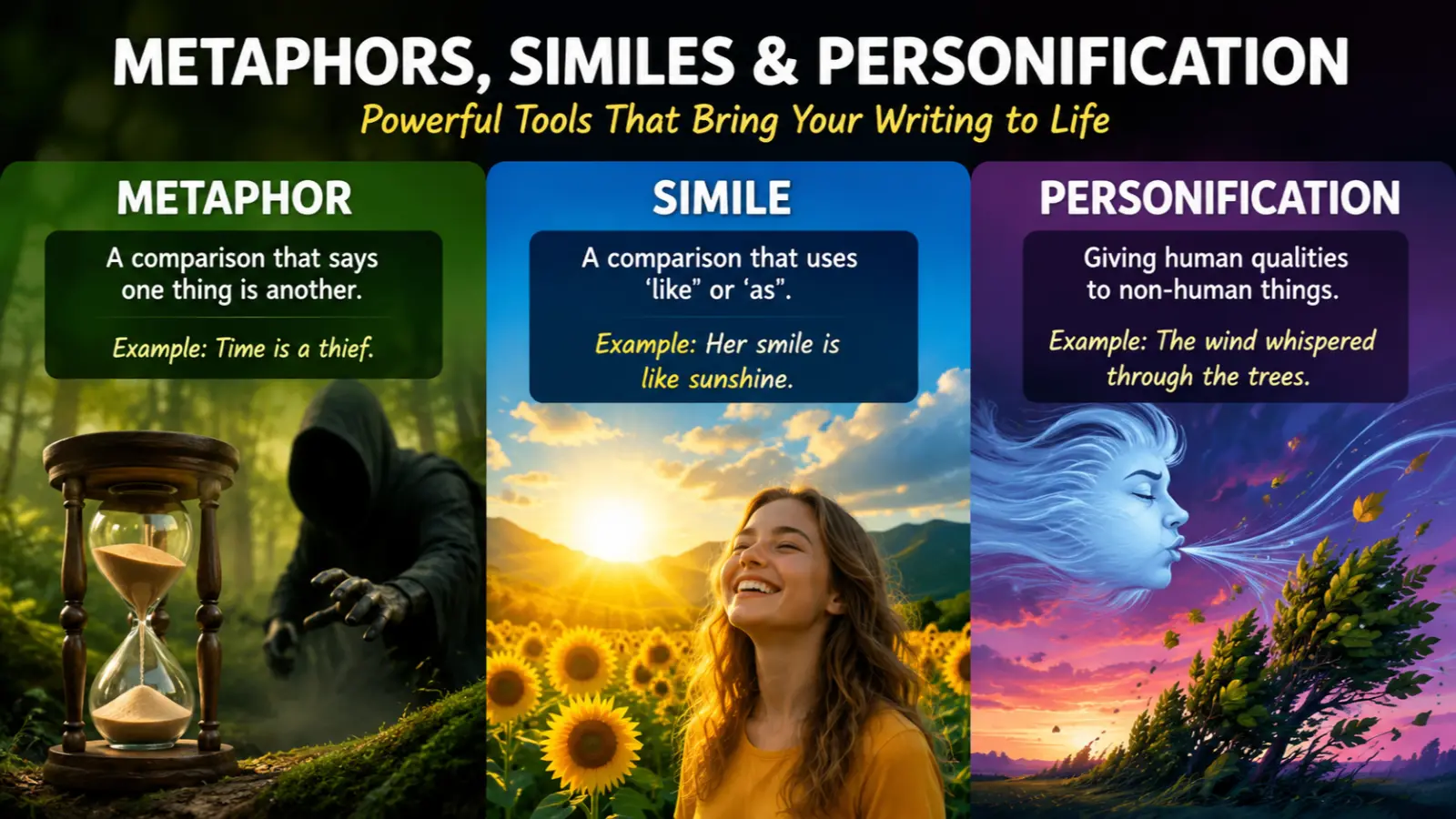
Metaphors Similes and Personification with clear definitions, original examples, writing tips, common mistakes, and creative exercises. Every memorable story, poem, speech, or essay relies on vivid language. Three of the most powerful literary devices are metaphors, similes, and personification. They help writers paint pictures with words, create emotion, and make ordinary descriptions unforgettable. Whether you’re a student, teacher, poet, novelist, or someone who simply enjoys creative writing, understanding how these techniques work will improve your writing dramatically. This guide explains the differences between metaphors, similes, and personification, shows how professional writers use them, and provides fresh, original simile examples you can adapt to your own work.
Quick Answer
Metaphors, similes, and personification are figurative language techniques that make writing more vivid.
- Simile compares two different things using like or as.
- Metaphor says one thing is another to create a stronger image.
- Personification gives human qualities to animals, objects, or ideas.
Each device helps readers imagine scenes, understand emotions, and connect more deeply with your writing.
Why Writers Use Figurative Language
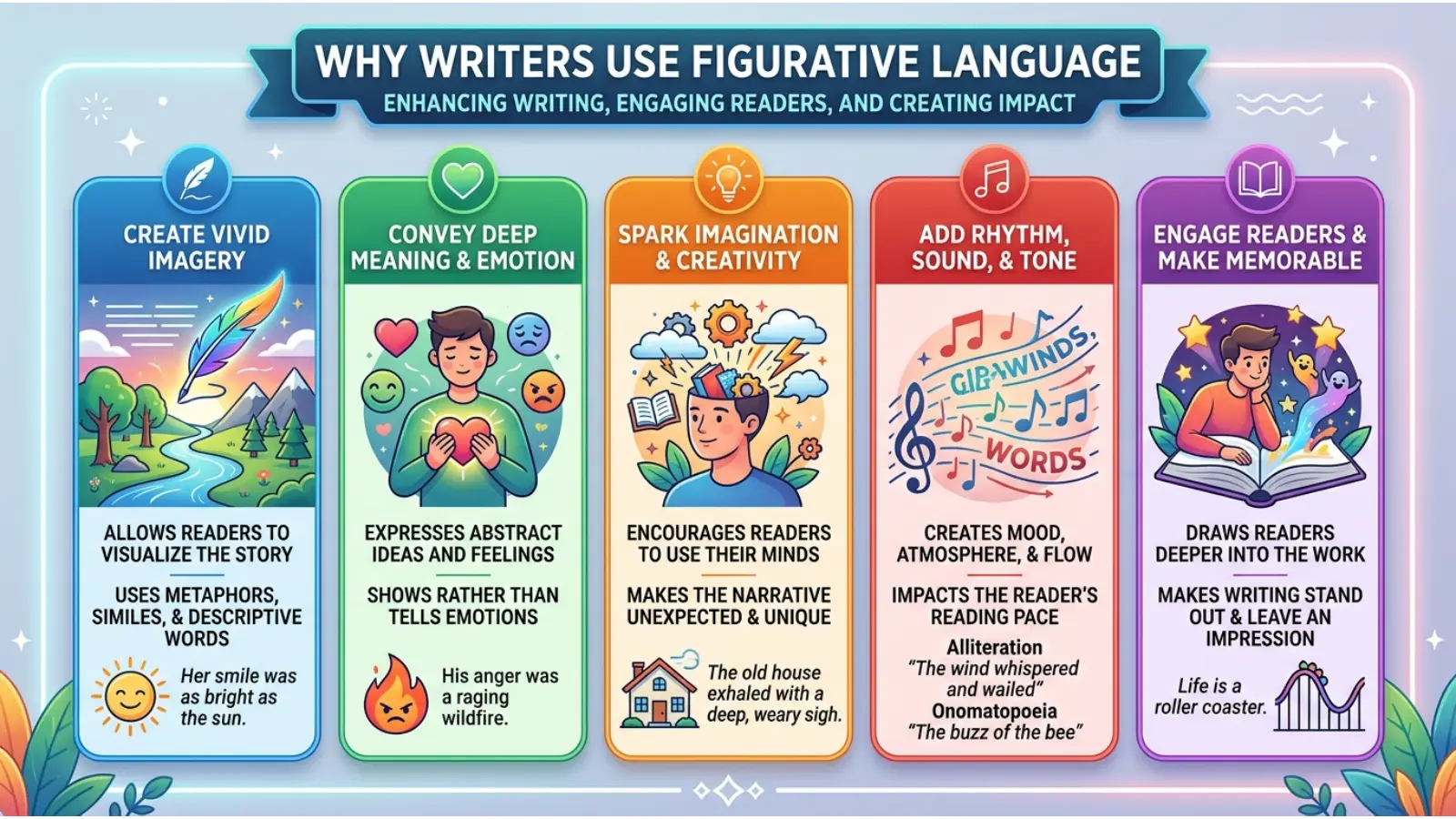
Literal writing explains.
Figurative writing helps readers experience.
Compare these sentences:
Literal: The sunset was beautiful.
With a simile: The sunset glowed like molten copper.
A metaphor: The sunset was a river of fire.
With personification: The sunset wrapped the hills in a warm embrace.
Each version creates a different emotional response while describing the same moment.
Understanding the Difference
What Is a Simile?
A simile compares two unlike things using like or as.
Example:
Her confidence spread like morning sunlight.
The comparison helps readers visualize confidence without saying it directly.
What Is a Metaphor?
A metaphor makes a direct comparison.
Example:
Her confidence was morning sunlight.
Instead of saying “like,” it treats one thing as another, making the image stronger.
What Is Personification?
Personification gives human actions or emotions to non-human things.
Example:
The old house sighed in the evening wind.
Houses cannot sigh, but readers instantly imagine age and loneliness.
When to Use Each Device
Choose a Simile When
- Explaining unfamiliar ideas
- Creating gentle imagery
- Helping readers visualize quickly
- Teaching young writers
A Metaphor When
- You want a stronger emotional impact
- Writing poetry
- Building symbolism
- Creating memorable descriptions
Choose Personification When
- Describing nature
- Writing children’s stories
- Creating atmosphere
- Making settings feel alive
25 Original Similes for Creative Writing
1. Bright as a lantern in fresh snow
Meaning: Extremely noticeable.
Examples
- Her smile was as bright as a lantern in fresh snow.
- The new idea shined as bright as a lantern in fresh snow during the meeting.
Writing Tip
Use it for hopeful or inspiring scenes.
2. Calm like a quiet lake before sunrise
Meaning: Completely peaceful.
Story Example
The captain remained calm like a quiet lake before sunrise.
3. Curious as a squirrel discovering a hidden path
Meaning: Eager to explore.
Conversation
My little brother is as curious as a squirrel discovering a hidden path.
4. Fast like rain racing down a window
Meaning: Moving quickly and smoothly.
Poetry
The memories slipped away like rain racing down a window.
5. Gentle as falling feathers
Meaning: Soft and kind.
Formal Example
Her voice remained gentle as falling feathers throughout the interview.
6. Sharp like winter stars
Meaning: Extremely clear or intelligent.
Writing Purpose
Excellent for describing observations or intelligence.
7. Brave as a lighthouse in a storm
Meaning: Courage despite danger.
Storytelling
He stood brave as a lighthouse in the storm.
8. Quiet like unopened letters
Meaning: Silent yet full of hidden meaning.
Emotional Effect
Creates mystery.
9. Warm as fresh bread from the oven
Meaning: Welcoming and comforting.
Conversation
Their family felt as warm as fresh bread from the oven.
10. Hopeful like the first green leaf of spring
Meaning: Optimistic after difficulty.
11. Fragile as frost on glass
Meaning: Easily broken emotionally or physically.
12. Steady like mountain roots
Meaning: Reliable and dependable.
13. Happy as birds greeting dawn
Meaning: Joyful and energetic.
14. Lonely like a forgotten lighthouse
Meaning: Deep isolation.
15. Clever as flowing water
Meaning: Flexible problem-solving.
16. Proud like an eagle meeting the sunrise
Meaning: Strong confidence.
17. Busy as bees building tomorrow
Meaning: Productively occupied.
18. Peaceful as drifting clouds
Meaning: Relaxed and free from worry.
19. Strong like ancient oak roots
Meaning: Inner resilience.
20. Colorful as autumn after rain
Meaning: Rich and vibrant.
21. Patient as the tide returning
Meaning: Willing to wait.
22. Silent like hidden snowfall
Meaning: Nearly soundless.
23. Clear as polished crystal
Meaning: Easy to understand.
24. Light as floating seeds
Meaning: Weightless or carefree.
25. Determined as a river finding the sea
Meaning: Persistent despite obstacles.
Writing Tip
Ideal for characters overcoming challenges.
How Professional Writers Create Strong Imagery
Good writers rarely choose the first comparison that comes to mind.
Instead, they ask:
- What emotion should readers feel?
- What image is unexpected but believable?
- Does the comparison fit the story’s mood?
For example, comparing courage to a lighthouse creates stability and hope, while comparing courage to fire creates intensity. Both work, but each serves a different purpose.
How to Make Similes More Memorable
Instead of using familiar comparisons, observe the world around you.
Rather than saying:
- Busy as a bee
- Cold as ice
- Soft as silk
Try creating comparisons from personal experiences.
Notice unusual textures, sounds, weather, architecture, or everyday moments. Original observations make your writing feel authentic.
Related Literary Devices
Metaphor
A metaphor creates a direct comparison.
Example:
Time is a river.
It encourages readers to interpret deeper meaning rather than simply visualize.
Personification
Example:
The moon watched over the sleeping town.
Personification builds atmosphere and emotional connection.
Imagery
Imagery appeals to the senses.
Instead of saying:
The forest was beautiful.
Write:
Pine needles released a crisp scent while sunlight shimmered across moss-covered stones.
Readers experience the scene instead of merely reading about it.
Hyperbole
Hyperbole is intentional exaggeration.
Example:
I’ve waited a thousand years.
It emphasizes emotion rather than literal truth.
Symbolism
A symbol represents a larger idea.
A bridge may symbolize hope.
A storm may symbolize conflict.
Unlike similes, symbols often carry meaning throughout an entire story.
Alliteration
Repeating beginning sounds creates rhythm.
Example:
Whispering winds welcomed winter.
Idioms
Idioms have meanings different from their literal words.
Example:
Break the ice.
Unlike similes, idioms are fixed expressions.
Create Your Own Similes
Developing original comparisons becomes easier with practice.
Step 1
Choose the emotion or quality.
Example:
Confidence.
Step 2
Think of something in nature or everyday life that shares that quality.
Example:
Morning sunlight.
Step 3
Connect them naturally.
Her confidence spread like morning sunlight.
Creative Exercise
Write one simile for each of these ideas:
- Joy
- Fear
- Friendship
- Determination
- Curiosity
Then replace one with a metaphor and another with personification. Compare how each version changes the mood.
Common Mistakes
Using Overused Comparisons
Readers have seen “cold as ice” countless times.
Look for fresher images.
Mixing Imagery
Avoid combining unrelated images.
Incorrect:
His thoughts flew like birds and rooted like trees.
Choose one consistent image.
Confusing Similes and Metaphors
Simile:
She is like sunshine.
Metaphor:
She is sunshine.
Forcing Comparisons
Every comparison should feel natural.
If readers stop to question the comparison, it probably needs revision.
Choosing Weak Descriptions
A comparison should reveal something meaningful.
Instead of decorating your writing, let it deepen understanding.
Frequently Asked Questions
What is the easiest way to tell a simile from a metaphor?
A simile uses like or as, while a metaphor makes a direct comparison without those words.
Can a sentence contain both a metaphor and personification?
Yes. Writers often combine literary devices when they strengthen the image and remain clear.
Are similes only used in poetry?
No. They appear in novels, speeches, songs, advertising, essays, and everyday conversations.
Why is personification effective?
It helps readers connect emotionally with places, weather, objects, and abstract ideas.
Should every paragraph contain figurative language?
No. Figurative language has the greatest impact when used purposefully rather than constantly.
How can I make my similes sound original?
Observe real-life experiences, avoid clichés, and compare ideas that share a meaningful quality instead of relying on familiar expressions.
Can children learn metaphors and similes together?
Yes. Teaching similes first often makes metaphors easier to understand because both rely on comparison.
Conclusion
Metaphors, similes, and personification are more than decorative language—they are tools for helping readers see, feel, and remember your ideas. Similes offer gentle comparisons, metaphors create bold connections, and personification brings the world to life. The strongest figurative language grows from careful observation rather than familiar clichés. Practice creating your own comparisons, experiment with different images, and revise until each one feels natural. Over time, these techniques will become an essential part of your writing, making every story, poem, or essay more vivid, engaging, and memorable.
I am Helena Frost, a writer captivated by the beauty of language and the art of comparison. Through my words, I explore the world by turning ordinary moments into vivid similes and reflections. I enjoy crafting phrases that spark imagination, evoke emotion, and linger in the mind. My writing celebrates the subtle connections between people, nature, and the stories we live. For me, every sentence is an opportunity to reveal the extraordinary in the everyday.