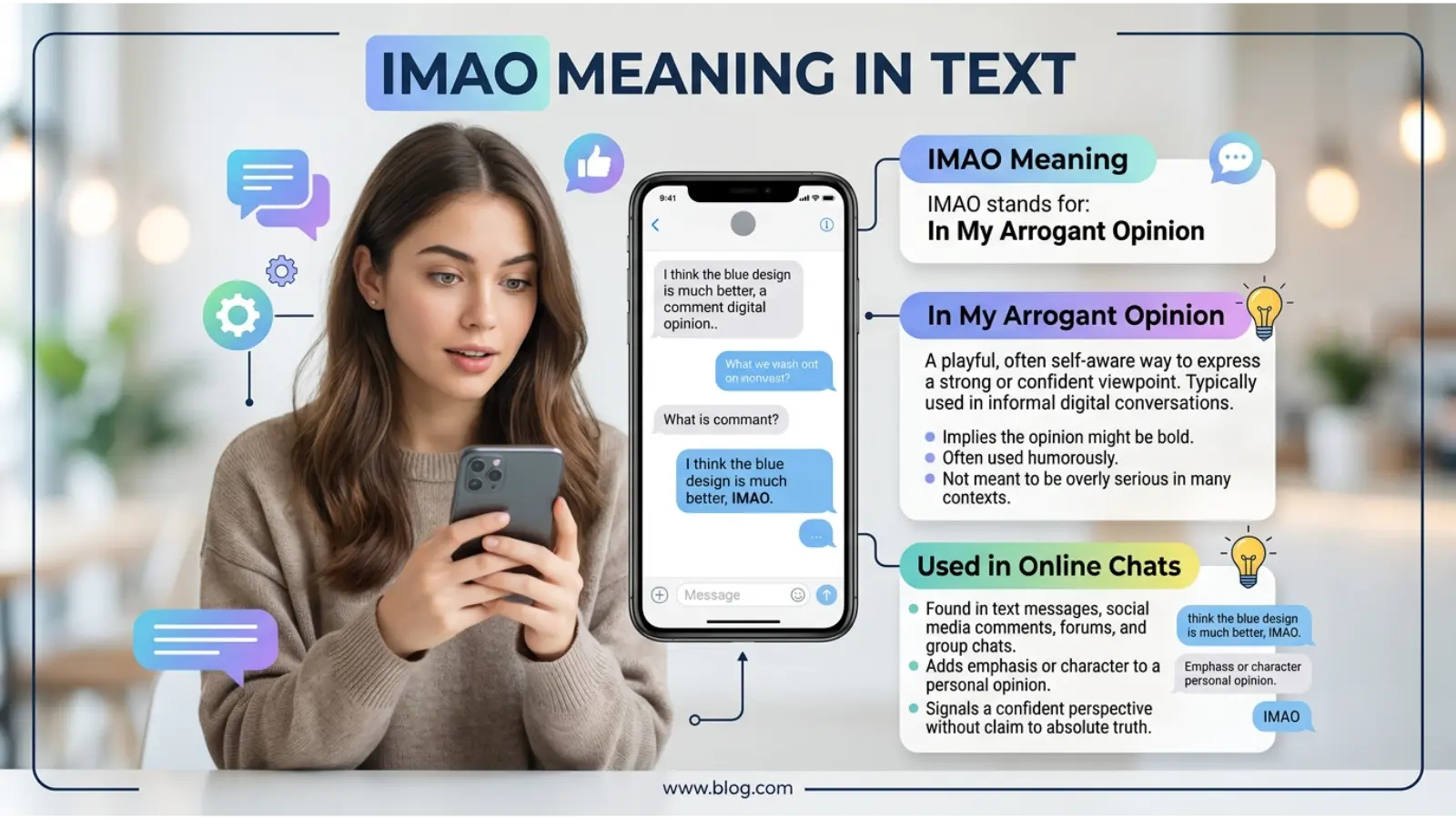
IMAO meaning in text is one of the most searched internet slang terms because people often see it in text messages, social media comments, online games, and group chats.
If you’ve ever received a message ending with “IMAO” and wondered what it means, you’re not alone.
Many people confuse IMAO with LMAO because the two abbreviations look similar. However, they have different meanings and are used in different situations.
Understanding internet slang helps you communicate better online and avoid misunderstandings.
If you’re chatting with friends, reading comments on TikTok, scrolling through X (Twitter), or texting someone, knowing how to use IMAO correctly can make conversations clearer and more natural.
Quick Answer
IMAO stands for “In My Arrogant Opinion” or, more commonly today, it is simply a misspelling of “LMAO.” When intentionally used, it expresses a confident or sarcastic opinion, but many people type it by mistake when they mean LMAO (Laughing My Ass Off).
What Does IMAO Mean in Text?
The IMAO meaning in text depends on the conversation.
There are two common meanings:
- In My Arrogant Opinion (intentional slang)
- A typo for LMAO (very common)
When used intentionally, IMAO means the speaker is sharing an opinion with exaggerated confidence or sarcasm.
Example
IMAO, pineapple belongs on pizza.
Here, the person is jokingly acting like their opinion is superior.
Sometimes, however, someone accidentally types IMAO instead of LMAO because the letters are next to each other on a keyboard.
Example:
That meme was hilarious! IMAO
The person probably meant LMAO.
IMAO Full Form
Many users search for IMAO full form or what does IMAO stand for.
The accepted expansion is:
IMAO = In My Arrogant Opinion
Unlike IMO (In My Opinion) or IMHO (In My Humble Opinion), IMAO intentionally sounds boastful or sarcastic.
Meaning in Different Contexts
The meaning changes depending on where it’s used.
In Text Messages
Usually expresses a playful or sarcastic opinion.
Example:
IMAO, this is the best burger in town.
On Social Media
People often use it in debates, memes, or humorous posts.
Example:
IMAO, cats secretly rule the internet.
In Gaming
Gamers may use it while joking with teammates.
Example:
IMAO, that was my best play today.
In Online Forums
It often introduces a personal opinion while adding humor.
Example:
IMAO, this update made the game much better.
Is IMAO Rude, Offensive, or Neutral?
IMAO is generally neutral to mildly sarcastic.
Whether it sounds rude depends on:
- Your tone
- Your relationship with the other person
- The topic being discussed
Friendly
IMAO, chocolate ice cream wins every time.
Slightly Rude
IMAO, your idea makes no sense.
Best Practice
Avoid using IMAO during serious conversations because sarcasm can easily be misunderstood in text.
Where Is IMAO Commonly Used?
You’ll mostly find IMAO on:
- Text messages
- Instagram comments
- TikTok
- Snapchat
- Discord
- Gaming chats
- X (Twitter)
- Group chats
It is much less common in professional emails or workplace communication.
Real-Life Conversation Examples
Friendly
Alex: Which movie should we watch?
Sam: IMAO, the new action movie is amazing.
Casual
Friend: This burger tastes incredible.
You: IMAO, it’s the best one here.
Argumentative
Person A: That phone is overpriced.
Person B: IMAO, you’re paying for quality.
Social Media
IMAO, this song deserves millions more streams.
Gaming
IMAO, we would’ve won if I hadn’t missed that shot.
Emotional and Psychological Meaning
Using IMAO often shows:
- Confidence
- Humor
- Playfulness
- Sarcasm
- Strong personal preference
Sometimes people use it to soften disagreements by making them sound humorous instead of aggressive.
Origin and Background of IMAO
Unlike popular abbreviations such as LOL or LMAO, IMAO has never become a mainstream internet acronym.
Its intentional meaning, “In My Arrogant Opinion,” appeared in online forums as a humorous variation of:
- IMO (In My Opinion)
- IMHO (In My Humble Opinion)
Today, many internet users encounter IMAO because it is mistakenly typed instead of LMAO, making the typo more common than the original slang meaning.
Comparison with Similar Slang
| Slang | Full Form | Meaning | Tone |
|---|---|---|---|
| IMAO | In My Arrogant Opinion | Confident or sarcastic opinion | Playful |
| IMO | In My Opinion | Personal opinion | Neutral |
| IMHO | In My Humble Opinion | Respectful opinion | Polite |
| LMAO | Laughing My Ass Off | Laughing very hard | Funny |
| LOL | Laugh Out Loud | Something is funny | Casual |
When to Use IMAO
You can use it when:
- Chatting with friends
- Posting funny opinions
- Sharing memes
- Making lighthearted jokes
- Casual online conversations
Example
IMAO, breakfast is the best meal of the day.
When to Avoid Using IMAO
Avoid using it:
- In business emails
- During interviews
- In academic writing
- In serious arguments
- When speaking with someone who may misunderstand sarcasm
Professional communication is usually clearer without internet slang.
Polite Alternatives
If you want to sound more respectful, try:
- I think…
- In my opinion…
- Personally…
- From my perspective…
- I believe…
- It seems to me…
These alternatives work well in formal and professional settings.
Why People Use IMAO
People use IMAO because it:
- Adds humor
- Makes opinions sound playful
- Shows confidence
- Fits casual internet culture
- Makes conversations feel relaxed
Some users also type it accidentally when they intended to write LMAO.
Impact of Using Slang in Communication
Slang like IMAO can make conversations:
More Engaging
Friends often enjoy informal language.
More Relatable
Internet slang creates a casual atmosphere.
Potentially Confusing
Not everyone understands internet abbreviations.
Easy to Misinterpret
Without facial expressions or tone of voice, sarcasm may be misunderstood.
Is IMAO Safe for Social Media?
Yes.
IMAO is generally safe to use on:
- TikTok
- Snapchat
- Discord
- X (Twitter)
However, avoid using it to insult or mock others, as context matters.
Common Misunderstandings
Many people mistakenly believe:
IMAO always means laughing.
Not true. That’s LMAO.
IMAO is an official acronym.
It exists but is far less common than IMO or LMAO.
Everyone knows what it means.
Because it’s relatively uncommon, some readers may be confused.
Variations and Types
You may also see:
- IMO – In My Opinion
- IMHO – In My Humble Opinion
- LMAO – Laughing My Ass Off
- LMFAO – Laughing My Freaking Ass Off
- LOL – Laugh Out Loud
Each abbreviation has its own tone and purpose.
How to Respond When Someone Uses IMAO
If someone shares an opinion using IMAO, you can respond politely.
Examples:
- I agree!
- That’s a good point.
- Interesting opinion.
- I see it differently.
- Fair enough.
- That’s funny.
If you think they accidentally meant LMAO, you can ask:
Did you mean LMAO?
Regional and Cultural Usage
IMAO is mostly seen in English-speaking online communities.
It appears in:
- United States
- Canada
- United Kingdom
- Australia
- International gaming communities
Many non-native English speakers also use it after learning internet slang through social media.
Frequently Asked Questions (FAQs)
What does IMAO mean in text?
IMAO usually means “In My Arrogant Opinion.” However, many people accidentally type it instead of LMAO.
What does IMAO stand for?
The IMAO full form is In My Arrogant Opinion.
Is IMAO the same as LMAO?
No. LMAO means “Laughing My Ass Off,” while IMAO means “In My Arrogant Opinion” when used intentionally, though it is often a typo for LMAO.
Is IMAO rude?
Not necessarily. It is usually humorous or sarcastic, but it can sound rude if used to dismiss someone else’s opinion.
Can I use IMAO in professional emails?
No. Professional writing should avoid internet slang. Use phrases like “In my opinion” instead.
Why do people confuse IMAO and LMAO?
The letters I and L are visually similar in many fonts, and people often make typing mistakes, causing IMAO to appear instead of LMAO.
Conclusion
Understanding the IMAO meaning in text helps you navigate modern online conversations with confidence. While IMAO officially stands for “In My Arrogant Opinion,” it is also frequently seen as an accidental typo for LMAO. The intended meaning depends on the context, tone, and surrounding conversation.
If you’re chatting with friends or posting on social media, IMAO can add humor and personality when used appropriately. However, it’s best to avoid it in formal or professional communication. By recognizing its meanings and knowing when to use it, you’ll communicate more clearly and avoid common misunderstandings in today’s digital world.