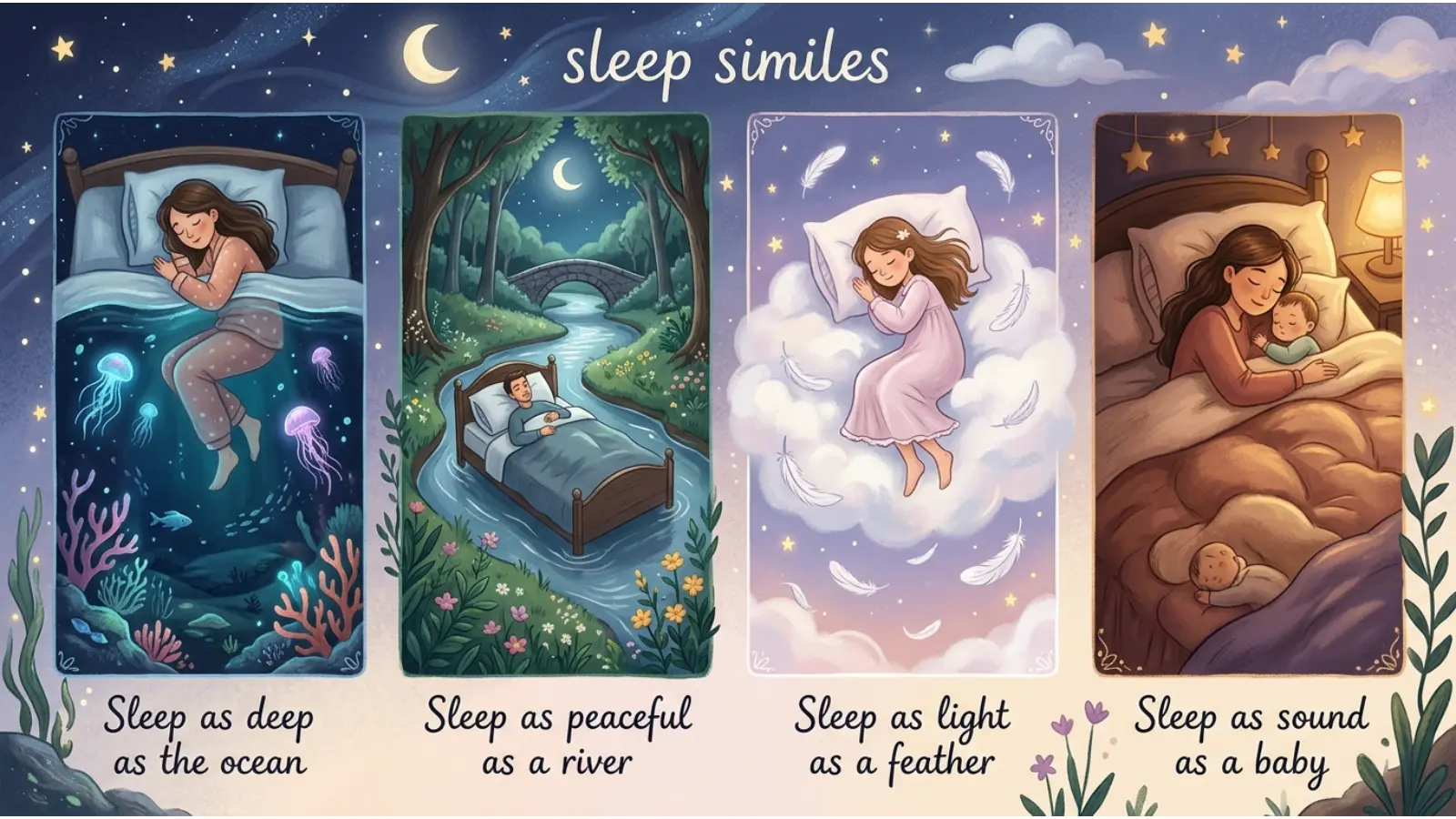
Sleep Similes is one of those experiences that can be difficult to describe directly. Saying someone was “very tired” tells the reader what happened, but it does not make them feel the heaviness behind it. A well-chosen simile can do much more.
A simile compares two different things using words such as like or as. In creative writing, sleep similes can turn an ordinary bedtime scene into something peaceful, strange, dreamy, funny, or deeply emotional.
You might describe a character sinking into sleep, a restless night, the quiet of a bedroom, or the exhaustion that follows a long day. The right comparison gives the reader something familiar to picture.
This collection of sleep similes offers original examples for stories, poems, essays, descriptions, and everyday writing. More importantly, it explains why the comparisons work and how you can create your own.
What Is a Sleep Simile?
A sleep simile is a comparison that uses like or as to describe sleep, tiredness, dreams, bedtime, or the atmosphere surrounding rest.
For example:
She drifted into sleep like a leaf settling onto still water.
The comparison connects falling asleep with a leaf landing gently on calm water. It creates an impression of softness and quiet rather than simply stating that she fell asleep.
Sleep similes can describe several different ideas:
- Peaceful sleep
- Deep sleep
- Falling asleep
- Tiredness
- Restless sleep
- Dreams
- Nighttime silence
- Waking up
- Exhaustion
- A cozy bedroom
The strongest comparisons focus on a specific quality rather than simply adding decorative language.
25 Creative Sleep Similes
1. Sleep Like a Leaf on Still Water
Simile: He slipped into sleep like a leaf settling onto still water.
Meaning: He fell asleep gently and without disturbance.
Why it works: The image suggests a smooth, quiet movement. It is especially useful when you want a peaceful mood.
Example:
After the long journey, he slipped into sleep like a leaf settling onto still water.
Best context: Peaceful fiction, reflective writing, and poetry.
2. As Quiet as a Snow-Filled Night
Simile: The bedroom was as quiet as a snow-filled night.
Meaning: The room was extremely still and silent.
The comparison works because fresh snow often creates an impression of muffled sound and stillness. It describes the environment around sleep rather than sleep itself.
Example:
The bedroom was as quiet as a snow-filled night, and the only sound was the slow ticking of the clock.
Writing tip: Environmental similes are useful when you want to establish atmosphere before describing a character.
3. Sleep Like a Stone in a Riverbed
Simile: She slept like a stone resting in a riverbed.
Meaning: She slept deeply and remained undisturbed.
The stone provides a sense of stillness and weight. Unlike a comparison involving movement, this one emphasizes complete physical quiet.
Best context: Describing someone who is difficult to wake.
4. Like a Curtain Falling at the End of a Play
Simile: Sleep came over him like a curtain falling at the end of a play.
Meaning: Sleep arrived and brought the day to an abrupt close.
This comparison works particularly well in storytelling because the end of a play naturally suggests an ending.
Example:
His thoughts finally slowed, and sleep came over him like a curtain falling at the end of a play.
Emotional effect: Closure, relief, and finality.
5. As Heavy as a Winter Blanket
Simile: Her eyelids felt as heavy as a winter blanket.
Meaning: She was extremely sleepy.
The comparison turns tiredness into something physical. Readers can imagine the weight of a thick blanket, making the sensation easier to feel.
Best context: First-person narration, children’s stories, and casual descriptions.
6. Dreams Like Lanterns on a Dark River
Simile: His dreams floated by like lanterns on a dark river.
Meaning: His dreams appeared briefly and moved through his sleeping mind.
This is useful when dreams feel beautiful, mysterious, or difficult to hold onto.
Example:
His dreams floated by like lanterns on a dark river, glowing for a moment before disappearing into the distance.
Writing purpose: Creating a dreamy, poetic atmosphere.
7. Sleep Like a Warm Nest
Simile: The bed held her like a warm nest.
Meaning: The bed made her feel safe, comfortable, and protected.
The comparison works because a nest suggests shelter and warmth.
Best context: Cozy scenes, family stories, bedtime writing, and comforting descriptions.
8. As Restless as a Clock Before Dawn
Simile: He was as restless as a clock before dawn.
Meaning: He could not settle down and remained awake.
The unusual comparison gives ordinary restlessness a sense of constant movement and anticipation.
Example:
He tossed beneath the blankets, as restless as a clock before dawn.
Writing tip: When creating an original simile, look for an object that behaves like the emotion you are describing.
9. Like Falling Through a Cloud
Simile: She entered sleep like falling through a soft cloud.
Meaning: Falling asleep felt gentle, weightless, and comfortable.
Emotional effect: Calm and dreaminess.
This works well in poetic writing because clouds naturally suggest softness and floating.
10. As Drained as an Empty Battery
Simile: After the tournament, he was as drained as an empty battery.
Meaning: He had almost no energy left.
This is a more modern comparison and works especially well in conversational or contemporary writing.
Best context: School stories, modern fiction, blogs, and informal writing.
11. Sleep Came Like a Soft Rain
Simile: Sleep came over her like a soft rain.
Meaning: Sleep arrived gradually and peacefully.
The gentle movement of rain creates a soothing image without making the sentence complicated.
Example:
She listened to the rain outside until sleep came over her like a soft rain of its own.
12. His Breathing Was Like a Slow Tide
Simile: His breathing moved like a slow tide.
Meaning: His breathing was steady and rhythmic while he slept.
The tide gives the sentence a natural sense of repetition.
Best context: Quiet nighttime scenes.
13. As Still as an Unopened Book
Simile: She lay as still as an unopened book.
Meaning: She barely moved while sleeping.
This comparison creates a slightly mysterious mood. An unopened book also suggests something waiting to be discovered.
Writing purpose: Showing stillness without simply saying “she did not move.”
14. Tiredness Like Sand in His Shoes
Simile: Tiredness clung to him like sand in his shoes.
Meaning: His exhaustion was persistent and difficult to ignore.
This is stronger than simply calling him tired because sand in a shoe is a small but constant irritation.
Best context: Describing lingering fatigue after a long day.
15. Sleep Wrapped Around Him Like Fog
Simile: Sleep wrapped around him like fog.
Meaning: He gradually became less aware of his surroundings.
The fog comparison suggests that consciousness is becoming blurred.
Example:
The lights faded in his mind as sleep wrapped around him like fog.
Emotional effect: Mystery and gradual disappearance.
16. Her Dreams Were Like Doors Without Handles
Simile: Her dreams were like doors without handles.
Meaning: Her dreams felt mysterious and impossible to understand or control.
This is particularly effective when describing strange or confusing dreams.
Writing tip: An effective simile does not always need to describe appearance. It can compare an experience or feeling with an object.
17. As Cozy as a Cabin in Winter
Simile: The bedroom felt as cozy as a cabin in winter.
Meaning: The room felt warm, comfortable, and protected from the cold outside.
Best context: Cozy descriptions and seasonal stories.
18. Sleep Took Him Like a Slow Current
Simile: Sleep took him like a slow current carrying a boat downstream.
Meaning: He gradually lost control as he drifted into sleep.
The current suggests movement without effort, making it useful for describing gradual sleep.
19. Awake as a Streetlight at Midnight
Simile: She was as awake as a streetlight at midnight.
Meaning: She remained completely awake despite the late hour.
This gives a nighttime scene a visual focal point.
Example:
Everyone else was asleep, but she was as awake as a streetlight at midnight.
20. His Mind Buzzed Like a Room Full of Bees
Simile: His mind buzzed like a room full of bees.
Meaning: He had so many thoughts that he could not relax.
This comparison is useful for restless sleep or insomnia scenes without merely repeating the word “restless.”
Writing purpose: Turning mental activity into a vivid sound-based image.
21. As Sleepy as a Cat in Sunshine
Simile: By late afternoon, he was as sleepy as a cat in sunshine.
Meaning: He was extremely relaxed and ready to sleep.
This has a lighter, friendlier tone than many sleep comparisons.
Best context: Children’s writing, humorous scenes, and casual conversation.
22. The Night Was Like a Blanket Over the City
Simile: The night settled over the city like a dark blanket.
Meaning: Darkness gradually covered everything.
This is not specifically about a person sleeping, but it creates an effective setting for a nighttime scene.
Writing tip: Sometimes the best sleep simile describes the world around the sleeper.
23. Exhaustion Hit Like a Door Closing
Simile: Exhaustion hit him like a door closing.
Meaning: His tiredness arrived suddenly and strongly.
The comparison is short and forceful, making it suitable for action-oriented storytelling.
Best context: Fast-paced narratives where a character suddenly reaches their limit.
24. Sleep Was as Deep as an Underground Lake
Simile: Her sleep was as deep as an underground lake.
Meaning: She was sleeping extremely deeply.
The underground lake creates an image of distance, darkness, and stillness.
Emotional effect: Depth, quiet, and isolation.
25. Morning Arrived Like a Knock at the Door
Simile: Morning arrived like a knock at the door.
Meaning: Morning came suddenly and demanded attention.
This works particularly well when a character does not want to wake up.
Example:
Morning arrived like a knock at the door, ending the dream before she could discover how it finished.
Best context: Stories, memoir-style writing, and poetry.
How to Choose the Right Sleep Simile
Not every sleep comparison creates the same mood. Before choosing one, decide what you want the reader to feel.
For peace, use images connected with still water, soft rain, warm blankets, nests, or gentle movement.
For deep sleep, choose images that suggest weight, depth, or stillness.
A restlessness, compare the mind or body with something constantly moving, buzzing, ticking, or shifting.
A dreams, use images that feel mysterious, fleeting, distant, or unreal.
For exhaustion, choose something that communicates emptiness, weight, or sudden loss of energy.
The key is to match the comparison with the emotional purpose of the sentence.
Why These Similes Work
A strong simile usually has more than one layer.
Consider:
His mind buzzed like a room full of bees.
The reader does not literally imagine bees inside the character’s head. Instead, the comparison communicates noise, movement, distraction, and mental overload.
That is the real value of figurative language. It lets writers communicate an experience indirectly through something readers already understand.
A useful test is to ask:
What specific quality do these two things share?
If you cannot answer that question, the comparison may need revision.
Sleep Similes for Different Writing Situations
For a Peaceful Story
Use soft and slow imagery:
Sleep came like a quiet tide.
The sentence encourages the reader to slow down.
For a Mystery
Choose an image that creates uncertainty:
The room disappeared around him like a road swallowed by fog.
The comparison adds tension rather than comfort.
For a Funny Scene
Use an unexpected everyday object:
He was as sleepy as a phone at one percent battery.
The modern image creates a playful tone.
For Poetry
You can make the comparison more symbolic:
Dreams drifted like paper boats beneath a moonlit bridge.
Poetry allows greater freedom because the goal may be emotional resonance rather than literal description.
For Children’s Writing
Keep the image familiar:
She curled into sleep like a kitten in a basket.
Children can understand the comparison immediately.
How to Make Sleep Similes More Vivid
The difference between a weak simile and a memorable one is often specificity.
Weak:
He was tired like an animal.
Stronger:
He dragged himself toward bed like a runner carrying a backpack full of stones.
The second comparison gives the reader more information. It communicates effort, weight, and exhaustion.
When revising a simile, replace general words with sensory details.
Think about:
- What does the thing look like?
- How does it move?
- What does it sound like?
- What does it feel like?
- Is it warm or cold?
- Is it heavy or light?
- Is it peaceful or threatening?
The more specific the shared quality, the more vivid the comparison becomes.
How to Avoid Cliché Sleep Comparisons
Some comparisons are so familiar that readers barely notice them. Familiar expressions are not automatically bad, but original writing often benefits from a fresher image.
Instead of immediately reaching for an obvious comparison, brainstorm five unrelated objects.
For example, if you want to describe deep sleep, consider:
- A submerged bell
- A locked room
- A stone beneath water
- An underground lake
- A distant lighthouse
Then ask which one best communicates the mood.
This technique pushes your writing beyond the first comparison that comes to mind.
Simile vs. Metaphor in Sleep Writing
A simile makes a direct comparison using words such as like or as.
Sleep came like a gentle wave.
A metaphor makes the comparison directly.
Sleep was a gentle wave.
Both can create strong imagery. The difference is grammatical and stylistic.
Similes often feel more conversational and explanatory, while metaphors can sound more immediate or poetic.
Other Literary Devices That Work With Sleep Similes
Imagery
Imagery appeals to the senses.
The cool sheets whispered against her skin as she settled into bed.
The description helps readers imagine the scene physically.
Personification
Personification gives human qualities to something nonhuman.
The night waited patiently outside the window.
This can make a nighttime setting feel alive.
Hyperbole
Hyperbole uses deliberate exaggeration.
He was so tired he could have slept through a thunderstorm.
The exaggeration emphasizes the character’s exhaustion.
Symbolism
Sleep can symbolize rest, escape, vulnerability, change, or the ending of one phase before another begins.
The meaning depends on the story and context.
How to Create Your Own Sleep Similes
Creating original comparisons becomes easier when you follow a simple process.
1. Identify the exact feeling
Do not start with “sleep.” Start with the quality you want to describe.
Is it:
- Peaceful?
- Heavy?
- Restless?
- Dreamlike?
- Sudden?
- Comfortable?
- Frightening?
- Exhausting?
2. List unrelated images
If the feeling is peaceful, write down objects or scenes that feel peaceful:
still lake, empty library, snowfall, quiet garden, sleeping village.
3. Find the strongest shared quality
Suppose you choose “empty library.” What does it communicate?
Silence. Stillness. Isolation. Calm.
Now you have several possible directions.
4. Add the comparison
The room was as quiet as an empty library after midnight.
5. Read it aloud
If the sentence sounds forced, simplify it.
A good simile should feel like part of the sentence rather than an ornament attached to it.
A Quick Exercise for Writers
Choose one of these feelings:
peaceful — exhausted — restless — dreamy — cozy
Now choose three unrelated objects.
For example, for restless:
- ticking clock
- trapped moth
- spinning fan
Create one sentence for each.
His thoughts moved like a ticking clock he could not turn off.
Then ask yourself:
Does the comparison add something that the original sentence did not have?
If yes, keep it. If not, try a more specific image.
Common Mistakes When Writing Sleep Similes
Using the First Comparison That Comes to Mind
The first idea is often the most familiar. Give yourself a few alternatives before choosing.
Mixing Images
Avoid combining unrelated pictures in one comparison unless the effect is intentional.
A sentence that starts with ocean imagery and suddenly switches to machinery can confuse the reader.
Making the Simile Too Complicated
A comparison should clarify or intensify an idea, not bury it beneath unnecessary words.
Choosing an Image Without a Clear Connection
An unusual comparison is not automatically a good one. The reader should be able to understand the shared quality.
Overusing Similes
If every sentence contains a comparison, none of them gets room to stand out.
Use figurative language where it contributes to mood, characterization, setting, or meaning.
Frequently Asked Questions About Sleep Similes
What is a good simile for sleep?
A good sleep simile depends on the mood. For peaceful sleep, you might write, “She slipped into sleep like a leaf settling onto still water.” For deep sleep, an image involving depth or stillness can work well.
What is a simile for being very tired?
You could write, “He was as drained as an empty battery.” This compares physical exhaustion with something that has completely run out of energy.
What is a simile for falling asleep?
Try a comparison that suggests gradual movement, such as “Sleep took him like a slow current carrying a boat downstream.” The image suggests that the character gradually loses awareness.
How do you describe peaceful sleep in writing?
Focus on qualities such as softness, stillness, warmth, and gentle movement. Comparisons involving calm water, quiet weather, warm shelters, or slow natural rhythms can create a peaceful effect.
Can sleep similes be used in poems?
Yes. Sleep is especially suitable for poetic comparisons because dreams, darkness, silence, and nighttime naturally lend themselves to imagery. Poets can use similes to create atmosphere as well as meaning.
What is the difference between a sleep simile and a sleep metaphor?
A sleep simile explicitly compares two things using like or as, while a metaphor makes the comparison directly. For example, “Sleep came like rain” is a simile, while “Sleep was rain” is a metaphor.
How can I make my sleep similes original?
Start with the exact emotion or quality you want to communicate, then brainstorm several unexpected objects that share that quality. Choose the comparison that gives the reader the clearest and freshest image.
Conclusion
The best sleep similes do more than decorate a sentence. They help readers experience something that is difficult to see directly: the gradual loss of awareness, the weight of exhaustion, the comfort of a bed, the strange movement of dreams, or the silence of a sleeping world. When you write your own, focus less on finding a “fancy” comparison and more on finding an accurate, specific, and surprising connection. A peaceful night might resemble still water. A restless mind might sound like a room full of bees. Exhaustion might cling like sand in a shoe. The possibilities are almost endless. Experiment with different images, read your sentences aloud, and keep the comparisons that make the reader see or feel something new. That is where a simple simile becomes memorable writing.
I am Helena Frost, a writer captivated by the beauty of language and the art of comparison. Through my words, I explore the world by turning ordinary moments into vivid similes and reflections. I enjoy crafting phrases that spark imagination, evoke emotion, and linger in the mind. My writing celebrates the subtle connections between people, nature, and the stories we live. For me, every sentence is an opportunity to reveal the extraordinary in the everyday.