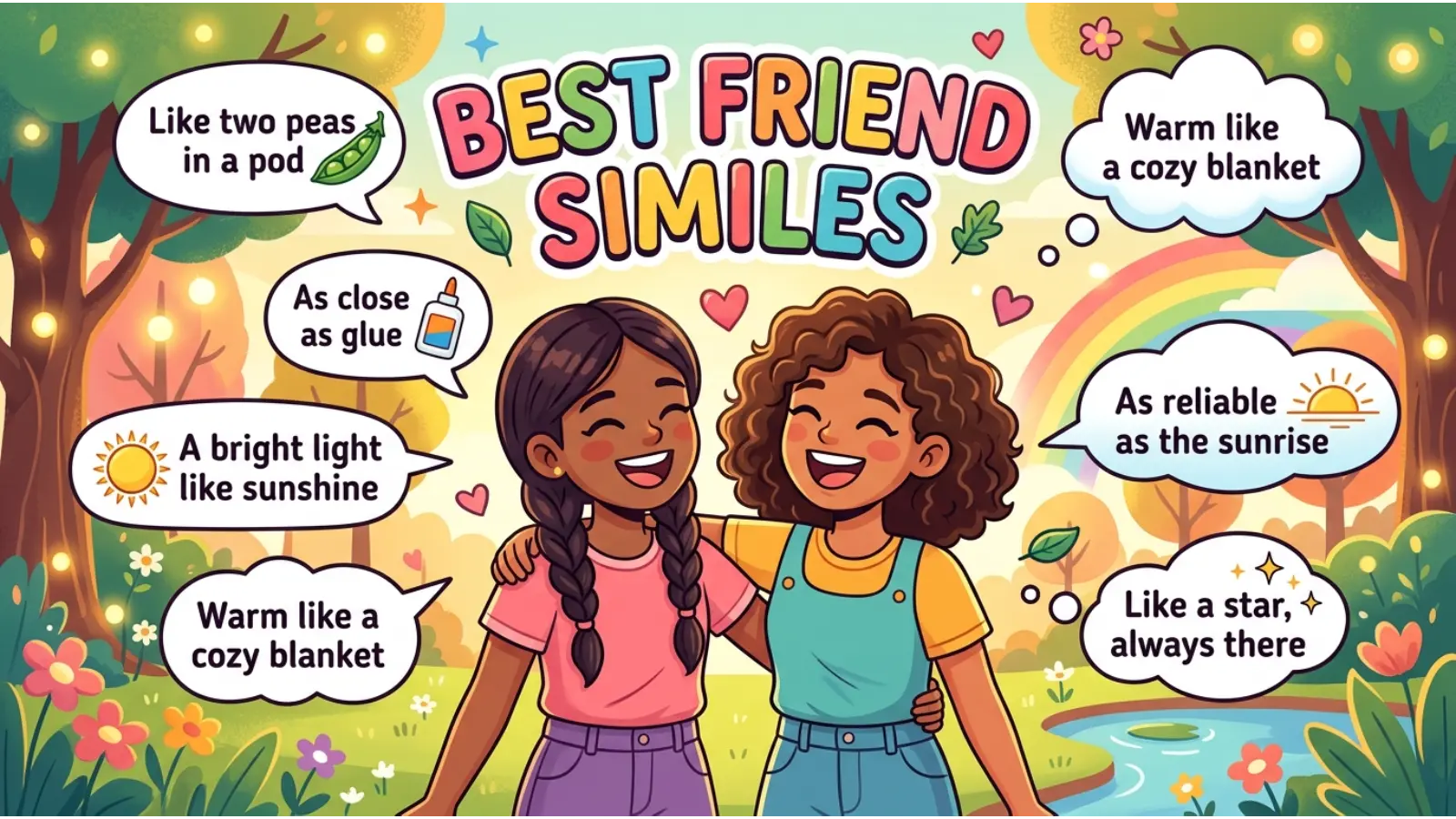
A Best Friend Similes compares two different things using words such as like or as. Best friend similes use this simple technique to make friendship feel more vivid, personal, and memorable.
Instead of saying, “My best friend is supportive,” you could write, “My Best Friend Similes is like a steady hand on a shaky bridge.” The second version creates an image that readers can feel.
You can use these comparisons in stories, poems, school assignments, speeches, social posts, cards, and everyday conversation. The best friend similes below focus on different sides of friendship, from trust and loyalty to humor, comfort, and shared memories.
Quick Answer: What Is a Good Simile for a Best Friend?
A good simile for a best friend compares friendship to something that communicates a specific quality. For example, “My best friend is like a lighthouse in a storm” suggests guidance, safety, and dependable support.
The strongest similes do more than say that someone is “great.” They show why the friendship matters.
Creative Best Friend Similes
1. My best friend is like a lighthouse in a storm.
Meaning: This describes a friend who provides guidance and reassurance during difficult moments.
Example:
When everything went wrong, my best friend was like a lighthouse in a storm.
Her advice helped me find my way through a confusing situation.
Emotional effect: Safe, comforting, and dependable.
Best context: Personal essays, stories, friendship poems, and heartfelt messages.
Writing tip: Use this comparison when the friendship involves support rather than simply fun.
2. My best friend is like a favorite song that never gets old.
Meaning: Their presence remains enjoyable no matter how much time passes.
Example:
Talking with him is like listening to a favorite song that never gets old.
Even after years of friendship, we can still make each other laugh.
Emotional effect: Warm, nostalgic, and joyful.
Best context: Friendship captions, creative writing, and personal reflections.
3. Our friendship is like a well-worn path through the woods.
Meaning: The relationship feels familiar because you have traveled through many experiences together.
Example:
Our friendship was like a well-worn path through the woods, shaped by years of shared adventures.
We rarely needed words to understand where the other person was going.
Writing tip: This works especially well for long-term friendships.
4. My best friend is as comforting as a blanket on a rainy afternoon.
Meaning: The friend makes you feel relaxed, protected, and at ease.
Example:
Her presence was as comforting as a blanket on a rainy afternoon.
Whenever I felt overwhelmed, sitting beside her made things seem manageable.
Emotional effect: Cozy and reassuring.
Best context: Personal narratives and emotional writing.
5. My best friend laughs like popcorn popping in a hot pan.
Meaning: Their laughter is sudden, energetic, and contagious.
Example:
My best friend’s laugh was like popcorn popping in a hot pan.
One burst of laughter usually made everyone else start smiling.
Writing tip: Notice how the comparison creates sound and movement rather than merely describing the laugh as “loud.”
6. Our secrets stay between us like letters locked in a wooden box.
Meaning: The friendship is built on privacy and trust.
Example:
Our secrets stayed between us like letters locked in a wooden box.
Neither of us worried that private conversations would become gossip.
Best context: Stories about loyalty and trust.
7. My best friend is like a spare key to my thoughts.
Meaning: This person understands you unusually well.
Example:
She was like a spare key to my thoughts; somehow, she knew when something was bothering me.
Emotional effect: Intimate and thoughtful.
Writing tip: This is stronger than simply writing “She understood me.”
8. Our friendship is like a patchwork quilt made from hundreds of little memories.
Meaning: A strong friendship develops through many small moments rather than one dramatic event.
Example:
Our friendship was like a patchwork quilt, stitched together from jokes, arguments, trips, and quiet conversations.
Best context: Reflective essays, memoir-style writing, and friendship poems.
9. My best friend is as reliable as the sunrise.
Meaning: The friend can be counted on consistently.
Example:
I knew he would show up because he was as reliable as the sunrise.
Emotional effect: Stable and reassuring.
Writing tip: This is useful when writing about dependability.
10. Our jokes bounce between us like a tennis ball.
Meaning: Both friends contribute quickly and naturally to their humor.
Example:
Our jokes bounced between us like a tennis ball, each one returning faster than the last.
Best context: Funny stories and casual descriptions.
11. My best friend is like a warm cup of tea after a long day.
Meaning: Their company brings calm after stress.
Example:
After the exhausting week, talking to my best friend was like a warm cup of tea after a long day.
Emotional effect: Peaceful and comforting.
12. Our friendship grew like ivy along an old wall.
Meaning: The relationship developed gradually and became deeply established.
Example:
Our friendship grew like ivy along an old wall, slowly covering more of our lives each year.
Best context: Long-term friendship stories.
13. My best friend is like a mirror that tells me the truth kindly.
Meaning: A true friend can be honest without being cruel.
Example:
She was like a mirror that told me the truth kindly, even when I did not want to hear it.
Writing purpose: This comparison highlights honest friendship rather than constant agreement.
14. Our laughter rises like birds startled from a tree.
Meaning: Your shared laughter can appear suddenly and spread through the moment.
Example:
Our laughter rose like birds startled from a tree when we remembered what had happened.
Best context: Poetry and descriptive storytelling.
15. My best friend is like a bookmark in the story of my life.
Meaning: The friend represents an important period or collection of memories.
Example:
My best friend is like a bookmark in the story of my life, marking some of my favorite chapters.
Emotional effect: Sentimental and reflective.
16. Our friendship is as sturdy as a bridge built from stone.
Meaning: The relationship can withstand pressure and difficult circumstances.
Example:
Even after our biggest disagreement, our friendship remained as sturdy as a bridge built from stone.
Best context: Writing about resilience.
17. My best friend is like sunlight through a window on a cold morning.
Meaning: Their presence brings warmth and brightness into an otherwise difficult moment.
Example:
Her cheerful message was like sunlight through a window on a cold morning.
Writing tip: Sensory details make emotional comparisons more memorable.
18. Our conversations move like a river after heavy rain.
Meaning: Conversation flows quickly and naturally.
Example:
Once we started talking, our conversation moved like a river after heavy rain.
Best context: Describing effortless communication.
19. My best friend is like a compass when I lose confidence.
Meaning: The friend helps you regain direction.
Example:
Whenever I doubted myself, my best friend was like a compass pointing me toward what mattered.
Emotional effect: Encouraging and hopeful.
20. Our memories sparkle like fireflies in a summer field.
Meaning: Shared memories feel small, bright, and precious.
Example:
Our childhood memories sparkle like fireflies in a summer field whenever we talk about them.
Best context: Poetry, memoirs, and nostalgic writing.
21. My best friend is like an open window in a stuffy room.
Meaning: Their presence makes life feel lighter and more refreshing.
Example:
Her honesty was like an open window in a stuffy room.
Writing tip: Physical sensations can communicate emotions without directly naming them.
22. Our friendship is like two bicycles traveling the same road.
Meaning: Both people move through life together while remaining individuals.
Example:
Our friendship was like two bicycles traveling the same road, sometimes side by side and sometimes taking different turns.
Emotional effect: Balanced and realistic.
23. My best friend is as cheerful as a room full of open windows.
Meaning: Their personality creates a bright, energetic atmosphere.
Example:
He was as cheerful as a room full of open windows, bringing fresh energy wherever he went.
Best context: Character descriptions.
24. Our friendship is like a notebook filled with unfinished stories.
Meaning: There are always more experiences and memories still to come.
Example:
Our friendship felt like a notebook filled with unfinished stories because every weekend gave us something new to remember.
Emotional effect: Hopeful and adventurous.
25. My best friend is like a quiet bench in a busy park.
Meaning: Being with this person gives you a peaceful place to slow down.
Example:
Talking with him was like sitting on a quiet bench in a busy park.
Best context: Calm, reflective writing.
26. Our teasing flies between us like paper airplanes.
Meaning: Friendly jokes move easily back and forth without becoming serious.
Example:
Our teasing flew between us like paper airplanes during lunch.
Emotional effect: Playful and lighthearted.
27. My best friend is like a flashlight in a forgotten drawer.
Meaning: Their help becomes especially valuable when you suddenly need it.
Example:
When I needed advice, she was like a flashlight in a forgotten drawer—unexpected but exactly what I needed.
Writing tip: Unexpected comparisons often feel fresher than familiar friendship clichés.
28. Our friendship is like a tree with roots beneath every season.
Meaning: The relationship continues through changing circumstances.
Example:
Our friendship was like a tree with roots beneath every season, surviving changes that once seemed enormous.
Best context: Essays about lasting friendships.
29. My best friend is like a window that lets me see myself more clearly.
Meaning: A close friend can help you understand your own personality and choices.
Example:
Her questions were like a window that helped me see myself more clearly.
Emotional effect: Thoughtful and introspective.
30. Our friendship is like a small campfire that keeps glowing after everyone else has gone home.
Meaning: A genuine friendship continues to provide warmth even when circumstances change.
Example:
Years apart had not erased our friendship; it was like a small campfire that kept glowing after everyone else had gone home.
Best context: Emotional endings, friendship essays, and reflective poetry.
How to Make Best Friend Similes More Vivid
A strong simile usually contains a meaningful connection between the two things being compared. Don’t choose an image simply because it sounds pretty.
Start by identifying the quality you want to show:
- Trust: a locked box, strong bridge, private letter
- Comfort: warm tea, a quiet room, soft light
- Loyalty: a lighthouse, compass, steady path
- Humor: bouncing balls, fireworks, playful birds
- Understanding: a key, mirror, open window
- Memories: photographs, quilts, fireflies, old notebooks
Then ask: What can the reader see, hear, touch, or imagine?
For example, “My friend is nice” gives the reader almost nothing to picture. “My friend is like sunlight through a window on a cold morning” creates warmth, brightness, and atmosphere.
How to Avoid Cliché Friendship Comparisons
Some comparisons have become so familiar that they may no longer create a strong image. Expressions involving unbreakable bonds, perfect matches, or constant sunshine can work in the right context, but they often feel predictable.
Try replacing a general comparison with a specific memory.
Instead of:
My best friend is like sunshine.
Try:
My best friend’s messages are like the first bright window in a dark hallway.
The second version gives the reader a scene and a reason for the comparison.
Why Specific Details Make Friendship Writing Stronger
The most memorable friendship descriptions often come from ordinary moments.
Think about:
- An inside joke
- A shared routine
- A difficult day
- A strange adventure
- A favorite place
- A conversation that changed your mind
- Something your friend always does
A simile built around one of these details will usually feel more personal than a generic comparison.
For example, instead of saying, “We have fun together,” you could write:
Our jokes bounced between us like tennis balls until even the quietest person at the table was laughing.
The comparison shows the energy of the friendship.
Best Friend Similes for Different Types of Writing
For a School Essay
Choose clear comparisons that communicate one quality.
Example:
“My best friend is like a compass because she helps me make better decisions when I feel uncertain.”
For a Story
Use a simile that fits the scene instead of stopping the story to explain it.
Example:
“His laugh burst through the quiet room like a match struck in the dark.”
For Poetry
You can make the comparison more sensory and emotional.
Example:
“Our memories glow like fireflies beneath the summer trees.”
For a Friendship Card
Keep the image simple and sincere.
Example:
“Your friendship is like a warm light I can always find.”
For Casual Conversation
A playful comparison can sound more natural.
Example:
“You’re like my personal emergency contact for bad ideas.”
Simile vs. Metaphor in Friendship Writing
A simile makes a comparison using words such as like or as.
“My best friend is like a compass.”
A metaphor makes the comparison directly.
“My best friend is my compass.”
Both can be effective. Similes often make the image feel more exploratory because they invite the reader to connect two separate things.
Other literary devices can also strengthen friendship writing. Imagery appeals to the senses, personification gives human qualities to nonhuman things, hyperbole exaggerates for effect, and alliteration repeats beginning sounds to create rhythm.
How to Create Your Own Best Friend Similes
Try this five-step method.
1. Choose one friendship quality
Pick something specific: patience, humor, honesty, loyalty, courage, or comfort.
2. Brainstorm physical images
For patience, you might think of a slow sunrise, a calm lake, or an old tree.
3. Find an unexpected connection
Don’t stop at the first idea. Ask what makes the image behave like the quality you’re describing.
4. Add a sensory detail
Make the reader see, hear, touch, smell, or feel something.
5. Test the sentence
Read it aloud. If the comparison sounds forced, simplify it or find a different image.
Try This Exercise
Complete these sentences with your own comparisons:
- My best friend is like __________ because __________.
- Our laughter sounds like __________.
- Our friendship has grown like __________.
- When I am worried, my best friend feels like __________.
- Our memories shine like __________.
Then write one sentence explaining why your comparison works. That extra step helps you move from a random comparison to a purposeful one.
Common Mistakes to Avoid
Overused Comparisons
A familiar simile isn’t automatically bad, but an original image usually gives your writing more personality.
Mixed Imagery
Avoid combining unrelated images in one comparison. If you begin with a sailing image, don’t suddenly switch to a forest metaphor without a reason.
Forced Similes
Not every sentence needs a comparison. If the simile makes the sentence less clear, remove it.
Confusing Similes With Metaphors
Remember the basic distinction: similes usually use like or as, while metaphors make a direct comparison.
Weak Descriptions
A vague comparison may not add anything.
Weak:
My best friend is like something nice.
Stronger:
My best friend is like a quiet bench in a crowded park.
The stronger version gives the reader an actual image and emotional atmosphere.
Frequently Asked Questions
What is a good simile for a best friend?
A strong example is “My best friend is like a lighthouse in a storm.” It suggests that the friend provides guidance, comfort, and stability during difficult moments.
What is a simile for a loyal friend?
You could write, “A loyal friend is like a bridge built from stone.” The image suggests strength and reliability.
How do you describe friendship with a simile?
Choose one quality of the friendship and compare it with something that naturally shares that quality. For example, comfort can be compared to warm tea, while trust can be compared to a locked box.
What are some funny best friend similes?
Try playful comparisons such as “Our jokes bounce between us like a tennis ball” or “Our teasing flies between us like paper airplanes.”
Can I use best friend similes in a school essay?
Yes. Similes can make personal narratives, descriptive essays, and creative writing more vivid. Choose comparisons that support the main idea rather than adding them just for decoration.
What makes a friendship simile effective?
A good friendship simile is clear, relevant, specific, and easy to visualize. The comparison should reveal something meaningful about the relationship.
Are similes and metaphors the same?
No. Both compare things, but a simile generally uses like or as, while a metaphor makes the comparison directly.
How can I make my friendship similes original?
Start with a real memory or specific personality trait. Then brainstorm unusual objects, places, sounds, or natural scenes that share that quality. Specific experiences usually lead to fresher comparisons.
Conclusion
The best friend similes are more than decorative phrases. They help writers turn abstract feelings—trust, comfort, loyalty, laughter, and shared history—into images readers can understand. When creating your own, focus on one quality at a time. Look beyond predictable comparisons and draw inspiration from real experiences. A familiar object, a small sound, or an ordinary moment can become a powerful image when the connection is specific. Most importantly, let the friendship guide the comparison. The best simile is not necessarily the most dramatic one; it is the one that makes the reader understand something true about the people involved.

I am Helena Frost, a writer captivated by the beauty of language and the art of comparison. Through my words, I explore the world by turning ordinary moments into vivid similes and reflections. I enjoy crafting phrases that spark imagination, evoke emotion, and linger in the mind. My writing celebrates the subtle connections between people, nature, and the stories we live. For me, every sentence is an opportunity to reveal the extraordinary in the everyday.