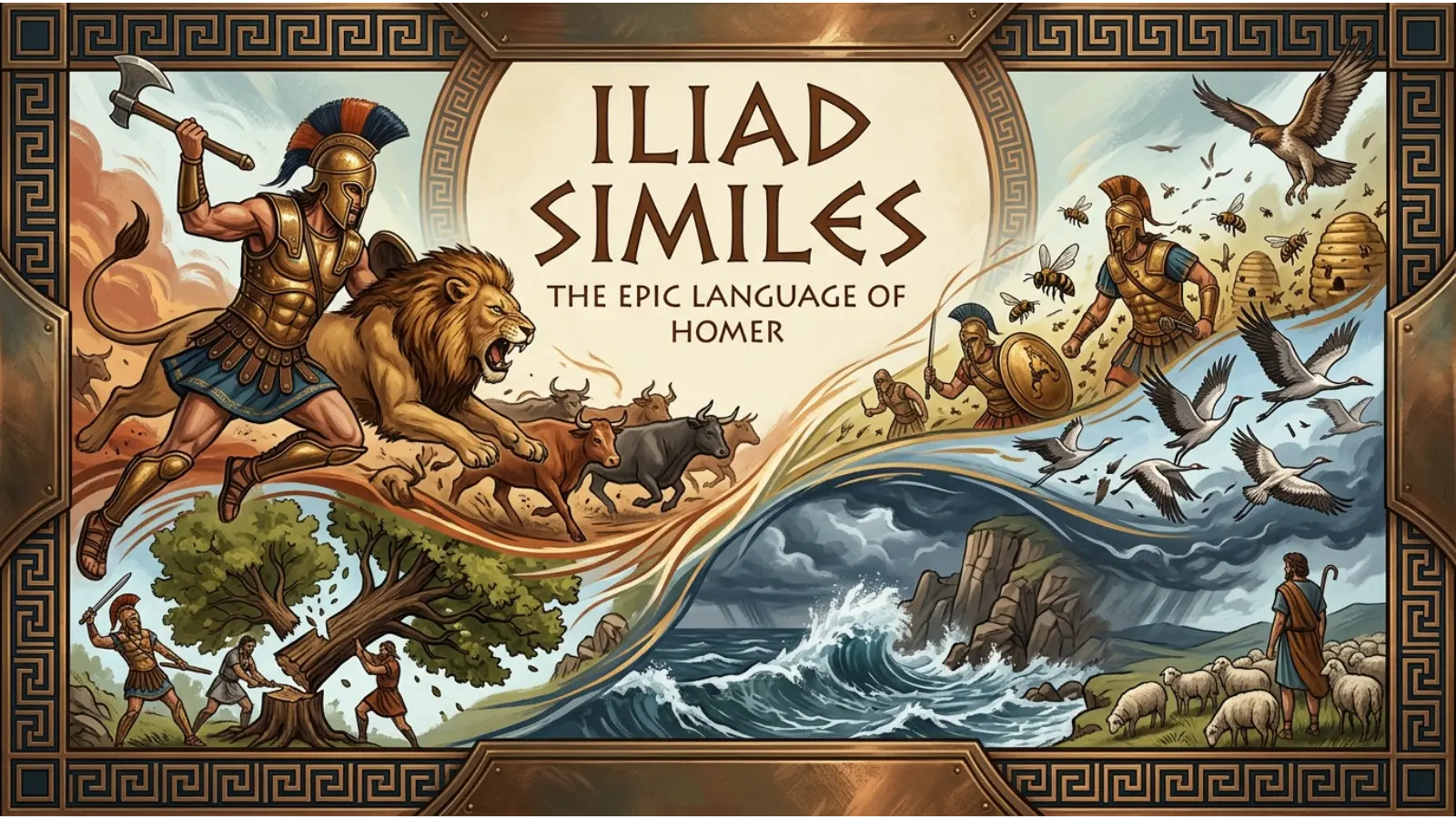
Iliad Similes traditionally attributed to the ancient Greek poet Homer, is famous for its vivid descriptions of warriors, battles, nature, animals, and human emotion. One Iliad Similes of its most distinctive literary features is the epic simile—an extended comparison that explains one scene by comparing it with something familiar and often drawn from everyday life or the natural world.
An Iliad simile can make a warrior seem as fierce as a wild animal, an army resemble a natural force, or a battlefield feel like a landscape transformed by weather. These comparisons slow the action for a moment and give readers a clearer, more memorable picture.
Iliad Similes matter because they do more than decorate writing. They help readers see, feel, and understand an idea. Studying Iliad similes can therefore teach modern writers how to build imagery, control pacing, develop emotion, and make descriptions more powerful.
Quick Answer: What Makes an Iliad Simile Different?
An Iliad simile is usually an extended comparison using “like” or “as” to make a person, action, object, or event easier to visualize. Homer often compares scenes of war to animals, storms, fire, farming, hunting, or ordinary human activities. Unlike a short comparison, an epic simile may continue for several lines and develop a complete image.
Why Homer Uses So Many Similes
The world of the Iliad Similes is filled with fast-moving action: warriors charge, armies collide, weapons fly, and fortunes change within moments. A simple description could communicate what happened, but a carefully developed simile can communicate what the event feels like.
For example, imagine writing:
The Iliad Similes soldiers advanced quickly.
That tells the reader what happened.
Now imagine:
The Iliad Similes soldiers advanced like a dark tide pushing across a narrow shore.
The second sentence creates movement, scale, and atmosphere. The comparison gives the reader something concrete to picture.
Homer’s similes often perform this same function on a much larger scale.
They Make Large Battles Understandable
Ancient battles could involve hundreds or thousands of people. Comparing an army to something familiar gives readers a visual framework for understanding its movement.
They Slow the Narrative at Important Moments
An epic simile can temporarily interrupt rapid action. That pause gives readers time to notice a warrior’s strength, a battlefield’s appearance, or the emotional significance of an event.
They Connect War With the Natural World
Homer frequently draws comparisons from storms, animals, fire, trees, waves, and agricultural life. This makes human conflict feel connected to forces larger than individual characters.
They Add Emotional Weight
A comparison can make an event seem frightening, beautiful, chaotic, relentless, or mournful without directly naming the emotion.
25 Original Simile Ideas Inspired by the Iliad
The following examples are original modern examples inspired by the techniques of epic simile. They are not quotations from Homer’s poem.
1. The Warrior Moved Like a Hawk Above a Crowded Field
The comparison suggests speed, control, and sharp attention.
Example:
The warrior moved like a hawk above a crowded field, watching every opening before striking.
Writing purpose: Use this structure when you want a character to appear alert and decisive.
2. The Army Rolled Forward Like a Black Storm
This comparison gives an advancing army enormous scale and momentum.
Example:
The army rolled forward like a black storm gathering over the hills.
Best context: Battle scenes, historical fiction, fantasy, and action writing.
3. His Anger Burned Like a Fire Fed by Dry Branches
The image suggests anger that becomes stronger instead of fading.
Example:
His anger burned like a fire fed by dry branches, growing hotter with every insult.
Writing tip: A comparison becomes stronger when the second image has its own internal action.
4. The Spears Shone Like Winter Reeds Beneath the Sun
This image focuses on the visual impression of many weapons gathered together.
Example:
Across the shield wall, the spears shone like winter reeds beneath a sudden sun.
Why it works: It transforms a military object into a natural image.
5. The Soldiers Swarmed Like Bees Around a Broken Hive
The comparison emphasizes frantic movement and disorder.
Example:
The soldiers swarmed like bees around a broken hive when the gates finally opened.
Best context: Chaotic scenes in which many characters move simultaneously.
6. The King Stood Like an Oak Against the Wind
The oak suggests strength, age, and endurance.
Example:
The king stood like an oak against the wind while the younger warriors hurried around him.
Writing lesson: Choose a comparison that adds character meaning, not merely physical similarity.
7. Their Cries Rose Like Birds Disturbed at Dawn
This comparison turns a noisy crowd into a recognizable natural scene.
Example:
Their cries rose like birds disturbed at dawn, filling the valley from ridge to ridge.
Emotional effect: Urgency and confusion.
8. The Chariots Rushed Like Stones Released From a Mountain
The image emphasizes unstoppable downward movement.
Example:
The chariots rushed like stones released from a mountain, scattering dust behind them.
Best context: Fast action.
9. The Shield Wall Closed Like a Door in a Narrow House
This comparison makes a military formation feel immediate and familiar.
Example:
The shield wall closed like a door in a narrow house, leaving no space for the enemy to enter.
Writing purpose: Useful when explaining complex movement through an ordinary image.
10. His Voice Cracked Like Ice Under a Heavy Foot
This comparison suggests tension and sudden danger.
Example:
His voice cracked like ice under a heavy foot when he heard the accusation.
Why it works: The physical sound creates an emotional impression.
11. The Battlefield Darkened Like a Field Beneath an Approaching Storm
The comparison establishes atmosphere before something important happens.
Example:
The battlefield darkened like a field beneath an approaching storm.
Best context: Foreshadowing.
12. The Messenger Ran Like a Deer Through Tall Grass
This emphasizes speed and evasiveness.
Example:
The messenger ran like a deer through tall grass, never looking back.
Writing tip: Add a detail that explains why the comparison fits.
13. The Warriors Gathered Like Wolves Around a Winter Kill
The image creates tension and predatory energy.
Example:
The warriors gathered like wolves around a winter kill, waiting for someone to make the first move.
Best context: Suspenseful confrontations.
14. The Dust Rose Like Smoke From a Distant Fire
This is useful when describing movement across dry ground.
Example:
Dust rose like smoke from a distant fire as the horses crossed the plain.
Writing purpose: Add atmosphere without simply saying “the road was dusty.”
15. Her Grief Spread Like Rain Across a Harvest Field
The comparison gives grief a sense of gradual, unavoidable expansion.
Example:
Her grief spread like rain across a harvest field, touching every thought she tried to escape.
Emotional effect: Sadness and inevitability.
16. The Crowd Surged Like Water Through a Broken Gate
This emphasizes uncontrolled movement.
Example:
The crowd surged like water through a broken gate when the news reached the city.
Best context: Crowds, celebrations, riots, evacuations, or dramatic entrances.
17. His Courage Flickered Like a Lamp in a Strong Wind
Unlike a comparison that simply says someone is brave, this one shows courage under pressure.
Example:
His courage flickered like a lamp in a strong wind, but he refused to step backward.
Writing lesson: Comparisons can reveal change rather than describe a fixed quality.
18. The Horses Thundered Like Rain on a Wooden Roof
This focuses on sound rather than appearance.
Example:
The horses thundered like rain on a wooden roof as they crossed the bridge.
Writing tip: Strong similes do not have to be visual. Sound, touch, smell, and movement can also create imagery.
19. The Silence Fell Like Snow Over the Valley
This comparison creates a quiet, almost physical atmosphere.
Example:
After the messenger finished speaking, silence fell like snow over the valley.
Best context: Dramatic pauses and emotional revelations.
20. The Old Warrior Remembered the Battle Like a Scar Remembers a Wound
This comparison connects memory with something lasting.
Example:
The old warrior remembered the battle like a scar remembers a wound.
Why it works: It gives an abstract idea—memory—a concrete physical association.
21. The Fire Leaped Like a Red Animal Across the Roof
The comparison makes the fire seem alive and unpredictable.
Example:
The fire leaped like a red animal across the roof, chasing the dry wood beneath it.
Writing purpose: Person-like comparisons can increase danger and movement.
22. The Dawn Spread Like Gold Across the Armor
This changes a simple sunrise into a visual scene connected to the warriors.
Example:
Dawn spread like gold across the armor as the soldiers prepared to march.
Best context: Transitions between night and day.
23. The Defenders Held Their Ground Like Roots Beneath an Ancient Tree
The image communicates stability.
Example:
The defenders held their ground like roots beneath an ancient tree while the attackers pressed forward.
Writing lesson: Compare an action with something that embodies the quality you want to emphasize.
24. His Fear Followed Him Like a Shadow at Noon
This suggests fear that remains close even when it is difficult to see.
Example:
His fear followed him like a shadow at noon, quiet but impossible to escape.
Best context: Internal conflict.
25. The Battlefield Stretched Like a Scar Across the Plain
The comparison makes the battlefield feel like a permanent mark on the landscape.
Example:
The battlefield stretched like a scar across the plain beneath the fading evening light.
Emotional effect: Loss, destruction, and remembrance.
What These Similes Teach Modern Writers
The strongest lesson from epic similes is not simply “compare one thing to another.” The deeper lesson is choose a comparison that reveals something.
Consider this:
The warrior was fast like a car.
The comparison communicates speed, but it feels ordinary and disconnected from a warrior’s world.
A more carefully chosen comparison might be:
The warrior crossed the field like a falcon dropping toward its prey.
Now speed is joined with purpose, direction, and danger.
A Good Simile Adds Information
Ask yourself:
What does the comparison tell the reader that the original description does not?
If the answer is “nothing,” the simile may not be necessary.
A Good Simile Fits the Scene
A medieval warrior, a modern athlete, and a child in a classroom should not necessarily use the same imagery. The comparison should feel natural within the world of the writing.
A Good Simile Has a Clear Point of Similarity
The reader should quickly understand why two things are being connected.
Epic Simile vs. Ordinary Simile
A regular simile can be very short:
The runner was fast like a deer.
An epic simile can develop the comparison:
The runner crossed the open field like a deer startled from the forest, leaping over stones and turning only when the sound behind him grew closer.
The second version creates a miniature scene.
It gives the reader movement, setting, tension, and emotion.
That is why epic similes are especially valuable to study if you want to improve narrative writing.
How to Write Your Own Iliad-Inspired Similes
You do not need to copy ancient language to learn from Homer. Instead, borrow the underlying technique.
Step 1: Choose the Main Action
Start with something happening.
Examples:
- a warrior charging
- a crowd moving
- someone becoming angry
- a storm approaching
- a character grieving
Step 2: Identify the Quality
Ask what you want the reader to notice.
Is the action:
- fast?
- violent?
- graceful?
- frightening?
- persistent?
- chaotic?
- silent?
- powerful?
Step 3: Find a Strong Image
Look outside the immediate scene.
Nature is especially useful:
- birds
- wolves
- trees
- rivers
- storms
- fire
- waves
- insects
- mountains
But ordinary life can work just as well.
Step 4: Extend the Comparison
Instead of stopping after “like a wolf,” ask:
What does the wolf do?
It watches. A circles. It waits. It moves carefully.
That gives you more material for an extended simile.
Step 5: Connect the Image Back to the Story
Do not let the comparison wander so far that readers forget the original action.
A Simple Formula for Building an Epic Simile
Try this pattern:
Main action + like/as + familiar image + one or two matching details + return to the original scene
For example:
The soldiers advanced like waves climbing a rocky shore, breaking apart around obstacles but gathering again, until the whole army reached the gates.
The comparison works because both armies and waves can move forward in large, repeated masses.
How to Avoid Cliché Similes
Common comparisons can be useful, but overused ones often make writing feel predictable.
Instead of automatically writing:
Her eyes were like stars.
Ask what makes her eyes interesting in the particular scene.
You might write:
Her eyes caught the lantern light like two small windows opening in a dark room.
The new image is more specific because it belongs to a particular setting.
Use Specific Details
Weak:
The warrior was strong like an animal.
Stronger:
The warrior lifted the gate beam like a farmer raising a fallen branch from a path.
The second comparison gives the reader a more concrete picture.
Avoid Random Beauty
A simile does not need to be beautiful. Sometimes an ugly, strange, or unsettling comparison is much more effective.
The goal is not to make every sentence poetic.
The goal is to make the right sentence memorable.
Common Mistakes When Writing Similes
Using a Comparison That Adds Nothing
If you can remove the simile without losing meaning, reconsider it.
Mixing Two Images
Avoid beginning with one comparison and suddenly switching to another.
For example, do not start with a storm and end by describing the same character as a wolf unless the transition is intentional.
Making the Comparison Too Long
Epic similes can be extended, but extension should create meaning. Extra words should not simply delay the sentence.
Choosing a Weak Point of Similarity
A comparison should have a recognizable connection.
Using Too Many Similes
If every sentence contains a comparison, none of them feels special. Give important images room to stand out.
Iliad Similes and Other Literary Devices
Simile and Metaphor
A simile usually makes the comparison explicit:
The warrior moved like a hawk.
A metaphor makes the comparison directly:
The warrior was a hawk above the battlefield.
Both can create strong imagery, but they produce slightly different effects.
Simile and Personification
Personification gives human qualities to something nonhuman:
The wind whispered through the trees.
A simile compares one thing with another:
The wind moved like a whisper through the trees.
Simile and Hyperbole
Hyperbole deliberately exaggerates:
His shout could shake the mountains.
A simile compares:
His shout rolled through the valley like thunder.
The devices can also work together.
Why Nature Works So Well in Epic Similes
Nature offers movement, scale, and recognizable patterns.
A storm can represent force.
A bird can represent speed.
A tree can represent endurance.
Fire can represent anger or destruction.
Water can represent movement or overwhelming numbers.
Writers can use these associations, but they should avoid treating them as fixed rules. Context changes meaning.
For example, fire might symbolize anger in one scene and warmth or hope in another.
The surrounding story determines the emotional meaning.
Creative Exercises for Writing Better Similes
Exercise 1: Replace a Plain Sentence
Start with:
The crowd became noisy.
Write three versions using different images:
- one from nature
- one from everyday life
- one from an animal
Exercise 2: Stretch a Short Simile
Begin:
The runner moved like a deer.
Now add two details explaining what the deer is doing.
Exercise 3: Use an Unexpected Image
Describe anger without using:
- fire
- heat
- explosions
This forces you to search for fresher imagery.
Exercise 4: Write From Sound
Create a simile for:
- marching feet
- rain
- shouting
- a closing door
Do not describe what the sound looks like. Describe what it resembles acoustically.
Exercise 5: Build Your Own Epic Simile
Choose:
- An action
- An emotion
- A natural image
- A matching movement
Then combine them into a two-sentence comparison.
How to Make Similes More Memorable
The best comparisons often contain specificity.
Compare:
The army moved like water.
with:
The army poured through the narrow gate like spring water escaping a broken dam.
The second image gives us direction, pressure, setting, and movement.
When revising your own similes, ask:
- Can I make the image more specific?
- Does the comparison match the emotion?
- Does it belong in this setting?
- Does it reveal something about the character?
- Can I remove unnecessary words?
- Would a less predictable image be stronger?
These questions can turn an ordinary comparison into a memorable one.
Frequently Asked Questions About Iliad Similes
What is an Iliad simile?
An Iliad simile is a comparison, often extended, that uses language such as “like” or “as” to make a character, action, object, or event vivid. Homer frequently connects scenes of war with animals, weather, nature, fire, farming, and everyday life.
Why are similes important in the Iliad?
They make complicated scenes easier to visualize, add emotional depth, slow important moments, and connect human actions with familiar experiences in nature and daily life.
What is an epic simile?
An epic simile is a developed comparison that can extend beyond a single phrase or sentence. Instead of simply identifying a similarity, it may create a small scene with its own movement, details, and atmosphere.
Are all Iliad similes about war?
No. Although warfare dominates much of the poem, the comparisons draw from many parts of life, including animals, farming, weather, landscapes, household activities, and nature.
How is an Iliad simile different from a normal simile?
A normal simile can be very brief. An Iliad-style epic simile often develops the comparison over several details, allowing the reader to experience a small secondary scene before returning to the main action.
Can modern writers use epic similes?
Absolutely. Writers can use the technique in novels, short stories, poetry, journalism, fantasy, screenwriting, and other forms of creative writing. The key is to create original comparisons that suit the subject.
What makes an epic simile effective?
An effective epic simile has a clear connection between the two images, adds meaningful information, fits the tone, and gives readers a fresh way to understand the main subject.
Conclusion
Studying Iliad similes is really an exercise in learning how powerful description works. Homer’s comparisons show that a writer does not have to describe everything directly. A warrior can become more than a warrior when placed beside a hawk, a storm, a tree, or another vivid image. An army can become easier to understand when its movement resembles something familiar. A character’s emotion can become tangible when it is connected to an image readers can see or feel. The most useful lesson is simple: do not compare things merely because they are similar. Compare them because the connection reveals something important. When writing your next story, poem, or description, pause before choosing the first comparison that comes to mind. Look for a sharper image, a more specific detail, or an unexpected connection. That small change can turn an ordinary sentence into one readers remember.
I am Helena Frost, a writer captivated by the beauty of language and the art of comparison. Through my words, I explore the world by turning ordinary moments into vivid similes and reflections. I enjoy crafting phrases that spark imagination, evoke emotion, and linger in the mind. My writing celebrates the subtle connections between people, nature, and the stories we live. For me, every sentence is an opportunity to reveal the extraordinary in the everyday.