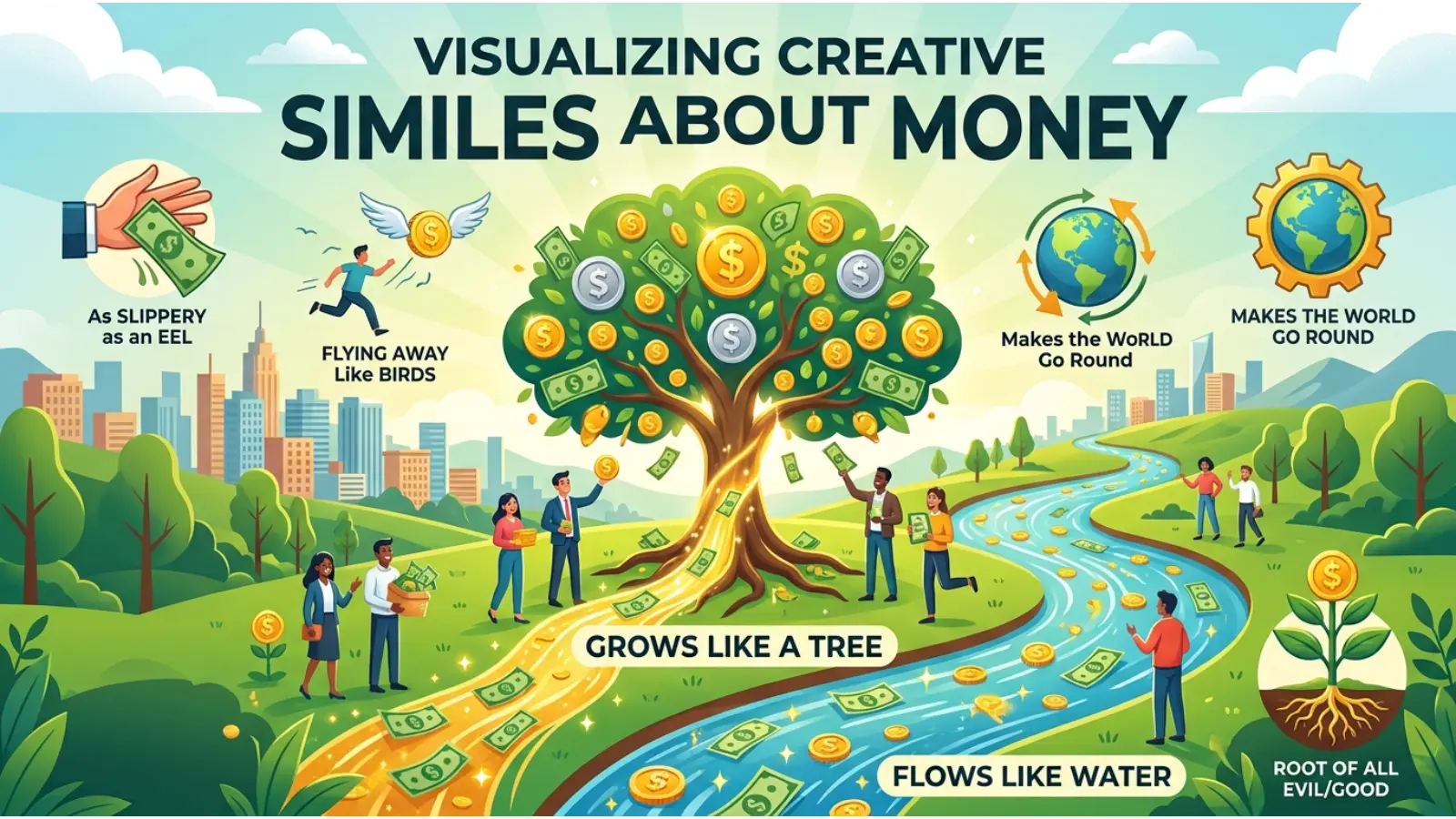
similes about money can be difficult to describe because it is both tangible and emotional. We count it, save it, spend it, worry about it, and sometimes let it influence our choices. A good simile can turn those ordinary ideas into memorable images.
Similes about money compare money, wealth, spending, saving, or financial situations with something familiar, usually using “like” or “as.” Instead of simply saying that someone has very little money, for example, a writer can create an image that makes the situation easier to picture.
This guide offers original money similes for creative writing, conversations, poetry, storytelling, essays, and character descriptions. More importantly, it shows how to build your own comparisons without relying on tired expressions.
What Is a Simile About Money?
A money simile is a comparison that connects money or a financial situation to another image.
For example:
“His savings grew like a garden watered every morning.”
The comparison suggests steady, patient growth. It does more than say that his savings increased; it gives the reader a picture of how that growth happened.
Money-related similes can describe:
- Wealth
- Poverty
- Saving
- Spending
- Debt
- Financial stress
- Generosity
- Greed
- Sudden wealth
- Financial security
- The value people place on money
Quick Answer: What Are Some Good Similes About Money?
Here are a few original examples:
- Money slipped through his fingers like rain through an open hand.
- Her savings grew like a quiet garden behind a locked gate.
- The unexpected bill hit his budget like a stone dropped into still water.
- Their wealth glittered like sunlight on a polished window.
- Debt followed him like a shadow that lengthened at sunset.
- His spending habits were like a leaking faucet left running overnight.
- The small investment grew like a seed finding room between stones.
- She guarded every dollar like a candle in a strong wind.
The strongest comparison depends on the emotion and situation you want the reader to feel.
30 Creative Similes About Money
1. Money Slipped Away Like Rain Through an Open Hand
Meaning: Money disappeared quickly despite an attempt to hold onto it.
Example:
Money slipped away like rain through an open hand before Marcus realized how much he had spent.
Writing purpose: This works well for stories about careless spending or financial regret.
Emotional effect: It creates a feeling of helplessness and loss.
Tip: Use natural physical movement when describing money disappearing. Movement often makes an abstract financial idea easier to visualize.
2. Her Savings Grew Like a Quiet Garden
Meaning: Her savings increased gradually through patience and consistency.
Example:
Her savings grew like a quiet garden, slowly becoming something valuable.
The account balance rose like new leaves appearing after spring rain.
Best context: Essays, personal-finance stories, and encouraging writing.
Why it works: A garden suggests patience rather than instant results, making it useful when the point is steady progress.
3. His Wallet Was as Empty as a Deserted Station
Meaning: He had almost no money left.
Example:
By Friday evening, his wallet was as empty as a deserted station.
He checked it again, hoping he had somehow missed a forgotten bill.
Emotional effect: The comparison adds loneliness and disappointment.
Writing tip: Avoid simply using “empty as a ___.” Choose a place or object that adds an emotion to the emptiness.
4. The Bill Landed Like a Stone in Still Water
Meaning: An unexpected bill caused a noticeable disturbance.
Example:
The repair bill landed like a stone in still water and disrupted their carefully planned budget.
Best context: Fiction, personal essays, and financial storytelling.
Why it works: The ripples from a stone provide a natural image for consequences spreading beyond the original expense.
5. His Spending Was Like a Faucet Left Running
Meaning: He spent money continuously without paying enough attention.
Example:
His spending was like a faucet left running; small purchases slowly drained his account.
Writing purpose: Useful for explaining how repeated minor expenses can become significant.
Tip: This comparison is especially effective when you follow it with a concrete example.
6. Debt Followed Him Like a Long Shadow
Meaning: Debt remained a constant presence in his life.
Example:
Debt followed him like a long shadow, even during the happiest parts of his week.
Emotional effect: The image suggests pressure that is difficult to escape.
Best context: Character development and serious storytelling.
7. Her Emergency Fund Was Like a Lantern in a Storm
Meaning: Her savings provided security during difficult circumstances.
Example:
Her emergency fund was like a lantern in a storm when an unexpected expense appeared.
Why it works: The lantern represents guidance and reassurance rather than wealth itself.
Writing tip: When describing financial security, compare money to something that provides protection or stability.
8. The Coins Rang Like Tiny Bells of Opportunity
Meaning: Even a small amount of money represented possibility.
Example:
The coins rang like tiny bells of opportunity in the child’s collection jar.
Best context: Children’s stories, poetry, and optimistic narratives.
Emotional effect: It creates a hopeful and playful mood.
9. His Fortune Rose Like a Balloon Caught by Warm Air
Meaning: His wealth increased rapidly.
Example:
His fortune rose like a balloon caught by warm air after the business became successful.
Writing purpose: Useful for describing sudden financial growth.
Tip: Use this type of comparison when you want to emphasize speed and upward movement.
10. Her Budget Was as Tight as a Button on a New Coat
Meaning: She had very little room for additional spending.
Example:
After paying the essential bills, her budget was as tight as a button on a new coat.
Best context: Conversational writing and light financial storytelling.
Why it works: The physical tightness creates an immediate picture of limited flexibility.
11. His Wealth Shimmered Like Sunlight on Glass
Meaning: His wealth was noticeable and impressive.
Example:
His wealth shimmered like sunlight on glass, visible from nearly every corner of the city.
Emotional effect: Depending on context, it can suggest admiration, glamour, or superficiality.
Writing tip: A beautiful image can become more interesting when the surrounding sentence reveals a contrasting emotion.
12. Her Money Was Guarded Like a Candle in the Wind
Meaning: She protected her money carefully because losing it would be difficult.
Example:
She guarded her money like a candle in the wind, refusing to waste even a small amount.
Best context: Character descriptions.
Why it works: The candle suggests something valuable and vulnerable at the same time.
13. The Investment Grew Like a Seed Between Stones
Meaning: Something financially successful developed despite difficult conditions.
Example:
The small investment grew like a seed between stones, surviving conditions that seemed impossible.
Emotional effect: The comparison creates resilience and hope.
Best context: Stories about perseverance and long-term growth.
14. His Payday Felt Like Sunrise After a Long Night
Meaning: Receiving money brought relief after a difficult period.
Example:
Payday felt like sunrise after a long night, bringing relief to his exhausted household.
Why it works: Sunrise naturally represents a change from difficulty toward relief.
Writing tip: This is stronger when the surrounding context establishes the “long night” before the comparison appears.
15. Her Expenses Multiplied Like Leaves in a Strong Wind
Meaning: Her expenses seemed to increase rapidly and uncontrollably.
Example:
Her expenses multiplied like leaves in a strong wind once the new semester began.
Best context: Student stories, family narratives, and humorous writing.
Emotional effect: It gives the situation energy and a sense of being difficult to control.
16. His Savings Were as Steady as a Clock
Meaning: He saved money consistently.
Example:
His savings were as steady as a clock, with a little added to the account every month.
Writing purpose: This works well when reliability matters more than dramatic growth.
Tip: Comparisons involving clocks, seasons, or daily routines can communicate consistency effectively.
17. The Luxury Car Was a Shiny Magnet for Money
Meaning: Owning or maintaining the expensive car attracted more expenses.
Example:
The luxury car was a shiny magnet for money, demanding attention every time something needed repair.
Emotional effect: This creates a slightly humorous view of expensive possessions.
Best context: Humor, essays, and character descriptions.
18. His Financial Plan Was Like a Map Through Fog
Meaning: A financial plan gave him direction even when the future was uncertain.
Example:
His financial plan was like a map through fog; it did not remove uncertainty, but it gave him a direction.
Why it works: The comparison recognizes that planning cannot predict everything.
Writing tip: Good similes do not need to exaggerate. Sometimes the most effective comparison simply clarifies an abstract idea.
19. Generosity Flowed From Her Like a Spring
Meaning: She gave freely and naturally.
Example:
Generosity flowed from her like a spring, refreshing everyone around her.
Best context: Character descriptions, inspirational writing, and poetry.
Emotional effect: It presents generosity as natural rather than forced.
20. His Greed Spread Like Ink in Water
Meaning: His desire for more money gradually affected everything around him.
Example:
His greed spread like ink in water until it colored every decision he made.
Why it works: Ink spreading provides a strong visual for something becoming increasingly difficult to contain.
Best context: Fiction and moral storytelling.
21. The Discount Disappeared Like Footprints in Fresh Snow
Meaning: A financial opportunity vanished quickly.
Example:
The discount disappeared like footprints in fresh snow before she could complete the purchase.
Emotional effect: It creates urgency without simply saying “the discount ended quickly.”
Writing tip: For temporary opportunities, choose imagery that naturally suggests disappearance.
22. His Budget Bent Like a Branch Under Heavy Snow
Meaning: His financial plan was under significant pressure.
Example:
His budget bent like a branch under heavy snow after several unexpected expenses arrived.
Best context: Serious storytelling and essays.
Why it works: The image suggests pressure without necessarily implying complete failure.
23. The Prize Money Sparkled Like a Door Opening
Meaning: The money represented a new opportunity rather than merely cash.
Example:
The prize money sparkled like a door opening onto possibilities he had never considered.
Emotional effect: Hopeful and optimistic.
Best context: Stories about achievement and opportunity.
24. Her Financial Worries Buzzed Like Mosquitoes at Night
Meaning: Small but persistent money worries repeatedly disturbed her peace.
Example:
Her financial worries buzzed like mosquitoes at night, keeping her thoughts restless.
Why it works: The sound and irritation of mosquitoes communicate persistent annoyance.
Best context: Character-driven fiction.
25. His Money Burned Like Dry Leaves in a Fire
Meaning: He spent money extremely quickly.
Example:
His money burned like dry leaves in a fire whenever he entered the shopping district.
Emotional effect: The image feels fast, wasteful, and difficult to stop.
Writing tip: Strong verbs such as “burned” can make a financial comparison more energetic.
26. Their New Business Was Like a Small Boat Finding Open Water
Meaning: The business was beginning to find opportunities after a difficult start.
Example:
Their new business was like a small boat finding open water after months of struggle.
Best context: Entrepreneurship stories and motivational writing.
Why it works: The boat suggests movement, uncertainty, and possibility at the same time.
27. His Savings Account Was a Snowball Gathering Weight
Meaning: His savings were increasing gradually, with growth becoming more noticeable over time.
Example:
His savings account was like a snowball gathering weight as he continued adding small amounts.
Writing purpose: Useful for explaining cumulative progress.
Tip: This comparison works best when the text emphasizes repeated small contributions.
28. The Unexpected Expense Was Like a Crack in a Dam
Meaning: One financial problem threatened to create several additional problems.
Example:
The unexpected expense was like a crack in a dam, forcing the family to reconsider several other plans.
Best context: Serious financial narratives.
Emotional effect: It creates tension and suggests that consequences may spread.
29. Her Wealth Was as Quiet as a Library
Meaning: She was financially comfortable but did not display her wealth.
Example:
Her wealth was as quiet as a library; nothing about her appearance revealed how successful she had become.
Why it works: The comparison challenges the assumption that wealth must be loud or visible.
Best context: Character descriptions and social commentary.
30. His Financial Future Looked Like a Road After Rain
Meaning: His future had become clearer or more hopeful after a difficult period.
Example:
His financial future looked like a road after rain, still marked by puddles but finally visible ahead.
Emotional effect: It combines recovery with realism.
Writing tip: A nuanced simile can acknowledge both progress and remaining difficulties.
How to Choose the Right Money Simile
Not every money comparison should communicate wealth. Money can represent security, freedom, pressure, temptation, responsibility, or opportunity.
Before choosing a simile, ask what the money means in the scene.
If money is disappearing, use imagery involving movement, leakage, wind, fire, or melting.
If money is growing, consider seeds, gardens, rivers, or gradual natural processes.
A money represents security, compare it with shelter, light, anchors, maps, or protective objects.
If money creates stress, imagery involving weight, shadows, noise, storms, or pressure can work well.
The comparison should reinforce the emotion rather than merely decorate the sentence.
How to Make Money Similes More Vivid
A weak comparison tells the reader what to imagine. A strong comparison gives the reader a specific image.
Compare:
His money disappeared like water.
with:
His weekend budget disappeared like rainwater running beneath a loose door.
The second version is more specific. It gives the reader a direction, setting, and sense of loss.
A useful formula is:
Subject + action + like/as + specific image + emotional connection
For example:
Her savings grew like ivy along a brick wall, slowly covering more ground each month.
The image of ivy communicates gradual expansion without directly explaining it.
Use Unexpected but Believable Comparisons
Originality does not mean choosing a completely random object.
A useful comparison should share at least one meaningful quality with the subject.
Money can be:
- Fast or slow
- Heavy or light
- Visible or hidden
- Stable or unpredictable
- Helpful or dangerous
- Temporary or lasting
- Scarce or abundant
Start with the quality you want to communicate, then find an image that naturally represents it.
Similes for Different Money Situations
When Money Is Scarce
Try imagery that communicates emptiness, limitation, or vulnerability.
His wallet felt as empty as a room after everyone had gone home.
This creates more emotion than simply saying, “He had no money.”
When Money Is Abundant
Abundance can be described through images of overflowing spaces, wide landscapes, or abundant natural resources.
Her opportunities seemed as wide as a field after the gates were opened.
Notice that the comparison does not need to mention money directly. The surrounding sentence can establish the financial meaning.
When Someone Spends Too Much
Movement is useful here.
His paycheck vanished like a train leaving before he reached the platform.
The reader immediately understands that the opportunity was brief.
When Someone Saves Carefully
Use imagery connected to protection and patience.
She treated every saved dollar like a brick in a wall she was building for the future.
This also gives the reader a sense of purpose.
Simile vs. Metaphor When Writing About Money
A simile makes a comparison using words such as like or as.
His savings grew like a garden.
A metaphor makes the comparison directly.
His savings were a garden.
Both devices can create imagery, but they have different effects.
Similes often feel more explanatory and conversational. Metaphors can feel stronger or more direct.
When teaching a reader how to understand a complicated financial idea, a simile may make the concept easier to picture. In poetry or literary fiction, a metaphor may create a more immersive image.
Other Literary Devices That Work With Money Similes
Imagery
Imagery appeals to the senses.
Coins clicked like tiny stones inside the metal box.
The sound makes the financial scene more concrete.
Hyperbole
Hyperbole deliberately exaggerates something.
He spent money so quickly it seemed like every store in town knew his name.
The statement is not meant literally. It adds humor and emphasis.
Personification
Personification gives human qualities to nonhuman things.
The unpaid bills waited impatiently on the kitchen table.
This can make financial pressure feel more immediate.
Symbolism
Money can symbolize freedom, power, insecurity, status, or temptation depending on the story.
A writer can therefore use a financial object as more than a literal object. A worn wallet might symbolize hardship, while a locked savings box might symbolize security or fear.
How to Create Your Own Similes About Money
You do not need to memorize dozens of comparisons. Learning how to build one yourself is more useful.
Step 1: Identify the financial situation
Ask what is happening.
Is money:
- Growing?
- Disappearing?
- Being protected?
- Causing stress?
- Creating an opportunity?
- Being wasted?
- Being shared?
Step 2: Choose the main quality
Decide what you want the reader to notice.
For example:
Money is disappearing quickly.
The key quality is speed.
Step 3: Brainstorm physical images
Think about things that move quickly:
- Wind
- Smoke
- Running water
- A departing train
- Falling leaves
- Melting ice
Step 4: Connect the image to the emotion
Suppose your character regrets spending too much.
Instead of:
His money disappeared like water.
Try something more emotionally specific:
His money disappeared like water rushing through a broken pipe.
Step 5: Remove unnecessary words
A good simile does not need a long explanation afterward.
Let the image do some of the work.
A Simple Exercise for Writers
Choose one sentence:
“I was worried about money.”
Now identify the emotion: worry.
Brainstorm images associated with persistent worry:
- A buzzing sound
- A heavy backpack
- A dark cloud
- A ticking clock
- A loose thread
Then create several possibilities:
Money worries followed me like a ticking clock.
Money worries hung over me like a cloud that refused to move.
Money worries felt like a loose thread I could never stop pulling.
Now choose the version that best matches the mood of your story.
This exercise teaches an important writing principle: the best simile is not necessarily the prettiest one; it is the one that fits the scene.
Common Mistakes When Writing Money Similes
Using the Same Comparison Everyone Knows
Expressions involving money and water, gold, or overflowing treasure can become predictable if used without a fresh angle.
A familiar image is not automatically bad, but an original detail can make it more memorable.
Mixing Two Different Images
Avoid sentences such as:
His money was a leaking boat that burned like a forest.
The images compete instead of supporting one another.
Choose one central picture.
Making the Comparison Too Complicated
A simile should clarify or intensify an idea.
If readers have to decode the comparison before understanding the sentence, it may need simplification.
Using a Simile Without a Purpose
Do not add a comparison simply because the paragraph needs more figurative language.
Ask:
What does this simile add?
If the answer is nothing, remove it.
Confusing Simile With Metaphor
Remember:
Simile: Her savings grew like a garden.
Metaphor: Her savings were a garden.
The comparison is similar, but the grammatical construction is different.
How Professional Writers Make Financial Imagery Memorable
Strong writers usually begin with the emotional truth of a scene rather than searching randomly for a clever comparison.
Imagine a character receiving an unexpected bill.
The basic sentence is:
The bill worried him.
A more vivid sentence might be:
The bill landed like a stone in still water.
Now the reader can imagine the disturbance.
But you can go one step further by connecting the image to the character:
The bill landed like a stone in still water, sending his carefully balanced plans outward in every direction.
The second sentence does more than decorate the prose. It connects the image to the character’s situation.
That is the real value of a strong simile.
Frequently Asked Questions
What is a good simile for money?
A useful money simile depends on the situation. For example, “Money slipped away like rain through an open hand” works well for describing money that disappears quickly.
What is a simile for having lots of money?
You might describe wealth as “shimmering like sunlight on glass” when you want to emphasize visibility, glamour, or status. For a quieter form of wealth, a different image may work better.
What is a simile for saving money?
A comparison such as “Her savings grew like a quiet garden” can suggest patience, consistency, and gradual progress.
What is a simile for spending money?
Try an image that suggests movement or disappearance. “His money burned like dry leaves in a fire” emphasizes extremely fast spending.
What is a simile for being poor?
Instead of focusing only on the word “poor,” describe the experience. For example, “His wallet was as empty as a deserted station” creates an image of emptiness and isolation.
How do you write a unique simile about money?
Start with the quality you want to describe—such as speed, scarcity, security, pressure, or growth. Then find a physical image that shares that quality. Finally, connect the comparison naturally to the scene.
Are money similes useful in essays?
Yes. A carefully chosen simile can make an abstract idea easier to understand. However, formal essays usually benefit from restrained figurative language. Use a comparison when it genuinely clarifies an idea rather than simply adding decoration.
Can money similes be used in poetry?
Absolutely. Poetry often benefits from unusual but understandable comparisons. A money simile can explore themes such as desire, power, freedom, insecurity, sacrifice, and social status.
Conclusion
Money is more than numbers on a page. In writing, it can represent security, ambition, fear, freedom, temptation, sacrifice, or hope. That is why financial comparisons can become much more powerful when they focus on the human experience behind the money. The best similes about money do not simply make financial language sound more interesting. They help readers see an invisible idea through something they already understand. When creating your own, start with the feeling or quality you want to communicate. Find a concrete image that shares that quality, connect the two naturally, and then read the sentence aloud. If the comparison feels forced, simplify it. If it creates a clear picture and strengthens the meaning, keep it. A strong simile can turn “I lost my money” into an image of something slipping away, breaking apart, fading, or disappearing. That small change can make ordinary writing much more memorable.

I am Helena Frost, a writer captivated by the beauty of language and the art of comparison. Through my words, I explore the world by turning ordinary moments into vivid similes and reflections. I enjoy crafting phrases that spark imagination, evoke emotion, and linger in the mind. My writing celebrates the subtle connections between people, nature, and the stories we live. For me, every sentence is an opportunity to reveal the extraordinary in the everyday.