Similes for Hot make ordinary descriptions more vivid by comparing one thing to another using words such as like or as. Instead of simply saying that something is hot, happy, angry, beautiful, or loud, a strong simile helps readers picture the feeling.
For example, “The pavement was hot” gives information, while “The pavement shimmered like a skillet left over a fire” creates an image.
Writers use Similes for Hot for Hot in stories, poems, songs, speeches, everyday conversation, and creative descriptions. This guide explores similes for hot, similes in music, similes for happiness, similes for friendship, similes for rain, Similes for Hot for love, similes for anger, common similes, and funny similes.
The Similes for Hot goal is not simply to collect comparisons. It is to show you why they work and how you can build better ones yourself.
What Is a Simile?
A Similes for Hot is a comparison between two different things, usually introduced by like or as.
- Her Similes for Hot was like sunlight through a window.
- The classroom became as quiet as an empty theater.
- His words landed like pebbles against glass.
The two things being compared do not have to be literally alike. The connection can come from their appearance, sound, movement, temperature, emotion, texture, or effect.
Quick Answer: What Are Good Similes?
Good Similes for Hot compare something familiar with an image that makes the reader feel or see the subject more clearly. For example:
- The afternoon was hot like a metal roof under direct sunlight.
- Her happiness bounced like a bright ball across the room.
- Their friendship was like two old paths meeting at the same hill.
- Rain tapped the window like impatient fingers.
- His anger rose like steam trapped beneath a lid.
The strongest Similes for Hot are specific, believable, and suited to the emotion or situation.
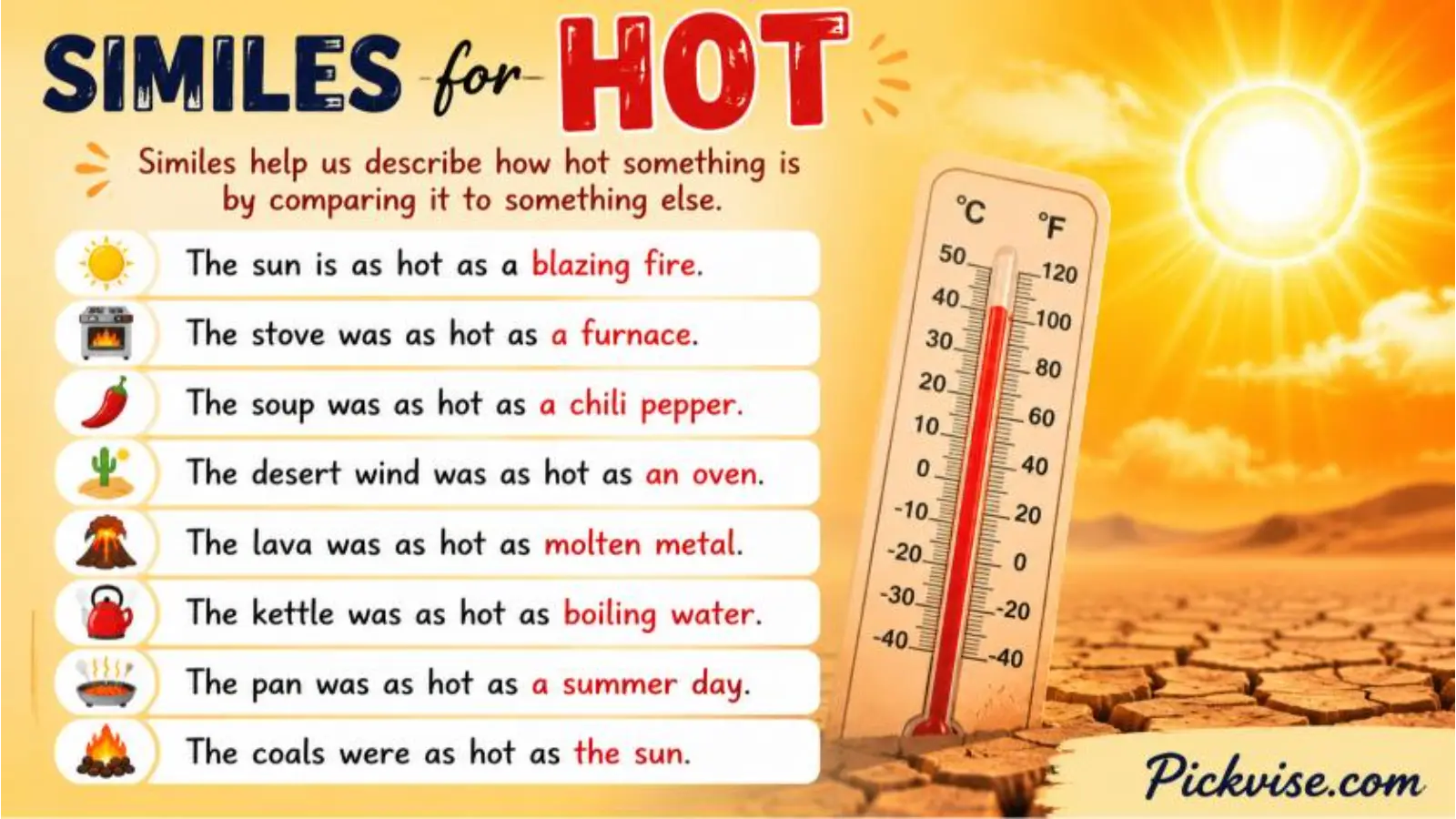
Similes for Hot: Comparisons That Make Heat Feel Real
Simply writing “It was hot” tells readers the temperature was high. A more effective simile gives that heat a physical presence.
1. The air was like a warm blanket wrapped around the town.
Meaning: The heat feels thick and surrounding.
Best context: Summer scenes and descriptive fiction.
Example:
By noon, the air was like a warm blanket wrapped around the town. Even the trees seemed tired.
This works because a blanket normally provides comfort, but too much warmth becomes uncomfortable. The familiar object therefore communicates both temperature and pressure.
2. The sidewalk felt like a frying pan beneath our shoes.
Meaning: The ground is intensely hot.
Example:
We hurried across the sidewalk, which felt like a frying pan beneath our shoes.
The comparison is especially useful when writing about a hot city street.
3. The afternoon burned like sunlight trapped inside a glass room.
This simile suggests more than heat. It creates a feeling of confinement.
Writing tip: When describing extreme heat, compare it to something that traps, presses, dries, or radiates warmth rather than repeatedly using words such as scorching and boiling.
4. The car interior was as hot as a closed greenhouse.
This works well in realistic writing because a greenhouse is strongly associated with trapped heat.
Conversation example:
“Open the windows. This car is as hot as a closed greenhouse.”
5. The wind felt like a hair dryer blowing across the street.
The comparison emphasizes moving heat rather than still heat.
Similes in Music: How Comparisons Create Sound and Emotion
Similes are especially powerful in music because they allow listeners to connect an abstract sound with something familiar.
A song can describe a voice, rhythm, melody, silence, or emotional atmosphere without explaining it literally.
6. Her voice floated like a paper boat on a quiet stream.
This creates a gentle, delicate image.
Best context: Describing a soft vocal performance.
7. The drums struck like footsteps racing down a hallway.
The comparison gives rhythm a sense of movement and urgency.
8. The melody curled through the room like smoke beneath a door.
This makes the music feel subtle and difficult to contain.
9. The chorus rose like a flock of birds lifting from a field.
This suggests expansion, energy, and release.
10. The bass pulsed like a distant train beneath the floor.
The reader can almost imagine the vibration.
Writing insight: When writing about music, avoid relying only on volume words such as loud, soft, or beautiful. Compare sound to movement, weather, objects, animals, or physical sensations.
Similes for Happiness That Feel Fresh
Happiness can be difficult to describe because it is invisible. A useful simile turns the emotion into something readers can imagine.
11. Her happiness spread like sunlight across a kitchen floor.
The image suggests warmth that gradually reaches more of a space.
12. His excitement bounced like a rubber ball in an empty room.
This is useful for energetic, youthful happiness.
13. Their laughter sparkled like coins tossed into clear water.
The image combines sound and visual brightness.
14. The good news opened inside her like a window after a long winter.
This simile presents happiness as relief and renewal rather than simple excitement.
15. He carried his happiness like a bright kite tugging at its string.
The comparison suggests joy that is difficult to keep completely still.
Writing tip: Think about the type of happiness before choosing an image. Quiet satisfaction needs a different simile from wild excitement.
Similes for Friendship
Strong friendship similes often focus on trust, reliability, shared history, or comfort.
16. Their friendship was like a well-worn path through familiar woods.
The path suggests something used repeatedly and trusted over time.
17. She was like a porch light on a road he knew too well.
This creates a feeling of welcome and reassurance.
18. Their conversations flowed like two rivers joining the same valley.
The image emphasizes natural connection.
19. Their friendship held steady like a bridge through changing weather.
This works particularly well when writing about a friendship that survives difficult circumstances.
20. They laughed together like children discovering the same secret.
The simile communicates shared amusement and closeness without explaining it directly.
Writing insight: Avoid making every friendship comparison sentimental. Friendship can also be playful, awkward, dependable, competitive, or quietly supportive.
Similes for Rain
Rain offers endless opportunities because it can be gentle, violent, rhythmic, refreshing, gloomy, or mysterious.
21. Rain whispered against the roof like a secret being passed from room to room.
This creates a quiet, intimate atmosphere.
22. The rain fell like silver threads from the clouds.
The visual comparison emphasizes thin, continuous streams.
23. Raindrops scattered across the window like tiny beads on glass.
This is useful for a gentle shower.
24. The storm arrived like a drumbeat growing louder in the distance.
The comparison focuses on anticipation.
25. Rain rushed down the street like children released from school.
This gives a sudden downpour energy and movement.
26. The drizzle clung to the morning like a gray veil.
The simile creates a muted, gloomy mood.
Writing tip: Match the rain image to the scene’s mood. Rain does not automatically mean sadness. It can represent freshness, relief, celebration, mystery, or renewal.
Similes for Love Without Falling Into Clichés
Love is one of the most frequently described emotions, which makes originality especially important.
27. Their love grew like ivy finding cracks in an old wall.
The comparison suggests persistence and gradual growth.
28. Her presence felt like a familiar song remembered after years of silence.
This creates a sense of recognition and emotional history.
29. Their affection settled between them like warm light at the end of the day.
The image suggests comfort rather than dramatic passion.
30. He protected the memory like a small flame sheltered from the wind.
This works when describing love connected to memory or care.
31. Their connection was like two melodies discovering they belonged in the same song.
This is particularly effective in literary writing because it combines love with music.
Writing insight: Love similes become stronger when they reveal a specific kind of love—comfort, admiration, longing, trust, reunion, or devotion.
Similes for Anger That Show Its Physical Force
Instead of saying “he was very angry,” show how the emotion behaves.
32. Her anger rose like steam trapped beneath a lid.
The image suggests pressure that is increasing.
33. His words snapped like dry branches under a heavy boot.
This emphasizes harshness and suddenness.
34. Frustration crawled through him like static under the skin.
The comparison creates restless discomfort.
35. His temper flared like a match in a dark room.
This is short, immediate, and useful for sudden anger.
36. The argument grew like a storm gathering over a quiet field.
The comparison emphasizes escalation.
Writing tip: Anger does not always explode. Sometimes it simmers, hardens, freezes, or quietly builds. Choose an image that matches the character’s behavior.
Common Similes You Can Recognize and Adapt
Some similes have become familiar through everyday speech and literature.
Examples include:
- as busy as a bee
- as quiet as a mouse
- as cold as ice
- as light as a feather
- as brave as a lion
- like a fish out of water
- like two peas in a pod
- as fast as lightning
These are useful because readers understand them immediately. However, they can also feel predictable.
How to Improve a Common Simile
Instead of writing:
She was as busy as a bee.
Try identifying the specific behavior:
She moved from desk to desk like a sparrow collecting scraps before sunset.
The second comparison gives the reader a more distinctive picture.
Rule of thumb: Use a familiar simile when clarity matters. Invent a fresh one when atmosphere, personality, or originality matters more.
Funny Similes for Creative Writing
Funny similes often work because they combine an ordinary subject with an unexpected image.
37. He stood in the kitchen like a confused tourist reading a menu in the wrong language.
This is useful for describing someone who has no idea what they are doing.
38. My backpack was as organized as a junk drawer during an earthquake.
The exaggeration creates humor through contrast.
39. The puppy chased its tail like a detective investigating its own shadow.
The image makes the animal’s behavior playful.
40. He entered the dance floor like a robot whose instructions had been translated three times.
This works because the comparison is unexpected rather than simply insulting.
Writing tip: Humor often comes from specificity. Instead of saying someone is “awkward,” compare their behavior to a surprisingly precise situation.
Why Some Similes Feel Powerful
A memorable simile usually has three qualities: clarity, relevance, and surprise.
Clarity means the reader can understand the connection.
Relevance means the comparison supports the scene instead of distracting from it.
Surprise means the image is not so predictable that the reader skips over it.
Consider these two sentences:
The rain was like water falling from the sky.
The comparison is technically understandable but adds little.
Now consider:
Rain stitched the dark street with silver threads.
The second image gives the reader shape, movement, color, and atmosphere.
How to Create Your Own Similes
You do not need to wait for inspiration. You can build similes systematically.
Step 1: Identify the exact quality
Do not begin with “What is this like?”
Begin with:
- Is it fast?
- Is it heavy?
- Is it fragile?
- Is it noisy?
- Is it comforting?
- Is it unpredictable?
- Is it overwhelming?
Step 2: Collect unexpected objects
For anger, you might consider:
- pressure cookers
- storms
- sparks
- locked doors
- cracked ice
- engines
For happiness:
- sunlight
- balloons
- open windows
- birds
- bells
- fresh fruit
Step 3: Connect the emotional quality
Suppose you want to describe nervousness.
Instead of:
She was nervous like a scared person.
Think about what nervousness does.
It trembles, interrupts concentration, speeds breathing, and makes small things feel important.
That could become:
Her thoughts fluttered like moths around a porch light.
Now the comparison expresses behavior rather than simply naming the emotion.
Step 4: Test the image
Ask:
Does this comparison make the sentence clearer, stronger, or more memorable?
If not, remove it.
A plain sentence is better than a forced simile.
Creative Exercises for Better Similes
Exercise 1: Describe an Emotion Without Naming It
Choose happiness, anger, fear, sadness, excitement, or embarrassment.
Write five sentences without using the emotion’s name. Use one different comparison in each sentence.
Exercise 2: Turn a Cliché Into Something Original
Start with:
He was as busy as a bee.
Now replace the bee with three unusual images that communicate the same sense of constant movement.
Exercise 3: Use the Wrong Category
Describe rain using a musical image.
For example, imagine rain as a drummer, violinist, singer, or orchestra.
Then describe music using a weather image.
This exercise helps writers discover fresh connections between unrelated subjects.
Exercise 4: Build a Simile From a Character
Ask three questions:
- What does this character notice?
- What objects are familiar to them?
- What experiences shaped their view of the world?
A farmer, musician, mechanic, student, and chef may describe the same event with completely different comparisons.
That is one way professional writers make imagery feel connected to character.
Simile vs. Metaphor: What’s the Difference?
A simile makes an explicit comparison, usually with like or as.
The moon looked like a lantern.
A metaphor makes the comparison directly.
The moon was a lantern.
Both can create strong imagery. The choice depends on the effect you want.
A simile often leaves more distance between the two ideas, while a metaphor can make the comparison feel immediate and absolute.
Similes and Other Literary Devices
Similes frequently work alongside other techniques.
Imagery gives readers sensory information.
The rain sounded like fingertips tapping on a window.
Personification gives human qualities to nonhuman things.
The old house groaned in the wind.
Hyperbole deliberately exaggerates.
I waited a thousand years for the bus.
Alliteration repeats beginning sounds.
The soft summer rain slipped silently.
A sentence can combine several techniques, but each should have a purpose. More literary devices do not automatically make writing better.
Common Mistakes Writers Make With Similes
Using too many similes
A paragraph packed with comparisons can become exhausting. Let your strongest image carry the scene.
Choosing an unrelated image
A comparison should contribute something meaningful. If the reader has to stop and wonder why two things are being connected, the simile may need revision.
Mixing images
Avoid combining incompatible comparisons:
His anger was a volcano racing like a speeding train beneath the ocean.
The sentence introduces several unrelated images and weakens the central idea.
Explaining the simile too much
If the image already communicates the meaning, trust the reader.
Using a comparison that everyone has seen
Clichés are not automatically wrong, but they often lack freshness. Revise them when the writing calls for a distinctive voice.
Making the comparison too complicated
A good simile does not need ten descriptive words. Often, one precise image is enough.
Frequently Asked Questions
What are some good similes for hot?
Useful examples include “the pavement felt like a frying pan beneath our shoes” and “the air was like a warm blanket wrapped around the town.” The best choice depends on whether the heat is uncomfortable, oppressive, dry, or intense.
What are similes in music?
Similes in music describe sounds, voices, rhythms, melodies, or performances by comparing them with familiar things. For example, a melody might be described as moving “like smoke beneath a door.”
What is a good simile for happiness?
A strong happiness simile should match the type of happiness being described. “Her happiness spread like sunlight across a kitchen floor” suggests warm, gradual joy.
What are some similes for friendship?
Friendship can be compared with things that suggest trust, history, comfort, or stability. For example, “Their friendship was like a well-worn path through familiar woods.”
What are some similes for rain?
Rain can be compared with silver threads, whispered secrets, tapping fingers, drumbeats, or other images depending on the mood of the scene.
What is a good simile for love?
A useful love simile should describe a particular quality of love rather than relying on a generic romantic image. “Their love grew like ivy finding cracks in an old wall” suggests persistence and gradual growth.
What are some similes for anger?
Anger can be described as steam beneath a lid, a match flaring in darkness, or a storm gathering over a quiet field. Choose an image that matches the character’s behavior.
How do I make my similes more original?
Focus on a specific quality, brainstorm several unexpected objects, and choose the comparison that creates the clearest and most memorable image. Revise anything that feels forced or overly familiar.
Conclusion
The best similes do more than decorate a sentence. They reveal how a writer sees the world. Heat can become a trapped force. Happiness can become moving light. Friendship can become a familiar road. Rain can become music. Anger can become pressure waiting for release. When creating your own comparisons, start with the exact feeling or quality you want readers to experience. Then search beyond the obvious image. Look at ordinary objects, sounds, weather, movement, and personal experiences. A fresh simile does not need to be complicated. It only needs to make the reader notice something in a new way. That is where comparison becomes real writing craft.
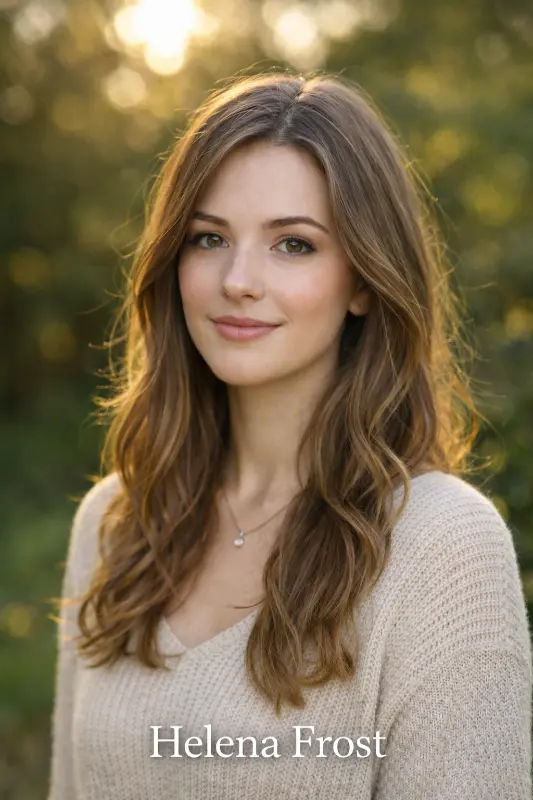
I am Helena Frost, a writer captivated by the beauty of language and the art of comparison. Through my words, I explore the world by turning ordinary moments into vivid similes and reflections. I enjoy crafting phrases that spark imagination, evoke emotion, and linger in the mind. My writing celebrates the subtle connections between people, nature, and the stories we live. For me, every sentence is an opportunity to reveal the extraordinary in the everyday.