Fast Similes make ordinary language easier to picture. By comparing one thing to another with words such as like or as, writers can turn a plain statement into something readers can see, hear, or feel.
A sentence such as “The rain was heavy” gives information. A sentence such as “The rain drummed against the roof like impatient fingers” creates an experience.
That is the real value of a simile: it does more than decorate a sentence. A well-chosen comparison can establish mood, reveal personality, sharpen a description, or make an abstract emotion easier to understand.
This guide explores fast similes, similes in music, and useful comparisons for happiness, friendship, rain, love, anger, everyday writing, and humor. Along the way, you will learn how to build stronger comparisons instead of simply collecting them.
What Is a Simile?
A simile is a comparison between two different things, usually using like or as.
For example:
The runner moved like a spark across dry grass.
The runner is not literally a spark. The comparison emphasizes speed and sudden movement.
A useful simile normally has three parts:
- The subject: what you are describing
- The comparison: what you connect it to
- The shared quality: what makes the comparison meaningful
The strongest similes are not random. They connect two things because they share a recognizable quality such as speed, brightness, tension, warmth, silence, or unpredictability.
What Are Fast Similes?
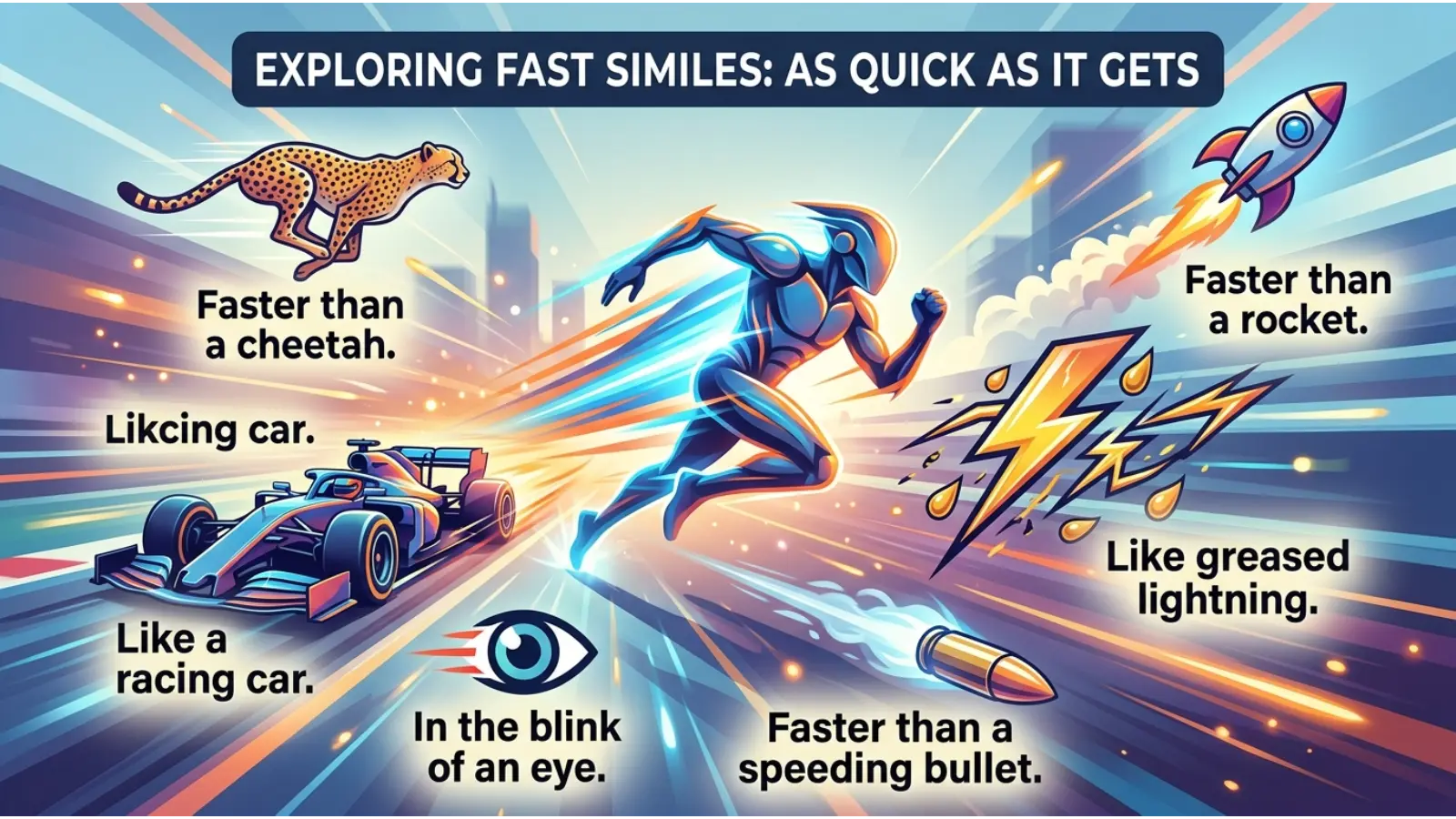
Fast similes describe people, animals, objects, sounds, or actions that move quickly. Because speed is difficult to visualize on its own, comparisons can make it feel immediate.
1. Fast as a thrown stone
Meaning: Extremely quick and direct.
Example:
The cyclist shot down the hill, fast as a thrown stone.
Writing purpose: This works especially well in action scenes because the comparison suggests sudden acceleration rather than steady movement.
2. Like a flash across a dark window
Meaning: Something moves so quickly that it is visible only for an instant.
Example:
The bird crossed the road like a flash across a dark window.
Best context: Stories, sports writing, and descriptions of sudden movement.
3. As quick as a match catching fire
Meaning: Something happens almost immediately.
Example:
Her expression changed as quick as a match catching fire.
This comparison is useful when the speed involves a change, rather than physical movement.
4. Like a startled rabbit through tall grass
Meaning: Fast, nervous, and unpredictable movement.
Example:
He raced through the crowd like a startled rabbit through tall grass.
The comparison adds emotion to the idea of speed, making it more vivid than simply saying “he ran quickly.”
5. Fast as a kite pulled by a strong wind
Meaning: Rapid movement driven by outside force.
Example:
The paper flew down the street, fast as a kite pulled by a strong wind.
Writing tip: Use fast similes when speed matters to the scene. If nothing changes because of the speed, the comparison may be unnecessary.
Similes in Music: How Comparisons Create Sound and Mood
Music already creates imagery through rhythm, melody, instruments, and voice. Similes can help a writer describe those qualities when ordinary adjectives feel too limited.
6. The melody curled like smoke around the room
Meaning: The melody feels soft, lingering, and difficult to grasp.
Example:
The violin melody curled like smoke around the room.
Emotional effect: Dreamy and mysterious.
7. The drums struck like footsteps on a wooden bridge
Meaning: The rhythm feels strong and deliberate.
Example:
The drums struck like footsteps on a wooden bridge, pulling everyone deeper into the song.
This is effective because the reader can almost hear the rhythm.
8. Her voice shimmered like sunlight on water
Meaning: The voice sounds bright, clear, and delicate.
Best context: Music reviews, poetry, fiction, and character descriptions.
9. The bass moved like a slow train beneath the melody
Meaning: The bass provides a steady, powerful foundation.
Writing tip: When describing music, compare sound to something readers can physically imagine. Motion, texture, weather, and natural forces can all become useful sources of musical imagery.
Similes for Happiness
Happiness can be difficult to describe because it is an internal emotion. A strong simile gives that emotion a physical shape.
10. Her happiness rose like sunlight through morning curtains
This suggests a gentle happiness that gradually fills a space.
Example:
Her happiness rose like sunlight through morning curtains when she saw the surprise waiting for her.
11. He was grinning like someone who had just found an unexpected gift
This comparison focuses on visible excitement.
12. The children bounced like popcorn in a hot pan
This creates energetic, playful happiness.
Writing purpose: It is especially suitable for children’s stories or humorous scenes.
13. His good mood spread like warm light across the table
This suggests happiness that affects other people.
Best context: Friendship scenes, family stories, and positive character descriptions.
14. She felt as light as a balloon released into a clear sky
This suggests relief as well as happiness.
Writing tip: Do not treat happiness as one emotion. Ask whether your character feels peaceful, excited, relieved, playful, proud, or grateful. The answer should determine the comparison.
Similes for Friendship
Good friendship similes often emphasize trust, comfort, loyalty, or shared memories.
15. Their friendship was like a well-worn path through the woods
Meaning: Familiar, dependable, and easy to return to.
Example:
Their friendship was like a well-worn path through the woods; even after years apart, neither had forgotten the way back.
16. She stood beside him like a steady hand on a shaking table
This suggests practical support during a difficult moment.
17. Their laughter fit together like two rhythms in the same song
This focuses on compatibility and shared joy.
18. He was as dependable as the porch light left on at dusk
This creates a quiet image of reliability.
Best context: Reflective writing, personal essays, novels, and poems.
Writing tip: Friendship is usually stronger when you show what friends do for one another rather than simply calling them “best friends.”
Similes for Rain
Rain can create comfort, sadness, suspense, freshness, or loneliness depending on how you frame it.
19. Rain tapped the windows like tiny impatient fingers
The comparison gives the rain a restless personality.
20. The rain fell like silver threads from a torn cloud
This creates a visual image of continuous rainfall.
21. Rain rushed down the street like marbles spilling from a box
This works for a sudden, heavy downpour.
22. The drizzle settled over the garden like a thin veil
The effect is quiet and delicate.
23. The storm rain hammered the roof like a thousand small fists
This emphasizes force and noise.
Writing tip: Avoid automatically making rain “sad.” Rain can be playful, cleansing, threatening, peaceful, romantic, or irritating. Let the scene decide.
Similes for Love
Love can be expressed through warmth, familiarity, growth, protection, or emotional intensity.
24. Their love grew like a vine finding sunlight
Meaning: The relationship develops gradually while reaching toward something sustaining.
25. Her presence felt like a warm lamp in a cold room
This suggests comfort and emotional security.
26. Their memories stayed like footprints after the tide had pulled away
This describes love that leaves a lasting impression.
27. His affection was as steady as a lighthouse beam crossing the water
This emphasizes consistency rather than dramatic emotion.
28. Their conversations unfolded like pages from a book neither wanted to close
This works well when describing emotional connection and curiosity.
Writing tip: Strong love similes do not need to be overly dramatic. A small, believable comparison can feel more powerful because readers recognize the experience.
Similes for Anger
Anger has many forms. It can be sudden, controlled, explosive, quiet, or slowly developing.
29. His anger flared like dry grass meeting a spark
This suggests a rapid emotional reaction.
30. Her words struck like hail against a thin roof
The comparison emphasizes repeated verbal impact.
31. His frustration built like pressure beneath a locked door
This describes anger that has not yet been released.
32. She stared at him like a storm waiting beyond the hills
This creates suspense because the anger is present but restrained.
33. His temper snapped like a branch under heavy snow
This suggests a breaking point after prolonged pressure.
Writing tip: Instead of repeatedly writing “he was angry,” show what anger does to the character’s voice, movements, thoughts, and surroundings.
Common Similes You Can Use Carefully
Some similes have become so familiar that readers may barely notice them.
Examples include comparisons involving:
- being busy like a bee
- being as cold as ice
- being as light as a feather
- being as brave as a lion
- fighting like cats and dogs
These are not grammatically wrong. They are simply familiar.
A cliché becomes a problem when a writer needs fresh imagery but reaches automatically for the first comparison that comes to mind.
How to Freshen a Familiar Simile
Instead of writing:
He was as busy as a bee.
Consider the character’s actual situation:
He moved between three unfinished tasks like a juggler trying to keep glass balls in the air.
The second version gives the reader more information about the kind of busyness involved.
Funny Similes That Actually Add Humor
Funny similes work best when the comparison is unexpected but understandable.
34. He entered the kitchen like a detective who had just discovered a suspicious sandwich
The humor comes from treating an ordinary event as dramatically important.
35. Her hair stood up like grass after a very confused lawnmower
The unusual image creates visual comedy.
36. The puppy charged around the room like a tiny rocket with no navigation system
This works because the comparison exaggerates the animal’s energy without becoming difficult to understand.
37. He stared at the empty refrigerator like it had personally betrayed him
The humor comes from giving an ordinary object emotional importance.
38. The old printer groaned like a tired robot being asked to work overtime
This can make a familiar household frustration more entertaining.
Writing tip: Humor often comes from a mismatch. Put a serious image beside an ordinary situation, or compare something small to something dramatically powerful.
Why Some Similes Feel Stronger Than Others
Compare these two sentences:
The rain was loud like a loud machine.
Rain hammered the roof like pebbles thrown by an impatient crowd.
The second works better because the comparison adds several layers of information: sound, force, movement, and mood.
A useful test is:
Does the comparison tell the reader something they could not easily get from the original noun or adjective?
If the answer is no, revise it.
How to Make Your Similes More Vivid
Start with the quality you want to emphasize
Do not begin by searching randomly for something to compare.
Ask:
- Is the character moving quickly?
- Is the room peaceful?
- Is the anger controlled or explosive?
- Is the rain gentle or violent?
- Is the music bright or haunting?
- Is the friendship dependable or playful?
Once you identify the quality, search for an image that naturally carries it.
Use concrete things
Abstract comparisons can be difficult to visualize.
Instead of:
Her sadness was like emotional darkness.
Try:
Her sadness hung over the afternoon like a cloud that refused to move.
The second comparison gives the emotion a visible presence.
Make the comparison specific
“Like a bird” is broad.
“Like a sparrow startled from a fence” gives the reader movement, scale, and emotion.
Specificity is one of the easiest ways to improve a weak simile.
How Professional Writers Avoid Clichés
Experienced writers do not avoid every familiar expression. They choose familiar language deliberately and create fresh imagery when the scene requires it.
One useful technique is to observe the real world.
If you are writing about rain, notice:
- what it sounds like on different surfaces
- how puddles behave
- how people walk differently
- what happens to light
- how smells change
- how wind changes the rain
Those observations give you raw material for original comparisons.
A writer who observes carefully does not need to force originality.
Simile vs. Metaphor
A simile usually makes a comparison with words such as like or as.
The moon looked like a pale coin.
A metaphor makes the comparison directly.
The moon was a pale coin.
Both create imagery, but they produce slightly different effects. Similes often feel more explicit, while metaphors can feel more immediate.
Simile vs. Hyperbole
A simile compares two things.
The bag felt as heavy as a suitcase full of bricks.
Hyperbole deliberately exaggerates.
That bag weighs a thousand pounds.
They can also work together:
The bag felt as heavy as a mountain.
Here the comparison is also intentionally exaggerated.
Simile and Personification
Personification gives human qualities to something nonhuman.
The rain tapped impatiently at the glass.
The rain is described as if it can be impatient.
Combined with comparison, personification can create particularly vivid imagery:
The rain knocked at the windows like a visitor who refused to leave.
How to Create Your Own Similes
Try this simple process.
Step 1: Choose one subject
Pick something concrete:
a runner, sunset, classroom, storm, friend, song, dog, silence
Step 2: Identify one quality
Choose only one:
speed, warmth, noise, fear, softness, confusion, excitement, loneliness
Step 3: Brainstorm unrelated objects
For “fast,” you might think of:
arrow, spark, bird, falling stone, racing train
Step 4: Choose the most precise image
Do not automatically choose the biggest or most dramatic object. Choose the one that best matches the feeling.
Step 5: Test the sentence
Ask whether the comparison feels natural.
The runner was fast like a refrigerator.
The grammar may be understandable, but the image does not communicate speed naturally.
Step 6: Add context
Instead of using the simile alone, place it inside an action:
The runner disappeared around the corner like a spark carried away by the wind.
Now the comparison contributes to the scene.
Creative Exercises for Better Similes
Exercise 1: One emotion, five images
Choose one emotion such as happiness.
Compare it to:
- weather
- an object
- an animal
- a sound
- a movement
This teaches you that one emotion can have many possible images.
Exercise 2: Remove the adjective
Write:
The room was quiet.
Now remove “quiet” and communicate the same idea through a simile.
For example:
The room was quiet like a library after closing time.
Exercise 3: Make a cliché stranger
Start with a familiar comparison and replace its subject with something more specific.
Instead of “busy as a bee,” think about what kind of busy the person is.
Are they:
- rushing between tasks?
- organizing dozens of objects?
- answering constant questions?
- working without stopping?
Specific situations produce better imagery.
Common Simile Mistakes
Using a comparison that says nothing new
The water was wet like water.
A comparison should reveal a meaningful quality.
Mixing images
Her voice was like thunder, soft as a feather, and it exploded quietly.
The images fight one another. Decide what the voice should actually feel like.
Forcing originality
A strange comparison is not automatically a good comparison.
The sunset was like a purple refrigerator thinking about mathematics.
It is unusual, but the connection is unclear.
Originality needs relevance.
Confusing a simile with a metaphor
His anger was a volcano.
That is a metaphor.
His anger rose like pressure inside a volcano.
That is a simile.
Adding too many similes
A paragraph filled with comparisons can become exhausting. Strong imagery needs space around it.
Use a simile when it earns its place.
Frequently Asked Questions About Similes
What is a simple example of a simile?
“The baby slept like a leaf resting on still water” is a simile because it compares the baby’s sleep to a leaf using the word “like.”
What are fast similes?
Fast similes describe speed through comparisons, such as movement that is “like a flash” or “as quick as a spark catching fire.” The best choice depends on whether you want to show physical speed, suddenness, or nervous movement.
What is a good simile for happiness?
A useful happiness simile is one that matches the type of happiness. For example, “Her happiness rose like sunlight through morning curtains” suggests gentle, gradually growing joy.
What are some similes for friendship?
Friendship can be compared to dependable or familiar things. “Their friendship was like a well-worn path through the woods” suggests a relationship that remains familiar and easy to return to.
How can I write a good simile for rain?
First decide what kind of rain you are describing. Gentle rain, heavy rain, storm rain, and drizzle should not all receive the same comparison. Then choose a concrete image that matches its sound, movement, or mood.
What is a simile in music?
A simile in music is a comparison used to describe a sound, melody, rhythm, voice, or musical experience. For example, describing a melody as “curling like smoke” gives readers a way to imagine its movement.
How do I make a simile less cliché?
Identify exactly what you want the comparison to communicate, then brainstorm less obvious objects or experiences that share that quality. Specific observation is usually more effective than trying to sound unusual.
Conclusion
A good simile does not exist simply to make writing prettier. It gives readers a way to experience an idea.The best comparisons are precise enough to create a picture and natural enough that readers do not stop to question them. Whether you are writing fast similes, descriptions of music, emotional scenes, poetry, fiction, or everyday conversation, begin with the quality you want readers to feel. Then look for an image that carries that quality. Experiment with familiar comparisons, challenge yourself to create fresh ones, and read your sentences aloud. If a simile makes the scene clearer, stronger, or more memorable, it is doing useful work. The goal is not to use more similes. The goal is to choose better ones.
I am Helena Frost, a writer captivated by the beauty of language and the art of comparison. Through my words, I explore the world by turning ordinary moments into vivid similes and reflections. I enjoy crafting phrases that spark imagination, evoke emotion, and linger in the mind. My writing celebrates the subtle connections between people, nature, and the stories we live. For me, every sentence is an opportunity to reveal the extraordinary in the everyday.