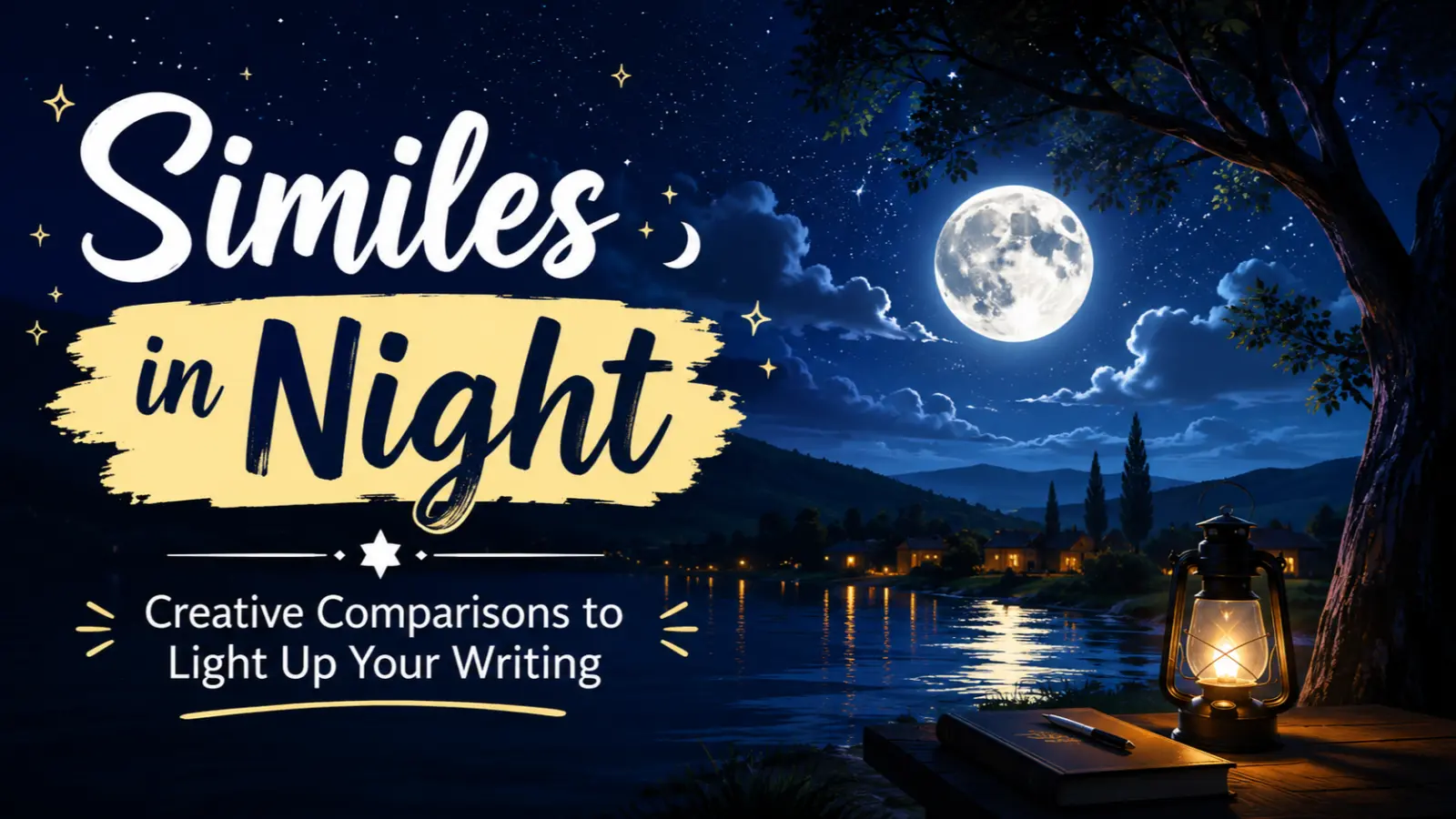
Night has inspired writers for centuries because it changes how we see the world. Familiar places become mysterious, quiet moments feel deeper, and emotions often become stronger. One of the easiest ways to capture those feelings is through similes. A simile compares two different things using “like” or “as.” It helps readers picture a scene, understand an emotion, or experience an atmosphere more vividly. Whether you’re writing a poem, a short story, a novel, or even a school assignment, these original similes in night can help your writing sound more imaginative and memorable.
Quick Answer
Similes in night are comparisons that describe the appearance, mood, sounds, or feelings of nighttime using words such as like or as. Strong night similes create vivid imagery, helping readers imagine darkness, moonlight, stars, silence, mystery, or peace more clearly.
Why Night Inspires Powerful Similes
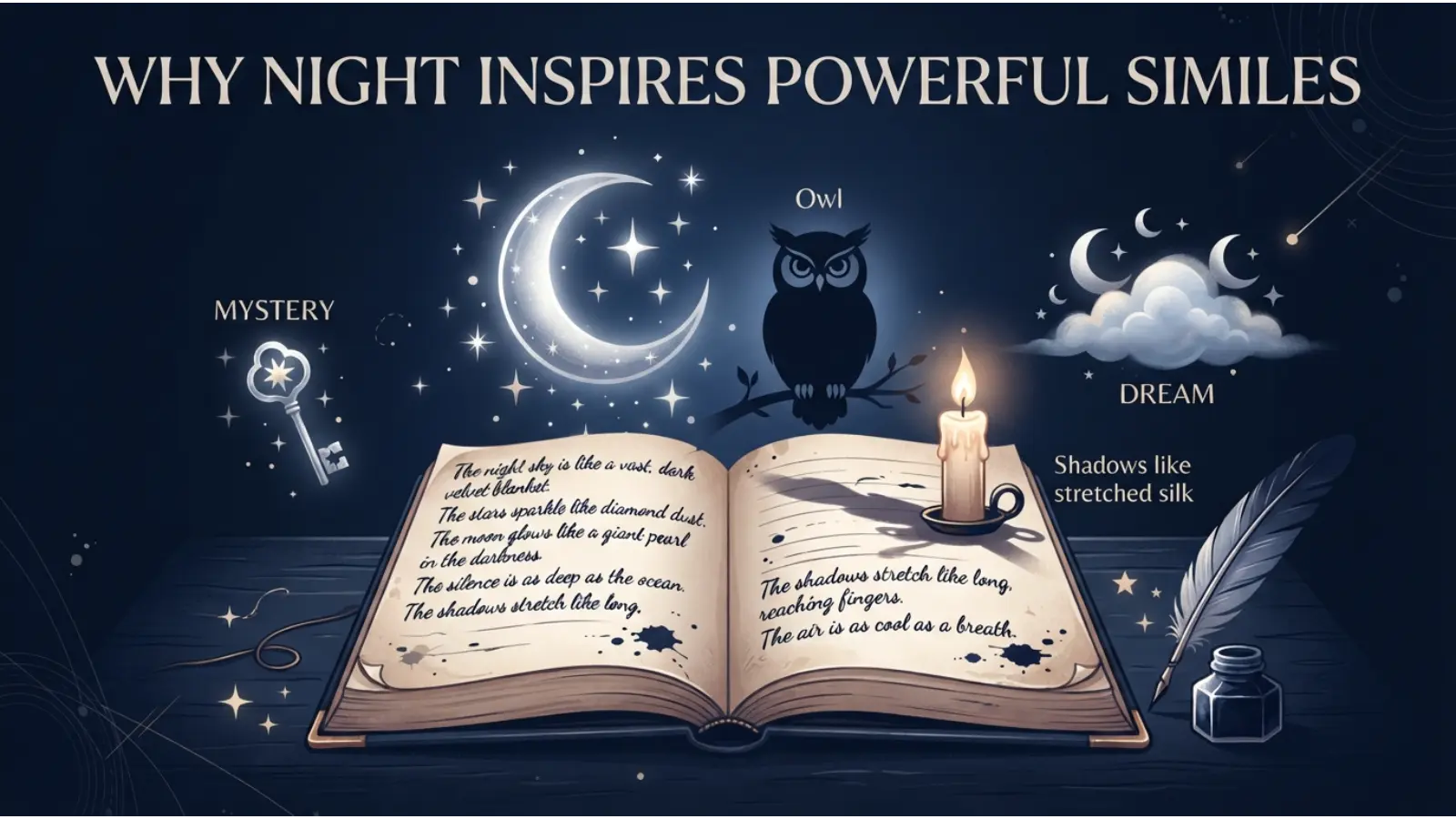
Night naturally creates contrast.
During the day, details are easy to see. At night, shadows, silence, and limited light encourage readers to imagine more than they actually see.
That mystery gives writers endless opportunities to create fresh comparisons.
Good night similes often describe:
- Darkness
- Moonlight
- Stars
- Silence
- Dreams
- Mystery
- Peace
- Loneliness
- Fear
- Hope
30 Original Similes in Night
1. The night spread across the hills like velvet poured over stone.
Meaning: Darkness covers everything smoothly.
Works best for: Nature writing and peaceful descriptions.
Story Example:
The night spread across the hills like velvet poured over stone, hiding every winding path.
Writing Tip:
Velvet suggests softness rather than fear.
2. The stars shimmered like tiny lanterns floating on an endless sea.
Meaning: Bright stars filling the sky.
Poetry Example:
The stars shimmered like tiny lanterns floating on an endless sea above us.
3. The moon hung like a silver coin forgotten in the sky.
Meaning: A bright full moon.
Conversation Example:
Look outside—the moon looks like a silver coin tonight.
4. The silence settled like fresh snow over the village.
Meaning: Deep, peaceful quiet.
Emotional Effect:
Creates calm and stillness.
5. Shadows moved like patient dancers across the road.
Meaning: Slow shifting shadows.
Best Context:
Mystery stories.
6. Darkness wrapped around the forest like a thick blanket.
Meaning: Complete darkness.
Writing Purpose:
Adds comfort or suspense depending on the scene.
7. The wind whispered like an old storyteller.
Meaning: Gentle nighttime wind.
Poetry Example:
The wind whispered like an old storyteller beneath the stars.
8. The lake reflected the moon like polished glass.
Meaning: Calm water.
Writing Tip:
Use this when the water is perfectly still.
9. The sky stretched like an endless ocean above us.
Meaning: A vast night sky.
Storytelling Example:
They lay in the field as the sky stretched like an endless ocean above them.
10. The stars blinked like curious eyes.
Meaning: Twinkling stars.
Best For:
Children’s stories.
11. The campfire glowed like a tiny sun against the darkness.
Meaning: Bright warmth in the night.
Emotional Effect:
Safety and comfort.
12. The moonlight flowed like liquid silver.
Meaning: Bright moonlight spreading gently.
Writing Insight:
This creates elegant imagery without becoming overly dramatic.
13. The path disappeared like ink dropped into water.
Meaning: A trail fading into darkness.
Best Context:
Adventure stories.
14. The owl called like a distant bell.
Meaning: A clear nighttime sound.
Conversation Example:
Did you hear that owl? It sounded like a distant bell.
15. The clouds drifted like quiet ships across the moon.
Meaning: Slow-moving clouds.
Poetry Example:
Clouds drifted like quiet ships across the moonlit sky.
16. Night folded around the town like closing curtains.
Meaning: Evening arriving.
Writing Purpose:
Transition between day and night.
17. The air felt as cool as fresh spring water.
Meaning: Pleasant nighttime temperature.
18. The stars scattered like handfuls of sparkling salt.
Meaning: Countless bright stars.
Writing Tip:
Simple but visually striking.
19. The darkness waited like a silent audience.
Meaning: Quiet anticipation.
Best Context:
Suspense.
20. Moonlight rested on the roof like soft silk.
Meaning: Gentle illumination.
Emotional Effect:
Peacefulness.
21. The trees stood like silent guardians beneath the stars.
Meaning: Tall, protective trees.
Storytelling Example:
The trees stood like silent guardians watching every traveler.
22. The breeze drifted through the grass like gentle fingers.
Meaning: Soft movement.
Best For:
Nature writing.
23. The sky glittered like scattered diamonds.
Meaning: A sky filled with bright stars.
Writing Tip:
Use sparingly to avoid sounding repetitive.
24. The darkness gathered like slow-moving fog.
Meaning: Night gradually arriving.
Best Context:
Scene transitions.
25. The moon floated like a white feather.
Meaning: Light, peaceful movement.
Poetry Example:
The moon floated like a white feather across the heavens.
26. Crickets sang like tiny musicians.
Meaning: Nighttime insect sounds.
Conversation Example:
Listen—the crickets sound like tiny musicians tonight.
27. The horizon faded like watercolor paint.
Meaning: Evening blending into darkness.
Writing Purpose:
Beautiful sunset-to-night transitions.
28. The stars sparkled like fresh ice beneath sunlight.
Meaning: Sharp, brilliant starlight.
Emotional Effect:
Wonder.
29. The forest breathed like a sleeping giant.
Meaning: Quiet natural movement.
Best Context:
Fantasy and adventure.
30. The night embraced the world like an old friend.
Meaning: Peaceful nighttime atmosphere.
Writing Tip:
Works well in reflective or emotional writing.
How to Make Night Similes More Vivid
The strongest similes focus on a specific detail instead of describing the whole scene.
Instead of writing that the night was simply dark, notice what stands out. Is it the quiet? The moonlight? The breeze? The shadows? Readers connect with details they can easily imagine.
Try to involve different senses. A night scene can be seen, heard, felt, and even smelled. Combining visual imagery with sound or temperature creates richer descriptions.
Why These Similes Work
Each comparison highlights one clear feature of nighttime instead of trying to describe everything at once.
For example:
- Velvet emphasizes softness.
- Lanterns suggest warmth and guidance.
- Closing curtains signal the end of the day.
- Silent guardians create protection and mystery.
- Fresh snow communicates complete stillness.
Choosing one strong image is often more effective than piling together several comparisons.
Related Literary Devices
Metaphor
A metaphor makes a direct comparison without using like or as.
Simile: The moon was like a silver coin.
Metaphor: The moon was a silver coin in the sky.
Imagery
Imagery appeals to the senses. Night similes naturally strengthen visual, sound, and emotional imagery.
Personification
Personification gives human qualities to non-human things.
Example:
The wind whispered through the trees.
Pairing personification with similes can make nighttime scenes feel more alive.
Symbolism
Night often symbolizes mystery, reflection, rest, uncertainty, or hope. Your similes can reinforce those ideas without stating them directly.
Create Your Own Night Similes
Creating original similes becomes easier when you follow a simple process.
Step 1
Choose one part of the night.
Examples:
- Moon
- Stars
- Darkness
- Wind
- Silence
- Shadows
Step 2
Ask what quality stands out.
Is it soft?
Bright?
Cold?
Quiet?
Endless?
Mysterious?
Step 3
Think of something with that same quality.
Instead of copying common comparisons, look for fresh images from everyday life or nature.
Step 4
Connect them using like or as.
Creative Writing Exercises
Exercise 1
Describe a campsite at midnight using three original similes.
Exercise 2
Write five different similes about moonlight without mentioning silver.
Exercise 3
Describe the same night scene once as peaceful and once as frightening using different similes.
Exercise 4
Replace one ordinary sentence like “It was dark” with a vivid simile that creates emotion.
Common Mistakes to Avoid
Using Overused Comparisons
Readers have seen familiar comparisons many times. Aim for fresh imagery that matches your scene.
Mixing Images
Avoid combining unrelated comparisons in one sentence. Keep each simile focused.
Forcing Comparisons
A simile should feel natural. If readers stop to puzzle over it, simplify the image.
Confusing Similes and Metaphors
Remember:
- Simile: uses like or as.
- Metaphor: makes a direct comparison.
Describing Everything
One memorable simile often creates a stronger impression than several weaker ones.
Frequently Asked Questions
What are similes in night?
They are comparisons using like or as to describe nighttime scenes, feelings, sounds, or objects more vividly.
Why are night similes useful?
They help readers imagine darkness, moonlight, silence, and atmosphere while making writing more engaging.
Can I use night similes in poetry?
Yes. Poetry often relies on similes to create mood, rhythm, and emotional depth.
Are night similes suitable for children’s writing?
Absolutely. Gentle comparisons involving stars, the moon, or animals work especially well for young readers.
How can I make my night similes original?
Focus on one detail, avoid common comparisons, and connect it with an unexpected but believable image.
Should every description include a simile?
No. Similes are most effective when used selectively. Mixing them with plain description keeps your writing balanced.
Can night similes create suspense?
Yes. Comparisons involving shadows, silence, or distant sounds can build tension without becoming overly dramatic.
Conclusion
Night offers endless inspiration for creative writing because it transforms ordinary places into scenes filled with wonder, mystery, and emotion. The best similes in night don’t simply describe darkness—they reveal how it feels, sounds, or changes the world around it. Experiment with fresh comparisons, pay attention to small details, and let each simile serve a clear purpose. With practice, you’ll create nighttime descriptions that stay with readers long after they’ve finished the page.
I am Helena Frost, a writer captivated by the beauty of language and the art of comparison. Through my words, I explore the world by turning ordinary moments into vivid similes and reflections. I enjoy crafting phrases that spark imagination, evoke emotion, and linger in the mind. My writing celebrates the subtle connections between people, nature, and the stories we live. For me, every sentence is an opportunity to reveal the extraordinary in the everyday.