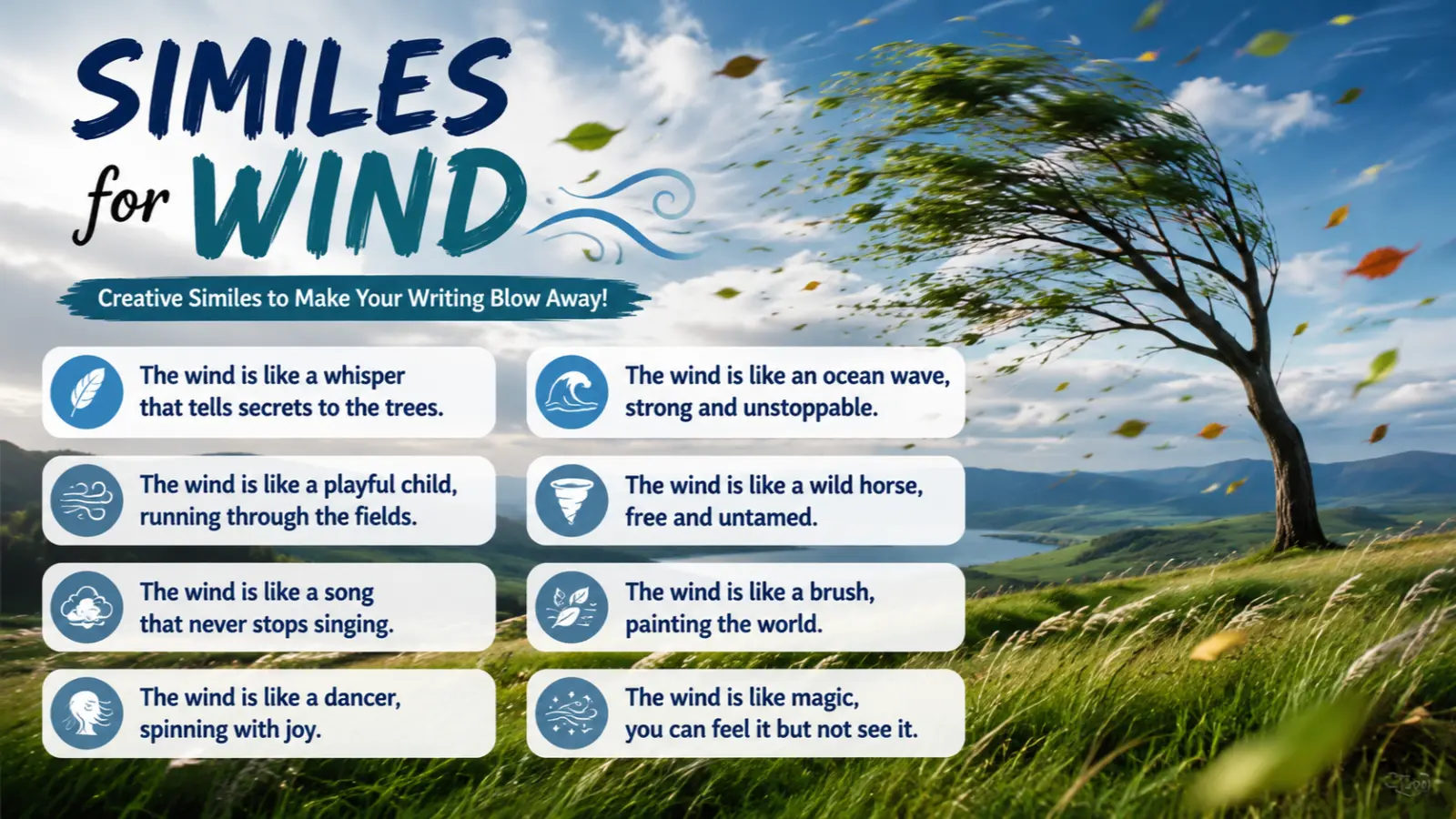
Similes for Wind is invisible, but good writing can make readers feel it, hear it, and almost see it moving through a scene. Similes for wind turn an ordinary breeze into something memorable by comparing it to a familiar person, object, animal, sound, or action.
A simile uses words such as “like” or “as” to connect two different things. Instead of simply writing, “The wind was strong,” you might write, “The wind pushed against the windows like an impatient visitor.” The second sentence gives the reader an image, a mood, and a sense of movement.
Writers use wind similes in poetry, fiction, essays, nature writing, children’s stories, songs, and everyday conversation. This collection gives you original examples while showing how to create stronger comparisons of your own.
Quick Answer: What Are Some Good Similes for Wind?
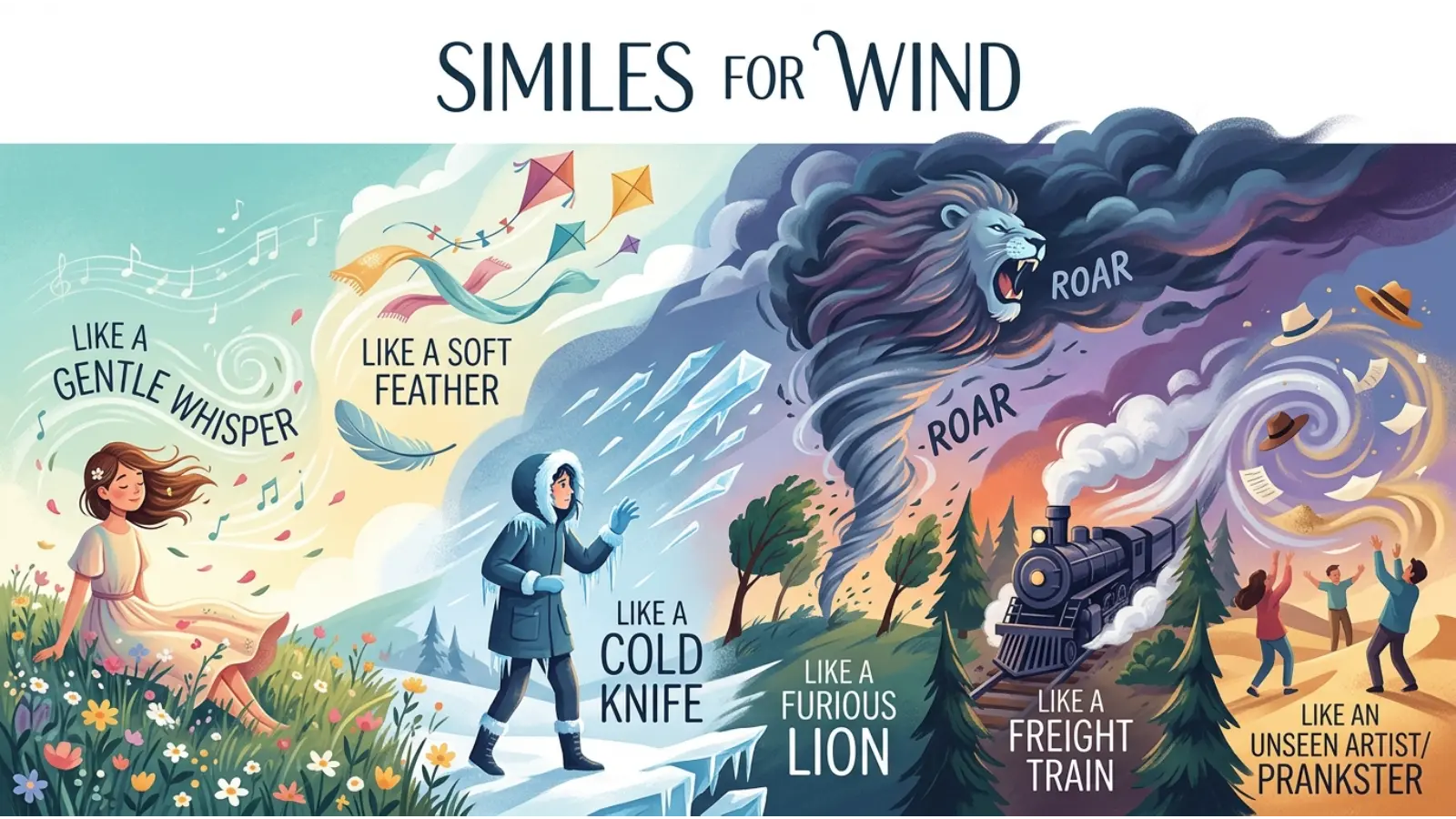
Here are a few original examples:
- The wind slipped through the trees like a whispered secret.
- The morning breeze moved like a ribbon across the field.
- The winter wind snapped at the rooftops like an angry bird.
- The wind rushed down the street like a crowd late for a train.
- A gentle breeze brushed my face like a cool silk scarf.
- The wind rattled the leaves like tiny paper drums.
- The evening wind wandered through the garden like a curious guest.
The best wind simile depends on the mood you want to create. A soft breeze may need a peaceful comparison, while a storm requires something more powerful.
Gentle Wind Similes for Peaceful Scenes
A light breeze often creates feelings of comfort, freedom, calm, or freshness. Soft comparisons work especially well in descriptions of gardens, beaches, spring mornings, and quiet evenings.
1. The wind slipped through the trees like a whispered secret.
Meaning: The wind moves quietly and almost mysteriously among the branches.
Example:
The wind slipped through the trees like a whispered secret, barely disturbing the sleeping birds.
Writing purpose: This simile creates a quiet, mysterious atmosphere.
Best context: Nature writing, peaceful fiction, and reflective poetry.
2. The morning breeze moved like a ribbon across the field.
The comparison makes the breeze feel smooth, graceful, and flowing.
Example:
The morning breeze moved like a ribbon across the field, bending the tall grass in gentle waves.
This works because the reader can imagine a ribbon floating and changing direction.
Writing tip: When describing gentle wind, choose comparisons that suggest flow rather than force.
3. A cool breeze brushed my face like a silk scarf.
This comparison emphasizes softness and comfort.
Example:
A cool breeze brushed my face like a silk scarf as I walked beside the lake.
It fits naturally into travel writing, summer scenes, and peaceful moments.
4. The breeze wandered through the garden like a curious guest.
Meaning: The wind moves from one part of the garden to another without seeming hurried.
Example:
The breeze wandered through the garden like a curious guest, stirring roses and tickling the leaves.
The comparison gives the invisible wind a sense of personality without directly calling it a person.
5. The spring wind danced through the blossoms like a child at a festival.
This simile creates an energetic but cheerful image.
Emotional effect: Joyful, playful, and lively.
Best context: Spring descriptions, children’s stories, and upbeat poetry.
Strong Wind Similes for Storms and Dramatic Writing
Powerful wind needs stronger imagery. Comparisons involving rushing crowds, animals, waves, or physical force can make a storm feel immediate.
6. The wind rushed down the street like a crowd late for a train.
The comparison gives the wind speed and urgency.
Example:
The wind rushed down the street like a crowd late for a train, scattering leaves in every direction.
Why it works: Readers already understand the frantic movement of a hurried crowd.
7. The storm wind punched against the shutters like a determined boxer.
This creates a forceful image without simply saying that the wind was strong.
Best context: Fiction, suspense, and dramatic weather scenes.
Writing tip: Match the comparison to the action. A powerful verb such as “punched” makes the simile more energetic.
8. The wind tore across the hills like a wild horse.
This comparison suggests speed, strength, and freedom.
Example:
The wind tore across the hills like a wild horse released from its reins.
The added detail makes the image more specific and memorable.
9. The winter wind snapped at the rooftops like an angry bird.
The verb “snapped” makes the wind seem sharp and aggressive.
Emotional effect: Tension and discomfort.
Best context: Winter fiction, suspense, and dramatic descriptions.
10. The gale swept over the harbor like a giant broom.
This comparison focuses on the wind’s ability to push and clear everything in its path.
Example:
The gale swept over the harbor like a giant broom, driving loose papers and leaves toward the water.
Wind Similes That Make Nature Feel Alive
Wind becomes more interesting when the comparison connects it to movement found elsewhere in nature.
11. The wind curled around the mountain like smoke around a chimney.
The comparison emphasizes the wind’s twisting movement.
Best context: Mountain descriptions and landscape writing.
12. The breeze flowed through the wheat like water through a stream.
This works especially well because both wind and flowing water create visible movement in fields of grass or wheat.
Example:
The breeze flowed through the wheat like water through a stream, sending golden ripples toward the horizon.
13. The wind shook the branches like a dog shaking off rain.
This is a more playful comparison.
Emotional effect: Lively and slightly humorous.
Best context: Children’s writing, light fiction, and informal descriptions.
14. The evening breeze circled the porch like a moth around a lamp.
This gives the breeze a gentle, repeating movement.
Writing purpose: Useful when you want the wind to feel present without making the scene dramatic.
15. The wind skimmed across the lake like a stone skipping over water.
The comparison emphasizes speed and light contact.
Example:
The wind skimmed across the lake like a stone skipping over water, leaving tiny waves behind it.
Poetic Similes for Wind
Poetry often benefits from comparisons that focus on sound, emotion, and sensory detail rather than physical strength alone.
16. The wind sang between the branches like a distant flute.
Meaning: The sound of moving air through trees resembles a soft musical instrument.
Best context: Poetry and lyrical nature writing.
Related idea: Sound-based similes are especially useful when the thing being described cannot be seen clearly.
17. The wind whispered across the meadow like a secret shared at dusk.
This comparison combines sound and mystery.
Example:
The wind whispered across the meadow like a secret shared at dusk, carrying the scent of rain.
The extra sensory detail makes the image stronger.
18. The night wind hummed like an old refrigerator in an empty house.
This is an unusual comparison that creates an eerie atmosphere.
Emotional effect: Lonely, unsettling, and slightly strange.
Best context: Suspense, horror-free mystery, or atmospheric fiction.
19. The wind moved through the pines like a low song with no singer.
The comparison gives the landscape a haunting musical quality.
Writing tip: Unexpected comparisons can be more memorable than familiar ones, provided the connection is easy to understand.
Funny Similes for Wind
Not every wind description needs to sound poetic. Humor can make ordinary weather memorable.
20. The wind messed up my hair like a barber who had forgotten his scissors.
Example:
The wind messed up my hair like a barber who had forgotten his scissors.
Emotional effect: Playful and comic.
This works particularly well in dialogue or humorous storytelling.
21. The wind chased my hat like a dog chasing a favorite toy.
The comparison immediately explains the speed and direction of the wind.
Best context: Children’s stories, funny essays, and casual storytelling.
22. The wind slammed the door like a roommate who had just discovered the electric bill.
This gives a weather event a humorous human situation.
Writing purpose: Great for comedy because the comparison creates a miniature story.
23. The breeze tossed the leaves around like a teacher throwing papers after a long Monday.
The comparison gives an ordinary autumn scene a relatable comic image.
Wind Similes for Different Moods
A strong simile does more than describe movement. It tells the reader how to feel about the scene.
| Mood | Example comparison | Effect |
|---|---|---|
| Peaceful | Wind like a soft ribbon | Calm and graceful |
| Mysterious | Wind like a whispered secret | Quiet and intriguing |
| Joyful | Wind like a child dancing | Playful |
| Powerful | Wind like a wild horse | Energetic |
| Frightening | Wind like an angry animal | Tense |
| Lonely | Wind like a song with no singer | Melancholic |
| Funny | Wind like a confused barber | Comic |
The key lesson is simple: choose the comparison for its emotional meaning, not just its physical similarity.
More Original Similes for Wind
24. The desert wind rolled over the sand like a giant invisible wave.
This makes the wind feel broad, continuous, and powerful.
25. The autumn breeze nudged the leaves like a child waking sleepy friends.
The comparison creates a gentle, playful feeling.
26. The wind pressed against the tent like a curious animal outside the door.
This is useful for camping or adventure scenes because it creates mild tension.
27. The sea wind raced along the shore like a messenger carrying urgent news.
The comparison gives the wind speed and purpose.
28. The cold wind slipped under my coat like an unwelcome letter.
This simile emphasizes discomfort in an unexpected way.
Writing purpose: Good comparisons can make physical sensations easier to imagine.
29. The wind scattered the clouds like someone clearing a cluttered desk.
This focuses on the effect of wind rather than the wind itself.
Best context: Weather descriptions and transitions from cloudy to clear skies.
30. The breeze floated through the open window like a visitor who knew not to knock.
This creates a quiet, intimate feeling.
Best context: Bedrooms, homes, evening scenes, and reflective writing.
How to Make Wind Similes More Vivid
A weak simile usually tells readers only one basic fact.
The wind was like a fast car.
The comparison communicates speed, but it does not give the reader much atmosphere.
A stronger version might be:
The wind raced through the alley like a delivery driver who had one minute left.
Now the reader gets speed, urgency, setting, and personality.
When creating a wind simile, ask yourself:
- How is the wind moving? Is it drifting, rushing, swirling, pushing, tapping, shaking, or circling?
- What does the wind sound like? Does it hum, whistle, whisper, roar, or rattle?
- What does it make you feel? Peaceful, excited, nervous, lonely, refreshed, or amused?
- What does it affect? Trees, curtains, waves, dust, clouds, grass, windows, or clothing?
- What unusual thing behaves similarly? That can become your comparison.
This approach produces more specific imagery than simply searching for a random object that moves quickly.
How Professional Writers Avoid Cliché Similes
Some comparisons become so common that readers barely notice them. Familiar expressions can have their place, but fresh writing often benefits from a more specific image.
Instead of:
The wind was as strong as a hurricane.
Try describing the effect:
The wind shoved against the fence until every loose board complained.
The second example does not compare the wind directly to another thing, but it creates stronger imagery through action and sensory detail.
A useful rule is:
Do not ask only, “What is the wind like?” Ask, “What does this particular wind make the world do?”
That question often leads to better writing.
Simile vs. Metaphor: What Is the Difference?
A simile makes a direct comparison using words such as like or as.
The wind moved like a silver ribbon.
A metaphor makes the comparison directly.
The wind was a silver ribbon.
Both can create vivid imagery, but they create slightly different effects. A simile gives the reader more distance between the real thing and the comparison, while a metaphor can sound more immediate.
Imagery
Imagery is the broader technique of using language that appeals to the senses.
Wind rattled the dry leaves against the window.
There is no simile here, but the sound and movement create vivid imagery.
Personification
Personification gives human qualities to something nonhuman.
The wind complained outside the window.
A writer can combine personification and simile:
The wind complained at the window like an impatient neighbor.
Using literary devices together can make a description richer, but avoid piling on too many techniques at once.
How to Create Your Own Wind Similes
You can build an original comparison in a few simple steps.
Step 1: Identify the type of wind
Is it a:
- gentle breeze?
- hot wind?
- cold wind?
- storm wind?
- coastal breeze?
- autumn wind?
- mountain wind?
Step 2: Choose its strongest quality
Maybe the wind is:
- quiet
- fast
- cold
- playful
- violent
- persistent
- unpredictable
Step 3: Brainstorm unrelated images
For a persistent wind, you might think of:
- a child asking questions
- a dripping faucet
- a tapping finger
- a repeated notification
- someone knocking on a door
Step 4: Add a precise verb
Compare:
The wind was like a child.
with:
The wind tapped against the shutters like a child who refused to leave.
The verb “tapped” and the added action make the image specific.
Step 5: Test the emotion
Read your simile and ask: What will the reader feel?
If you want calmness, avoid an image associated with chaos. If you want tension, choose something that suggests pressure, danger, or persistence.
Creative Exercises to Practice Wind Similes
Exercise 1: Five Moods
Describe the same breeze five different ways:
- peaceful
- mysterious
- funny
- sad
- threatening
Do not change the wind. Change only the comparison.
Exercise 2: Use the Senses
Write one simile based on each sense:
- sound
- touch
- sight
- smell
- movement
Not every sense needs to be equally literal. The goal is to discover different ways of approaching the same subject.
Exercise 3: Remove the Obvious Comparison
Write a wind simile using an object you have never associated with wind before.
For example, instead of choosing a bird, wave, or storm, think about a page, zipper, elevator, school bell, or rolling suitcase.
Unexpected connections can lead to distinctive writing.
Common Mistakes When Writing Wind Similes
Using an overused comparison
If the same comparison appears everywhere, it may not add much personality to your writing.
Choosing a comparison that does not fit the mood
A funny comparison can weaken a serious scene. A frightening comparison can make a peaceful scene feel unintentionally tense.
Mixing images
Avoid combining unrelated comparisons in one sentence:
The wind raced like a whispering elephant made of water.
Each individual image may be interesting, but together they confuse the reader.
Making the comparison too complicated
A simile should clarify or enrich an image, not force readers to solve a puzzle.
Forgetting the actual subject
The wind should remain understandable. The comparison is there to strengthen the description, not replace it completely.
Confusing similes with metaphors
If you write:
The wind was a wolf.
that is a metaphor, not a simile.
If you write:
The wind moved like a wolf stalking through the forest.
that is a simile.
Frequently Asked Questions About Similes for Wind
What is a good simile for wind?
A good wind simile depends on the mood. For a gentle breeze, try, “The wind slipped through the trees like a whispered secret.” For stronger wind, “The wind tore across the hills like a wild horse” creates a more energetic image.
What is a simile for a strong wind?
You could write, “The wind rushed down the street like a crowd late for a train.” The comparison suggests both speed and urgency.
What is a simile for a gentle breeze?
“The morning breeze moved like a ribbon across the field” suggests smooth, graceful movement and works well in peaceful nature writing.
How do you describe wind in creative writing?
Focus on what the wind does, what it sounds like, how it feels, and what it moves. Then choose a comparison that reinforces the mood of the scene.
Can wind be personified?
Yes. Personification gives wind human qualities, such as:
The wind knocked impatiently against the door.
You can combine this with a simile:
The wind knocked against the door like an impatient visitor.
What are some funny similes for wind?
For humorous writing, you might compare wind to a dog chasing a toy, a barber without scissors, or someone frantically clearing papers from a desk. The best funny comparison creates a recognizable situation.
What is the difference between a wind simile and a wind metaphor?
A wind simile uses a comparison word such as like or as. A metaphor makes the comparison directly. For example, “The wind moved like a ribbon” is a simile, while “The wind was a ribbon” is a metaphor.
Conclusion
The strongest wind similes do more than tell readers that air is moving. They create motion, atmosphere, emotion, and sensory detail. When you write your own, start with the wind’s behavior rather than reaching immediately for a familiar comparison. Notice whether it whispers through leaves, pushes against buildings, cools your skin, scatters clouds, or sends waves across water. Then find an image that captures that specific behavior. A memorable simile does not need to be complicated. It needs to be specific, believable, and connected to the feeling you want the reader to experience. The next time you describe the wind, don’t settle for simply saying it is strong, cold, or gentle. Give it an image—and let your readers feel it moving through the scene.

I am Helena Frost, a writer captivated by the beauty of language and the art of comparison. Through my words, I explore the world by turning ordinary moments into vivid similes and reflections. I enjoy crafting phrases that spark imagination, evoke emotion, and linger in the mind. My writing celebrates the subtle connections between people, nature, and the stories we live. For me, every sentence is an opportunity to reveal the extraordinary in the everyday.