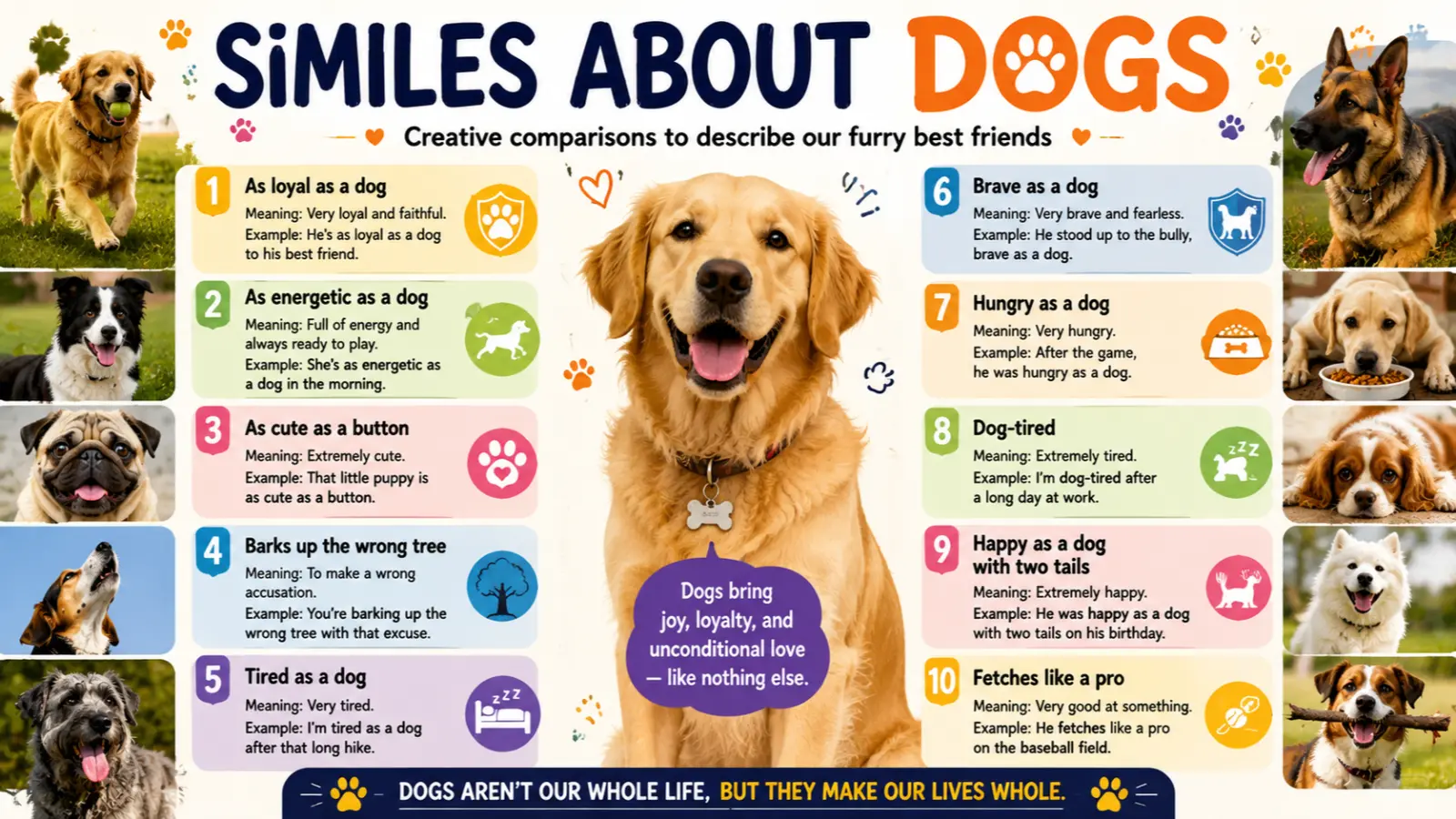
A Similes About Dogs compares two different things using words such as “like” or “as.” For example, “The puppy darted like a spark across the yard” compares the puppy’s movement with a spark to make its speed easier to imagine.
Writers use similes in stories, poems, essays, conversations, captions, and descriptive writing. When Similes About Dogs the comparison is specific and believable, it can show personality and emotion instead of simply telling readers what something is like.
This collection of similes about dogs gives you original comparisons you can study, adapt, or use as inspiration. More importantly, it shows why certain comparisons work and how to create your own.
Quick Answer: What Are Some Good Similes About Dogs?
Some creative similes about dogs include:
- The puppy bounced like a rubber ball on a polished floor.
- The old dog watched the doorway like a patient lighthouse.
- Her tail wagged like a tiny flag caught in a cheerful breeze.
- The terrier raced across the garden like a comet with muddy paws.
- The sleepy dog curled up like a warm comma at the end of a sentence.
These comparisons work because they connect recognizable dog behavior with images readers can immediately visualize.
Why Similes Work So Well for Describing Dogs
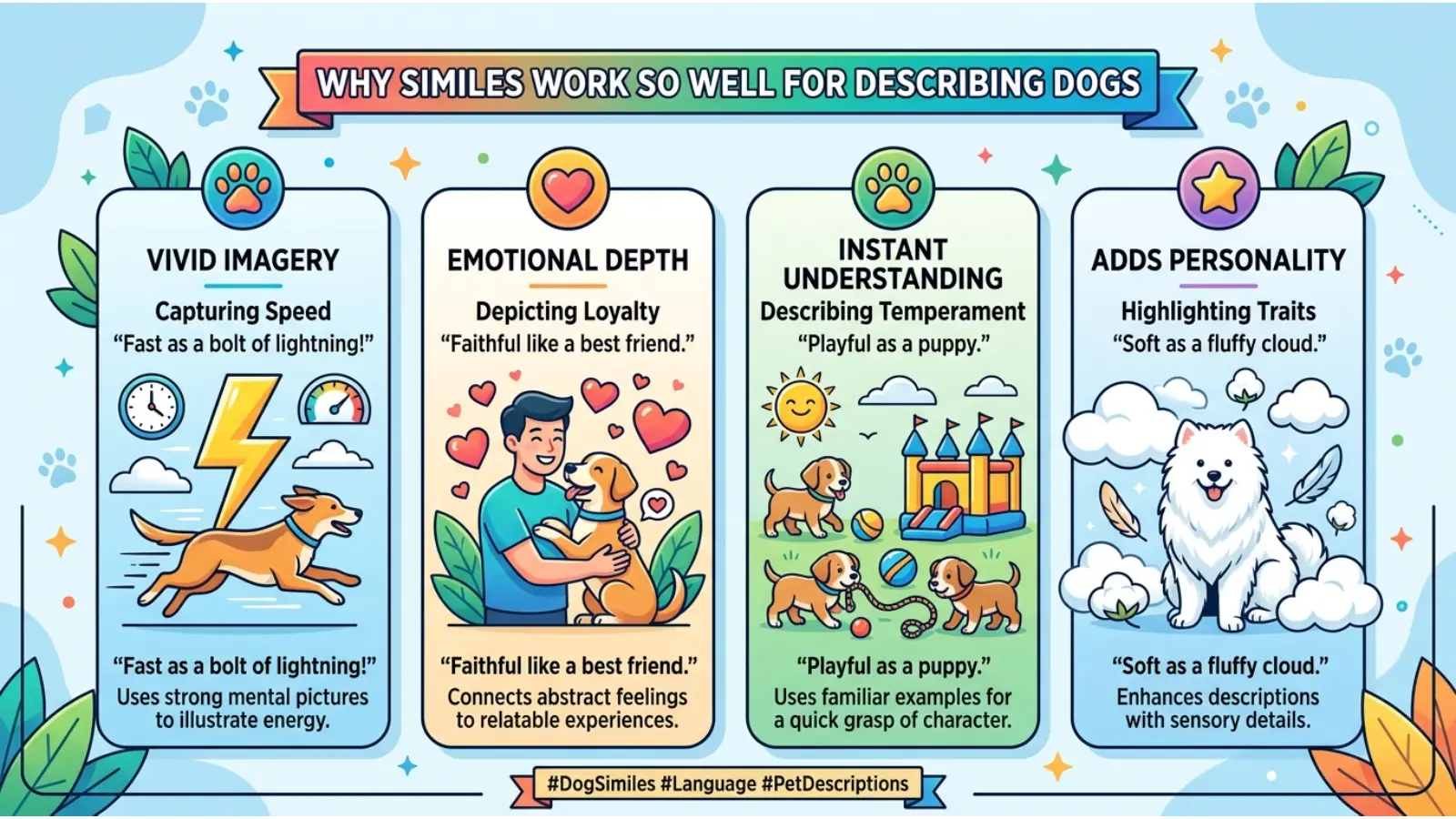
A plain sentence tells readers information:
The dog was energetic.
A Similes About Dogs gives them an image:
The dog sprang around the yard like a wind-up toy that had finally been released.
The second sentence does more than describe energy. It suggests speed, excitement, and playful movement.
The best dog similes usually begin with observable behavior. Instead of searching randomly for something that rhymes with “dog,” notice what the dog is actually doing.
Ask:
- Is the dog moving quickly or slowly?
- Is it curious, nervous, playful, protective, or tired?
- What does its movement resemble?
- What sound does it make?
- What shape does its body create?
- What image matches its personality?
That process produces stronger comparisons than simply choosing the first familiar phrase that comes to mind.
30 Original Similes About Dogs
1. The Puppy Bounced Like a Rubber Ball
Simile:
The puppy bounced like a rubber ball every time someone opened the door.
Meaning:
The puppy’s excitement makes it jump repeatedly and energetically.
Why it works:
A rubber ball suggests repeated, unpredictable movement. It gives the reader a physical picture of the puppy’s enthusiasm.
Writing tip:
Use this comparison for playful puppies rather than calm or older dogs.
2. Her Tail Flicked Like a Tiny Flag
Simile:
Her tail flicked like a tiny flag whenever she heard her name.
The comparison makes the dog’s happiness visible without simply saying, “She was excited.”
Best context:
Stories, children’s writing, and warm character descriptions.
3. The Dog Raced Like a Comet
Simile:
The dog raced across the open field like a comet released from the sky.
Effect:
This creates a feeling of speed and dramatic movement.
Writing tip:
A powerful image such as a comet works best when the dog’s movement is unusually fast. Save dramatic comparisons for moments that deserve them.
4. His Ears Stood Like Two Little Antennas
Simile:
His ears stood like two little antennas as he listened to the strange noise outside.
Meaning:
The dog’s ears are raised because it is alert and curious.
This is especially useful because it connects a familiar physical feature with a recognizable object. The reader can easily picture the posture.
5. The Old Dog Moved Like a Slow Clock
Simile:
The old dog moved through the hallway like a slow clock ticking toward bedtime.
Emotional effect:
The comparison creates a quiet, gentle mood.
It can also suggest age without directly describing the dog as old, weak, or fragile.
6. Her Bark Was Like a Doorbell in the Dark
Simile:
Her bark was like a doorbell in the dark, sudden and impossible to ignore.
Why it works:
The comparison focuses on the effect of the sound, not merely its volume.
Best context:
Mystery stories, nighttime scenes, and suspenseful descriptions.
7. The Puppy Slept Like a Folded Blanket
Simile:
After playing all afternoon, the puppy slept like a folded blanket beside the sofa.
The image creates warmth and stillness. It works particularly well after a scene filled with energetic action.
8. His Nose Worked Like a Detective’s Compass
Simile:
His nose worked like a detective’s compass, pulling him toward every unfamiliar scent.
Meaning:
The dog seems determined to investigate everything around him.
Writing purpose:
This is useful for portraying curiosity without directly writing, “The dog was curious.”
9. The Dog Curled Up Like a Question Mark
Simile:
The little dog curled up like a question mark on the corner of the rug.
This is a shape-based comparison. It focuses on the dog’s body position rather than its personality.
Writing tip:
Shape similes are powerful because readers can visualize them immediately.
10. His Paws Pattered Like Rain on a Window
Simile:
His paws pattered across the wooden floor like rain tapping on a window.
Effect:
The repeated sound becomes easier to hear in the reader’s imagination.
This works particularly well in scenes involving a small, fast-moving dog.
11. The Rescue Dog Watched Like a Guard at an Empty Gate
Simile:
The rescue dog watched the unfamiliar visitors like a guard at an empty gate.
Meaning:
The dog is cautious and observant.
Writing purpose:
The comparison communicates uncertainty without labeling the dog as “nervous.”
12. Her Fur Shone Like Sunlit Velvet
Simile:
Her dark fur shone like sunlit velvet when she stepped into the morning light.
This comparison combines appearance and texture. It is more vivid than simply saying the dog’s coat was shiny.
Best context:
Poetry, descriptive prose, and character introductions.
13. The Puppy Chased Its Tail Like a Dancer Following Music
Simile:
The puppy chased its tail like a dancer following music only it could hear.
Emotional effect:
The image feels playful and slightly whimsical.
It is useful when you want the dog to feel energetic without making the description too ordinary.
14. His Eyes Were Like Two Bright Windows
Simile:
His eyes were like two bright windows watching the kitchen.
Meaning:
The comparison emphasizes alertness and interest.
Writing tip:
When using a visual simile, make sure the object being compared shares a clear quality with the subject. Here, both eyes and windows can suggest something being watched or seen through.
15. The Dog Trembled Like a Leaf in a Breeze
Simile:
The frightened dog trembled like a leaf in a cold breeze.
This comparison emphasizes nervousness through movement.
Best context:
A scene where a dog is frightened by unfamiliar surroundings, loud noises, or a new situation.
16. Her Tail Swished Like a Painter’s Brush
Simile:
Her tail swished like a painter’s brush across the air.
Why it works:
The comparison turns a simple movement into a visual stroke.
It can be especially effective in poetry or slow descriptive scenes.
17. The Puppy Was Like a Pocket-Sized Tornado
Simile:
The puppy was like a pocket-sized tornado, leaving toys scattered behind it.
Effect:
This is a playful exaggeration that communicates chaotic energy.
Writing tip:
Humorous similes often work best when they contain a little exaggeration while remaining recognizable.
18. The Dog Waited Like a Statue Outside the Kitchen
Simile:
The dog waited like a statue outside the kitchen while dinner was being prepared.
Meaning:
The dog remains unusually still while waiting.
The contrast between an animal and a statue makes the moment amusing and easy to visualize.
19. His Growl Rumbled Like Distant Thunder
Simile:
His growl rumbled like distant thunder beneath the porch.
Emotional effect:
The comparison creates tension without describing anything violently or graphically.
Best context:
Suspense, protective behavior, or an unfamiliar nighttime scene.
20. The Puppy Followed Her Like a Shadow With Paws
Simile:
The puppy followed her like a shadow with paws from room to room.
Meaning:
The puppy stays close to the person wherever she goes.
Writing purpose:
This is useful for showing attachment through behavior rather than explaining the relationship directly.
21. The Dog Spun Like a Weather Vane
Simile:
The dog spun like a weather vane whenever he heard footsteps outside.
Why it works:
A weather vane changes direction, so the comparison highlights the dog’s constant shifting attention.
22. His Yawn Opened Like a Folding Tent
Simile:
His huge yawn opened like a folding tent after a long afternoon walk.
This is an unusual comparison based on shape and movement.
Best context:
Funny descriptions, children’s stories, and lighthearted narratives.
23. The Dog Trotted Like a Soldier on a Mission
Simile:
The dog trotted down the sidewalk like a soldier on a mission.
Meaning:
The dog walks with purpose and determination.
The comparison is particularly effective when the dog appears unusually serious about an ordinary task.
24. Her Whiskers Quivered Like Grass in a Breeze
Simile:
Her whiskers quivered like grass in a breeze as she investigated the box.
Effect:
This creates a delicate, detailed image.
Writing tip:
Small physical details can make animal descriptions feel more personal and less generic.
25. The Dog Sat Like a Judge at the Dinner Table
Simile:
The dog sat like a judge at the dinner table, silently examining every plate.
Emotional effect:
This creates humor by giving the dog a serious human role.
This is an example of a simile that also edges toward personification because the animal is being described through a human social role.
26. His Fur Felt Like a Warm Winter Coat
Simile:
His fur felt like a warm winter coat beneath my hand.
Meaning:
The comparison emphasizes warmth and softness.
Best context:
Comforting scenes and sensory descriptions.
27. The Dog Moved Like a Whisper
Simile:
The dog moved like a whisper across the carpet.
Effect:
The comparison suggests extremely quiet movement.
Short similes can be especially effective when the surrounding sentence is already detailed.
28. Her Excitement Spread Like Ripples on Water
Simile:
Her excitement spread like ripples on water when the children entered the yard.
This comparison focuses on how one moment of excitement seems to expand through the scene.
Writing purpose:
Use it when you want to describe not just the dog’s emotion but its effect on the atmosphere.
29. The Stray Dog Stood Like a Question in the Rain
Simile:
The stray dog stood like a question in the rain, unsure which direction to take.
Emotional effect:
This creates uncertainty and invites the reader to wonder what will happen next.
Why it works:
The comparison is abstract but still understandable. A “question” suggests uncertainty, hesitation, and unanswered possibilities.
30. The Sleepy Dog Curled Like a Comma
Simile:
The sleepy dog curled like a comma beside the fireplace.
Meaning:
The dog’s curved body resembles the shape of punctuation.
Writing purpose:
This is a compact example of how an unexpected comparison can make a familiar image memorable.
How to Make Your Dog Similes More Vivid
A strong simile usually comes from a specific observation.
Compare these:
The dog was fast like a car.
with:
The terrier shot through the open gate like a red kite caught by a sudden wind.
The second comparison works better because it gives the reader more information about the movement.
When creating your own similes, think about five elements:
Movement
Look for comparisons involving things that move in similar ways.
A running dog might resemble a kite, arrow, comet, bouncing ball, or racing bicycle.
Sound
Think beyond “loud” or “quiet.”
A bark might remind you of a bell, drumbeat, alarm, echo, or knock.
Shape
A curled dog could resemble a comma, crescent, question mark, coil, or rolled blanket.
Texture
A dog’s coat might remind you of velvet, wool, fleece, grass, or a winter coat.
Emotion
Instead of writing:
The dog was nervous.
Show the emotion through an image:
The dog trembled like a leaf waiting out a storm.
The reader experiences the feeling rather than simply receiving the label.
How Writers Avoid Cliché Dog Similes
Some comparisons are so familiar that they may no longer create a strong image. Familiar phrases can still have a place, but original writing often becomes more memorable when the comparison reflects the specific scene.
For example, instead of automatically writing:
The dog was as fast as lightning.
Try identifying what actually makes the dog’s movement distinctive.
Perhaps:
The puppy shot between the chairs like a marble escaping a child’s hand.
The new comparison is more specific because it creates a particular movement and setting.
A useful rule is:
Don’t ask, “What is this dog like?” Ask, “What exactly is this dog doing, and what else behaves that way?”
That question often leads to fresher imagery.
Similes, Metaphors, and Personification: What’s the Difference?
These literary devices can overlap, but they are not identical.
Simile
A simile makes a comparison using words such as like or as.
The dog slept like a folded blanket.
Metaphor
A metaphor makes a direct comparison without using “like” or “as.”
The dog was a folded blanket beside the fireplace.
The statement is figurative rather than literal.
Personification
Personification gives human qualities, actions, or roles to nonhuman things.
The dog judged every sandwich that crossed the kitchen.
The dog isn’t literally a judge. The sentence gives the animal a human role for humorous effect.
Imagery
Imagery is broader. It uses sensory language to help readers see, hear, feel, smell, taste, or otherwise experience a scene.
A strong simile is one tool writers use to create imagery.
How to Create Your Own Similes About Dogs
You don’t need a huge vocabulary to write an effective simile. You need careful observation.
Step 1: Notice One Specific Detail
Don’t start with “dog.”
Start with something concrete:
- wagging tail
- muddy paws
- twitching ears
- sleepy eyes
- quick footsteps
- soft fur
- excited barking
Step 2: Identify the Quality
Ask what the detail communicates.
Is it:
- fast?
- soft?
- noisy?
- nervous?
- curious?
- graceful?
- clumsy?
- persistent?
Step 3: Search Your Imagination for a Matching Image
If the dog is moving quickly, think of other fast-moving things.
its fur is soft, think of objects with a similar texture.
If its ears are alert, think of things that stand up and listen.
Step 4: Choose the Most Precise Comparison
Don’t choose an image simply because it sounds poetic.
Choose one that actually shares an important quality with the dog.
Step 5: Put It Into a Real Sentence
Instead of writing a comparison by itself, place it inside a scene.
Weak:
The dog was like a rocket.
Stronger:
The puppy launched across the kitchen like a toy rocket when the back door opened.
The surrounding action makes the simile meaningful.
Creative Exercises for Practicing Dog Similes
Exercise 1: Five Senses
Describe the same dog using five different sensory details.
Write one simile for:
- What you see
- What you hear
- What you feel
- What you smell
- How the dog moves
This teaches you to avoid relying only on appearance.
Exercise 2: Change the Mood
Describe the same dog as:
- joyful
- suspicious
- sleepy
- curious
- determined
Keep the dog the same, but change the simile each time.
This shows how comparison can influence a reader’s emotional response.
Exercise 3: Make a Cliché Fresh
Start with a familiar comparison such as:
The dog was as fast as lightning.
Now replace “lightning” with something more specific to your setting.
For example, if the dog is running through a kitchen:
The puppy zipped between the chairs like a marble on a sloping table.
The goal isn’t to make the comparison complicated. It is to make it specific.
Common Mistakes When Writing Dog Similes
Using Too Many Similes
A paragraph packed with comparisons can become exhausting.
One excellent simile can be stronger than five average ones.
Let the surrounding writing breathe.
Choosing a Comparison That Doesn’t Fit
A dog that barely moves should not suddenly be compared to a racing comet unless the comparison is intentionally humorous.
The image needs to match the action.
Mixing Images
Avoid combining unrelated comparisons:
The dog ran like a thunderstorm with wings and a roaring engine.
The reader receives too many competing images.
Choose one clear comparison and develop it.
Explaining the Simile Too Much
If the image is already clear, trust the reader.
For example:
The dog curled like a comma, which means its body was curved in a shape similar to punctuation.
The second part is unnecessary in creative writing. The image can stand on its own.
Confusing Similes With Metaphors
Remember the basic distinction:
Simile: The dog slept like a stone.
Metaphor: The dog was a stone.
Both are figurative, but they use different structures.
Making Every Comparison Grand
Not every dog needs to be a comet, storm, warrior, or superhero.
Sometimes the most effective comparison is quiet:
The old dog waited like a clock in an empty room.
Small images can carry strong emotion.
Frequently Asked Questions About Similes About Dogs
What is a good simile for a dog?
A good dog simile connects a specific behavior or feature with a familiar image. For example, “The puppy bounced like a rubber ball” clearly communicates playful, repeated movement.
What is a simile for a happy dog?
You could write, “The dog’s tail waved like a tiny flag in a cheerful breeze.” The comparison shows excitement through movement rather than simply stating that the dog is happy.
What is a simile for a fast dog?
A creative example is, “The terrier raced across the field like a comet released from the sky.” The comparison emphasizes sudden speed and dramatic movement.
What is a simile for a cute puppy?
Try focusing on a specific feature rather than simply using the word “cute.” For example: “The puppy curled like a comma on the soft rug.” Shape-based comparisons can make descriptions more distinctive.
How do I write a funny simile about a dog?
Exaggerate one recognizable behavior and connect it with an unexpected image. For example, “The puppy was like a pocket-sized tornado, leaving toys scattered behind it.” Humor often comes from the contrast between a small dog and a dramatic image.
What is the difference between a dog simile and a dog metaphor?
A dog simile uses a comparison word such as “like” or “as”: “The dog slept like a blanket.” A metaphor makes the comparison directly: “The dog was a blanket beside the fireplace.”
Can I use dog similes in poetry?
Absolutely. Similes can add rhythm, emotion, sensory detail, and visual imagery to poems. Short, unusual comparisons often work especially well because poetry gives readers space to picture them.
Conclusion
The strongest similes about dogs do more than make a sentence sound creative. They help readers see movement, hear sounds, understand emotion, and remember a scene. When you write about a dog, start by observing one small detail. Notice the ears, paws, tail, fur, posture, sound, or movement. Then ask what else shares that particular quality. The answer can become your simile. Don’t worry about making every comparison dramatic. A simple, precise image can be more powerful than an elaborate one. Try changing one ordinary sentence into a vivid comparison, then experiment with different moods and settings. With practice, you’ll begin creating similes that feel natural, specific, and unmistakably your own.

I am Helena Frost, a writer captivated by the beauty of language and the art of comparison. Through my words, I explore the world by turning ordinary moments into vivid similes and reflections. I enjoy crafting phrases that spark imagination, evoke emotion, and linger in the mind. My writing celebrates the subtle connections between people, nature, and the stories we live. For me, every sentence is an opportunity to reveal the extraordinary in the everyday.