Love Similes Examples can be difficult to describe because it is both emotional and deeply personal. A Love Similes Examples gives that feeling a shape readers can imagine by comparing love to something familiar, such as light, music, weather, nature, or a treasured object.
For example, saying “Her Love Similes Examples was like a window opening after a long winter” creates a clearer picture than simply saying “Her love was comforting.”
These love similes examples can help with poems, stories, romantic writing, greeting cards, personal messages, speeches, and everyday conversation. More importantly, they show how writers can turn an abstract emotion into an image readers can feel.
What Is a Simile for Love?
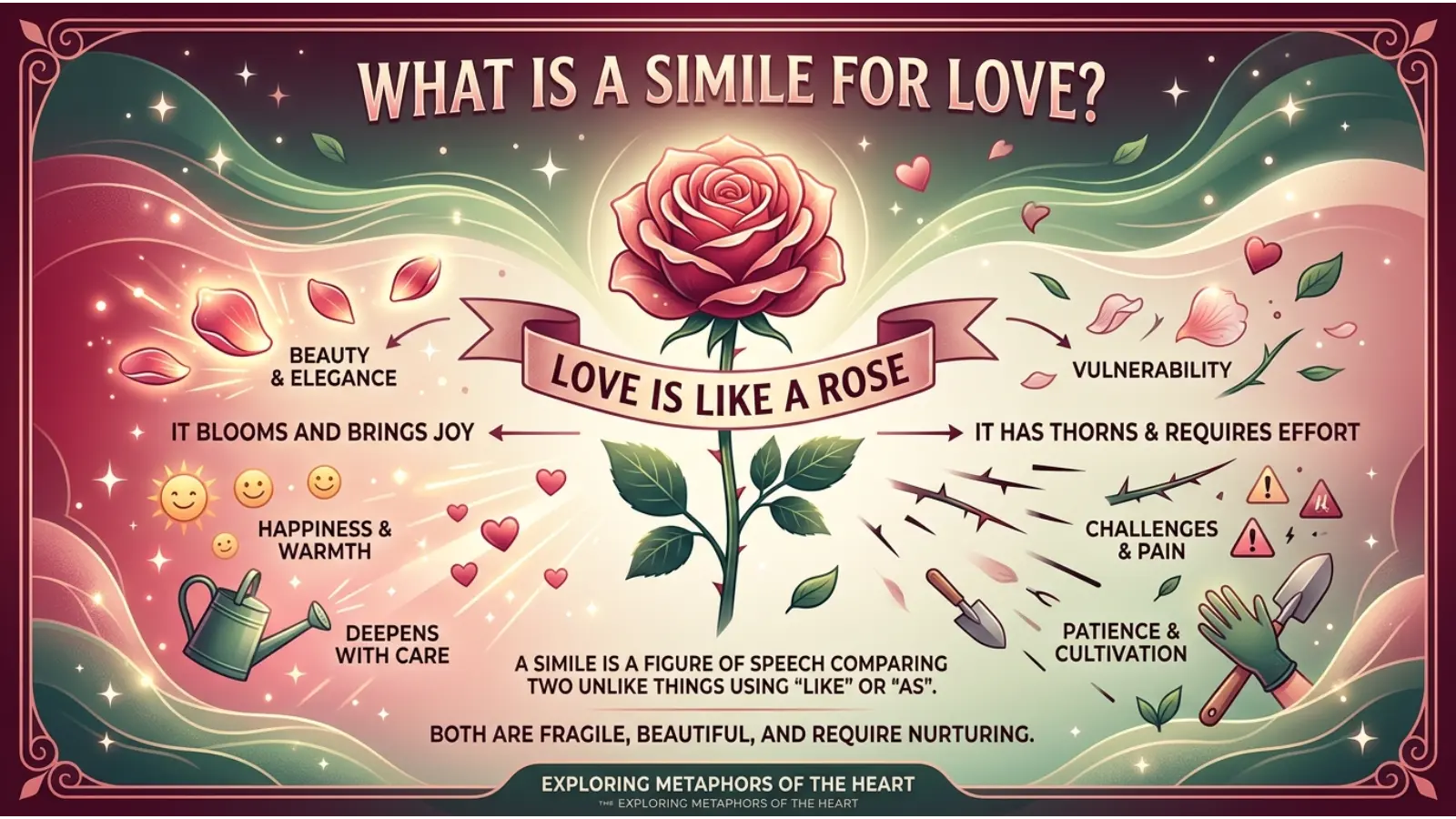
A Love Similes Examples compares love or a loving feeling to something else using words such as like or as.
For example:
His love was like a steady lantern on a dark road.
The comparison does more than say that his love was good. It suggests guidance, warmth, reliability, and hope.
A strong Love Similes Examples usually answers an important question: What does this particular kind of love feel like?
Love Similes Examples can be gentle, exciting, reassuring, complicated, unexpected, or bittersweet. The comparison should match the emotion you want readers to experience.
Love Similes Examples at a Glance
Here are some original comparisons to spark ideas:
- Love Similes Examples was like sunlight finding its way through closed curtains.
- Her affection was as gentle as rain settling over a quiet garden.
- His kindness felt like a warm cup between cold hands.
- Their connection was like two melodies finding the same rhythm.
- Love Similes Examples arrived like a letter with no return address but a familiar handwriting.
- Her smile was like a small lamp turning on in an empty room.
- Their trust grew like roots beneath an old tree.
- His presence was as calming as a lake before sunrise.
- Their laughter moved like sparks across dry leaves.
- Love felt like finding a familiar song in an unfamiliar city.
- Her encouragement was like a bridge over a difficult road.
- Their relationship was as resilient as grass bending beneath heavy rain.
- Love entered his life like morning air through an open window.
- Their closeness felt like two pages belonging to the same unfinished story.
- Her presence was like a candle reflected in several mirrors.
- Their care for each other was as natural as birds returning in spring.
- Love felt like a door opening into a room he did not know he needed.
- Their connection shimmered like sunlight on moving water.
- His devotion was like a path worn gently into the earth by returning footsteps.
- Love was as quiet as snow but impossible to ignore once it covered the world.
These examples are deliberately varied. Some describe romantic love, while others can describe friendship, family affection, loyalty, or emotional connection.
1. Love Was Like Sunlight Finding Its Way Through Closed Curtains
This comparison presents love as something capable of bringing warmth and brightness into a difficult or closed-off situation.
Example sentences:
- Her love was like sunlight finding its way through closed curtains.
- After months of loneliness, his friendship felt like sunlight slipping through a narrow window.
Why it works:
The image suggests hope without simply using the word “hope.”
Best context: Poetry, reflective essays, emotional stories, and heartfelt messages.
Writing tip: When describing emotional healing, compare the feeling to something that gradually changes a dark environment.
2. Her Affection Was as Gentle as Rain Settling Over a Quiet Garden
This simile emphasizes tenderness rather than intensity.
Rain can nourish a garden without demanding attention, making it a useful image for quiet affection.
Example:
Her affection was as gentle as rain settling over a quiet garden.
The comparison works especially well when the character’s love is caring, patient, and understated.
3. His Kindness Felt Like a Warm Cup Between Cold Hands
Here, love is communicated through physical comfort.
The reader can almost feel the warmth, which makes the emotional description more concrete.
Use it for:
Comfort, friendship, family affection, or a relationship built on kindness.
Writing lesson: Sensory comparisons are often stronger than abstract descriptions. Think about what love might feel, sound, smell, look, or taste like before choosing your comparison.
4. Their Connection Was Like Two Melodies Finding the Same Rhythm
Music provides a natural language for relationships.
Two melodies do not need to be identical to work together. This makes the simile useful for describing people with different personalities who understand one another.
Example:
They were different in almost every way, but their connection was like two melodies finding the same rhythm.
Best context: Romantic fiction, poetry, relationship essays, and music-related writing.
5. Love Arrived Like a Letter With No Return Address but a Familiar Handwriting
This comparison gives love a sense of mystery and recognition.
The missing return address suggests uncertainty, while familiar handwriting suggests that the feeling somehow belongs.
Writing purpose: This is especially effective when introducing an unexpected relationship or rediscovered affection.
6. Her Smile Was Like a Small Lamp Turning On in an Empty Room
The small lamp does not transform the entire world. It simply creates enough light to change the atmosphere.
That makes this a useful comparison for a subtle emotional effect.
Example:
Whenever the conversation became uncomfortable, her smile was like a small lamp turning on in an empty room.
Why it works: The image is specific rather than simply calling the smile “beautiful.”
7. Their Trust Grew Like Roots Beneath an Old Tree
Trust rarely appears instantly. It develops gradually, often where other people cannot see it.
Roots are therefore a strong image for relationships that become stronger over time.
Writing tip: Use growth imagery when your story focuses on a relationship developing gradually.
8. His Presence Was as Calming as a Lake Before Sunrise
This simile creates a peaceful emotional atmosphere.
The lake represents stillness, while sunrise suggests that something new may be beginning.
Best context: Quiet romance, reflective writing, poetry, and scenes where characters feel safe around each other.
9. Their Laughter Moved Like Sparks Across Dry Leaves
Not every love simile needs to be soft.
This comparison gives laughter energy and movement. The image suggests that one person’s amusement quickly affects another.
Example:
Their laughter moved like sparks across dry leaves, spreading through the room before anyone could stop smiling.
Writing lesson: Dynamic verbs can make similes more vivid. Instead of saying laughter “was like” something, describe how it moves.
10. Love Felt Like Finding a Familiar Song in an Unfamiliar City
This comparison combines unfamiliarity with recognition.
It works particularly well for stories about meeting someone who makes a strange situation suddenly feel comfortable.
Best context: Travel stories, romantic fiction, personal essays, and poetry.
11. Her Words Were Like Soft Footprints Across Fresh Snow
This simile presents speech as gentle and memorable.
Fresh snow also suggests that the words leave an impression.
Example:
Her words were like soft footprints across fresh snow, quiet but impossible to overlook.
Writing purpose: Use this kind of comparison when dialogue changes a character emotionally without being dramatic.
12. Their Bond Was as Patient as a River Shaping Stone
A river does not need to change a stone all at once.
This makes the comparison useful for long-lasting relationships that become stronger through time and persistence.
Key idea: Good similes can communicate time, not just emotion.
13. His Love Was Like a Compass That Never Demanded a Destination
This comparison presents love as guidance without control.
It can describe someone who supports another person’s choices instead of deciding their future for them.
Best context: Character development, reflective writing, relationship essays, and mature love stories.
14. Their Memories Glowed Like Windows at Dusk
Windows glowing at dusk suggest warmth, distance, and memory.
The comparison works particularly well when characters are remembering someone they have not seen for a long time.
Writing tip: Images associated with evening, distance, and fading light can create a reflective mood without directly stating that a character feels nostalgic.
15. Love Was as Surprising as a Wildflower Growing Through a Sidewalk Crack
This image emphasizes unexpected beauty.
A sidewalk is hard and ordinary, while a wildflower is delicate and alive. Their contrast creates the emotional effect.
Use it when: Writing about love that appears during an unexpected period of life.
16. Her Friendship Felt Like Shade on a Long Summer Walk
Not every love comparison has to describe romance.
This simile works beautifully for friendship because it focuses on relief, comfort, and companionship.
Example:
Her friendship felt like shade on a long summer walk; she made difficult days easier to cross.
Writing lesson: When writing about friendship, think about the practical ways a person makes life easier.
17. Their Reunion Was Like Rain Returning to Thirsty Soil
The image suggests that both characters have been waiting for something they deeply need.
It can communicate relief, renewal, and emotional restoration.
Best context: Reunion scenes, family stories, romantic fiction, and poetry.
18. His Affection Was as Steady as a Clock Ticking Through the Night
This comparison focuses on consistency rather than excitement.
It works for a character whose love is dependable even when circumstances become difficult.
Writing tip: For dependable characters, choose images that continue working quietly in the background.
19. Love Wrapped Around Them Like a Quiet Melody
This is a softer and more atmospheric comparison.
A melody surrounds listeners without physically touching them, making it useful for describing an emotional atmosphere shared by two people.
Best context: Poetry, romantic scenes, reflective prose, and lyrical descriptions.
20. Their Hearts Seemed to Move Like Dancers Who Already Knew the Next Step
The dancers suggest coordination, anticipation, and trust.
The comparison does not require the characters to agree about everything. It suggests that they understand one another emotionally.
Writing purpose: Use movement-based imagery when describing chemistry or emotional connection.
21. Her Encouragement Was Like a Bridge Over a Difficult Road
This comparison shows support as something that helps another person move forward.
Example:
When he doubted himself, her encouragement was like a bridge over a difficult road.
Why it works: The image turns an abstract quality—encouragement—into something functional.
22. Their Relationship Was as Resilient as Grass Bending Beneath Heavy Rain
Grass bends but can continue growing.
This makes the simile suitable for relationships that survive difficult circumstances without pretending that hardship never happened.
Best context: Stories about resilience, family, friendship, and long-term relationships.
23. Love Entered His Life Like Morning Air Through an Open Window
This comparison creates a feeling of freshness and unexpected change.
The open window also suggests that the character has become receptive to something new.
Writing tip: When a character experiences a major emotional change, compare it to a physical change in their surroundings.
24. Their Closeness Felt Like Two Pages Belonging to the Same Unfinished Story
This simile connects love with storytelling itself.
The unfinished story suggests that the relationship is still developing.
Best context: Contemporary fiction, poetry, personal essays, and reflective writing.
25. Her Presence Was Like a Candle Reflected in Several Mirrors
One candle produces multiple reflections.
The comparison suggests that one person’s presence can affect many parts of another person’s life.
Writing lesson: An unusual image becomes stronger when the reader can understand the connection without needing a long explanation.
26. Their Care for Each Other Was as Natural as Birds Returning in Spring
This comparison suggests instinct, familiarity, and renewal.
It can describe a relationship that feels effortless after a period of separation.
Best context: Family relationships, friendship, reunion stories, and gentle romance.
27. Love Felt Like a Door Opening Into a Room He Did Not Know He Needed
This image is about discovery.
The character does not merely enter a new room; he realizes that he needed something he had not previously understood.
Use it for: Stories about unexpected emotional growth or surprising relationships.
28. Their Connection Shimmered Like Sunlight on Moving Water
Moving water reflects light in changing patterns, making it an effective image for a relationship that is lively and constantly evolving.
Example:
Their connection shimmered like sunlight on moving water, never quite the same from one moment to the next.
Writing tip: Choose moving images when the relationship itself is changing.
29. His Devotion Was Like a Path Worn Gently Into the Earth by Returning Footsteps
A path becomes visible because someone keeps walking it.
The image therefore communicates repeated choice, commitment, and consistency.
Best context: Long-term relationships and stories about loyalty.
30. Love Was as Quiet as Snow but Impossible to Ignore Once It Covered the World
This comparison combines silence with overwhelming presence.
It shows that love does not always announce itself dramatically. Sometimes its impact becomes obvious gradually.
Best context: Poetry, reflective essays, and emotionally restrained fiction.
How to Make Love Similes More Powerful
A simile becomes memorable when the comparison adds information that a plain adjective cannot provide.
Compare:
She was kind.
with:
Her kindness was like shade on a long summer walk.
The second sentence suggests relief, comfort, patience, and companionship.
The goal is not to make every sentence poetic. Instead, use similes where an image can reveal something important about a character or emotion.
Choose the Emotion Before Choosing the Image
“Love” is too broad to guide your comparison by itself.
First decide what kind of love you mean:
- Tender love: flowers, warm light, soft rain
- Steady love: roots, clocks, bridges, rivers
- Unexpected love: open doors, wildflowers, unfamiliar songs
- Joyful love: music, sparks, sunlight, dancing
- Protective love: shelter, shade, lanterns, bridges
- Long-lasting love: trees, paths, rivers, stars
This approach helps prevent random comparisons.
Use Contrast to Create Stronger Imagery
One of the easiest ways to create an interesting simile is to put contrasting things together.
For example:
Love was like a wildflower growing through a sidewalk crack.
The contrast between a hard sidewalk and a delicate flower makes the image memorable.
When brainstorming, ask:
What is the opposite of the emotional environment?
If your character feels lonely, perhaps love can be compared with warmth entering a cold place. If the character feels lost, love might resemble a compass or a light.
Avoid Similes That Sound Generic
Some comparisons have become so common that they no longer create a strong image.
For example, phrases involving hearts, stars, roses, and endless oceans can work, but only when the writer gives them a fresh angle.
Instead of:
Her love was like a rose.
Try asking:
What specifically about a rose represents this character’s love?
Maybe it is the way the flower survives a harsh season, the unexpected color, or the contrast between beauty and thorns.
Specificity creates originality.
Love Similes in Poetry
Poetry gives similes room to create mood and rhythm.
A poetic simile does not always need to explain itself immediately.
For example:
Their memories glowed like windows at dusk.
The reader can interpret the image emotionally without receiving a direct explanation.
When writing poetry, pay attention to:
- rhythm
- sound
- line length
- sensory detail
- emotional contrast
- the relationship between nearby images
Avoid placing several unrelated comparisons next to one another. A poem becomes stronger when its imagery belongs to the same emotional world.
Love Similes in Stories
In fiction, similes can reveal character as well as describe emotion.
Imagine two characters experiencing the same feeling.
One might think:
His love was like an anchor.
Another might think:
Her love was like an unlocked window.
The first character may value stability. The second may value freedom.
That means a simile can tell readers something about the person making the comparison, not just the thing being described.
Use Similes to Reveal Character
Instead of writing:
Maria trusted him completely.
You could write:
Her trust in him was like roots beneath an old tree, mostly invisible but impossible to pull away.
Now the comparison communicates both strength and depth.
Similes for Love in Everyday Conversation
Similes do not belong only in poems and novels.
They can make messages, speeches, cards, and conversations more expressive.
For example:
“Talking to you is like finding a quiet place in a busy day.”
Or:
“Your support has been like a bridge when everything felt difficult.”
The key is moderation. A single thoughtful comparison often has more impact than a paragraph filled with dramatic imagery.
Simile vs. Metaphor: What’s the Difference?
A simile makes a comparison using words such as like or as.
Her love was like sunlight.
A metaphor makes the comparison directly.
Her love was sunlight.
Both can create strong imagery, but they produce slightly different effects.
Similes often feel more conversational and explanatory because the comparison is clearly signaled. Metaphors can feel more direct and compressed.
Simile vs. Hyperbole
A hyperbole uses deliberate exaggeration.
I could wait a thousand years for you.
That sentence is not intended literally.
A simile could use exaggeration too:
His love felt like an ocean stretching beyond the horizon.
The comparison creates imagery, while the enormous scale adds intensity.
How to Create Your Own Love Similes
You do not need to wait for inspiration. You can build an original simile deliberately.
Step 1: Name the exact emotion
Don’t start with “love.”
Try:
- comfort
- excitement
- trust
- longing
- admiration
- affection
- loyalty
- relief
- tenderness
Step 2: Describe the emotion physically
Ask what it might:
- look like
- sound like
- feel like
- move like
- smell like
- behave like
Step 3: Brainstorm ordinary objects
Consider:
- weather
- rooms
- roads
- music
- plants
- water
- light
- books
- tools
- animals
- seasons
Step 4: Look for an unexpected connection
Suppose your emotion is trust.
Instead of immediately choosing “strong as a rock,” think about things that develop slowly.
You might arrive at:
Their trust grew like roots beneath an old tree.
Step 5: Test the comparison
Ask three questions:
- Does the image make sense?
- Does it create the emotion I want?
- Does it tell the reader something new?
If the answer is yes, the simile is probably doing useful work.
Creative Exercises for Writing Better Love Similes
Exercise 1: Five Senses
Choose the word love and create one comparison for each sense.
- Love sounds like ______.
- Love feels like ______.
- Love looks like ______.
- Love smells like ______.
- Love tastes like ______.
You do not need to use every result. Choose the most surprising one.
Exercise 2: Change the Mood
Take one idea and create three versions.
Love is like ______.
Write one that feels:
- joyful
- peaceful
- bittersweet
This teaches you how changing the image changes the emotional effect.
Exercise 3: Avoid the Obvious
Write a love simile without using:
- roses
- hearts
- stars
- oceans
- angels
The restriction forces you to search for fresher imagery.
Exercise 4: Character-Based Comparisons
Imagine three characters describing love.
One is optimistic.
is cautious.
One is adventurous.
Write a different simile for each character.
The goal is not merely to create three comparisons. It is to make each comparison sound as though a different person created it.
Common Mistakes When Writing Love Similes
Using Too Many Clichés
If readers have encountered the same comparison thousands of times, it may no longer surprise them.
A familiar image is not automatically bad, but it should serve a clear purpose.
Mixing Unrelated Images
Be careful with sentences such as:
Her love was like a stormy lighthouse dancing through a river of fire.
The individual images do not naturally belong together.
Choose one dominant image and develop it.
Forcing a Simile Into Every Sentence
Similes are tools, not decorations.
If every sentence contains a comparison, the strongest images lose their impact.
Use them where they add something.
Explaining the Simile Too Much
Sometimes writers create a strong image and then explain exactly what every part means.
For example:
His love was like a lantern in the dark because lanterns give light, and his love gave her emotional support.
The second half can weaken the image.
Trust readers to make reasonable connections.
Confusing a Simile With a Metaphor
Remember:
Her love was like a river. — simile
Her love was a river. — metaphor
Both are valid. They simply use different structures.
Choosing an Image That Does Not Match the Emotion
A playful love story may not need an image associated with grief or isolation.
Always ask whether the comparison’s emotional associations match the scene.
Frequently Asked Questions About Love Similes
What are some examples of similes for love?
Examples include “Love was like sunlight finding its way through closed curtains” and “Their connection was like two melodies finding the same rhythm.” Strong love similes connect emotion with a clear, memorable image.
How do you describe love using a simile?
Start by identifying the specific feeling you want to express, such as tenderness, trust, excitement, or comfort. Then compare that feeling with something readers can easily imagine.
What is a romantic simile?
A romantic simile compares romantic feelings, relationships, or affection with another image using words such as like or as. For example, “Their connection was like two melodies finding the same rhythm.”
What are some similes for deep love?
Deep love can be compared with things that suggest permanence or gradual growth, such as roots, rivers, paths, trees, or enduring light.
Can similes describe friendship and family love?
Yes. Similes are useful for any form of affection. A friendship might be described as “like shade on a long summer walk,” while family love might be compared with roots beneath a tree.
What is the difference between a love simile and a love metaphor?
A love simile explicitly compares two things using like or as, while a metaphor makes the comparison directly. “Love is like sunlight” is a simile; “Love is sunlight” is a metaphor.
How can I make my love similes more original?
Focus on a specific emotion, use sensory details, avoid predictable comparisons, and look for connections between things that do not usually appear together. Specific experiences often produce fresher imagery.
Conclusion
The best love similes do more than make writing sound poetic. They help readers experience an emotion through an image. Instead of simply telling readers that someone feels loved, show what that feeling resembles. When creating your own comparisons, start with the feeling, search for a physical image, and choose details that fit the character and situation. A good simile does not need to be complicated. It needs to be specific, believable, and emotionally useful. Experiment with different images, revise the comparisons that feel predictable, and let your own experiences guide the metaphors and similes you create. The more carefully you observe ordinary things, the more possibilities you will find for describing extraordinary feelings.

I am Helena Frost, a writer captivated by the beauty of language and the art of comparison. Through my words, I explore the world by turning ordinary moments into vivid similes and reflections. I enjoy crafting phrases that spark imagination, evoke emotion, and linger in the mind. My writing celebrates the subtle connections between people, nature, and the stories we live. For me, every sentence is an opportunity to reveal the extraordinary in the everyday.