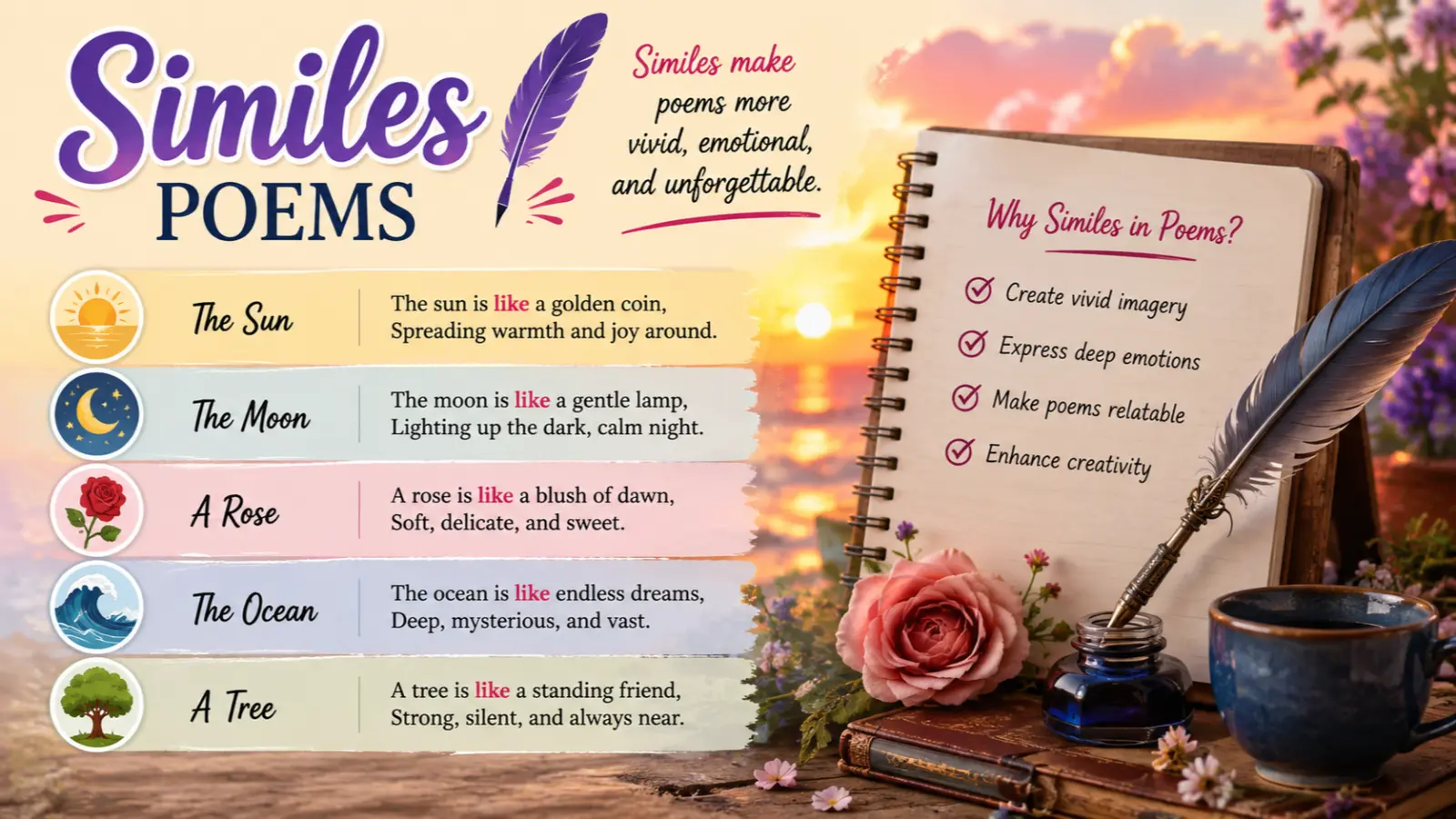
Similes Poems are one of the easiest ways to make poetry more vivid, emotional, and memorable. By comparing one thing to another using words such as like or as, a poet can help readers see an ordinary idea in a fresh way.
For example, instead of saying the moon was bright, a poet might write, “The Similes Poems moon glowed like a lantern above the sleeping town.” The comparison gives the reader a picture rather than simply stating a fact.
Similes poems can appear in love poetry, nature poems, songs, children’s verse, storytelling, and spoken-word writing. This guide explains how similes work in poetry, provides original examples, and shows you how to create comparisons that feel natural rather than forced.
What Is a Simile in a Poem?
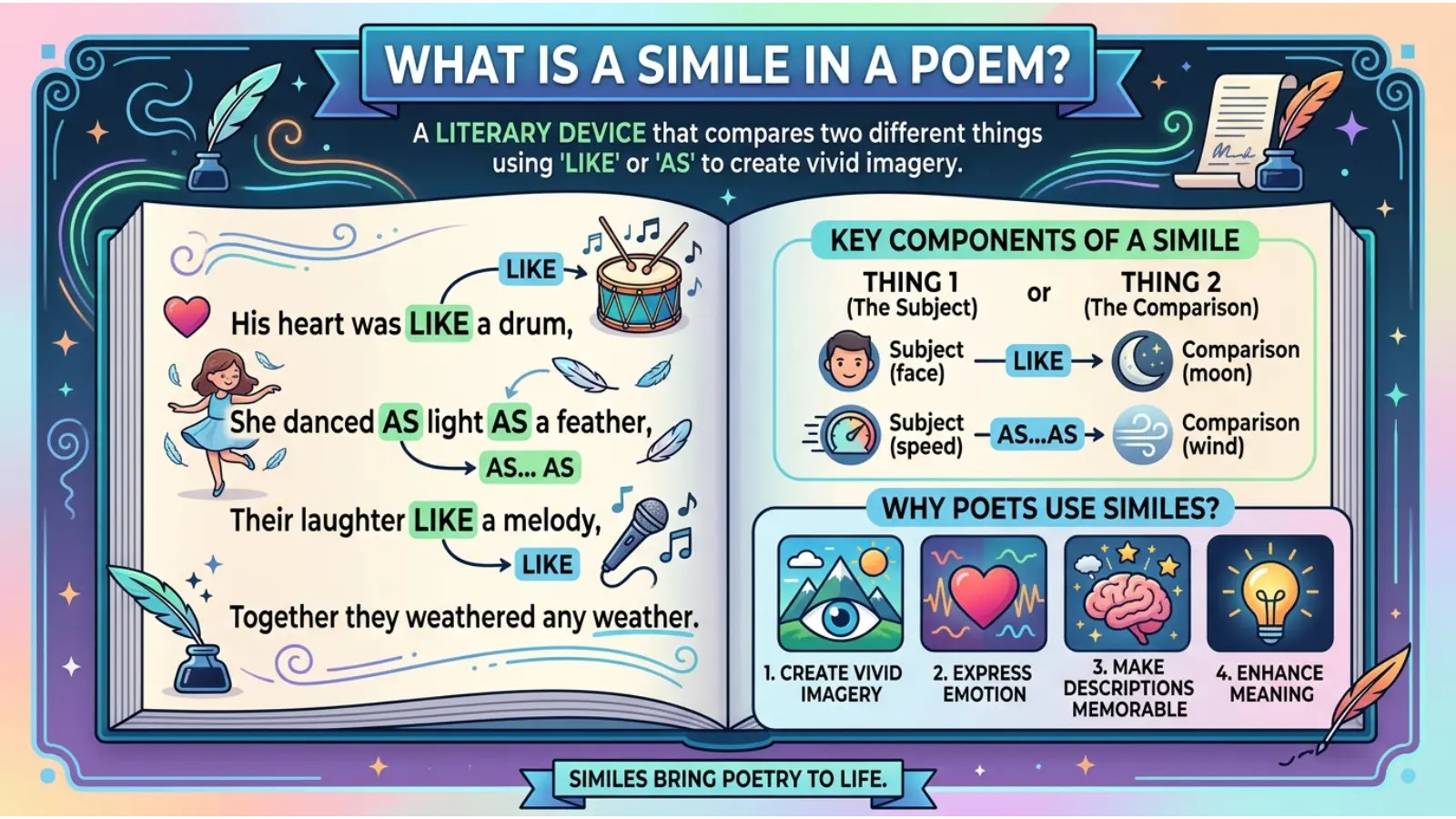
A Similes Poems is a comparison between two different things, usually introduced by like or as.
Example:
Her laughter rose like birds startled from a tree.
The Similes Poems writer does not mean that the laughter is literally birds. The comparison suggests that it is quick, lively, and full of movement.
In poetry, Similes Poems can help communicate:
- Emotion
- Appearance
- Movement
- Sound
- Atmosphere
- Personality
- Abstract ideas
- Sensory experiences
A strong poetic Similes Poems does more than decorate a line. It gives the reader a way to experience the subject.
Why Do Poets Use Similes?
Poetry often has limited space, so every image needs to earn its place. A Similes Poems carefully chosen comparison can communicate an idea in only a few words.
Compare these sentences:
The rain was heavy.
and:
Rain pressed against the windows like handfuls of silver thrown from the sky.
The second version creates movement, sound, and visual imagery. The reader can almost feel the storm.
Similes Turn Feelings Into Images
Some emotions are difficult to describe directly. A simile gives them a physical shape.
Instead of:
I was nervous.
A poem could say:
My thoughts fluttered like paper caught beneath a door.
The comparison makes nervousness feel restless and uncontrollable.
Similes Help Readers Remember a Poem
A fresh image can stay in a reader’s mind long after the poem ends. This is especially useful when writing about familiar subjects such as love, rain, friendship, childhood, or nature.
The goal is not to make every line dramatic. One precise comparison can sometimes be more effective than several ordinary ones.
25 Original Similes for Poems
The following examples are original comparisons designed to demonstrate different poetic effects.
1. “The Moon Was Like a Quiet Lantern”
Simile:
The moon hung like a quiet lantern above the fields.
Meaning: The moon provides a gentle source of light in darkness.
Writing effect: This creates a peaceful nighttime atmosphere.
Best context: Nature poetry, reflective poems, and nighttime scenes.
2. “Her Smile Was Like Morning Through Curtains”
Simile:
Her smile was like morning slipping through half-closed curtains.
Meaning: Her smile brings warmth and brightness after darkness.
Writing effect: It creates a feeling of hope without simply using the word hopeful.
Poetry example:
Her smile was like morning through curtains,
soft enough to wake the room.
3. “The River Moved Like a Silver Thread”
Simile:
The river moved like a silver thread stitched across the valley.
Meaning: The narrow, winding river visually connects different parts of the landscape.
Writing tip: Comparisons work especially well when they connect movement with something readers already understand.
4. “His Voice Was as Gentle as Falling Snow”
Simile:
His voice was as gentle as falling snow.
Meaning: His voice is quiet, soft, and calming.
Best context: Peaceful or emotional poetry.
Writing purpose: This comparison emphasizes sound through a visual image.
5. “The City Buzzed Like a Beehive”
Simile:
At noon, the city buzzed like a restless beehive.
Meaning: The city is crowded, noisy, and active.
Writing effect: The word restless makes the familiar comparison more specific.
6. “Her Thoughts Ran Like Wild Horses”
Simile:
Her thoughts ran like wild horses across an open field.
Meaning: Her mind is moving quickly and without control.
Best context: Poems about anxiety, excitement, imagination, or uncertainty.
7. “The Stars Were Like Pinholes in Velvet”
Simile:
The stars looked like pinholes scattered through black velvet.
Meaning: Tiny points of light appear against a dark sky.
Writing insight: Comparing the night sky to fabric gives the image texture as well as color.
8. “His Anger Rose Like a Storm Tide”
Simile:
His anger rose like a storm tide against the shore.
Meaning: His anger becomes increasingly powerful.
Emotional effect: The comparison suggests strength and danger without describing anger directly.
9. “Her Memory Was Like a Photograph in Water”
Simile:
Her memory was like a photograph left in water, beautiful but slowly changing.
Meaning: A memory remains meaningful while becoming less clear over time.
Best context: Nostalgic poetry and poems about growing older.
10. “The Wind Whispered Like a Secret”
Simile:
The wind moved through the grass like a secret nobody wanted to say aloud.
Meaning: The wind feels quiet, mysterious, and intimate.
Writing tip: Adding an emotional situation to a natural image can make the comparison more original.
11. “His Hope Was Like a Match in Winter”
Simile:
His hope was like a match in winter, small but fiercely protected.
Meaning: Hope may seem fragile, yet it can remain powerful.
Writing purpose: This works well when a poem explores perseverance.
12. “The Old House Stood Like a Forgotten Book”
Simile:
The old house stood like a forgotten book beneath the trees.
Meaning: The house seems neglected and full of untold history.
Writing effect: The comparison encourages readers to imagine stories hidden inside the house.
13. “Laughter Spilled Like Marbles Across the Floor”
Simile:
Their laughter spilled like marbles across the kitchen floor.
Meaning: The laughter is lively, scattered, and difficult to contain.
Best context: Childhood poems, family scenes, and joyful memories.
14. “The Clouds Drifted Like Ships Without Anchors”
Simile:
The clouds drifted like ships without anchors.
Meaning: The clouds move freely across the sky.
Writing tip: A comparison becomes stronger when both sides share a clear quality—in this case, drifting movement.
15. “Loneliness Sat Beside Him Like an Empty Chair”
Simile:
Loneliness sat beside him like an empty chair.
Meaning: The absence of companionship feels physically present.
Emotional effect: The image creates quiet sadness without explaining it directly.
16. “The Morning Opened Like a Window”
Simile:
Morning opened like a window onto a brighter world.
Meaning: A new day creates a sense of possibility.
Best context: Hopeful, inspirational, or renewal-themed poems.
17. “The Leaves Fell Like Letters From the Trees”
Simile:
The leaves fell like letters the trees had finally decided to send.
Meaning: Falling leaves are imagined as messages from nature.
Writing purpose: This adds imagination and narrative to an ordinary seasonal event.
18. “Her Courage Was Like a Small Boat in Rough Water”
Simile:
Her courage was like a small boat crossing rough water.
Meaning: Courage does not eliminate difficulty; it helps someone continue through it.
Writing insight: Strong similes do not always compare something powerful with something powerful. A small object can represent great strength.
19. “The Classroom Was as Quiet as a Closed Museum”
Simile:
The classroom was as quiet as a closed museum.
Meaning: The room is unusually silent.
Best context: School poetry or scenes involving suspense and anticipation.
20. “The Ocean Roared Like a Giant Door”
Simile:
The ocean roared like a giant door opening somewhere beyond the world.
Meaning: The sound of the waves feels enormous and mysterious.
Writing effect: The comparison combines sound with imagination.
21. “His Words Fell Like Pebbles”
Simile:
His words fell like pebbles into the still conversation.
Meaning: His words disturb an otherwise calm moment.
Best context: Dramatic or tense poetry.
22. “The Garden Glowed Like a Painted Memory”
Simile:
The garden glowed like a painted memory after the rain.
Meaning: The garden looks vivid and dreamlike.
Writing tip: Abstract nouns such as memory can produce striking images when paired with something concrete.
23. “Time Moved Like a Train in Fog”
Simile:
Time moved like a train in fog, always leaving before I could see where it went.
Meaning: Time seems fast, mysterious, and impossible to hold.
Best context: Reflective poetry about aging, change, or loss.
24. “The Child’s Curiosity Was Like a Door With No Lock”
Simile:
The child’s curiosity was like a door with no lock.
Meaning: Nothing seems able to stop the child’s desire to discover things.
Writing purpose: This creates a memorable character description.
25. “The Sunset Spread Like Ink Across the Sky”
Simile:
The sunset spread like warm ink across the evening sky.
Meaning: The colors gradually cover the sky.
Writing effect: The image emphasizes movement and color at the same time.
How to Make Your Similes More Vivid
A weak simile often compares something with the first object that comes to mind.
For example:
The girl was as happy as the sun.
The idea is understandable, but it is broad and predictable.
A more specific comparison could be:
Her happiness bounced through the room like sunlight on a moving lake.
The second version gives the reader movement and a visual scene.
Choose Comparisons With Shared Qualities
Ask yourself:
What exactly do these two things have in common?
If you write:
His voice was like thunder,
you need to know whether you mean loud, deep, frightening, powerful, or sudden.
Then make that quality clearer.
His voice rolled through the hall like thunder trapped beneath a roof.
Now the comparison has a more defined purpose.
Use Unexpected but Believable Connections
Originality does not mean making a comparison completely random.
A useful technique is to take an ordinary subject and connect it with an unexpected object that shares one important characteristic.
For example:
The old photograph felt like a window that had forgotten the view.
The photograph and window are different, but both can connect the viewer with something distant.
How Poets Avoid Cliché Similes
Some comparisons have become so familiar that they may no longer create a strong image.
Examples include:
- as busy as a bee
- as cold as ice
- as white as snow
- like a lion
- like a bolt from the blue
These expressions are not automatically wrong. They can still work when the context calls for a familiar phrase. But original poetry often benefits from a more specific comparison.
Instead of:
The room was as cold as ice.
Try identifying what the cold actually does:
Cold gathered in the room like water collecting beneath a door.
The new image gives cold a physical presence.
Similes for Different Poetic Subjects
Similes for Love
Love poetry often becomes stronger when it avoids simply saying that love is beautiful or strong.
Try images that show what love does:
Their love grew like roots beneath an old stone wall, hidden but persistent.
The comparison suggests endurance rather than merely attractiveness.
Similes for Happiness
Happiness moved through the house like music from an open window.
This works because both happiness and music can spread from one place to another.
Similes for Friendship
Their friendship was like a well-worn path through the woods, familiar even in the dark.
This suggests trust, familiarity, and reliability.
Similes for Rain
Rain tapped on the roof like impatient fingers.
This emphasizes sound and gives the weather a human quality.
Similes for Anger
His anger climbed like smoke through a closed room.
This presents anger as something that gradually fills a space.
Simile vs. Metaphor in Poetry
A simile makes a comparison openly, usually with like or as.
Simile:
The clouds were like ships.
A metaphor makes the comparison directly.
Metaphor:
The clouds were ships.
Both can create imagery, but they produce slightly different effects.
A simile leaves a little distance between the two ideas. A metaphor can feel more immediate and forceful.
Simile, Imagery, and Personification
Similes often work alongside other literary devices.
Imagery appeals to the senses:
The rain smelled like wet earth after a long summer.
Personification gives human qualities to nonhuman things:
The old house watched the road.
A poet can combine them:
The old house watched the road like a tired guard waiting for someone to return.
The result creates character, atmosphere, and comparison in one image.
How to Create Your Own Similes
You do not need to wait for inspiration. You can build an effective simile deliberately.
Step 1: Choose the Subject
Start with something simple:
rain, fear, friendship, moonlight, music, childhood, silence
Step 2: Identify Its Main Quality
Ask:
- What does it look like?
- What does it sound like?
- How does it move?
- What does it feel like?
- What does it make me remember?
For rain, you might choose persistent, restless, soft, or heavy.
Step 3: Brainstorm Concrete Objects
If the quality is persistent, think of things that keep going:
- A dripping tap
- A clock
- Roots
- A river
- Footsteps
- A knocking door
Step 4: Test the Comparison
Put the ideas together:
The rain was like a dripping tap.
It works, but it is ordinary.
Try:
The rain kept returning like footsteps in a hallway.
Now the comparison creates suspense and movement.
Step 5: Add One Precise Detail
Do not overload the line. One strong detail can be enough.
The rain returned like footsteps in a hallway no one could see.
The added detail changes the emotional atmosphere.
Creative Exercises for Writing Similes
Exercise 1: Five Senses
Choose one subject and describe it through sight, sound, smell, taste, and touch. Create one simile for each sense.
Exercise 2: Replace an Abstract Word
Take a sentence such as:
She felt lonely.
Replace the abstract emotion with an image.
For example:
She felt like the last light left on in an empty building.
Exercise 3: Ban the Obvious Comparison
Choose a familiar topic such as the sun, rain, love, or anger. Write five comparisons without using the first idea that comes to mind.
This forces your imagination beyond familiar phrases.
Exercise 4: Build a Simile From Movement
Choose a moving subject and ask what else moves in a similar way.
For example:
Leaves → letters → falling messages
Then create a line:
Leaves fell like letters the trees had written but never addressed.
Common Mistakes When Writing Similes
Using a Comparison That Adds Nothing
The blue sky was like something blue.
A comparison should reveal something rather than repeat an obvious characteristic.
Mixing Two Different Images
Avoid beginning with one comparison and suddenly switching to another unrelated image.
A reader should be able to follow the visual idea.
Choosing a Comparison Only Because It Sounds Poetic
Beautiful-sounding words do not automatically create a meaningful image. Ask what the comparison actually tells the reader.
Explaining the Image Too Much
If the simile already communicates the emotion, you may not need to explain it afterward.
Instead of:
His loneliness was like an empty chair, which means he felt alone and had nobody with him.
The image may be stronger by itself:
Loneliness sat beside him like an empty chair.
Confusing Similes With Metaphors
Remember the basic distinction:
- Simile: The river moved like a ribbon.
- Metaphor: The river was a ribbon.
Knowing the difference helps you control the strength and style of your imagery.
Frequently Asked Questions
What is an example of a simile in a poem?
An example is: The moon hung like a quiet lantern above the fields. The moon is compared with a lantern to emphasize its gentle light.
Why are similes important in poetry?
Similes help poets turn ideas and emotions into concrete images. They can make a poem easier to visualize and more memorable.
What words are commonly used in similes?
Like and as are the most common words used to introduce similes, although the exact grammatical structure can vary.
How do I write a good simile?
Start with the subject, identify its most important quality, then find a concrete object that shares that quality. Choose a comparison that adds new information.
What is the difference between a simile and a metaphor?
A simile openly compares two things, commonly using like or as. A metaphor states the comparison directly.
Can similes be used in short poems?
Absolutely. A single well-chosen simile can create a strong image in a very short poem.
Should every poem contain similes?
No. Similes are a tool, not a requirement. Use one when a comparison genuinely strengthens the poem.
Conclusion
The best similes do not simply make poetry sound fancy. They help readers see, hear, feel, and understand something more clearly. When creating similes poems, focus on the quality you want to communicate. Look beyond predictable comparisons, choose concrete images, and make sure the connection between the two ideas feels meaningful. Start with an ordinary subject—a rainy window, a friend’s laugh, a quiet street, a childhood memory—and ask yourself one simple question: What else behaves, looks, sounds, or feels like this? That question can turn an ordinary line into an image your readers remember.
I am Helena Frost, a writer captivated by the beauty of language and the art of comparison. Through my words, I explore the world by turning ordinary moments into vivid similes and reflections. I enjoy crafting phrases that spark imagination, evoke emotion, and linger in the mind. My writing celebrates the subtle connections between people, nature, and the stories we live. For me, every sentence is an opportunity to reveal the extraordinary in the everyday.