A Similes for Sleeping is a comparison between two different things using words such as “like” or “as.” Writers use similes to make an idea, feeling, person, sound, or scene easier to picture.
For example:
The Similes for Sleeping rain fell like silver threads across the window.
The Similes for Sleeping rain is not literally made of silver. The comparison gives the reader a visual image of thin, shining rain.
Similes for Sleeping appear everywhere: in poems, novels, songs, speeches, everyday conversations, advertisements, and storytelling. A strong Similes for Sleeping can turn a plain sentence into one a reader remembers.
This Similes for Sleeping collection explores similes for sleeping, similes in music, similes for happiness, friendship, rain, love, anger, common similes, and funny similes. More importantly, it shows how to create comparisons that feel fresh rather than predictable.
Quick Answer: What Are Good Simile Examples?
Good Similes for Sleeping make an unfamiliar idea vivid by comparing it with something familiar. Examples include:
- He Similes for Sleeping slept like a lantern finally switched off at dawn.
- Her laughter rang like coins dancing on glass.
- Happiness spread through him like sunlight across a quiet room.
- Their friendship was like a bridge that stayed standing through every storm.
- The rain tapped the roof like impatient fingertips.
- His anger rose like steam trapped beneath a lid.
The best Similes for Sleeping do more than compare two things. They create a particular image, emotion, sound, or atmosphere.
Similes for Sleeping
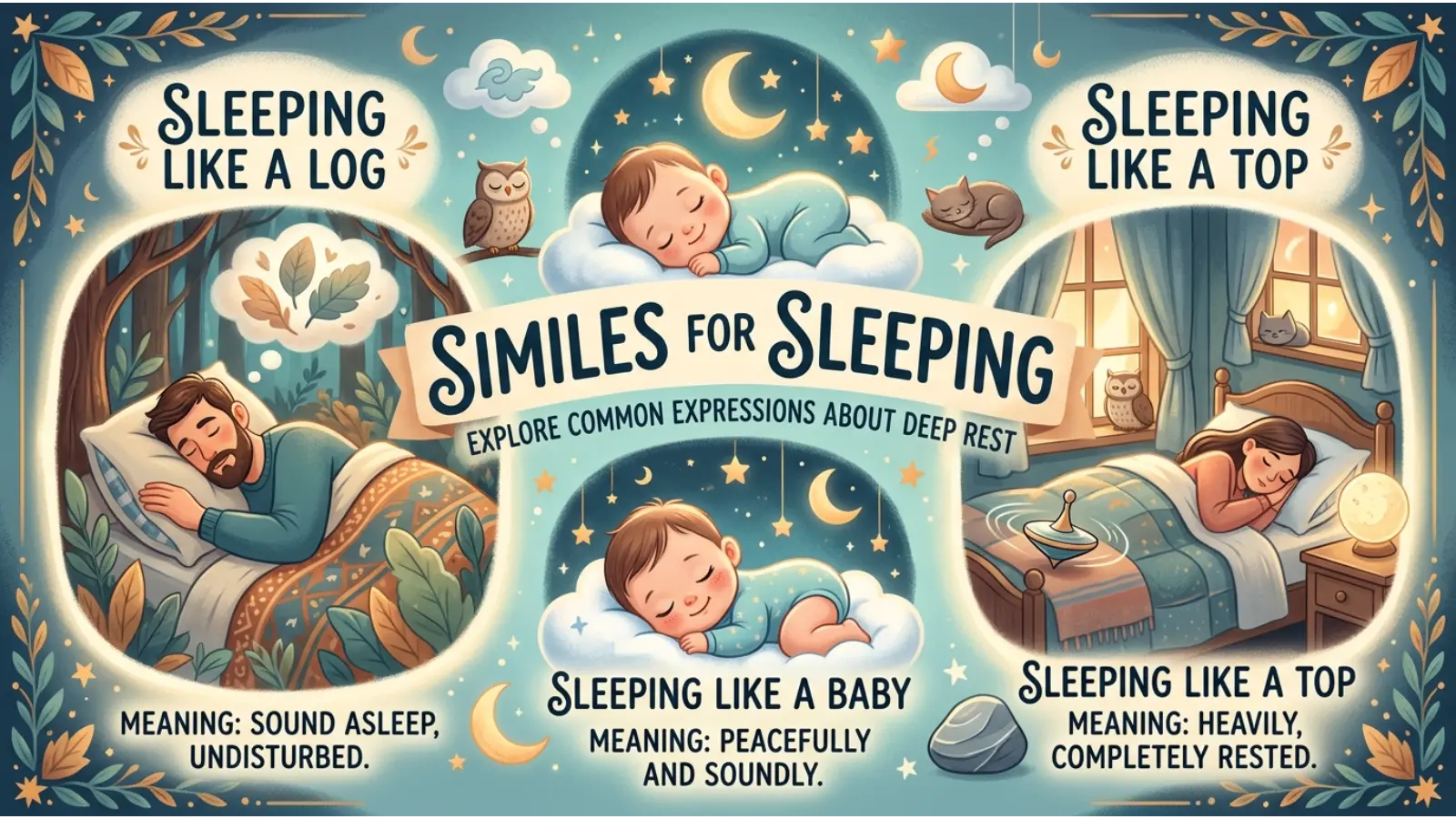
Sleep Similes for Sleeping can be peaceful, restless, deep, light, or mysterious. Instead of simply writing “She was sleeping deeply,” a writer can use a comparison that shows what the sleep looks or feels like.
1. He slept like a lighthouse after the last ship had passed.
Meaning: His sleep was deep, still, and undisturbed.
Why it works: A lighthouse normally suggests activity and watchfulness, so imagining it completely quiet creates a strong sense of peaceful rest.
Example:
After the exhausting journey, he slept like a lighthouse after the last ship had passed.
2. She curled up like a leaf resting on a quiet pond.
This Similes for Sleeping suggests gentle, delicate sleep. It works particularly well in descriptive or poetic writing.
3. The baby slept as peacefully as a cloud drifting through a blue morning.
The Similes for Sleeping comparison creates softness and calm without relying on the familiar phrase “slept like a baby.”
4. He slept like a train waiting in an empty station.
This image suggests stillness after movement. It can work well when describing someone who has finally stopped after a busy day.
5. Her dreams moved through her mind like lanterns floating down a dark river.
This is especially useful in fiction because it focuses not only on sleep but also on the mysterious quality of dreams.
6. He lay as still as a book left open on a silent desk.
The comparison emphasizes complete physical stillness.
Writing tip: When writing about sleep, decide what kind of sleep you want the reader to imagine. Deep sleep needs different imagery from restless sleep.
Similes in Music
Music is difficult to describe because it cannot always be seen. Similes give writers a way to translate sound into movement, texture, color, or emotion.
7. Her voice floated like a paper boat on a gentle stream.
This comparison gives singing a light, delicate quality.
8. The drums struck like footsteps racing toward a distant door.
The simile communicates rhythm and urgency rather than merely saying the drums were loud.
9. The violin sounded like sunlight slipping through old curtains.
This creates a warm, nostalgic atmosphere.
10. His guitar notes fell like rain on a sleeping street.
The comparison gives the music a soft, rhythmic quality.
11. The chorus rose like a flock of birds startled into the sky.
This works especially well for music that gradually becomes louder or more expansive.
12. The bass shook the room like thunder beneath the floor.
This emphasizes physical power and low-frequency sound.
Writing insight: When describing music, don’t limit yourself to sound words such as loud, soft, or beautiful. Ask what the music moves like, feels like, or reminds you of.
Similes for Happiness
Happiness can be quiet or overwhelming. A useful simile captures the specific kind of happiness rather than simply calling someone very happy.
13. Happiness spread through her like sunlight entering a dark room.
The image suggests a gradual transformation from sadness or uncertainty into joy.
14. His smile opened like a window on the first warm morning of spring.
This works well when describing someone whose happiness becomes visible.
15. Her excitement bounced around like a rubber ball in an empty hallway.
Unlike a peaceful happiness simile, this one suggests energetic, almost uncontrollable excitement.
16. The good news landed like a bright feather on his tired heart.
The soft image communicates relief and emotional comfort.
17. Their laughter rose like bubbles escaping from a glass.
This creates a playful, lighthearted feeling.
18. Joy rushed through the crowd like sunlight through a row of open windows.
The comparison works particularly well for celebrations and shared happiness.
Writing tip: Match the movement of the comparison to the emotion. Quiet happiness might glow or settle, while excitement might burst, bounce, or rush.
Similes for Friendship
Friendship is easier to understand when it is represented through something dependable, comforting, or shared.
19. Their friendship was like a bridge built from years of small promises.
The bridge represents connection, while the promises suggest trust.
20. She was like a warm lamp on a night when everything felt unfamiliar.
This focuses on the comfort a good friend can provide.
21. Their conversations flowed like two rivers meeting after a long journey.
The image suggests natural communication and shared experience.
22. His friendship stayed beside her like a familiar song she never forgot.
This conveys emotional familiarity and lasting connection.
23. They laughed together like children discovering a secret garden.
The comparison emphasizes playfulness and shared joy.
24. A loyal friend can be like a handrail on a steep staircase.
This simile focuses on support rather than constant attention.
Writing insight: Friendship similes become stronger when they show a specific quality—trust, humor, loyalty, comfort, or understanding—instead of simply saying that friendship is strong.
Similes for Rain
Rain provides rich material for imagery because it can sound, move, shine, flood, mist, or transform a landscape.
25. Rain tapped the roof like impatient fingertips.
The comparison gives the rain a human rhythm.
26. The drizzle hung in the air like a gray curtain.
This works well for misty or gloomy weather.
27. Raindrops raced down the window like tiny travelers searching for a road.
The image gives individual drops a sense of movement.
28. The storm poured over the town like a bucket tipped from the sky.
This is useful for describing sudden, heavy rainfall.
29. Rain glittered on the leaves like scattered pieces of glass.
The simile emphasizes the visual effect of sunlight or streetlights reflecting from wet leaves.
30. The rain whispered against the window like someone telling a secret.
This creates a quiet, intimate atmosphere.
Writing tip: Rain does not always need to represent sadness. It can suggest renewal, excitement, loneliness, peace, danger, or anticipation depending on the surrounding imagery.
Similes for Love
Strong love similes avoid reducing every relationship to the same familiar comparisons. Focus on what the relationship actually feels like.
31. Their love grew like a tree watered by ordinary days.
The comparison emphasizes that lasting affection can develop through everyday experiences.
32. Her kindness felt like a blanket on a cold evening.
This describes love through comfort rather than romance alone.
33. Their memories stayed between them like photographs tucked inside an old book.
This works well for reflective writing.
34. His affection moved quietly like morning light across the floor.
The image suggests gentle, gradual emotion.
35. Their bond held firm like a knot carefully tied by patient hands.
The simile emphasizes commitment and stability.
36. Love filled the room like music that continued after the speakers went silent.
This gives love an almost invisible but lasting presence.
Writing insight: Instead of asking, “What is love like?” ask, “What does this particular love do?” Does it comfort, challenge, protect, surprise, heal, or transform? The answer will lead to more original imagery.
Similes for Anger
Anger has movement and physical energy, which makes it especially suitable for dynamic comparisons.
37. His anger rose like steam trapped beneath a heavy lid.
The image suggests pressure building without release.
38. Her words snapped like dry branches under a boot.
This focuses on the sharpness of angry speech.
39. Frustration crawled through him like heat spreading across pavement.
The comparison emphasizes a feeling that gradually expands.
40. His temper flashed like a match struck in a dark room.
The simile communicates sudden intensity.
41. Anger sat inside him like a stone he could not put down.
Unlike explosive anger, this suggests resentment or emotional weight.
42. Her patience disappeared like mist beneath the morning sun.
This gives the reader a visual sense of patience vanishing quickly.
Writing tip: Anger does not always explode. It can simmer, tighten, burn, freeze, or quietly settle. Choose imagery that matches the exact emotional state.
Common Similes That Still Work
Some similes are common because they communicate an idea quickly. There is nothing automatically wrong with using a familiar comparison, especially in conversation or simple educational writing.
Examples include:
- As busy as a bee.
- As cold as ice.
- As quiet as a mouse.
- As bright as the sun.
- As brave as a lion.
- As light as a feather.
- As fast as lightning.
- As clear as glass.
These expressions are useful when clarity matters more than originality.
However, creative writers should recognize when a familiar simile has become predictable. If the reader can finish the comparison before reaching the end of the sentence, consider creating a more specific image.
Instead of:
The classroom was as quiet as a mouse.
Try:
The classroom was so quiet that even the clock seemed embarrassed to tick.
The second version creates a more particular scene.
Funny Similes
Humor often comes from comparing something ordinary with something unexpectedly specific.
43. He ran like a shopping cart with one rebellious wheel.
The humor comes from the strange but recognizable movement.
44. Her hair stood up like grass after a very confused lawn mower.
This creates a playful visual image.
45. The puppy attacked the slipper like it had personally insulted his entire family.
The exaggeration makes the comparison humorous.
46. He stared at the math problem like it had arrived in a language invented five minutes ago.
This works because the comparison turns ordinary confusion into an absurd situation.
47. The old computer moved like a turtle carrying a suitcase uphill.
The added detail makes the comparison more visual than simply saying the computer was slow.
48. His excuse was as thin as a napkin in a rainstorm.
This can describe an obviously weak explanation in a humorous way.
Writing tip: Funny similes work best when the comparison is unexpected but still understandable. The reader should recognize the connection almost immediately.
How to Make a Simile More Vivid
A weak simile usually compares something with a broad, generic idea:
The city was like a jungle.
The reader understands the general meaning, but the image is familiar.
A stronger version identifies a specific feature:
The city moved like a restless hive before a storm.
Now the comparison communicates noise, movement, pressure, and anticipation.
When creating a simile, consider these five questions:
- What exactly am I describing?
- What quality do I want the reader to notice?
- What familiar object has that same quality?
- Can I make the comparison more specific?
- Does the image fit the mood of the scene?
The goal is not to make every comparison complicated. The goal is to make it precise.
Why Specific Details Make Better Similes
Compare these two sentences:
The singer’s voice was like a bird.
and:
The singer’s voice rose like a small bird calling across an empty field.
The second sentence gives the reader more information. It suggests distance, loneliness, pitch, and movement.
Specificity is especially valuable in fiction and poetry because readers experience writing through images.
A useful technique is to add one carefully chosen detail to an ordinary comparison:
Basic:
The rain was like a curtain.
More vivid:
The rain hung over the street like a curtain of silver thread.
The added detail changes the mental picture without making the sentence unnecessarily complicated.
How Professional Writers Avoid Cliché Similes
A cliché is an expression that has been used so often that it has lost much of its original freshness.
For example, comparisons involving busy bees, red roses, or cold ice may communicate their meaning quickly, but they usually do little to surprise an experienced reader.
To develop fresher imagery, look at the scene itself.
If you are describing a tired person, don’t immediately search for a comparison for tired. Notice what the person is actually doing.
Maybe:
He moved through the kitchen like a phone running on its last one percent of battery.
The comparison feels contemporary because it comes from a recognizable experience.
The strongest similes often come from observation, not from a list of impressive words.
Simile vs. Metaphor: What’s the Difference?
A simile makes an explicit comparison, usually using like or as.
Her voice was like rain.
A metaphor makes the comparison directly.
Her voice was rain.
Both can create imagery, but they produce slightly different effects.
Similes often feel more conversational because the comparison is clearly signaled. Metaphors can feel more immediate or imaginative because they temporarily treat one thing as another.
Simile, Imagery, and Personification
Similes are closely connected to other literary devices.
Imagery uses descriptive language to help readers experience a scene through the senses. A simile can create imagery, but imagery is a broader technique.
Personification gives human qualities to nonhuman things:
The wind complained against the windows.
A writer can combine personification and simile:
The wind complained like an old door refusing to close.
The first part gives the wind a human action; the second creates a comparison that makes the sound more concrete.
How to Create Your Own Similes
Creating original similes becomes easier when you stop trying to sound poetic and start paying attention to details.
Step 1: Choose the subject
Pick something specific:
- a person’s smile
- a crowded street
- a storm
- a song
- a difficult decision
- a quiet bedroom
Step 2: Identify its strongest quality
Ask what stands out.
Is it:
- fast?
- fragile?
- noisy?
- comforting?
- unpredictable?
- heavy?
- bright?
- awkward?
Step 3: Brainstorm unrelated objects
For fast, don’t immediately write lightning. Consider:
- a dropped phone racing toward the floor
- a bicycle downhill
- a message appearing on a screen
- a startled rabbit
Step 4: Find the surprising connection
Suppose you are describing someone talking quickly.
Instead of:
He talked like a machine.
Try:
He talked like someone trying to fit an entire suitcase into an already packed drawer.
Now the speed has a purpose and personality.
Step 5: Test the sentence
Read it aloud. If the comparison sounds forced, simplify it.
A good simile should feel intentional rather than decorative.
Creative Exercises for Better Similes
Exercise 1: Replace a Plain Description
Start with:
The girl was nervous.
Write three versions using different comparisons.
One should show physical nervousness, one should show mental uncertainty, and one should be humorous.
Exercise 2: Describe the Same Thing Three Ways
Describe rain as:
- peaceful
- threatening
- joyful
The subject stays the same, but the similes should change the emotional atmosphere.
Exercise 3: Avoid the Obvious Comparison
Choose a word such as happy, fast, cold, or angry.
Write five possible comparisons without using the first comparison that comes to mind.
This exercise helps break the habit of relying on clichés.
Exercise 4: Use an Everyday Object
Choose something ordinary—a backpack, phone, spoon, bicycle, window, or alarm clock.
Use it in a simile about an emotion.
For example:
His worry followed him like an alarm clock he could never switch off.
The ordinary object becomes meaningful because it is connected to an emotional experience.
Common Simile Mistakes
Using an Overused Comparison
A familiar simile is not automatically bad, but using one in a place where originality matters can make the writing feel predictable.
Fix: Add a specific detail or find a less obvious comparison.
Mixing Images
Avoid combining unrelated comparisons:
Her anger was like a volcano, a burning candle, and a storm.
Three images compete for attention.
Fix: Choose the image that best communicates the emotion.
Forcing a Simile
Not every sentence needs a comparison. If a simple description is stronger, use it.
A simile should add something—not merely make a sentence sound literary.
Making the Comparison Too Complicated
A comparison can become difficult to understand when it contains too many layers.
Keep the central image clear.
Confusing Similes and Metaphors
Remember:
The moon was like a silver coin. — simile
The moon was a silver coin. — metaphor
Both are useful, but they work differently.
Choosing an Image That Doesn’t Fit the Mood
A humorous comparison can weaken a serious scene. A dark comparison can make a cheerful scene feel unexpectedly gloomy.
Always ask whether the image supports the emotion you want.
Frequently Asked Questions
What are 5 examples of similes?
Five examples are:
- The rain tapped the roof like impatient fingertips.
- Her laughter rose like bubbles.
- He slept like a lighthouse after the last ship had passed.
- Their friendship was like a bridge built from small promises.
- His anger rose like steam beneath a lid.
What is a good simile for happiness?
A useful example is:
Happiness spread through her like sunlight entering a dark room.
It works because sunlight suggests warmth, brightness, and positive change.
What is a good simile for love?
Try:
Their love grew like a tree watered by ordinary days.
The comparison emphasizes how affection can develop through everyday experiences.
What is a good simile for anger?
One example is:
His anger rose like steam trapped beneath a heavy lid.
It communicates pressure that is building and becoming difficult to contain.
What are some similes for rain?
Examples include:
- Rain tapped the roof like impatient fingertips.
- The drizzle hung like a gray curtain.
- Raindrops raced down the glass like tiny travelers.
- Rain glittered on the leaves like scattered glass.
What is the difference between a simile and a metaphor?
A simile makes a comparison using words such as like or as, while a metaphor makes the comparison directly.
Why do writers use similes?
Writers use similes to make descriptions more vivid, communicate emotions, create atmosphere, and help readers visualize unfamiliar experiences.
How can I make my similes more original?
Start with the specific quality you want to communicate, then brainstorm unexpected objects or experiences that share that quality. Specific observation usually produces fresher comparisons than relying on familiar phrases.
Conclusion
A memorable simile does not need to be complicated. It needs to make the reader notice something. The best comparisons connect an abstract feeling or ordinary object with an image the reader can immediately experience. A sleeping person can become a silent lighthouse. Happiness can spread like sunlight. Rain can tap like impatient fingers. Anger can rise like trapped steam. The real skill is knowing why the comparison belongs there. When you write your own similes, pay attention to ordinary details, avoid the first cliché that comes to mind, and choose comparisons that match the mood of your scene. Experiment with unexpected objects, read your sentences aloud, and remove any comparison that does not genuinely improve the description. A strong simile should not merely decorate your writing. It should help the reader see, hear, feel, or understand something more clearly.
I am Helena Frost, a writer captivated by the beauty of language and the art of comparison. Through my words, I explore the world by turning ordinary moments into vivid similes and reflections. I enjoy crafting phrases that spark imagination, evoke emotion, and linger in the mind. My writing celebrates the subtle connections between people, nature, and the stories we live. For me, every sentence is an opportunity to reveal the extraordinary in the everyday.