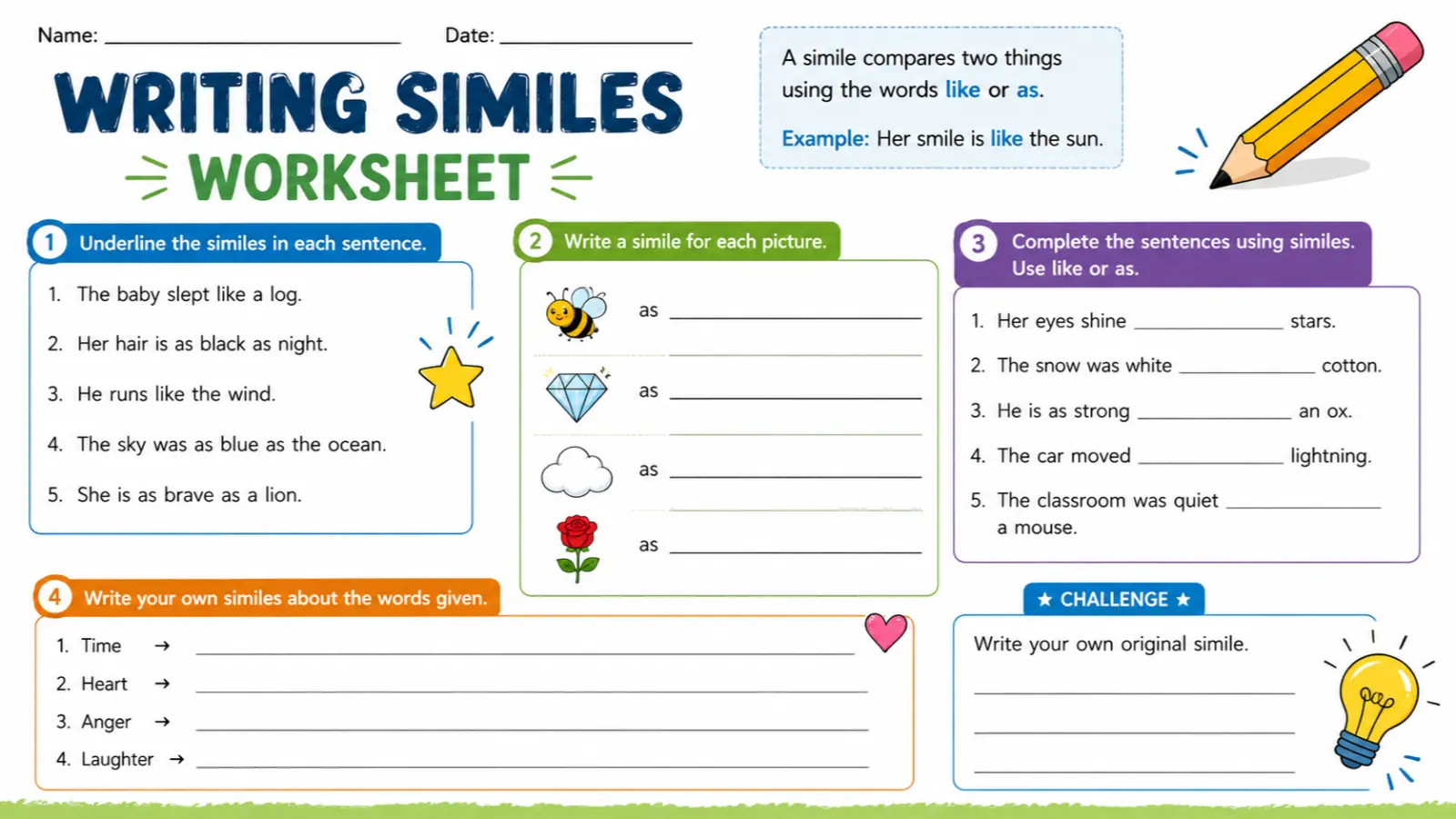
A Writing Similes Worksheet compares two different things using words such as like or as. Instead of simply saying, “The classroom was quiet,” a writer might say, “The classroom was as quiet as a library after closing.” The comparison gives the reader something concrete to imagine.
Writing Similes Worksheet matter because strong writing is not only about telling readers what happened. It is also about helping them see, hear, feel, and experience a moment. Writers use similes in stories, poems, essays, songs, speeches, advertisements, and everyday conversation.
A writing similes worksheet can make this skill easier to practice. Rather than memorizing definitions, you can experiment with comparisons, identify why they work, and create your own. The Writing Similes Worksheet exercises and examples below are designed to help students, beginning writers, and anyone who wants more vivid language.
What Is a Simile?
A Writing Similes Worksheet is a figure of speech that directly compares two unlike things, usually with like or as.
For example:
The old house stood like a forgotten ship on the edge of the town.
The house is not actually a ship. The comparison gives it a feeling of isolation and age.
A useful Writing Similes Worksheet has three parts:
- The subject: what you are describing
- The comparison: what you connect it to
- The shared quality: what the two things have in common
The Writing Similes Worksheet strongest comparisons are not random. They reveal something about the subject.
Why Similes Make Writing More Powerful
Consider these two sentences:
Plain:
The boy was nervous before the performance.
With a simile:
His thoughts bounced around like marbles in an empty box before the performance.
The second sentence gives nervousness a physical quality. Readers can imagine the movement and noise.
A good simile can:
- Make an abstract emotion easier to understand
- Create a memorable image
- Establish mood
- Reveal a character’s personality
- Add rhythm to poetry and prose
- Make ordinary descriptions more distinctive
The Writing Similes Worksheet goal is not to add a simile to every sentence. One precise comparison can be more effective than five predictable ones.
Original Similes to Study and Adapt
1. Her Smile Was Like Sunlight Through Moving Leaves
Meaning: Her smile felt warm, lively, and constantly changing.
This comparison works because sunlight through leaves is bright but not perfectly still. It suggests a smile that brings energy without feeling artificial.
Example:
Her smile was like sunlight through moving leaves, appearing whenever the conversation became awkward.
Writing purpose: Use this when describing someone whose presence makes a scene feel lighter.
Tip: Notice how the comparison creates movement rather than simply saying the person was cheerful.
2. His Ideas Spread Like Ink Dropped Into Clear Water
Meaning: His ideas gradually reached every part of the discussion.
This is useful for describing influence. Ink does not instantly fill the water; it expands outward.
Example:
His ideas spread like ink dropped into clear water until everyone at the table was discussing them.
This works especially well in essays, stories, and descriptions of conversations.
3. Their Friendship Was Like a Well-Worn Trail Through the Woods
Meaning: Their friendship felt familiar, dependable, and shaped by repeated experiences.
A trail becomes easier to recognize because people travel it repeatedly. That makes the image especially useful for long-lasting friendships.
Example:
Their friendship was like a well-worn trail through the woods: familiar, reliable, and still capable of leading somewhere new.
4. The Rain Tapped the Roof Like Fingertips on a Piano
Meaning: The rain made a rhythmic, musical sound.
The comparison connects weather with music, making the sound easier to imagine.
Example:
Rain tapped the roof like fingertips on a piano while Maya finished her homework.
Best context: Stories, poems, atmospheric descriptions, and reflective writing.
5. Her Happiness Rose Like a Kite Catching a Sudden Wind
Meaning: Her happiness grew quickly and lifted her mood.
The image suggests movement and freedom rather than simply labeling the emotion as happiness.
Example:
When she heard the good news, her happiness rose like a kite catching a sudden wind.
Writing lesson: When describing emotions, compare them with something that behaves in a similar way.
6. His Anger Burned Like a Lamp Left on Too Long
Meaning: His anger was intense and increasingly difficult to ignore.
Unlike a comparison to fire, this image feels quieter and more controlled. It can work well when a character is angry but not openly explosive.
Example:
His anger burned like a lamp left on too long, bright enough to reveal every flaw in the room.
7. The New Student Moved Through the Hallway Like a Compass Looking for North
Meaning: The student seemed unsure where to go.
This comparison gives confusion a physical direction.
Example:
The new student moved through the hallway like a compass looking for north.
Writing purpose: This is useful when introducing a character who feels lost, uncertain, or unfamiliar with a new environment.
8. Her Voice Was as Soft as Snow Falling at Midnight
Meaning: Her voice was extremely quiet and gentle.
The comparison creates both sound and atmosphere. Readers can almost imagine the silence surrounding it.
Example:
Her voice was as soft as snow falling at midnight, so everyone leaned closer to listen.
9. The Empty Playground Looked Like a Stage After the Audience Leaves
Meaning: The playground felt strangely quiet and abandoned.
This simile works through contrast. A playground normally suggests activity, while an empty stage suggests that something has ended.
Writing tip: Contrasting images can create stronger emotional effects than obvious comparisons.
10. His Laugh Burst Out Like Popcorn in a Hot Pan
Meaning: His laughter came suddenly and repeatedly.
The comparison gives the laugh an energetic, almost uncontrollable quality.
Example:
His laugh burst out like popcorn in a hot pan, making everyone else start laughing too.
This fits humorous scenes particularly well.
11. The Moon Hung Above the Houses Like a Silver Button on Dark Cloth
Meaning: The moon looked small, bright, and distinct against the night sky.
This image is especially suitable for descriptive or poetic writing.
Writing purpose: Use a familiar object to make a distant or abstract image easier to picture.
12. Her Words Fell Like Pebbles Into a Still Pond
Meaning: Her words disturbed an otherwise calm situation and created consequences.
The ripples implied by the pond add another layer of meaning.
Example:
Her words fell like pebbles into a still pond, and the conversation was never quite calm again.
13. The City Woke Like a Giant Stretching After a Long Sleep
Meaning: The city gradually became active in the morning.
This is an example of a simile that also creates personification because the city is compared to something performing a human action.
Example:
At sunrise, the city woke like a giant stretching after a long sleep.
14. His Memory Was Like a Drawer Filled With Unlabeled Photographs
Meaning: He remembered many things but struggled to organize or identify them.
This works because the comparison turns an invisible mental process into something physical.
Best context: Character development, reflective writing, memoir-style prose, and fiction.
15. The Athlete’s Determination Was Like a Door That Refused to Close
Meaning: The athlete would not give up.
The image suggests persistence without relying on the common comparison of determination to an unstoppable machine.
Example:
Her determination was like a door that refused to close, even when the wind pushed against it.
16. The Baby’s Cry Cut Through the Room Like a Bicycle Bell on a Quiet Street
Meaning: The cry was sudden and noticeable in an otherwise quiet place.
The comparison gives the sound a sharp quality without becoming overly dramatic.
17. The Old Photograph Felt Like a Window Into a House That No Longer Stood
Meaning: The photograph provided a glimpse into a vanished past.
This is useful for nostalgia and historical storytelling.
Example:
The old photograph felt like a window into a house that no longer stood.
18. Their Conversation Drifted Like Two Boats Losing Sight of Shore
Meaning: The conversation gradually moved away from its original subject and became uncertain.
This simile is effective because the image suggests separation and lack of direction.
Writing purpose: Use it when a conversation becomes complicated, emotional, or disconnected.
19. The First Snow Covered the Town Like a Blank Page
Meaning: Snow made the familiar landscape look new and untouched.
This comparison is especially useful in poetry and winter descriptions.
Example:
By morning, the first snow covered the town like a blank page.
20. His Excitement Flickered Like a String of Tiny Lights
Meaning: His excitement appeared in small, visible moments.
Unlike a comparison that presents excitement as overwhelming, this one suggests quiet anticipation.
Best context: Character description and scenes involving hope or anticipation.
How to Turn Weak Similes Into Strong Ones
Not every comparison improves a sentence.
Consider:
Weak:
She was happy like a happy person.
The comparison gives the reader no new information.
Now consider:
Stronger:
She was as cheerful as someone who had just found an unexpected note of encouragement in an old book.
The second version gives the emotion a situation and image.
When creating a simile, ask:
- What exactly am I trying to show?
- What physical object or experience behaves in a similar way?
- What emotion should the comparison create?
- Is the image specific enough to picture?
- Have readers seen this comparison too many times?
The best similes usually make readers think, “I can see that.”
A Simple Writing Similes Worksheet Exercise
Try this five-step exercise.
Step 1: Choose an ordinary subject
Start with something simple:
- Rain
- A teacher
- A crowded room
- Happiness
- Friendship
- Anger
- A difficult test
- A quiet evening
Step 2: Identify its strongest quality
For example:
Rain: rhythmic
Friendship: dependable
Anger: tense
Happiness: uplifting
Step 3: Brainstorm unrelated objects
For “rhythmic,” you might think of:
- A drum
- Footsteps
- A clock
- Piano keys
- A train
Step 4: Connect the images
Instead of:
The rain was like a drum.
Try to make the image more personal and specific:
Rain drummed against the windows like impatient fingers waiting for an answer.
Now the comparison has sound, movement, and personality.
Step 5: Test the simile
Ask whether the comparison adds something that a plain adjective cannot.
If “angry” already communicates everything important, the simile may not be necessary. If the comparison reveals how the anger behaves, keep it.
Practice: Complete These Similes
Use your own ideas to finish each sentence.
- The classroom was as quiet as __________.
- Her excitement spread like __________.
- The old tree looked like __________.
- His words were as sharp as __________.
- Their friendship grew like __________.
- The rain sounded like __________.
- My thoughts moved like __________.
- The sunset looked as if __________.
- His disappointment settled over him like __________.
- The child laughed like __________.
Do not worry about making the first answer perfect. Generate several possibilities before choosing one.
Challenge Exercise: Replace the Cliché
Writers often use familiar comparisons such as “busy as a bee” or “cold as ice.” These are easy to understand, but they may not create a fresh image.
Instead of:
The hallway was as busy as a bee.
Try:
The hallway hummed like a train station five minutes before departure.
The second comparison gives readers a stronger sense of noise, movement, and urgency.
Challenge: Replace these familiar ideas with original images:
- Very busy
- Very quiet
- Extremely tired
- Very happy
- Very angry
- Very nervous
For each one, create three different comparisons. Then choose the one that tells the reader the most.
How Professional Writers Build Better Similes
Strong writers often begin with observation rather than a dictionary of comparisons.
Suppose you want to describe someone nervous.
Instead of immediately writing “nervous as a cat,” observe nervous behavior:
- Fingers move constantly.
- Eyes keep checking the clock.
- Words come out too quickly.
- A person forgets simple things.
- Their attention jumps from one detail to another.
Now you have material for an original comparison:
His attention jumped around like a radio searching for a clear station.
The simile works because the behavior and the image share a recognizable quality: constant searching.
That is the key principle: compare behavior with behavior, texture with texture, movement with movement, and emotional experience with something readers can physically imagine.
Common Simile Mistakes
Using Too Many Similes
A paragraph packed with comparisons can become exhausting.
Let important images breathe. If every sentence contains a simile, none of them feels especially important.
Choosing a Random Comparison
A comparison should have a logical connection.
If you describe someone’s sadness as “like a bright bicycle,” the reader may struggle to understand your intention unless the surrounding context explains it.
Mixing Images
Avoid combining unrelated comparisons:
His anger was like a volcano, a storm, and a locked door.
Choose the strongest image and develop it instead.
Using Clichés Without a Purpose
Common similes are not automatically bad. Sometimes familiar language is exactly right for dialogue or informal writing. The problem occurs when a cliché replaces an opportunity for sharper description.
Confusing Similes With Metaphors
A simile normally signals comparison with like or as:
The classroom was like a maze.
A metaphor makes the comparison directly:
The classroom was a maze.
Both can create imagery, but they produce slightly different effects.
Making the Comparison Too Complicated
A simile should clarify an image, not make the reader solve a puzzle.
If the comparison requires a long explanation, reconsider it.
Simile vs. Metaphor: What’s the Difference?
A simile explicitly compares two things:
The clouds moved like ships across the sky.
A metaphor states the comparison directly:
The clouds were ships crossing the sky.
A simile can feel more explanatory or conversational, while a metaphor can feel more direct and powerful. Neither is automatically better. The choice depends on the voice and purpose of the writing.
Simile, Imagery, and Personification
Similes often work alongside other literary devices.
Imagery creates sensory experiences:
The rain smelled like wet pavement after a long summer afternoon.
Personification gives human qualities to nonhuman things:
The wind complained against the window.
Alliteration repeats beginning sounds:
Silver streets shimmered after the storm.
Combining devices carefully can make a description richer, but clarity should always come first.
How to Create Your Own Original Similes
Use this formula as a starting point:
Subject + shared quality + unexpected comparison
For example:
Subject: A difficult memory
Quality: Hard to escape
Comparison: A song stuck in your head
Possible result:
The memory followed him like a song he could never quite finish.
Now change the comparison:
The memory followed him like a shadow that appeared even indoors.
Both work, but they create different emotional effects. The first suggests repetition; the second suggests persistence.
This shows why choosing the comparison matters. The object you compare something to influences how readers interpret it.
Frequently Asked Questions
What is a simile in simple words?
A simile is a comparison between two different things using words such as like or as. It helps readers imagine an idea more clearly.
What are some examples of similes?
Examples include:
- The rain tapped the roof like fingertips on a piano.
- Her happiness rose like a kite catching wind.
- His memory was like a drawer filled with unlabeled photographs.
- The city woke like a giant stretching after sleep.
Why do writers use similes?
Writers use similes to make descriptions more vivid, communicate emotions, create atmosphere, and help readers visualize unfamiliar experiences.
How do I write a good simile?
Start with the quality you want to communicate. Then find an unexpected object, action, sound, or experience that shares that quality. Make sure the connection is clear.
What words are commonly used in similes?
The most common comparison words are like and as. For example, “The water glittered like glass” and “She was as quiet as snowfall.”
Can a simile be used in an essay?
Yes. Similes can be effective in essays when they clarify an idea or make an explanation easier to understand. Academic writing usually benefits from precise comparisons rather than decorative ones.
Are clichés always bad in writing?
No. Familiar expressions can work in dialogue, humor, or informal writing. However, original comparisons are often more memorable when you want to create a distinctive voice.
Conclusion
A strong simile does more than decorate a sentence. It gives readers a new way to understand an object, emotion, person, or experience. Use the examples in this writing similes worksheet as starting points rather than formulas to memorize. Look closely at ordinary moments, notice how things move and sound, and search for connections that other writers might overlook. The most memorable comparisons often begin with a simple question: “What else behaves, feels, sounds, or looks like this?” Answer that question with curiosity, and your descriptions can become sharper, more personal, and much easier for readers to remember.
I am Helena Frost, a writer captivated by the beauty of language and the art of comparison. Through my words, I explore the world by turning ordinary moments into vivid similes and reflections. I enjoy crafting phrases that spark imagination, evoke emotion, and linger in the mind. My writing celebrates the subtle connections between people, nature, and the stories we live. For me, every sentence is an opportunity to reveal the extraordinary in the everyday.