Are Similes Analogies make writing easier to picture, easier to feel, and often more memorable. A Are Similes Analogies writer can describe a feeling, person, place, or experience directly, but a carefully chosen comparison can give that description much more life.
This leads to an interesting question: Are similes analogies?
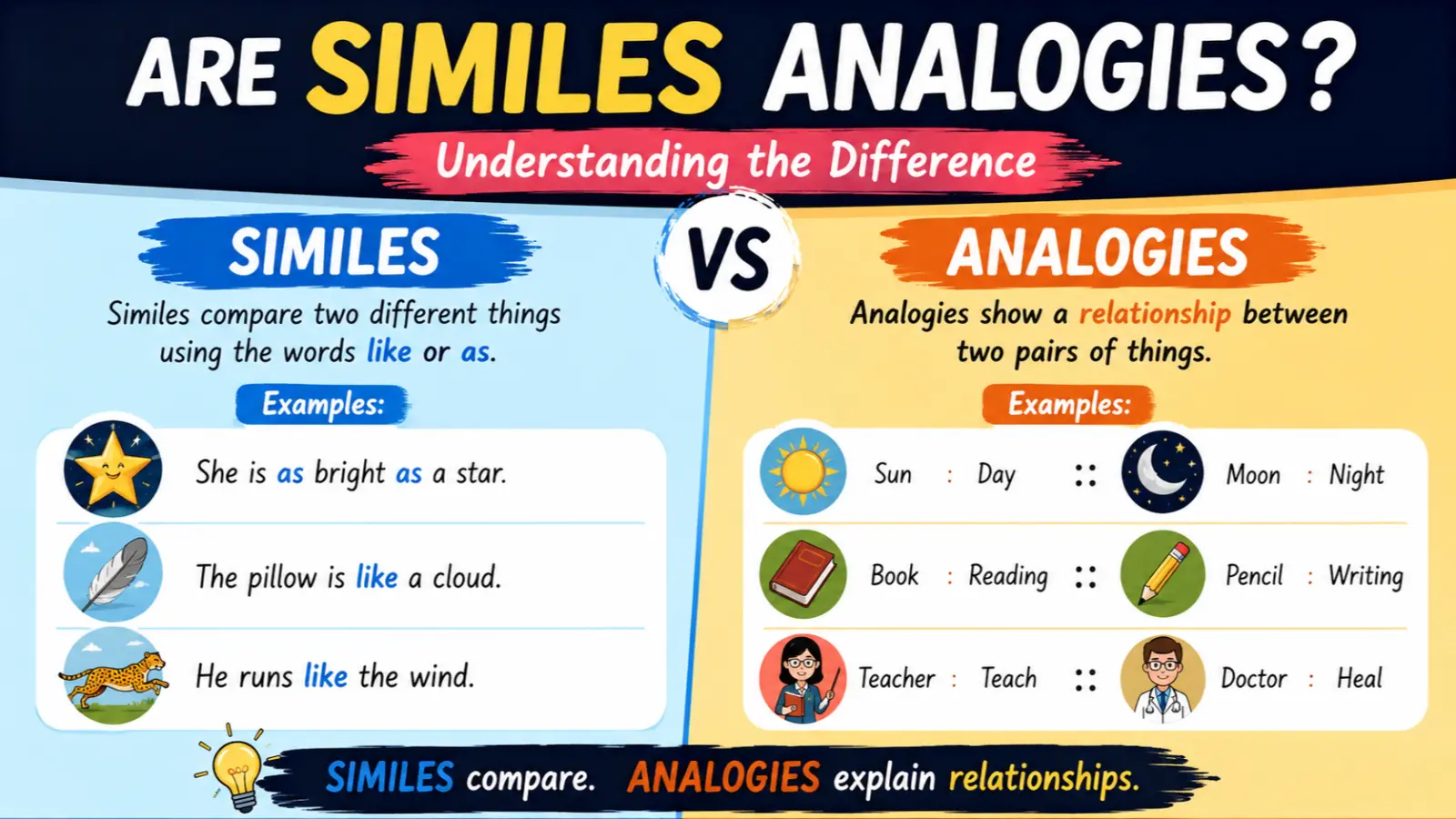
The short answer is that similes and analogies are related forms of comparison, but they are not exactly the same thing. A Are Similes Analogies usually compares two different things using words such as like or as. An analogy goes further by explaining a relationship or similarity between two things, often to make an unfamiliar idea easier to understand.
Understanding that distinction can help you choose the right literary device for your writing. Along the way, you’ll also find original examples involving happiness, friendship, rain, love, anger, music, and everyday situations.
Are Similes Analogies?
A Are Similes Analogies is a comparison between two unlike things, usually using like or as.
Example:
Her happiness sparkled like sunlight on a moving river.
An Are Similes Analogies is a broader comparison used to explain an idea, relationship, or process by connecting it with something more familiar.
Example:
Learning a language is like building a bridge: each new word adds another piece that helps you reach someone else’s world.
The first example creates an image. The second explains an idea through comparison.
So, a useful way to remember the relationship is:
A Are Similes Analogies can be part of an analogy, but not every simile is an analogy.
Simile vs. Analogy at a Glance
| Simile | Analogy |
|---|---|
| Usually short | Often more developed |
| Creates an image or impression | Explains an idea or relationship |
| Commonly uses “like” or “as” | May use many forms of comparison |
| Often appears in poetry and creative writing | Common in teaching, arguments, and explanations |
| Focuses on vivid similarity | Focuses on meaningful connection |
The difference is not always absolute. Writers sometimes use a simile inside a larger analogy. Context and purpose matter.
Why Similes Matter in Good Writing
A strong Are Similes Analogies does more than decorate a sentence. It gives readers something familiar to hold onto.
Compare these two descriptions:
The room was quiet.
The room was quiet as a library before sunrise.
The second sentence gives the reader a stronger sense of the silence. The comparison creates an atmosphere rather than simply naming a condition.
Good Are Similes Analogies can help writers:
- Make abstract emotions easier to understand
- Create sensory imagery
- Establish mood
- Reveal personality
- Add humor
- Strengthen descriptions
- Make poetry more memorable
- Give stories a distinctive voice
The key is specificity. A comparison becomes more powerful when the reader can immediately recognize why the two things belong together.
Original Similes for Different Feelings and Situations
Similes for Happiness
Happiness can be difficult to describe because it is invisible. Instead of simply saying someone was happy, connect the feeling with movement, light, sound, or physical energy.
1. Her happiness rose like a kite catching its first strong wind.
Meaning: Her joy grows quickly once something gives it room to expand.
Example:
After hearing the good news, her happiness rose like a kite catching its first strong wind.
This works because the kite suggests freedom, lift, and excitement.
2. His smile opened like a window after a long storm.
This simile connects happiness with relief. It works especially well after a difficult moment because the storm creates emotional contrast.
3. The children’s laughter bounced like bright coins across the hallway.
The unusual comparison gives sound a physical quality. It suits lively scenes and playful storytelling.
Writing Tip
When writing about happiness, avoid relying only on words such as sunshine, rainbows, and butterflies. Ask what happiness does. Does it lift, spill, glow, burst, soften, or spread?
That question often produces fresher imagery.
Similes for Friendship
Friendship can be described through trust, comfort, reliability, and shared experiences.
4. Their friendship was like a well-worn path through a familiar forest.
The comparison suggests that the friends know how to find their way together, even when circumstances change.
5. Her advice was steady like a handrail on a steep staircase.
This simile emphasizes dependable support rather than simply calling someone a “good friend.”
6. Their jokes traveled between them like a ball passed without looking.
This works because it suggests familiarity. The friends understand each other well enough to respond naturally.
Best Context
These comparisons fit personal essays, stories, friendship poems, school writing, and character descriptions.
A useful technique is to describe what a friendship provides rather than merely describing the friends themselves.
Similes for Rain
Rain offers writers many possibilities because it can suggest peace, sadness, renewal, danger, or excitement.
7. Rain tapped against the roof like impatient fingers.
The comparison creates a slightly restless mood.
8. The rain spread across the window like silver threads.
This creates a quieter, more visual image suitable for reflective writing.
9. Summer rain arrived like a guest who had forgotten to knock.
This gives the weather personality while keeping the image playful.
10. Rain fell over the empty street like a soft curtain.
This comparison works well when rain separates the character from the outside world.
Writing Tip
Do not decide that rain automatically represents sadness. In literature, rain can signal relief, renewal, romance, suspense, loneliness, celebration, or change. Let the surrounding scene determine its emotional meaning.
Similes for Love
Love can easily lead to clichés, so specific imagery is especially important.
11. Their affection grew like ivy finding cracks in an old wall.
The comparison suggests something gradual and persistent.
12. Her voice felt like a familiar song heard in an unfamiliar city.
This simile connects love with recognition and emotional comfort.
13. Their care for each other was like a lamp left burning in an empty house.
The image suggests quiet constancy rather than dramatic emotion.
Writing Tip
For mature writing, avoid trying to make every comparison about intensity. Love can also be described through patience, familiarity, attention, trust, and ordinary acts of care.
Those details often feel more believable.
Similes for Anger
Anger has physical energy, which makes it especially suitable for dynamic comparisons.
14. His anger climbed like heat trapped beneath a metal roof.
The image suggests pressure that becomes increasingly difficult to ignore.
15. Her words snapped like dry branches under a heavy boot.
This creates a sharp and confrontational tone.
16. Frustration crowded his thoughts like people pushing through a narrow doorway.
The comparison shows how anger can interfere with clear thinking.
Why These Similes Work
Notice that the comparisons do not merely say angry = fire. Instead, they focus on particular experiences of anger: pressure, sharpness, crowding, and rising intensity.
That specificity makes an emotional simile more useful.
Similes in Music
Music frequently uses similes because sound is difficult to describe directly. Writers often compare voices, melodies, rhythms, and instruments with physical experiences.
17. The melody moved like a paper boat carried by a slow stream.
This creates a gentle, flowing impression.
18. His voice cracked through the chorus like a match struck in a dark room.
The contrast between darkness and sudden brightness gives the sound dramatic force.
19. The drums rolled like distant thunder behind the singer.
This creates a sense of growing power and anticipation.
20. The violin sounded like a conversation whispered through a closed door.
This suggests intimacy, distance, and emotional restraint.
Writing Tip
When describing music, ask yourself:
What does this sound feel like?
Then consider texture, movement, temperature, distance, weight, color, or physical action. These sensory categories can produce much stronger descriptions than simply calling music “beautiful.”
Common Similes
Some similes are so familiar that readers barely notice them.
Examples include:
- As busy as a bee
- As cold as ice
- As brave as a lion
- As quiet as a mouse
- Like a fish out of water
These are useful when clarity matters more than originality. However, creative writers should recognize when a familiar comparison has lost its impact.
When Is a Common Simile Useful?
Common similes are not automatically bad. They can work well in conversation, children’s writing, explanations, and situations where the reader needs an immediate image.
The problem occurs when every description depends on familiar comparisons.
Instead of automatically writing as quiet as a mouse, ask:
What kind of quiet is it?
You might create something more precise, such as:
The classroom sat quiet as an unplugged machine.
The second comparison creates a different atmosphere and gives the sentence a more distinctive voice.
Funny Similes
Humor often comes from an unexpected comparison.
21. He ran like a shopping cart with one stubborn wheel.
The image is funny because the movement is easy to imagine.
22. My brain was as organized as a drawer after an earthquake.
This exaggerates ordinary confusion for comic effect.
23. She stared at the math problem like it had personally insulted her.
The comparison gives an ordinary situation a humorous emotional reaction.
24. The puppy bounced around the room like popcorn in a hot pan.
The rapid movement makes the sentence energetic and playful.
Why Funny Similes Work
Comedy often depends on surprise. The reader begins with one idea and suddenly receives an unexpected comparison.
A useful formula is:
Ordinary situation + surprising but recognizable image = comic effect
The comparison still needs to make sense. Randomness alone does not necessarily create good humor.
How to Make Your Similes More Vivid
A strong simile usually begins with observation.
Instead of asking:
What can I compare this to?
Ask:
What does this actually remind me of?
Suppose you want to describe a nervous character. “He was nervous like a scared animal” is understandable but vague.
Look closer.
Maybe his fingers keep moving. he checks the clock repeatedly. Maybe his thoughts jump from one possibility to another.
You could write:
His thoughts jumped like loose stones in a washing machine.
The comparison works because it captures movement and disorder.
Use the Five Senses
Strong imagery does not have to be visual.
Consider:
- Sound: What does it resemble?
- Texture: What would it feel like?
- Smell: What familiar scent does it suggest?
- Taste: What flavor matches the experience?
- Movement: What behaves in a similar way?
A simile based on movement can be particularly effective when describing emotions or action.
Choose the Comparison Carefully
The best comparison is not necessarily the most unusual one.
It should fit the emotional situation.
A peaceful character might not benefit from an aggressive image. A comic scene might be weakened by an overly serious comparison. Tone matters.
Think about three qualities:
Accuracy + imagery + emotional fit
When those three align, the simile usually feels natural.
How Professional Writers Avoid Clichés
Clichés become weak when readers have encountered them so many times that they no longer create a fresh mental picture.
This does not mean every familiar simile must be removed. Instead, consider whether the comparison is doing useful work.
For example:
The night was as dark as coal.
This communicates darkness, but it does not reveal much about the particular night.
A more developed image might be:
The alley looked dark enough to swallow the glow from the nearest streetlamp.
Now the darkness affects something within the scene.
The goal is not to make every sentence strange. The goal is to make comparisons specific to the moment.
Simile, Metaphor, and Other Literary Devices
Similes belong to a larger family of figurative language.
Simile
A simile explicitly compares two things, often using like or as.
The river moved like a ribbon.
Metaphor
A metaphor makes a direct comparison without using like or as.
The river was a ribbon.
The two devices can create similar imagery, but their grammatical structures differ.
Personification
Personification gives human qualities to nonhuman things.
The wind whispered through the trees.
Hyperbole
Hyperbole uses deliberate exaggeration for emphasis.
I waited a thousand years for the bus.
Imagery
Imagery uses descriptive language to create sensory experience. Similes are one tool writers can use to create imagery.
Alliteration
Alliteration repeats beginning consonant sounds.
Silver streams slipped silently.
Alliteration can complement a simile by adding rhythm and sound.
Idiom
An idiom is a familiar expression whose meaning is not always literal.
For example, break the ice means to make a social situation more comfortable.
Unlike a newly created simile, an idiom is usually understood as an established expression.
How to Create Your Own Similes
You do not need to wait for inspiration. You can build a simile deliberately.
Step 1: Identify the exact thing you want to describe
Do not begin with a vague idea such as “make this interesting.”
Choose something specific:
The character’s nervousness.
Step 2: Describe what it actually does
Maybe the character:
- Speaks too quickly
- Avoids eye contact
- Repeats questions
- Moves constantly
- Forgets simple things
Step 3: Find something that behaves similarly
What else moves, sounds, or behaves that way?
Perhaps:
A radio searching for a station.
Step 4: Connect the two
His thoughts flickered like a radio searching for a clear station.
Step 5: Test the comparison
Ask:
- Is the image easy to understand?
- Does it fit the tone?
- Does it reveal something?
- Is it unnecessarily complicated?
- Have I heard this comparison many times?
If the answer is strong, keep it.
Creative Exercises for Better Similes
Exercise 1: Describe an Emotion Without Naming It
Choose happiness, anger, fear, loneliness, excitement, or calm.
Write three sentences without using the emotion’s name.
For example, instead of writing She was excited, describe her movements, voice, or thoughts.
Then create one simile from those observations.
Exercise 2: Give an Ordinary Object a New Image
Choose something familiar:
Backpack, pencil, phone, desk, bus, shoes.
Describe it with a comparison that reveals something about its condition or purpose.
Exercise 3: Rewrite a Cliché
Start with a familiar simile.
Then ask:
What would this scene look like specifically?
Replace the cliché with an image connected to your character, setting, or situation.
Exercise 4: Write One Simile in Three Tones
Take one subject, such as rain.
Write a comparison that makes the rain seem:
- Peaceful
- Funny
- Threatening
You will quickly see how word choice changes emotional meaning.
Common Mistakes Writers Make With Similes
Using Too Many Similes
A paragraph packed with comparisons can become tiring.
Readers need moments of plain language too. Use a simile when it adds something that direct description cannot.
Mixing Images
A sentence can become confusing when several unrelated images compete.
For example, a comparison that begins with a storm and suddenly shifts to machinery may leave the reader wondering what to picture.
Choose one central image and develop it clearly.
Forcing a Comparison
If the reader has to work hard to understand why two things are being compared, the simile may need revision.
Unusual does not automatically mean effective.
Confusing Similes With Metaphors
Remember:
Her voice was velvet = metaphor.
Her voice was like velvet = simile.
Both can be effective, but they create slightly different effects.
Explaining the Simile Too Much
Sometimes writers create an interesting comparison and then immediately explain it.
If the image is clear, trust the reader.
Let the simile do some of the work.
Frequently Asked Questions
Are similes and analogies the same thing?
No. They are related but serve different purposes. A simile usually creates a direct comparison, often using like or as. An analogy generally explains a relationship or idea through a broader comparison.
Can a simile also be an analogy?
Yes. A simile can function as part of an analogy when the comparison is developed to explain a larger idea. However, a short descriptive simile does not automatically become an analogy.
What is an easy example of a simile?
The baby’s laugh was like a tiny bell.
The sentence compares a laugh with a bell using the word like.
What makes a simile powerful?
A powerful simile is specific, understandable, emotionally appropriate, and relevant to the scene. It should give readers an image or feeling they would not get from plain description alone.
Why do writers use similes?
Writers use similes to create imagery, clarify unfamiliar ideas, express emotions, establish mood, add humor, and make descriptions more memorable.
What is the difference between a simile and a metaphor?
A simile makes an explicit comparison, usually with like or as. A metaphor makes a direct comparison without those words.
Can similes be used in everyday conversation?
Absolutely. People use comparisons in conversation to make experiences easier to describe, exaggerate for humor, or communicate feelings quickly.
How can I stop writing cliché similes?
Start with observation. Instead of reaching immediately for a familiar comparison, study the specific object, emotion, movement, or setting you are describing. Then find an image that belongs naturally to that situation.
Conclusion
Similes are more than decorative phrases. Used well, they help readers see, hear, and feel an experience through something familiar. The most effective simile is rarely the most complicated one. It is the one that makes the reader think, Yes, I can picture that. So when writing your next story, poem, essay, or description, look beyond the obvious comparison. Study the subject first. Notice its movement, texture, sound, behavior, and emotional effect. Then find another thing that shares one meaningful quality with it. That is where memorable imagery begins. And when you understand the difference between a simile and an analogy, you gain another useful skill: you can choose whether your comparison should simply create a vivid picture or help the reader understand a larger idea.

I am Helena Frost, a writer captivated by the beauty of language and the art of comparison. Through my words, I explore the world by turning ordinary moments into vivid similes and reflections. I enjoy crafting phrases that spark imagination, evoke emotion, and linger in the mind. My writing celebrates the subtle connections between people, nature, and the stories we live. For me, every sentence is an opportunity to reveal the extraordinary in the everyday.