Purpose of Similes every memorable story, poem, speech, or conversation paints pictures with words. One of the simplest ways to make writing more colorful is by using a simile. A simile compares one thing to another using “like” or “as”, helping readers imagine ideas more clearly.
The purpose of similes goes far beyond decoration. They make descriptions easier to understand, strengthen emotions, add personality, and help readers connect with what they read. From children’s books to famous novels, speeches, songs, and everyday conversations, similes appear almost everywhere.
In this guide, you’ll learn why similes matter, how professional writers use them, common mistakes to avoid, and dozens of original examples that can improve your own writing.
Quick Answer
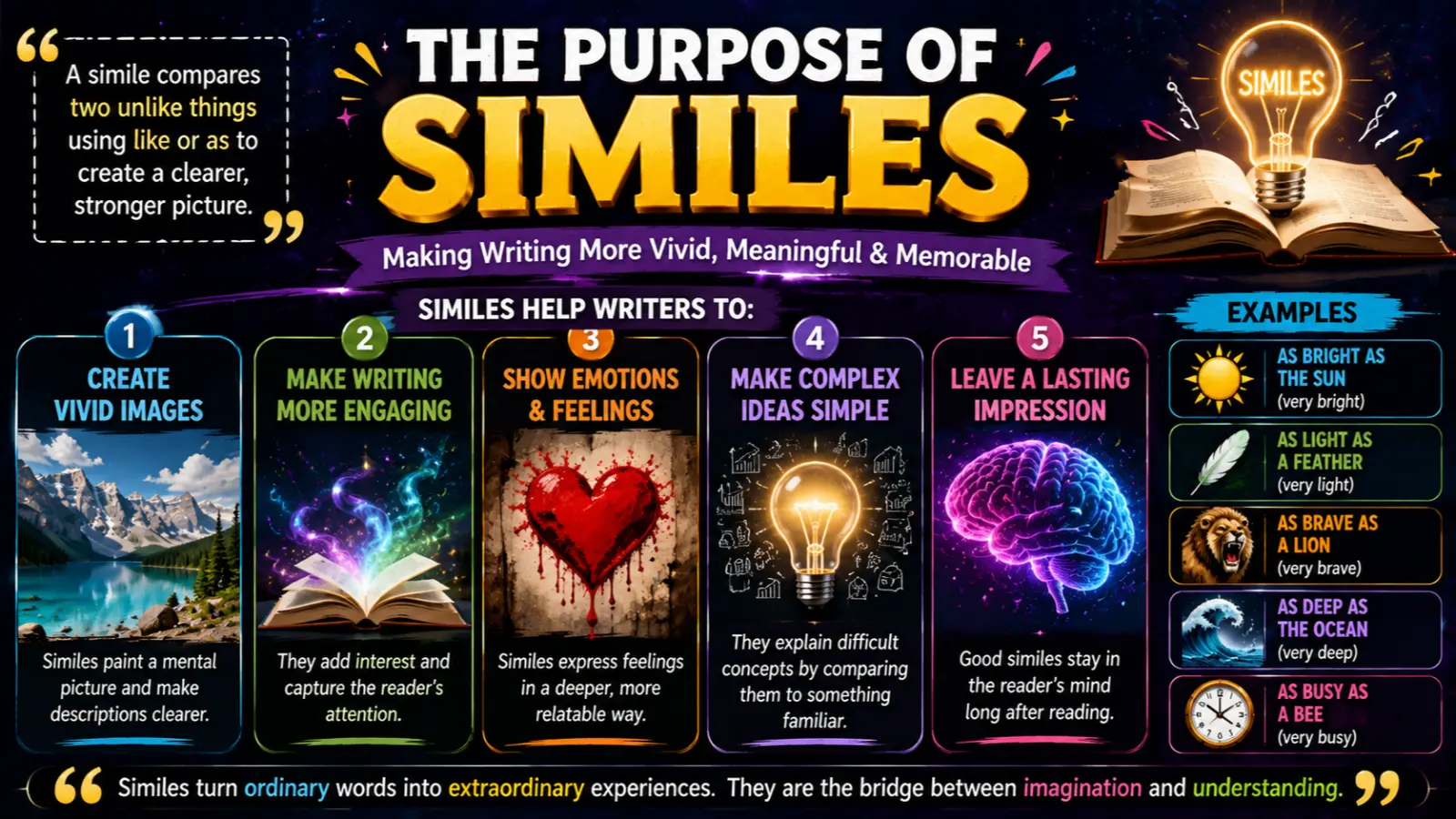
The purpose of similes is to compare two different things using the words like or as to create clearer images, stronger emotions, and more memorable writing. Similes help readers visualize ideas, understand feelings, and enjoy more engaging descriptions in stories, poems, speeches, and everyday communication.
Why Writers Use Similes
They Make Ideas Easier to Imagine
Readers understand unfamiliar ideas faster when they can compare them to something they already know.
Instead of saying:
“The room was quiet.”
You might write:
“The room was as quiet as untouched snowfall.”
The second sentence creates a stronger mental image.
They Create Emotional Connection
Similes allow readers to feel emotions instead of simply reading about them.
Compare these:
- She felt lonely.
- She felt like a single lantern glowing in endless darkness.
The second version carries much more emotional weight.
They Add Rhythm to Writing
Many similes naturally improve sentence flow. They make descriptions feel smoother and more memorable without adding unnecessary complexity.
They Help Readers Remember Details
People often remember vivid comparisons longer than plain facts.
That’s why similes appear frequently in:
- Fiction
- Poetry
- Song lyrics
- Speeches
- Children’s books
- Advertisements
- Everyday conversations
Different Purposes of Similes
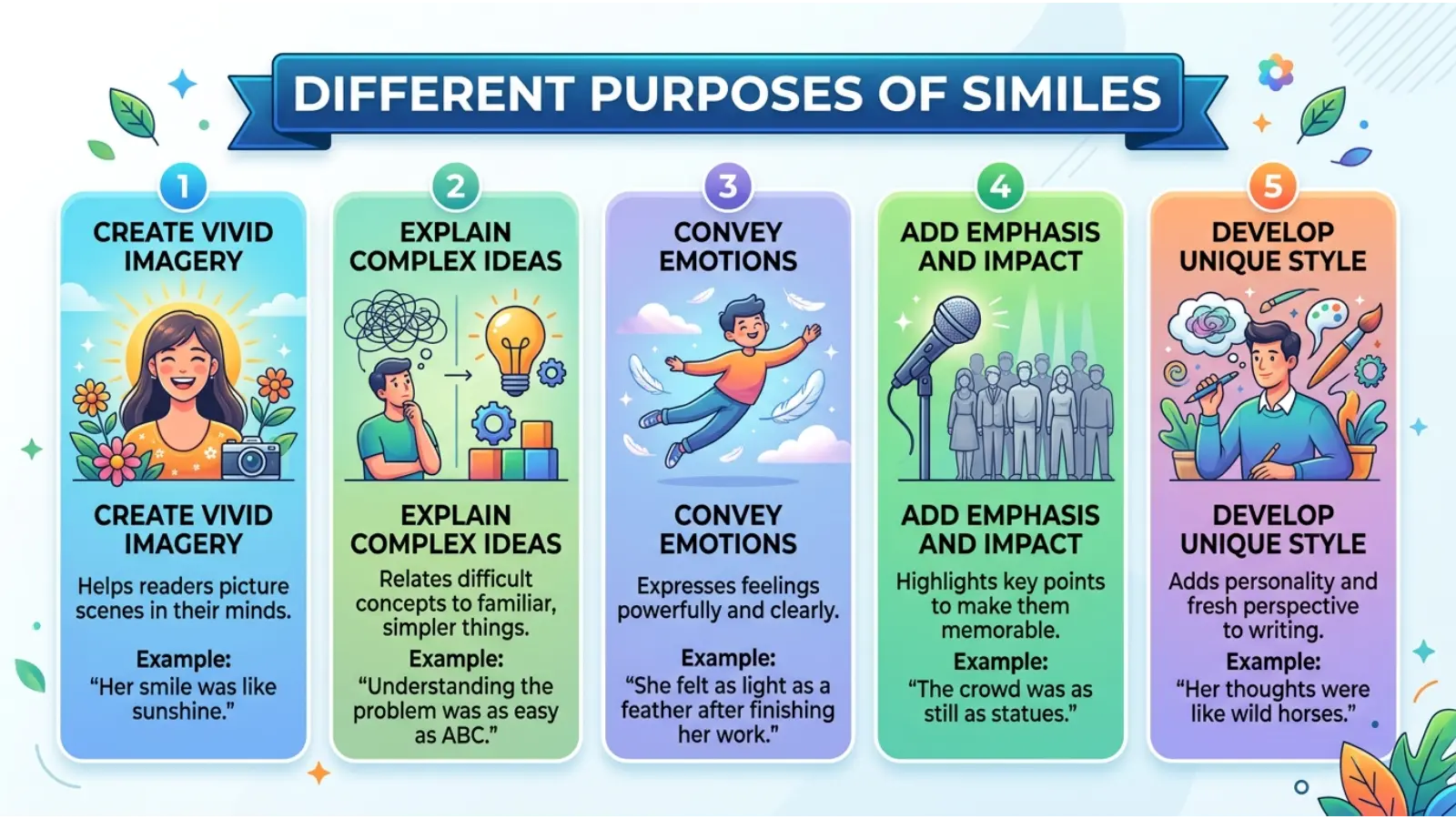
To Paint Clear Pictures
Good similes help readers visualize scenes.
Example:
The river curled like a silver ribbon through the valley.
To Express Feelings
Emotions become easier to understand through comparison.
Example:
Her excitement danced like sunlight across water.
To Simplify Complex Ideas
Teachers and speakers often use similes to explain difficult concepts.
Example:
Learning a language is like planting a garden—it grows little by little.
To Add Personality
Characters become more memorable when they speak with colorful comparisons.
Example:
He smiled like someone carrying a wonderful secret.
To Strengthen Storytelling
Stories become more immersive when readers can picture scenes easily.
25 Original Similes That Show the Purpose of Similes
1. Like morning light opening a window
Meaning: Brings hope and clarity.
Example 1: Her advice spread like morning light opening a window.
Example 2: His smile arrived like morning light after a storm.
Best for: Inspiration and hope.
Writing Tip: Use when describing emotional change.
2. As calm as a floating leaf
Meaning: Peaceful and relaxed.
Conversation: She stayed as calm as a floating leaf during the interview.
Storytelling: The captain remained as calm as a floating leaf despite the waves.
3. Like fresh paint on an old wall
Meaning: Bringing new energy.
Formal: The redesign felt like fresh paint on an old wall.
4. As steady as a lighthouse beam
Meaning: Reliable and dependable.
Poetry: Your kindness remained as steady as a lighthouse beam.
5. Like rain waking a thirsty garden
Meaning: Bringing needed relief.
Example: Her encouragement felt like rain waking a thirsty garden.
6. As bright as laughter in spring
Meaning: Joyful and cheerful.
Conversation: The children were as bright as laughter in spring.
7. Like a compass finding north
Meaning: Discovering purpose.
Storytelling: His decision settled like a compass finding north.
8. As gentle as falling petals
Meaning: Soft and caring.
Writing Purpose: Warm emotional scenes.
9. Like stars appearing after clouds
Meaning: Hope returning.
Example: New opportunities arrived like stars appearing after clouds.
10. As patient as growing trees
Meaning: Long-term perseverance.
Writing Tip: Excellent for character development.
11. Like quiet music filling a room
Meaning: Comfort without attention.
12. As refreshing as cool shade in summer
Meaning: Relief and comfort.
13. Like an unopened letter
Meaning: Full of mystery.
14. As welcoming as an open gate
Meaning: Friendly and inviting.
15. Like a candle refusing the wind
Meaning: Quiet determination.
16. As curious as sunlight exploring every corner
Meaning: Strong curiosity.
17. Like a bridge across rushing water
Meaning: Connecting differences.
18. As graceful as drifting clouds
Meaning: Smooth movement.
19. Like seeds waiting beneath winter
Meaning: Hidden potential.
20. As confident as an eagle riding warm air
Meaning: Natural confidence.
21. Like soft echoes across a valley
Meaning: Lasting memories.
22. As hopeful as the first green leaf
Meaning: New beginnings.
23. Like footprints after fresh rain
Meaning: Leaving a lasting impression.
24. As determined as a river finding the sea
Meaning: Persistence.
25. Like the first page of a new notebook
Meaning: Fresh opportunities.
How Great Writers Build Strong Similes
Start with Observation
Notice everyday details.
Instead of comparing everything to diamonds or stars, look for fresh comparisons in nature, cities, sports, weather, or ordinary life.
Match the Emotion
Every comparison should support the mood.
A funny scene needs playful similes.
A serious scene needs meaningful comparisons.
Keep the Comparison Natural
Ask yourself:
Would a real person actually imagine this?
If not, simplify it.
Surprise the Reader
Fresh comparisons stay memorable.
Instead of:
“Cold as ice.”
Try:
“Cold like forgotten keys in a winter pocket.”
Specific details create stronger imagery.
Related Literary Devices
Metaphor
A metaphor says something is another thing.
Example:
Time is a river.
A simile says:
Time is like a river.
Imagery
Imagery creates sensory experiences.
Similes often strengthen imagery by giving readers familiar comparisons.
Personification
Personification gives human qualities to non-human things.
Example:
The wind whispered.
Combined with similes:
The wind whispered like an old storyteller.
Hyperbole
Hyperbole exaggerates for emphasis.
It can work alongside similes for humorous or dramatic effects.
Symbolism
Some similes include symbolic images, such as light representing hope or storms representing conflict.
How to Create Your Own Similes
Step 1
Choose the thing you want to describe.
Example:
A smile.
Step 2
Think about its strongest quality.
Warm.
Bright.
Comforting.
Step 3
Find something with that same quality.
Morning sunshine.
A welcoming fire.
Fresh bread.
Step 4
Connect them using like or as.
Example:
Her smile spread like sunshine across a quiet porch.
Creative Practice
Exercise 1
Describe rain without mentioning water.
Exercise 2
Write three similes that describe happiness using nature.
Exercise 3
Describe fear using everyday household objects.
Exercise 4
Replace one cliché simile with an original comparison.
Common Mistakes
Using Overused Comparisons
Examples like:
- Busy as a bee
- Cold as ice
- Quiet as a mouse
are familiar but rarely memorable.
Mixing Images
Avoid combining unrelated comparisons.
Example:
Her voice floated like thunder.
The images don’t naturally fit together.
Confusing Metaphors and Similes
Remember:
Similes use like or as.
Metaphors do not.
Forcing Comparisons
Every simile should make understanding easier—not more confusing.
Choosing Comparisons That Don’t Fit
Always consider the tone, audience, and context before adding a simile.
Frequently Asked Questions
What is the main purpose of similes?
Their main purpose is to create vivid comparisons that make writing easier to imagine, understand, and remember.
Why do authors use similes?
Authors use similes to build imagery, express emotions, strengthen storytelling, and create memorable descriptions.
Are similes only used in poetry?
No. Similes appear in novels, speeches, advertisements, songs, classrooms, conversations, and many other forms of communication.
How are similes different from metaphors?
Similes compare using like or as, while metaphors make direct comparisons without those words.
Can similes improve creative writing?
Yes. Effective similes make descriptions more engaging, help readers visualize scenes, and create stronger emotional connections.
Should every description include a simile?
No. Similes work best when used thoughtfully. Overusing them can distract readers and reduce their impact.
Conclusion
The true purpose of similes is not simply to make writing sound beautiful—it is to make ideas clearer, emotions stronger, and experiences more memorable. A well-crafted simile gives readers a fresh way to see something familiar, turning ordinary sentences into vivid moments that stay in their minds. As you practice, look beyond common comparisons and draw inspiration from everyday life, nature, memories, and personal experiences. The most effective similes are often the ones that feel both surprising and believable. With careful observation and creativity, you’ll develop comparisons that enrich your stories, poems, essays, and conversations while making your writing uniquely your own.

I am Helena Frost, a writer captivated by the beauty of language and the art of comparison. Through my words, I explore the world by turning ordinary moments into vivid similes and reflections. I enjoy crafting phrases that spark imagination, evoke emotion, and linger in the mind. My writing celebrates the subtle connections between people, nature, and the stories we live. For me, every sentence is an opportunity to reveal the extraordinary in the everyday.